The first person to laugh was not a stranger.
That was what made the fourteen-year-old farm boy remember it.
The man had known his father for more than twenty years.
He had eaten at their kitchen table.
He had helped repair a fence after a spring storm.
He had stood beside the family at the funeral three months earlier with his cap pressed against his chest and tears in his eyes.
Yet when the boy said he planned to put thirty-six acres into sunflowers, the older farmer stared at him across the feed-store counter and laughed.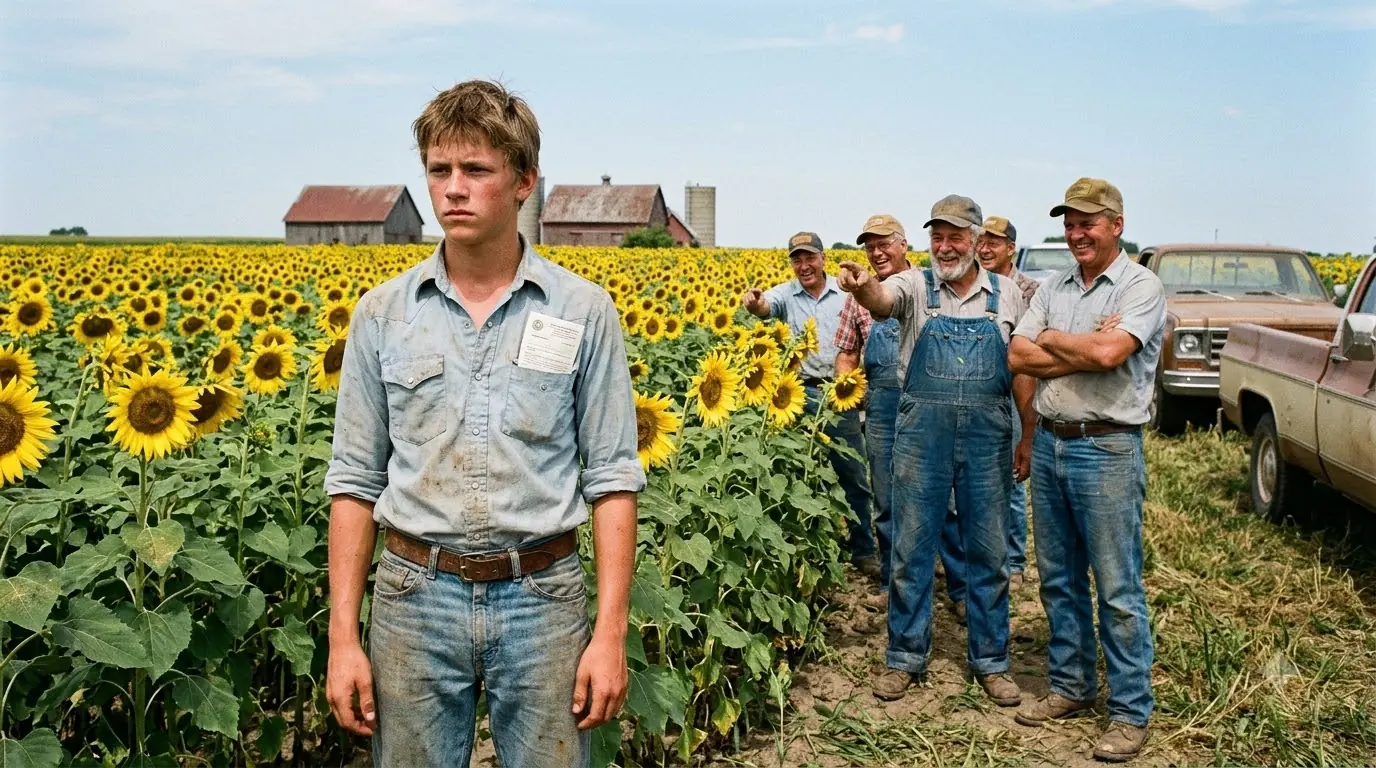
Not cruelly at first.
Almost affectionately.
As though a grieving child had announced he intended to build a tractor from fence wire.
“Sunflowers?”
The boy nodded.
“Thirty-six acres?”
Another nod.
The older farmer looked toward the men standing near the seed display.
“You boys hear this?”
Several turned.
The boy wished immediately that he had kept his mouth shut.
The older farmer smiled.
“He’s putting the south ground into sunflowers.”
A second farmer frowned.
“All of it?”
“Thirty-six acres.”
The first farmer slapped one hand against the counter.
“Pretty flowers won’t pay a mortgage.”
Someone near the coffee machine laughed.
Another man said:
“Thirty-six acres of bird food.”
That became the line everyone repeated.
Bird food.
The boy stood with one hand in the pocket of his faded farm shirt and said nothing.
He had expected doubt.
He had not expected the story to travel before he got home.
By evening, two pickup trucks slowed beside the farm.
The drivers looked toward the freshly worked south field.
One honked.
The other man leaned out the window and shouted:
“Hope the birds have money!”
The truck disappeared in dust.
The boy kept walking toward the barn.
His mother had heard too.
She stood in the kitchen when he entered, one hand resting on an unpaid fuel invoice.
“You told them?”
“They asked what seed I was buying.”
“You could have said seed.”
He looked toward her.
“I didn’t think they’d care.”
His mother laughed once.
“Twelve hundred acres of corn can disappear without anyone noticing.”
“One fourteen-year-old plants flowers and suddenly the county needs a meeting.”
The boy almost smiled.
Then he saw the invoice again.
His expression changed.
The farm was in trouble.
Not the dramatic kind of trouble where men arrived from the bank the next morning and put a padlock on the barn.
The slower kind.
The dangerous kind.
Bills paid later each month.
Repairs delayed.
Machinery kept running because nobody could afford to replace it.
One operating loan rolled into another.
A mortgage payment that seemed manageable when his father was alive now looked larger every time his mother opened the ledger.
The boy had begun noticing numbers before the funeral.
Afterward, he started studying them.
His father had been forty-six when his heart stopped beside the machine shed.
No warning.
No long illness.
No time to explain what had been postponed, which accounts needed attention, or what plans existed only inside his head.
One morning he had been alive.
By afternoon, the farm belonged to a widow and a fourteen-year-old boy who suddenly understood that land could be inherited faster than knowledge.
His mother knew the household.
She knew records.
She knew bills.
She could run a tractor when needed.
But she had never been responsible for deciding what thirty-six acres should become.
Neither had he.
The south ground mattered because it was their best flexible ground.
The northern fields were already committed.
Corn on one.
Soybeans on another.
Hay near the creek.
The south thirty-six remained undecided because his father had intended to make that decision after spring soil testing.
Then he died.
Neighbors offered advice.
Corn.
Almost everyone said corn.
Corn was familiar.
Equipment was available.
Storage existed.
Markets existed.
Soybeans were the other obvious choice.
Sunflowers were not.
That was exactly why the boy kept looking at them.
The idea started beneath the yellow kitchen light in February.
He had been searching through his father’s old farm bulletins because he could not sleep.
The house felt wrong after the funeral.
Too quiet.
His mother sometimes stayed up past midnight balancing accounts.
The boy pretended not to notice.
He would sit at the kitchen table with catalogs, extension bulletins, seed-company pamphlets, and his father’s notebooks spread around him.
At first, he was not searching for anything specific.
He simply wanted to understand what the farm cost to operate.
Seed.
Fuel.
Fertilizer.
Repairs.