The auctioneer hit the side of the rusted steel safe with his cane.
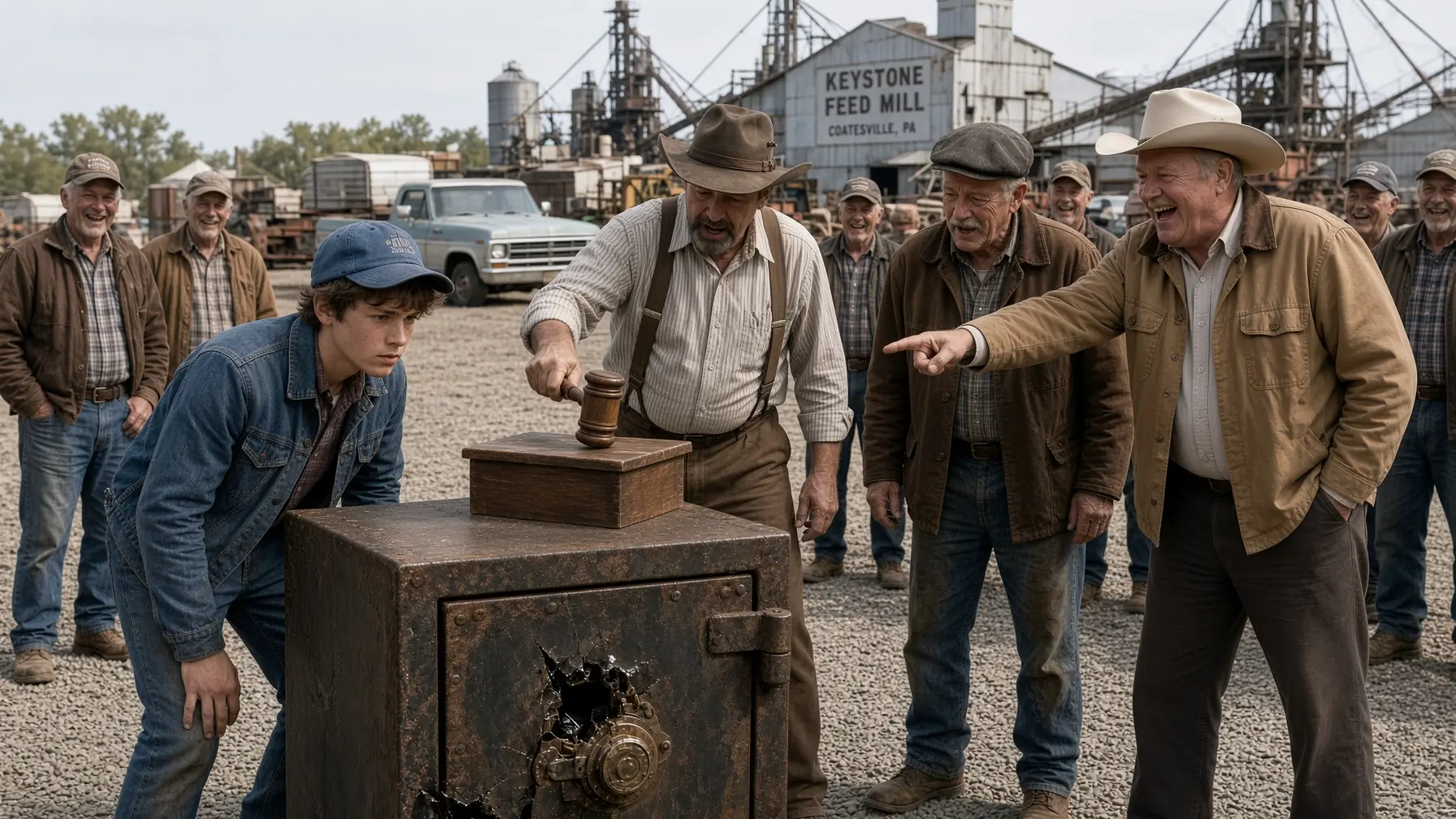
The sound rang across the gravel yard like somebody striking an empty boiler.
“Eight hundred pounds of premium Pennsylvania scrap metal!”
A few farmers laughed.
The safe had been sitting behind the abandoned Harland Feed and Machine Works for years.
Its brass dial was shattered.
Rust covered almost every inch of the door.
One corner had been blackened by an old cutting torch.
Someone, sometime, had tried to break into it and failed.
To everybody gathered at the auction that Saturday morning in 1971, that meant the mystery was over.
If there had ever been anything valuable inside, surely whoever attacked the safe had already taken it.
The auctioneer pointed toward it.
“Five dollars.”
Nobody raised a hand.
“Come on, gentlemen. Steel alone has value.”
A voice came from the crowd.
“Turn it sideways and Calvin can use it as a chicken feeder.”
Laughter moved through the yard.
The loudest came from Calvin Rusk.
Calvin owned the largest farm-supply business in the county, leased several thousand acres, and had spent the previous eighteen months quietly buying struggling farms around the valley.
He stood beside a polished black pickup wearing clean work boots that had probably never seen a manure pit.
“That thing wouldn't make a decent chicken feeder,” he called.
More laughter.
Then a hand went up.
The crowd turned.
Fifteen-year-old Eli Mercer stood beside his grandfather.
The auctioneer blinked.
“You bidding, son?”
Eli nodded.
“Five dollars.”
His grandfather, Ellis Mercer, slowly turned his head.
He did not say anything.
The auctioneer grinned.
“Five dollars from the young gentleman.”
Someone offered ten just for amusement.
Eli answered with fifteen.
The other bidder laughed and went to twenty.
Eli raised again.
Twenty-five.
Now people were watching.
Calvin smiled.
“You starting a bank, boy?”
Eli ignored him.
Thirty.
Thirty-five.
The yard grew louder.
Ellis finally leaned toward his grandson.
“You know how much money is in your pocket?”
“Forty dollars.”
“I know.”
That forty dollars represented nearly an entire summer.
Fence repair.
Feed hauling.
Cleaning equipment.
Moving hay.
Every dollar Eli could save.
They had come to the auction looking for a used hydraulic pump because the Mercer farm could not afford a new one.
Instead, Eli was about to spend everything he had on eight hundred pounds of useless steel.
The bidding reached forty.
Silence.
The auctioneer looked around.
“Forty dollars once.”
Eli could hear Calvin chuckling.
“Twice.”
Ellis looked at him.
Still no objection.
“Sold.”
The cane struck the safe.
“To the young man with more courage than sense.”
The crowd laughed again.
Calvin shook his head.
“Forty dollars.”
He looked at Eli.
“You could've burned the money and saved yourself the trouble of hauling that thing home.”
Eli did not respond.
He walked toward the safe.
Crouched beside the damaged corner.
And studied the torch cut one more time.
That was what everyone else had missed.
The cut did not go deep enough.
Whoever attacked the safe had burned through the outer shell.
Then stopped.
Several inches before reaching the central chamber.
More strangely, the steel beyond the damage carried a different heat pattern.
A second weld.
Newer than the safe itself.
Someone had tried to get inside.
Failed.
And afterward, somebody else had gone to considerable trouble to make the safe even harder to open.
Eli touched the rough weld.
Calvin called from behind him:
“What do you think you bought?”
Eli stood.
“I don't know yet.”
That answer made Calvin laugh harder.
But Ellis did not laugh.
He was looking at the same weld now.
And when Eli met his grandfather’s eyes, the old man said quietly:
“Let's get it home.”
The Mercer farm covered sixty acres along the lower edge of the valley.
Corn.
Hay.
A few cattle.
A creek that cut behind the south pasture.
It was not prosperous.
That year had been particularly bad.
Spring rain delayed planting.
Then summer heat reduced the corn yield.
Their diesel tractor developed an engine problem during the worst possible week.
Ellis kept it alive using salvaged parts from three older machines.
The repair consumed nearly every dollar they had put aside.
Calvin Rusk knew all of this.
That was why he had already offered to buy the Mercer land twice.
Enough money to make Ellis think.
Not enough to make him leave.
Calvin had a particular way of discussing farms.
He never talked about families.
Or barns.
Or soil somebody’s father had worked.
He said: