Sixty tractors.
Every one of them broken.
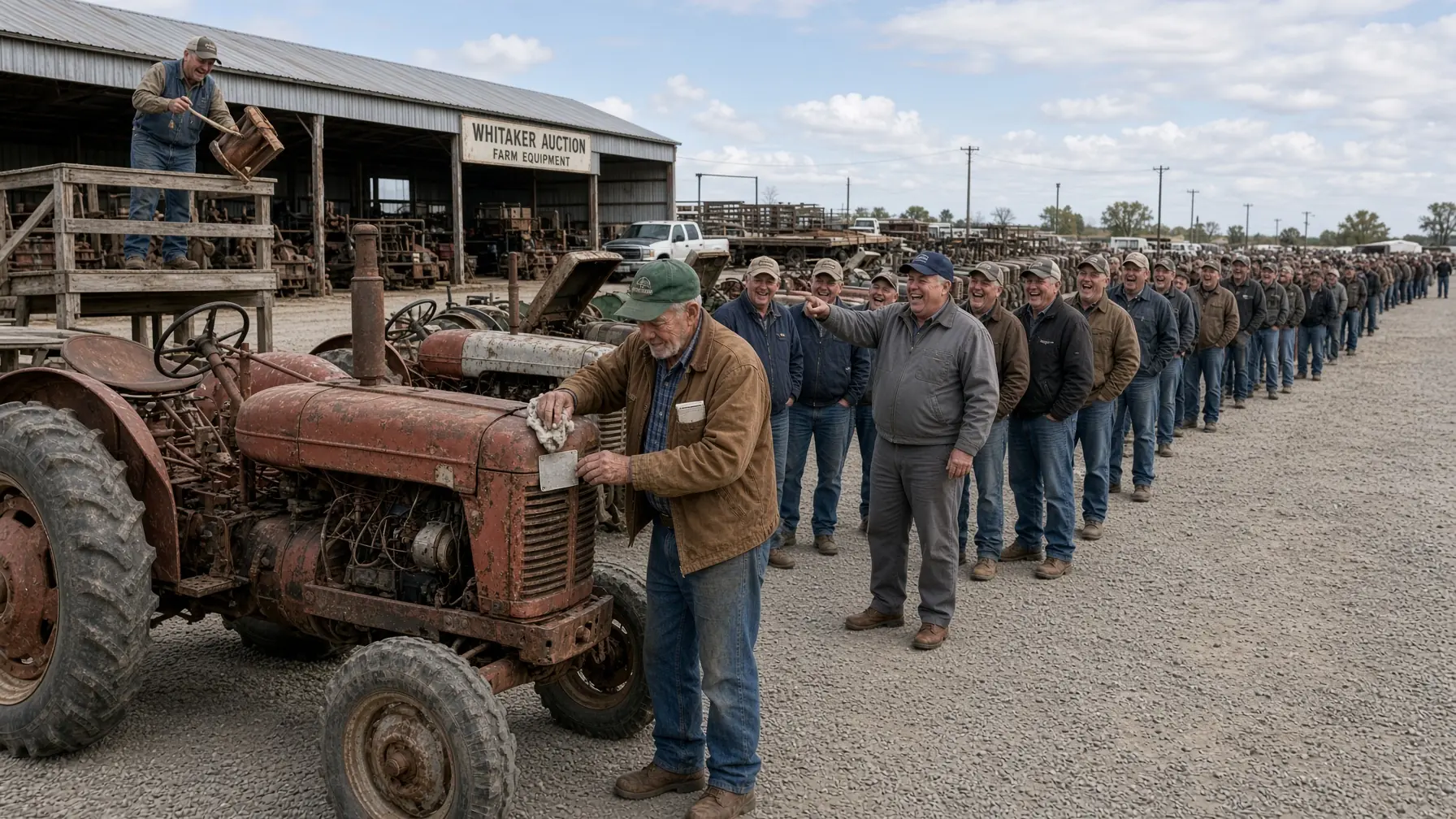
And seventy-year-old Earl Whitaker had just spent one thousand dollars to own the entire row.
The auction yard erupted in laughter before the hammer had even stopped bouncing.
A machinery dealer near the front shook his head.
“Earl, you planning to start the county’s largest lawn ornament collection?”
Another man called out:
“Better buy yourself sixty tow trucks next.”
More laughter.
Earl did not answer.
He simply buttoned the flap on the small notebook in his shirt pocket and looked once more across the line of dead machines.
Faded red.
Sun-bleached green.
Rust.
Cracked tires.
Missing hoods.
One tractor leaned so badly to the right that it looked tired of standing.
Another had weeds growing through the rear axle.
To everyone else, the row represented sixty different ways for a tractor to die.
Seized engines.
Failed hydraulics.
Destroyed transmissions.
Rotted wiring.
Cracked housings.
Missing parts.
Machines that had been kept alive for years by cannibalizing one another until the rental company that owned them finally collapsed.
The auctioneer had tried selling them individually.
Nobody wanted them.
Then in groups of five.
Still nothing.
Finally, half joking, he asked whether anyone wanted the entire row.
Earl raised his hand.
“One thousand.”
The auctioneer stared.
“All sixty?”
“All sixty.”
That was when the laughter started.
The auctioneer looked around.
“Anybody give me eleven hundred?”
Silence.
Not one hand moved.
The hammer came down.
“Sold.”
Earl Whitaker became the owner of sixty tractors that could not collectively drive themselves out of the yard.
A dealer named Gordon Hale laughed loudest.
Gordon had sold farm equipment for almost thirty years.
He walked over as Earl signed the purchase slip.
“You know scrap prices aren't good enough to save you, right?”
Earl folded the receipt.
Put it in his pocket.
“I know.”
“Half those engines are locked.”
“I know.”
“Hydraulic pumps are gone on at least a dozen.”
“Probably.”
“Three have cracked transmission cases.”
“I saw them.”
Gordon stared.
“Then why buy them?”
Earl looked toward the tractors.
“Because I wasn't looking at the same thing you were.”
Gordon laughed again.
“Oh, I can't wait to see this.”
Earl nodded.
“You probably will.”
His son Rey Whitaker was not laughing when the first flatbed arrived at the family property later that afternoon.
He was horrified.
“What is that?”
Earl stood outside the workshop guiding the driver backward.
“One of the tractors.”
“One?”
“Fifty-nine more.”
Rey stared at him.
“You're joking.”
Another flatbed turned onto the gravel road behind the first.
Then another.
Rey took off his cap.
“Dad.”
Earl kept signaling to the driver.
“Left a little.”
“Dad.”
“Keep coming.”
“Dad!”
The driver stopped.
Earl turned.
“What?”
“You spent retirement money on these?”
“One thousand dollars.”
“That was almost everything you set aside in cash.”
“Yes.”
“And you bought sixty dead tractors?”
“Yes.”
Rey looked over the first machine.
Flat tire.
Missing side panel.
Oil streaking the block.
“Does this one even run?”
“No.”
“Then what exactly are you planning to do?”
Earl considered the question.
“I don't know yet.”
Rey’s face somehow became more alarmed.
“You don't know?”
“I know what I think I bought.”
“That is not the same thing.”
“No.”
Earl smiled slightly.