The forklift came around the corner with a wooden crate so long that the men in the clearance yard stopped talking to watch it pass.
It was nine feet from one reinforced end to the other, an enormous rectangular shipping case built of thick boards and dark metal corners. Three steel bands, orange with rust, clasped its body. What remained of the olive paint had gone gray-green beneath eighty years of dust. On one side, letters could still be distinguished if a person stood close enough and looked through the dirt: U.S. ARMY. Everything beneath the lettering had faded into an almost unreadable blur.
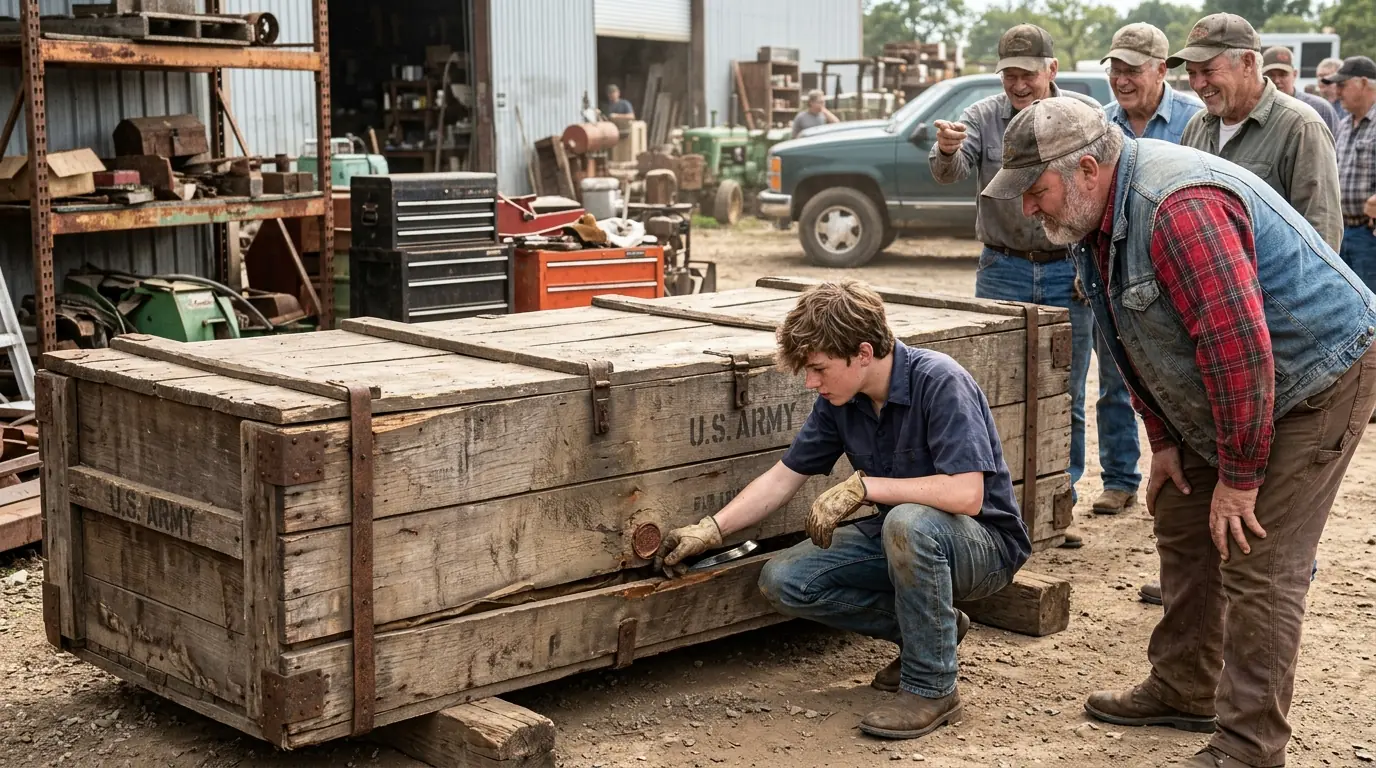
Terence Cole stood near the concrete loading dock with the receipt folded inside his leather glove. He was seventeen, slight in the shoulders but wiry through the arms from helping his grandfather repair equipment, and his faded navy work shirt looked too thin for the wind that blew through the Tennessee yard. He had paid thirty-five dollars for the crate. Thirty-five dollars that could have bought fuel, groceries, or the replacement starter his mother had told him the pickup would need before winter.
The forklift's warning horn sounded twice. People cleared a path between a row of rusted shelving and the old green pickup parked beside the auction tent. The operator lowered his forks until the crate hovered over two heavy wooden blocks. A small cloud of dust fell from the boards as the load settled. Then the weight transferred fully, and the blocks gave a low complaint without breaking.
Terence moved closer before the operator had finished backing away.
“Careful of the underside,” he called. “There's something down near the corner.”
The forklift driver raised a hand without looking back. He had already heard enough from the boy who wanted trash treated like museum property.
Curtis Malloy heard him too.
Curtis owned the scrapyard outside town and had come to the closing warehouse sale hoping to buy engines, tool chests, and whatever steel could be moved with one rented trailer. He was fifty-five, heavy through the stomach and neck, with a coarse gray beard and a stained cap pulled above his eyes. His red plaid shirt hung open under a dirty denim vest. He looked at the military crate, looked at Terence, then laughed in a voice built to make other people laugh with him.
“You paid thirty-five dollars for eighty years of dust.”
The older farmers behind Curtis joined in. One shook his head. Another pointed to a hole left by an insect in a corner board. The third asked whether the boy planned to use the crate as a coffin for mice.
Curtis stepped closer and kicked the side with his work boot. A burst of old grit dropped from a seam.
“Listen to that,” he said. “Probably full of nothing but a dry skeleton and rotten packing straw.”
Terence watched the place where the boot had landed, not Curtis's face. He wanted to tell the man to step away. He also knew how quickly a seventeen-year-old boy's anger could be made into entertainment for an audience that had already chosen its winner.