“Half your crew is gone. Contracts frozen. You did this.”
Raymond Crowe stood in the middle of the Carter Fieldworks office with his hat tucked under one arm and the calm expression of a man who believed the argument was already over. He did not raise his voice because he did not think he needed to. Through the glass behind Maya Carter’s desk, three work bays sat empty where mechanics had been moving between tractors only a week earlier.
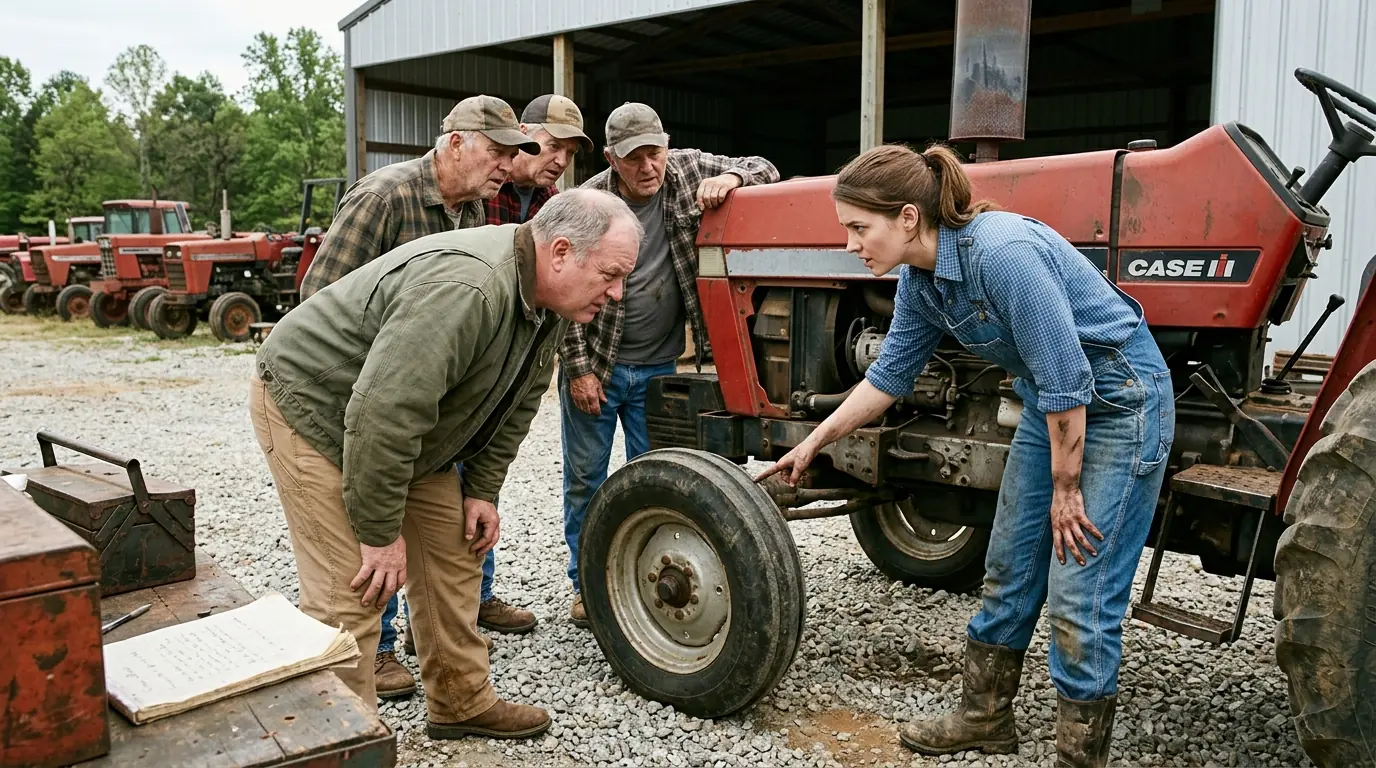
“The company is still mine,” Maya said.
Raymond let out a short breath that was almost a laugh. “Your father spent forty years building that name. You burned it in one.”
Maya’s mother, Danielle, stood beside the filing cabinet with her arms folded. She had worked a twelve-hour shift at the regional hospital the day before and still looked more rested than her daughter. She did not interrupt. She had learned that when Raymond Crowe came to talk business, the first thing he usually tried to sell was certainty.
Maya looked at him across the desk. She was twenty-six now, though exhaustion made her look older. Her brown hair had been twisted into a loose knot before dawn and had already fallen around her face. Grease marked one cuff of her work shirt. She looked like what she had always been—a white American farm girl from rural Georgia who had grown up with more time inside a machine shed than inside an office.
“What’s your number?” she asked.
Raymond’s eyes sharpened. He had been waiting for that question.
“Seven hundred thousand.”
Maya did not move.
“You should have taken the first offer,” he added.
Outside the office, an impact wrench rattled for three seconds and stopped. A cart rolled across the concrete floor, one bad caster squeaking at regular intervals. Carter Fieldworks was still alive, but only barely, and Raymond had come because he believed desperate businesses eventually stopped negotiating with the future and started selling the present.
Five months earlier, he had watched Maya reject $1.4 million.
Now he was offering half.
In his mind, that was not cruelty. It was mathematics.
The company had lost technicians. Its largest expansion contract had frozen. A bank had declined Maya’s request for growth capital. A major supplier had changed payment terms at exactly the wrong moment. Payroll had arrived before the money that was supposed to cover it.
Raymond had seen companies enter this stage before.
Owners started talking about vision because cash had stopped cooperating. They blamed timing, banks, vendors, markets, anybody except themselves. Then they discovered that the doors did not care how correct their original idea had been.
Raymond expected Maya to be angry.
She was not.
He expected a speech about what Earl Carter would have wanted.
She gave him none.
He expected her to argue that Carter Fieldworks was worth more than seven hundred thousand dollars.
Instead, Maya asked, “What exactly are you buying?”
Raymond frowned. “The company.”
“What part?”
“All of it.”
“The building?”
“Yes.”
“The equipment?”
“Yes.”
“The inventory?”
“Yes.”
“The customer records?”
“Yes.”
“The Carter Compatibility Index?”