“Your fish pond is a joke—and so are you,” Dale Crowley said, holding Nora Lindgren’s aquaculture permit between two fingers as though it were something dirty.
Nora stood beside the seven-acre back pond on her family’s farm outside St. John, Kansas. A floating aerator churned the dark water behind her, and hundreds of young crappie gathered beneath the automatic feeder. Beyond the pond, the family’s cornfields had already begun curling beneath the brutal summer heat.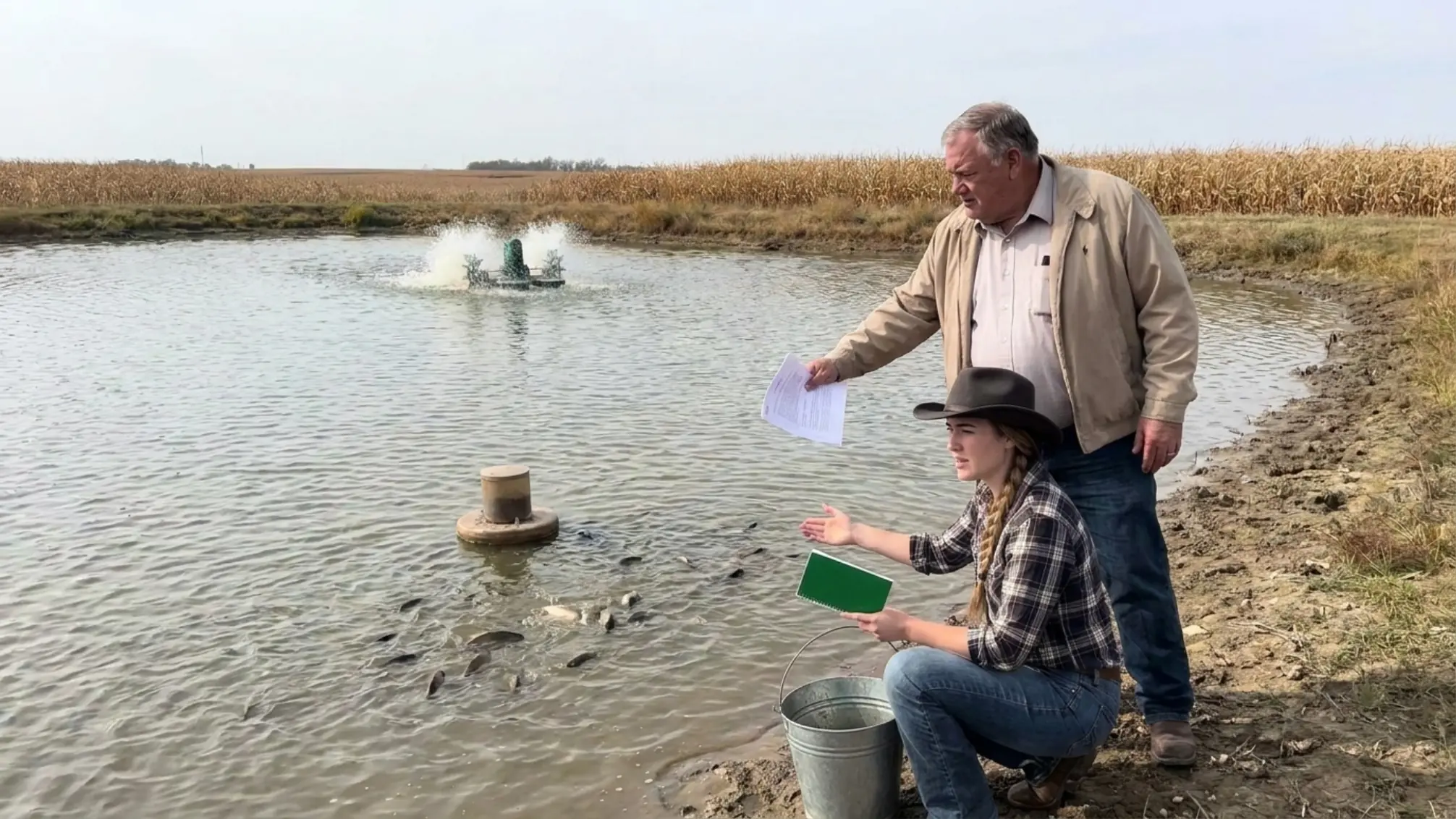
“Laugh now,” Nora replied, throwing a scoop of pellets across the water. “The drought hasn’t finished with you.”
Dale stepped closer, his polished boots stopping at the muddy edge. He had managed the county extension office for nineteen years and carried himself like a man who believed every successful farm in Stafford County had survived because someone had listened to him.
“When those fish rot,” he said, “don’t come begging me for help.”
Nora watched the water erupt as the crappie struck the floating feed.
“When your wheat dies,” she answered, “you’ll beg at my pond.”
Six months earlier, Nora had returned home from Kansas State University with a degree in natural-resource management, four years of aquaculture research, and a plan her father did not understand.
The Lindgren family had farmed the same six hundred forty acres since 1923. Nora’s great-grandfather had broken the original sod with horses. Her grandfather had built grain bins, expanded the acreage, and purchased the first modern combine anyone in the family had owned.
By 2012, Nora’s father, Gunnar Lindgren, ran the operation with the quiet precision of a man who had spent thirty-six years watching the same soil respond to rain, heat, wind, and mistakes. He planted winter wheat, milo, and corn when the water outlook justified the risk. He did not gamble, chase trends, or enjoy hearing that university researchers had discovered a better way to farm ground his family had worked for nearly ninety years.
The back pond was one of the few parts of the farm Gunnar barely considered.
His father had built it in 1961 by blocking a natural draw at the southern end of the property. It covered seven acres in a wet year and had originally provided water for cattle. Several largemouth bass had been stocked during the 1970s, but beyond occasional evening fishing, the pond produced no income.
To Gunnar, it was useful water surrounded by unusable ground.
To Nora, it was an unfarmed crop.
She first explained her idea at the kitchen table during Christmas of 2011. Her mother, Carol, sat quietly with a cup of tea while Nora spread university studies, handwritten calculations, and printed market reports across the worn wood.
She proposed removing most of the existing bass, improving the water quality, and stocking the pond with black crappie and channel catfish. Fathead minnows would provide forage, while automatic feeders and aerators would support growth during hot summers. The fish could be sold directly to restaurants, local customers, and anglers willing to pay by the pound for what they caught.
Gunnar read the first page without expression.
“You want to farm fish,” he finally said.
“I want to produce food on seven acres that currently produce nothing.”
“It waters cattle.”
“We haven’t kept cattle on the south pasture in twelve years.”
“That doesn’t turn it into a fish farm.”
Nora slid a revenue projection toward him. Managed crappie ponds in similar regions had produced hundreds of pounds of harvestable fish per acre. Even after feed, electricity, licensing, and equipment, the projected return per acre exceeded what dryland wheat produced during a strong year.
Gunnar studied the numbers. “Arkansas isn’t Kansas.”
“The fish don’t know the state line.”
“That sounds like something a professor says.”
“It sounds like biology.”
Carol picked up one of the reports. “She’s done the work, Gunnar.”
He glanced at his wife, then back at Nora. “I need to think.”
Nora gathered the papers without arguing. She knew her father well enough to understand that immediate refusal would have sounded different. Thinking meant he had found no obvious flaw strong enough to end the conversation.
Six weeks later, she visited the Stafford County extension office to ask about commercial permits.
Dale Crowley was standing at the co-op counter with three farmers when Nora walked inside wearing her Kansas State jacket and carrying a green spiral notebook. She explained the proposed stocking program, market plan, and aeration system.
Dale laughed.
It was not the loud cruelty of a bully. It was worse in a quieter way—the confident amusement of a man who believed the idea was too foolish to deserve serious opposition.
“Crappie farming?” he said. “In a stock pond in Stafford County?”
The men around him smiled because Dale had smiled.
Nora opened her notebook. “Black crappie tolerate the temperature range, turbidity, and seasonal changes better than several faster-growing species. With controlled stocking and aeration—”
“Honey, that pond has been there since 1961,” Dale interrupted. “You know what it’s good for?”
“I suspect you’re going to tell me.”
“Watering cattle and drowning your sorrows.”
One man laughed. Another stared into his coffee.
Nora laid out the studies and revenue projections anyway. She explained market prices, anticipated harvest weights, electricity costs, feed ratios, and worst-case evaporation. Dale listened, but his expression showed that he regarded the numbers as interesting fiction.
When she finished, he tapped one report.
“You know the difference between a university study and a Stafford County pond?”
“What?”
“About four hundred miles and thirty years of doing things the way they work here.”
Nora closed the notebook. “I didn’t come for permission. I came for the permitting process.”
Dale gave her the forms and explained the regulations accurately. She thanked him and turned toward the door.
Before she stepped outside, she heard him speaking behind her.
“Gunnar Lindgren’s girl. Smart kid. Shame about the fish idea.”
Nora drove home without crying.
She wrote his exact words on the final page of her green notebook.
In March, Gunnar gave her the pond.
“You buy the fingerlings, feed, equipment, and licenses,” he said over breakfast. “You keep records of everything. If it fails within three years, we clear it and return it to cattle water.”
Nora nodded. “Fair.”
“I didn’t say I thought you were right.”
“I know.”
He returned to his coffee. That was as close to blessing the plan as Gunnar was prepared to come.
Nora invested $8,400 of her savings.
She hired a pond-management crew to reduce the old bass population, test the water, and remove rough fish that would compete with the new stock. She ordered 3,500 black-crappie fingerlings, 1,400 channel catfish, and thousands of fathead minnows from a Missouri hatchery.
She installed a two-horsepower floating aerator in the deeper section and a solar surface aerator near the shallow bank. An automatic feeder stood on a wooden platform she built herself, while a cleaning station constructed from treated lumber waited near the access road.
Every morning, Nora walked the pond perimeter.
She measured water temperature, clarity, oxygen levels, feeder activity, and fish behavior. She recorded every expense in the green notebook, including fuel used to reach the hatchery, screws purchased for the cleaning station, and the electricity consumed by the aerator.
The first months offered no dramatic proof.
The fingerlings disappeared beneath the surface and remained mostly invisible. Nora could not point toward rows of growing wheat or healthy calves. She had invested thousands of dollars in creatures no one could see.
Dale drove past twice that summer. Both times, his truck slowed where the pond became visible from the road.
He never stopped.
Then the drought arrived.
By late June, the sky over Stafford County had turned the color of old bone. Corn remained two feet shorter than it should have been, wheat stubble cracked beneath boots, and pasture grass became dry enough to crumble between fingers.
Gunnar walked the cornfields every evening, though there was nothing useful he could do there. The ears were thin, the silk had burned before proper pollination, and the expected yield fell with every rainless day.
The county had experienced drought before. This one felt different.
Stock ponds evaporated into shallow mud. Ranchers sold cattle because purchasing feed cost more than the animals would bring. Some cornfields were abandoned because harvesting them would cost more than the grain inside them was worth.
The Lindgren back pond dropped fourteen inches.
Nora had planned for fifteen.
She extended the aerator cycles during the hottest hours and reduced feeding whenever oxygen levels became dangerous. She checked the fish before sunrise, at midday, and after dark. Several catfish died, but the majority survived.
The crappie continued growing.
They did not grow quickly enough to sell that year, yet they remained alive while crops around them failed. Gunnar’s corn operation lost between $60,000 and $75,000 in expected revenue.
The pond lost no projected harvest because Nora had always planned to wait until spring.
One evening, Gunnar found her checking the aerator.
“You calculated this?” he asked.
“The water loss?”
“The drought.”
“I calculated a severe dry year.”
“You expected this?”
“No. I prepared for it.”
He looked across the pond. Fish disturbed the surface near the feeder, sending circles through the sunset reflection.
Gunnar placed his hands in his pockets. “That’s not the same thing.”
“No.”
He remained beside her for several minutes before returning to the house.
In April 2013, Nora pulled the first serious harvest.
She borrowed a seine net from the county conservation office and entered the cold pond in chest-high waders. The water pressed against her legs as she dragged the net toward the bank, uncertain whether her calculations would become food or excuses.
The mesh began flashing silver.
Crappie crowded the pocket of the net, clean and healthy, most weighing between three-quarters of a pound and one pound. Nora stood in the water and stared at them until Gunnar called from shore.
“You planning to admire them or sell them?”
She laughed and continued pulling.
The first harvest produced 340 pounds.
Nora packed the fish in ice and drove them to Wichita. Two restaurant chefs who had spoken with her the previous year inspected the catch, checked the flesh, and purchased nearly everything.
She returned carrying a check for $1,870 and orders for the following week.
Gunnar studied the check at the kitchen table.
“That’s from one harvest?”
“Two days.”
“What did it cost?”
“I’ll know after fuel and ice are entered.”
He nodded. “Write it down.”
By the end of 2013, the pond had generated $11,240 in gross revenue. After feed, electricity, licenses, equipment maintenance, and transportation, Nora recorded a net profit of $7,060.
The pond had earned slightly more than $1,000 per acre.
The farm’s dryland wheat had earned approximately $195 per acre.
Nora wrote both numbers in her notebook and drew a line between them.
Carol looked over her shoulder. “Write it twice so you don’t lose it.”
Nora did.
The second year performed even better. She improved the harvesting schedule, added direct sales, and opened selected weekends for fee fishing. Families drove from Pratt, Hutchinson, and Wichita to catch fish and pay by weight.
The pond earned a net profit of $9,840.
People began noticing.
Vance Hassell, a neighboring grain farmer, stopped his truck one Saturday after seeing anglers lined along the bank. He watched for several minutes before driving home and telling his wife, “Gunnar’s girl has something happening down there that I don’t understand, but I think I want to.”
Within months, four farmers contacted Nora.
She visited their homes with the green notebook, explained stocking densities and oxygen management, and showed them the real expenses alongside the profits. She warned them that a pond could not simply be filled with fish and ignored.
Two farmers stocked their ponds the next spring.
One succeeded immediately. The other lost nearly half his fingerlings to an algae bloom after placing the aerator incorrectly.
He called Nora.
She drove over, tested the water, repositioned the equipment, and created a temporary treatment plan. The algae cleared, and the remaining fish recovered.
Knowledge began moving through Stafford County in the way reliable knowledge usually moves—one person admitting a problem and another arriving with muddy boots to solve it.
Dale Crowley still did not visit.
In early 2015, wheat prices fell sharply while operating costs remained high. Farmers who had survived the drought now faced years of thinner margins. The county Farm Bureau scheduled its annual spring meeting to discuss commodity prices and financial pressure.
Nora attended carrying three years of records.
When the floor opened, she stood.
She presented pond revenue from 2013 and 2014, drought survival data, restaurant demand, and results from neighboring farms. She did not claim fish should replace grain. She argued that farms dependent upon one crop remained vulnerable to one disaster.
A managed pond could provide food and income when fields failed.
When she finished, Dale rose from the third row.
“Those are interesting numbers,” he said carefully. “But what you’ve described is a specialty operation working on one unusual pond. I’m not convinced it scales into a countywide recommendation.”
Nora looked directly at him.
“Three years ago, you told me the difference between a university study and a Stafford County pond was four hundred miles and thirty years of doing things the way they work here.”
Several men shifted in their seats.
Dale remembered saying it.
Nora lifted the green notebook. “Here’s what three years of doing something different produced.”
She read the per-acre comparison aloud. She described the $60,000 to $75,000 loss the Lindgren farm suffered during the drought and the positive return from the pond during the same period.
“The lesson isn’t that crappie are better than wheat,” she said. “The lesson is that a farm growing only one thing needs only one disaster to fail.”
The room fell silent.
This was not the amused silence of the co-op counter. It was the silence of farmers doing arithmetic against their own debts.
Gunnar sat in the back row.
He stood without being called on.
“She’s right,” he said. “I’ve watched it for three years.”
Then he sat down.
Dale looked toward the floor. When he raised his head again, his arms were no longer crossed.
After the meeting, he approached Nora in the parking lot.
The evening air was cold, and farmers were climbing into their trucks around them. Dale kept both hands inside his jacket pockets.
“I’d like to see the pond,” he said.
Nora remembered his laughter, the men smiling around him, and the words she had written in her notebook.
She could have refused.
Instead, she asked, “Are you coming to laugh again?”
“No.”
“To tell me it doesn’t count?”
“No.”
“Then come Thursday at seven. Bring your own coffee.”
He arrived ten minutes early.
Nora showed him the aerators, feeder, cleaning station, customer records, restaurant contracts, and three full years of financial data. Dale asked careful questions and listened to every answer.
At the pond bank, Nora scattered pellets over the surface. Crappie rose beneath them, striking the water in quick silver flashes.
Dale watched for a long time.
“How do I help other farmers do this?” he finally asked.
Nora had spent six months preparing an answer.
She proposed a county aquaculture program offering water testing, stocking guidance, shared market access, and partial grants for aeration equipment. Participating farmers would maintain detailed records so failures could be corrected and successful practices repeated.
Dale helped secure state funding.
By 2016, eleven Stafford County farms operated managed crappie and catfish ponds. Nora negotiated group contracts with restaurants that no individual farmer could have supplied consistently.
The ponds averaged approximately $940 in net revenue per acre during their first full production year. Dryland grain averaged roughly $210.
Nora became the technical director of the county program while continuing to manage the Lindgren pond.
In 2017, she was invited to present at the Kansas Agricultural Extension Service conference in Manhattan. Six years earlier, she had sat in the back of the same kind of room while researchers explained opportunities few people believed would work in Kansas.
This time, the audience listened.
Dr. Marcus Holloway, the professor who had guided her research, sat in the front row. When Nora finished presenting Stafford County’s real production figures, he stood before anyone else.
Gunnar had also come.
He had not told her.
Nora saw him standing in the back row, clapping with both hands. The man beside him asked whether they knew each other.
“That’s my daughter,” Gunnar said.
“She’s something.”
Gunnar watched Nora gathering her papers at the front.
“She is.”
Dale retired the following year. At his farewell dinner, he stood before eighty farmers and admitted that the best program developed during his nineteen years at the extension office had begun with an idea he laughed at.
“The credit belongs to Nora Lindgren,” he said. “She brought us research, numbers, and a working plan. I brought her confidence without curiosity.”
Nora sat in the audience.
When he looked toward her, she nodded once.
That was enough.
Years later, the back pond still produced crappie. Its population had stabilized through careful harvest, selective breeding, and regular monitoring. The original green notebook remained inside a kitchen drawer beside two newer volumes.
The drought-year numbers were still visible.
So was the line Nora had drawn between pond income and grain income.
Her younger brother eventually returned from college with his own unconventional plan. He wanted to convert an unfarmable creek corridor into native pollinator habitat and grow specialty seed for conservation projects.
He spread studies and projections across the same kitchen table where Nora had once presented her fish-farming plan.
Gunnar read every page.
“Does it require aeration?” he asked.
Her brother blinked. “No. It’s dryland habitat.”
Gunnar placed the projections on the table.
“Do it,” he said. “Do it the way you explained.”
Nora stood in the doorway holding coffee. Her father did not look at her, but he did not need to.
The pond had changed more than the farm’s income.
It had changed how the family responded when the next generation saw value in something older eyes had dismissed.
Nora had never claimed that crappie would save every farm or that grain no longer mattered. Wheat still filled the Lindgren bins, and tractors continued crossing the fields each season.
But the pond remained profitable when the corn burned.
It supplied restaurants when grain prices collapsed.
It taught a county that tradition and innovation did not have to be enemies unless pride forced them to become enemies.
Dale Crowley had called the back pond a joke.
The drought answered him.
The crappie survived, the pond paid, and the farmers who once laughed eventually stood along its shore asking Nora to teach them what she knew.