“Only a foolish farm girl buries money in pasture she could profit from.”
Roy Detwiler stood beyond the fence with one hand resting on his tractor wheel, laughing as Nadine Pruitt knelt in the freshly turned Missouri soil. Her wide-brimmed work hat shaded a face already reddened by the spring sun, and the knees of her faded denim overalls were dark with earth. Beside her waited a bucket of bare-root black walnut seedlings, a planting bar, and a notebook filled with soil measurements and timber calculations. Nadine pressed the roots of another seedling into place without looking up.
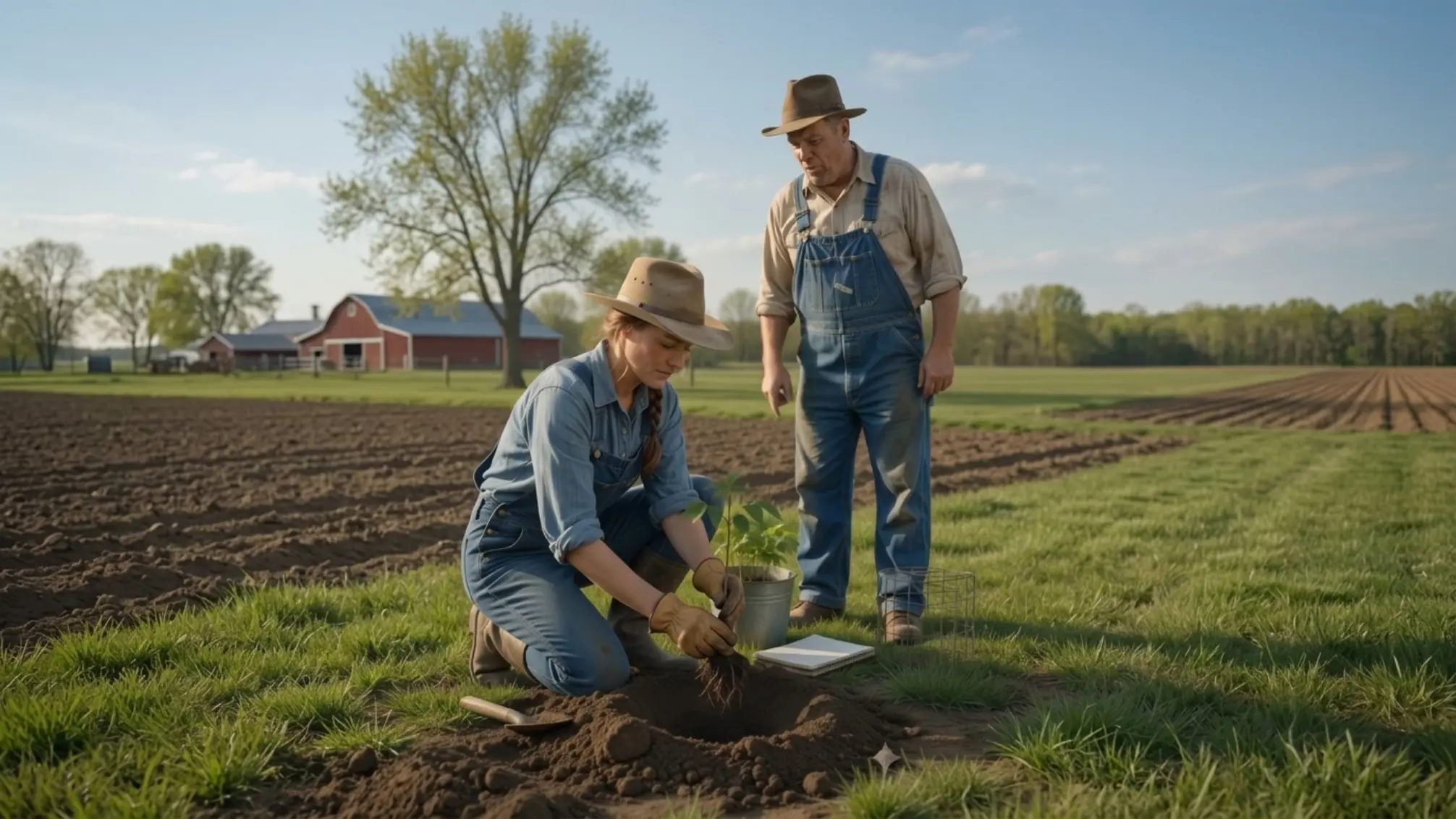
“You count this year,” she said. “I count the next forty.”
Roy laughed harder. “You’ll be an old woman before one tree pays you back.”
Nadine packed the soil firmly around the thin stem and finally met his eyes. “Then live long enough to watch the buyers stop at my fence.”
By evening, the story had traveled from the back forty to the feed store in Kirksville. By the next morning, Dale Fender at the grain desk was telling customers that Nadine had discovered a new agricultural method: replacing profitable grass with sticks too small to shade a rabbit. Before Sunday service, her brother-in-law Gerald Pruitt had improved the story by claiming she had spent nearly one hundred dollars protecting each seedling like a newborn child.
The amount was actually eighty-two dollars for the entire project.
Sixty dollars purchased two hundred grade-one bare-root black walnut seedlings from a nursery in Columbia. Twenty-two dollars paid for woven wire used to build protective cages around them. The Osage orange stakes came from Nadine’s own hedgerow, and the planting bar had been made years earlier by her father from a length of steel pipe with a welded foot.
The laughter continued because no one understood that Nadine’s decision had not begun with the nursery order. She had been planning the planting for fourteen months before the first seedling entered the ground. What the county mistook for impulse was the final stage of a calculation she had already examined from every possible direction.
Nadine was born in 1931 on the same 280-acre farm outside Kirksville that she would later inherit. Her father, Elwood Pruitt, was a farmer by inheritance and a soil conservationist by instinct. He had never attended a university, but he read every agricultural bulletin he could obtain and kept them in a wooden crate beneath the workbench inside his concrete-block shop.
The bulletins went back to 1924.
Elwood recorded numbers in their margins: yield per acre, rainfall totals, livestock carrying capacity, timber growth, and historical crop prices. He bought an old surveyor’s transit at a government surplus sale for four dollars and used it to map every slope, wet spot, drainage path, and soil change on his farm. He taught Nadine that land was never merely a field; it was a collection of possibilities limited only by what its owner understood.
He also taught her to distrust debt.
During the Depression, Nadine watched neighboring families lose farms that had belonged to them for generations. Many had been good farmers, but falling prices left them unable to meet equipment loans, operating notes, and mortgage payments. Elwood survived because he owned his land and machinery outright, repaired everything he could, and never borrowed against a crop that had not yet grown.
“A man with debt farms for the bank first,” he told her. “A farmer without it can choose what the ground needs.”
Nadine carried that lesson more faithfully than any of his tools.
She had once intended to leave the farm. In the spring of 1950, she packed a suitcase and purchased a bus ticket to Columbia, where she had been accepted into a nursing program. Then her mother suffered a stroke three weeks before departure, and Nadine unpacked without complaint.
She spent the following years caring for her mother, working beside Elwood, keeping farm accounts, repairing machinery, and reading the bulletins beneath the workbench. Some neighbors treated her decision as proof that a woman’s ambition naturally ended at the family kitchen. Nadine saw it differently.
She had traded one kind of education for another.
Elwood died in the fall of 1961. He left Nadine the mortgage-free farm, $14,200 in savings, every tool in the workshop, and the wooden crate of agricultural research. Among the papers was a folder containing years of correspondence with Harold Sievert, a University of Missouri forester who had studied black walnut production and long-term timber markets.
Nadine read the entire folder during the week after the funeral.
The letters explained that high-quality black walnut could become extraordinarily valuable when grown in deep, moist soil with good drainage. They described proper spacing, straight-trunk development, pruning, silvopasture systems, and long-term demand from furniture and veneer mills. Elwood had written calculations beside nearly every page.
Nadine added her own.
Most people saw the back forty as adequate cattle pasture. It supported twelve Angus without difficulty and produced a modest, predictable return each year. Roy Detwiler believed that was the only sensible measure of its value: how much beef the grass could support this season.
Nadine saw class-two bottomland running beside a creek drainage that retained moisture through dry August weather. Her father’s soil maps showed depth, organic matter, and reliable water movement. Harold Sievert’s letters described almost identical ground as ideal for producing premium walnut trunks.
She did not intend to eliminate cattle from the pasture.
She planned to grow trees and grass together.
The walnut rows would stand thirty feet apart, leaving enough space for grazing. Trees placed on twenty-foot centers would provide summer shade for livestock while cattle controlled competing vegetation beneath them. Over decades, the pasture would continue producing beef while accumulating timber value almost invisibly.
Before ordering anything, Nadine sent soil samples to the university extension office. She studied drainage through one wet season and one dry one. She wrote directly to Harold Sievert, who responded with projected timber prices at twenty-, thirty-, and forty-year intervals.
Only then did she purchase the seedlings.
During the autumn of 1962, she marked the planting grid using Elwood’s transit. She established the rows northeast to southwest to control shading, cut Osage orange stakes from the northern hedgerow, and built two hundred wire cages by hand. The work took six weekends after harvest chores were finished.
Nobody noticed.
In April 1963, the nursery shipment arrived with the roots wrapped carefully to preserve moisture. Nadine planted from first light until evening for four consecutive days, heeling the remaining stock into damp soil each night so the roots would not dry. She spread every root, set each stem to the proper depth, closed the planting slit, and pressed the earth firmly with her boot.
Roy saw her on the second afternoon.
He stopped beside the fence and laughed because that was easier than asking whether she knew something he did not. Nadine offered no long explanation. She had learned that people who mocked a forty-year plan rarely listened long enough to understand one.
Gerald Pruitt came the next morning.
He walked among the wire cages, poking one seedling with the toe of his boot. “You could have rented this pasture to someone with more cattle.”
“I could have.”
“You could plant corn.”
“Too wet in a rainy year and too uneven for efficient machinery.”
“You’ll lose pasture once those trees grow.”
“I’ll gain shade and timber.”
Gerald shook his head. “Thirty years is too long to wait for money.”
Nadine adjusted a cage he had disturbed. “The thirty years will pass whether I plant or not.”
That answer traveled through the county too.
Some repeated it because they found it amusing. Others repeated it more quietly because it unsettled them. Most farmers planned around the next planting season, the next calf crop, or the next loan payment; Nadine had arranged her work around a future several decades away.
Four seedlings died during the first summer. She replaced them with spares kept near the creek and entered every loss in her notebook. By autumn, 196 healthy walnut trees stood in straight rows across the back forty.
The county continued laughing.
Nadine continued farming.
She maintained cattle, planted row crops, raised a garden, and kept her costs lower than almost every comparable operation in the region. When the tractor engine required an overhaul in 1967, the dealer quoted nearly nine hundred dollars. Nadine ordered the parts and rebuilt it inside Elwood’s workshop for a fraction of that amount.
When grain-bin floor supports weakened, she poured new concrete herself. When the well pump failed, she borrowed a truck and pulled it. When fencing needed replacing, she cut posts, stretched wire, and completed the work without waiting for a man to declare the job appropriate for her.
The walnut trees grew quietly while people stopped paying attention.
By 1966, they had reached eight to twelve feet. Nadine removed the protective cages once the trunks were thick enough to resist cattle browsing. The trees stood straight, healthy, and evenly spaced, matching the university projections almost perfectly.
Roy Detwiler stopped his tractor along the fence in 1968.
The walnuts were nearly fifteen feet tall by then, and cattle grazed comfortably between the rows. Roy removed his cap and stared across the pasture for a long time. He did not laugh, but he did not apologize either.
He drove on.
Nadine entered annual measurements into the notebook: height, trunk diameter, storm damage, mortality, and form. She removed low branches when necessary, protected the best stems, and watched for diseases. The work required patience, but it did not require blind faith.
The trees followed the arithmetic.
Meanwhile, her savings increased. Without mortgage payments or machinery loans, she put aside between three and five thousand dollars during good years. She kept money in two separate banks because Elwood believed one account created one point of failure.
By 1975, Nadine had saved $61,000.
By 1979, she had $84,000.
The walnut trees were thirty feet high, and the best trunks measured almost eight inches in diameter at breast height. Nadine completed a light thinning in 1978, removing forty poorly formed trees so the strongest could grow faster. A mill in Macon paid her $1,100 for the logs.
She used the money to replace the equipment-shed roof.
Then she planted new seedlings inside the thinning gaps.
Gerald visited after hearing about the timber sale. He walked through the rows with his hands in his pockets, studying trunks that had once been fragile sticks inside wire cages. “You waited fifteen years for eleven hundred dollars.”
“No,” Nadine said. “I earned cattle income for fifteen years and received eleven hundred dollars while improving the remaining stand.”
He frowned. “You always have an answer.”
“I usually have records.”
She showed him the notebook.
Every cost and return had been documented from the first sixty-dollar nursery order. Cattle capacity had not declined as severely as people predicted, and summer shade reduced heat stress among the herd. The remaining trees were increasing in quality and value each year.
Gerald returned the notebook without comment.
Time moved differently inside the back forty.
Children who had watched Nadine plant the first seedlings grew old enough to marry. Tractors changed shape, grain prices rose and collapsed, farms expanded under easy credit, and families began borrowing heavily to purchase larger machinery. Through all of it, the walnut trunks widened in silence.
Nadine remained debt-free.
People occasionally accused her of being overly cautious. She watched farmers mortgage paid land to expand during prosperous years, then struggle when interest rates climbed and crop prices fell. She never celebrated their trouble, but she refused to imitate their decisions.
Her trees owed nothing to a bank.
In January 1991, freezing rain began falling across northern Missouri. It continued for four days, coating every road, fence, power line, and branch beneath layers of ice. Trees bent under unbearable weight, and then the county began hearing them break.
Mature oaks split at their strongest forks. Elms collapsed in tangled groups, pulling frozen roots from the earth. Osage orange limbs as thick as a man’s thigh crashed through fences and blocked roads. Timber stands that had survived drought, disease, and decades of weather were destroyed in a single week.
Nadine remained inside until the storm eased.
When she finally walked toward the back forty, frozen branches cracked beneath her boots. She expected devastation. At sixty years old, she had invested nearly half her life in those rows.
A few outer limbs were broken.
Several younger trees had bent.
But the main trunks remained standing.
Their narrow crowns and strong wood had handled the ice better than the spreading oaks and weakened elms surrounding them. Long, clear sections of walnut trunk remained intact beneath the first branches. The timber’s form, quality, and value had survived.
Across the county, landowners tried to sell storm-damaged timber. Buyers from St. Louis, Kansas City, and Springfield drove the rural roads, inspecting fallen oak, shattered elm, and twisted hedge. Most offered disappointing salvage prices because damage reduced milling value.
Then Warren Styles stopped beside Nadine’s fence.
He had purchased black walnut timber for twenty-two years. He stepped out of his truck, placed both hands on the fence, and stared across the rows for nearly fifteen minutes. The trees were twenty-eight years old, forty to fifty feet tall, and exceptionally straight.
Warren walked to the farmhouse and knocked.
Nadine answered in work clothes.
“I’ve never seen a private walnut planting this good outside a university demonstration plot,” he said. “Who managed it?”
“I did.”
“From the beginning?”
“Since 1963.”
He looked toward the pasture again. “I want to purchase the standing timber.”
“All of it?”
“As much as you’re willing to sell.”
Nadine did not allow excitement to control the negotiation. She asked which trees he wanted, how he calculated board feet, what percentage qualified for veneer, who would supervise cutting, and what protection he offered for the remaining stand. Warren’s expression gradually changed from surprise to respect.
“I’ll need several days,” she said.
“Other buyers will come.”
“I expect them to.”
He left his card.
By the following morning, news had reached Roy Detwiler.
He drove to the fence and found Nadine inspecting storm damage. At seventy-one, Roy moved more slowly than he had when he laughed from his tractor almost three decades earlier. He removed his cap and held it in both hands.
“I owe you something,” he said.
Nadine waited.
“An apology.”
“For which year?”
The question carried no cruelty, but Roy winced anyway. “All of them.”
He looked across the walnut rows. “I thought you were wasting pasture. I thought you didn’t understand farming because you were planning something I couldn’t see.”
Nadine touched the bark of the nearest tree. “Most people judge land by what it pays this year.”
“I was wrong.”
“Yes.”
Roy almost smiled at her directness. “You could make this easier.”
“I could, but then it wouldn’t be true.”
He nodded. “Your father would be proud.”
Nadine’s expression softened. “He liked you, Roy. He would be glad you came.”
That spring, Warren Styles purchased a selective harvest of sixty-two mature trees for $38,400. Nadine retained 112 trees of varying ages, including younger replacements planted after the 1978 thinning. The logging crew followed strict routes to prevent soil damage and protected every remaining trunk.
When the final truck left, the back forty did not look empty.
Sunlight entered wider spaces, giving the younger walnuts room to grow. Cattle returned to the pasture, grazing beneath trees that now represented another future harvest. Nadine entered the sale figure into the notebook beneath the original cash investment.
Initial planting cost: $82.
1991 selective harvest: $38,400.
The comparison spread through Adair County.
People who once called her foolish began asking what else she had planted, how many trees remained, and whether black walnut would grow on their property. Nadine answered serious questions but had little patience for those searching for instant wealth.
“You cannot plant yesterday,” she told them.
That summer, 240 acres north of her farm came up for sale. The family who owned it had borrowed heavily during the agricultural boom, then watched interest rates rise and land prices fall. They were capable farmers trapped by debt rather than laziness.
The listing price was $148,000.
At auction, land speculators from Kansas City competed against a farm-management company from Des Moines and two neighboring farmers using bank financing. The bidding climbed beyond $130,000. One farmer dropped out, then the second.
Nadine remained.
When the final competing bidder stopped, the auctioneer announced the sale. Nadine walked forward wearing the same kind of work clothes she wore in the pasture and wrote a personal check for the full purchase price.
No financing.
No bank approval.
No mortgage.
The room became completely silent.
Gerald stood near the rear wall. He had come expecting to watch outside investors purchase the land. As Nadine passed him with the signed agreement, he said her name quietly.
She stopped.
“Elwood would have been proud of you,” Gerald said.
Nadine studied him, remembering the diner jokes, the church laughter, and his boot nudging a newly planted seedling. She could have made him carry the weight of every old insult.
Instead, she looked at the purchase agreement.
“Father would have considered it a reasonable price for good ground beside reliable creek drainage.”
She meant exactly what she said.
Nadine farmed the expanded operation for another eleven years. She planted 140 additional walnut seedlings on two parcels with soil characteristics matching the original back forty. She used the same steel planting bar Elwood had made decades earlier.
Her niece Carla eventually returned to learn the operation.
Nadine spent two years teaching her how to use the old transit, read drainage maps, inspect timber form, maintain machinery, and understand the farm ledger. She showed Carla Harold Sievert’s letters and every extension bulletin preserved beneath the workbench.
“People think the trees made the money,” Nadine told her. “The trees only followed the plan.”
In 2004, the county extension office asked Nadine to speak at a land-management meeting. At seventy-three, she stood before sixty farmers and described the back forty without exaggeration. She explained the original $82 cost, the $38,400 selective harvest, continued cattle production, and the additional land purchased because she had spent decades remaining debt-free.
Roy Detwiler sat in the audience.
Afterward, he approached her once more. “I’ve thought about what you did for forty years, and I still don’t know whether I would have had the patience.”
“Patience isn’t quite the word,” Nadine replied.
“What is?”
“Arithmetic.”
Roy waited.
“If you know what the ground can produce, what the market may pay, and how long growth requires, then you multiply across the years. The answer does not change because other people find the waiting uncomfortable.”
She looked toward Carla, who was carrying the wooden crate of bulletins to the truck.
“My father taught me to think in the same units of time the land uses. That was worth more than the farm he left me.”
The original walnut stand continued growing.
Some trees were harvested selectively, while others remained for the next generation. The back forty still supported livestock, held the creek bank in place, protected soil, and carried timber worth far more than anyone in 1963 believed possible.
Nadine never pretended she had predicted the ice storm.
She had done something more useful.
She built an operation strong enough to benefit from opportunity when it arrived. The storm destroyed timber across the county, but it did not create the value behind her fence. That value had been accumulating one growth ring at a time for twenty-eight years.
The buyers stopped because she had prepared long before anyone knew preparation was necessary.
The county remembered the sixty-dollar nursery order and the woman kneeling in the pasture while a neighbor laughed. They remembered the wire cages, the planting bar, and the tiny stems people said would never repay her labor.
Most of all, they remembered her answer.
“You count this year. I count the next forty.”
Nadine had never buried money in the soil.
She had buried a plan.
And when the right season finally arrived, an entire county was forced to watch it rise taller than every opinion that had tried to keep her small.