In the summer of 1973, the Georgia sun arrived before breakfast and stayed until long after reasonable people had surrendered to shade.
At twenty-four years old, Lena Marsh stood ankle-deep in brown pond water with a black livestock tub braced against both thighs while hundreds of bluegill slapped against the plastic inside.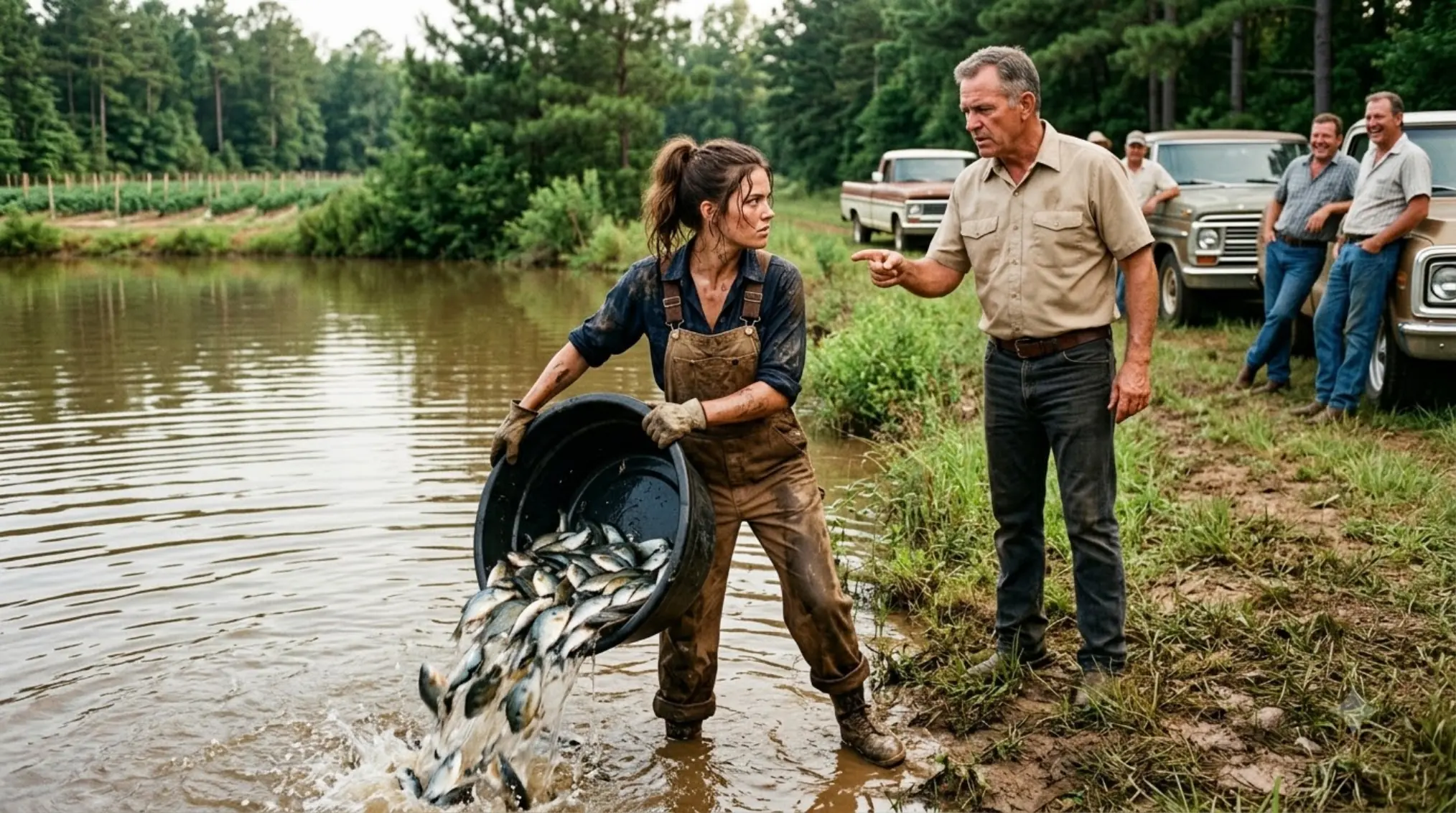
Mud covered her brown overalls from the knees downward.
Her dark navy work shirt clung to her shoulders.
Wet strands of dark-brown hair had escaped her ponytail and stuck across her cheek.
Behind her, six men were laughing.
Lena tipped the tub farther.
Silver-blue fish poured into the pond.
The surface exploded.
Fish flashed beneath the water and vanished.
A man behind her shouted, “There goes another load of fertilizer money!”
More laughter.
Lena lowered the empty tub.
She turned.
Standing several yards up the muddy bank was Arthur Thorne, fifty-two years old, broad-shouldered, deeply tanned, and dressed far too cleanly for a man supposedly visiting another person’s farm to offer practical advice.
Arthur owned the acreage west of Lena’s property.
More importantly, he behaved as though success had given him ownership over every agricultural opinion within twenty miles.
His pepper fields were famous locally.
Straight rows.
High yields.
Large machinery.
Chemical fertilizer delivered on schedule.
Pesticide applications calibrated by the gallon.
Arthur believed modern farming worked because he had watched it work.
He also believed anyone refusing the methods that had made him successful was not merely different.
They were foolish.
Arthur pointed at Lena’s pond.
“You’re turning your irrigation reservoir into a fishing hole.”
Lena dropped the empty tub into the mud.
“It was never just a reservoir.”
Arthur laughed.
The men behind him joined in.
One farmer leaned against an old pickup and shook his head.
“Jacob’s girl really did it.”
Another asked, “How many you put in there?”
Lena answered without hesitation.
“Enough to establish a breeding population.”
Arthur raised both eyebrows.
“A breeding population.”
“Yes.”
He looked around theatrically.
“Wonderful. She’s raising fish.”
“I’m raising peppers.”
“Then maybe put fertilizer on the peppers.”
Lena took off one muddy glove.
Arthur’s mouth curled into a smile.
He mistook her silence for embarrassment.
That happened often.
It had happened when her father died.
It had happened at the feed store.
It had happened when the bank manager asked whether there was “a man in the family” who would help oversee the property.
Lena had learned something useful.
People revealed much more while they believed you were intimidated.
Arthur stepped closer.
“Listen, Lena. I knew your father a long time.”
Her expression changed slightly.
“Then you should know better than to use him to explain my farm to me.”
Several farmers stopped smiling.
Arthur’s own smile disappeared.
“I’m trying to save you money.”
“No.”
She wiped pond water from her cheek.
“You’re trying to make me farm like you.”
Arthur folded his arms.
“That would be a considerable improvement.”
Lena looked past him toward his fields.
Miles of green rows seemed to stretch behind the fence.
From a distance they were nearly perfect.
That was the problem.
Arthur loved things that looked perfect from a distance.
She looked back at him.
“My father taught me this pond is part of the soil.”
Arthur laughed again.
“Your father believed a lot of things.”
“He kept this farm productive without half the chemicals you use.”
“He kept it small.”
Lena’s jaw tightened.
Arthur continued.
“That’s the part you never understood about Jacob. He was a decent farmer, but he never wanted to become anything.”
Lena stepped out of the pond.
Mud sucked at her boots.
The farmers watched her climb the bank.
She stopped directly in front of Arthur.
Her voice stayed calm.
“My father knew the difference between growing and getting bigger.”
Arthur stared at her.
Lena pointed toward the pond.
“These fish will eat algae and insect larvae. Their waste stays in the water. I move that water through the field.”
Arthur shook his head.
“You’ve been reading too many old notebooks.”
“I have.”
“You think you can replace fertilizer with fish waste?”
“I think the pond can become more than storage.”
“Based on what?”
“My father’s field records.”
Arthur laughed sharply.
“Jacob’s field records.”
“Yes.”
“Girl, I’m buying fertilizer by the truckload and you’re standing knee-deep in mud talking about bluegill.”
Lena stepped even closer.
“Then we should have a very easy way to settle this.”
Arthur narrowed his eyes.
“What?”
“Harvest.”
Silence.
Lena pointed toward his property.
“Grow yours your way.”
Then toward hers.
“I’ll grow mine mine.”
Arthur smiled again.
“You want to compete?”
“No.”
Lena picked up the empty tub.
“I want you to stop talking long enough for the peppers to answer.”
She walked back toward the pond.
Behind her, laughter restarted.
Arthur called after her.
“By August, I’ll be buying this place for pennies!”
Lena stopped.
She looked over her shoulder.
“Then bring cash.”
Arthur’s grin widened.
Lena added:
“Because if mine outsell yours, I don’t want you pretending you weren’t serious.”
Nobody laughed after that.
The Marsh farm had belonged to Lena’s family for three generations.
Her grandfather had cleared parts of it with a mule.
Her father, Jacob Marsh, expanded the pepper acreage without ever expanding the debt attached to it.
The farm was not rich.
It was not famous.
It was productive.
Jacob considered that enough.
Arthur Thorne considered enough a failure of imagination.
Their disagreement had lasted twenty years.
Arthur would arrive at the feed store talking about the newest pesticide schedule.
Jacob would listen.
Then ask what the earthworms looked like afterward.
Arthur would describe yield increases.
Jacob would ask how much topsoil left the field during the first hard rain.
Arthur would speak about speed.
Jacob would speak about resilience.
Neither man converted the other.
Arthur built a larger farm.
Jacob built a quieter one.
When Jacob died suddenly that spring, Lena inherited both the land and everyone else’s opinion about what she should do with it.
Arthur appeared less than a week after the funeral.
He brought three neighboring farmers with him.
They stood in Lena’s yard.
Hats in their hands.
Concern carefully arranged across their faces.
Arthur spoke first.
“Your father was a good man.”
Lena waited.
She already knew the word coming next.
“But.”
Arthur sighed.
“His methods were behind the times.”
There it was.
Lena folded her arms.
Arthur continued.
“You don’t have to prove anything.”
“I didn’t know I was.”
“You’re twenty-four.”
“Yes.”
“This is almost one hundred acres.”
“I know the acreage.”
One farmer looked uncomfortable.
Arthur ignored him.
“You could sell.”
Lena stared.
“To who?”
Arthur hesitated.
That was answer enough.
“You?”
“I’d make a fair offer.”
“How generous.”
“I’m serious.”
“So am I.”
Arthur removed his hat.
“Lena, this is no place for a young woman alone.”
She looked toward the men standing behind him.
Then toward the farm.
The pond shimmered in the distance.
Jacob had called it the heart of the property.
Lena had spent half her childhood sitting beside that water while her father pointed out things nobody else seemed interested in noticing.
Frogs.
Algae.
Dragonflies.
Birds.
Soil color.
The direction runoff moved after rain.
Jacob never said nature was magical.
He hated vague language.
He said nature was working whether farmers understood the work or not.
Lena looked back at Arthur.
“I’m not selling.”
He sighed.
“Think about it.”
“I have.”
“You haven’t had enough time.”
“I’ve had twenty-four years.”
Arthur shook his head.
“What are you planning to do?”
Lena looked toward the pond.
“First?”
“Yes.”
“I’m putting bluegill in the irrigation pond.”
Silence.
One of the younger farmers coughed.
Another laughed.
Arthur stared.
“Bluegill.”
“Yes.”
“For what?”
“The water.”
“What does that mean?”
“It means I want the pond biologically active.”
Arthur looked toward the other men.
They started laughing.
Lena remembered standing in the middle of them while the sound rolled around her.
Nobody shouted.
Nobody called her stupid directly.
They did something more dismissive.
They treated her idea like entertainment.
Arthur slapped one man lightly on the shoulder.
“Jacob leaves her a pepper farm and she’s opening a fishing business.”
Lena said nothing.
That silence convinced them they had won.
They left.
Lena walked to her father’s study.
Three shelves of journals waited against the wall.
Jacob’s handwriting filled hundreds of pages.
Rainfall.
Planting dates.
Insect observations.
Soil texture.
Harvest weights.
Failures.
Questions.
One entry from years earlier had stayed in Lena’s mind.
A flash flood connected the irrigation pond temporarily with a creek.
Fish entered.