The green dumpster stood behind Millbrook Farm Market beneath a yellow loading-dock light that made everything around it look older than it was. At 5:45 on a freezing November morning, Evelyn Calder climbed onto the metal step rail and looked inside at seven broken wooden crates packed with pale blue-green duck eggs. Nearly every shell was scratched, cracked, or stained from being thrown against the others, and the cold air carried the sour smell of wet cardboard and spoiled produce.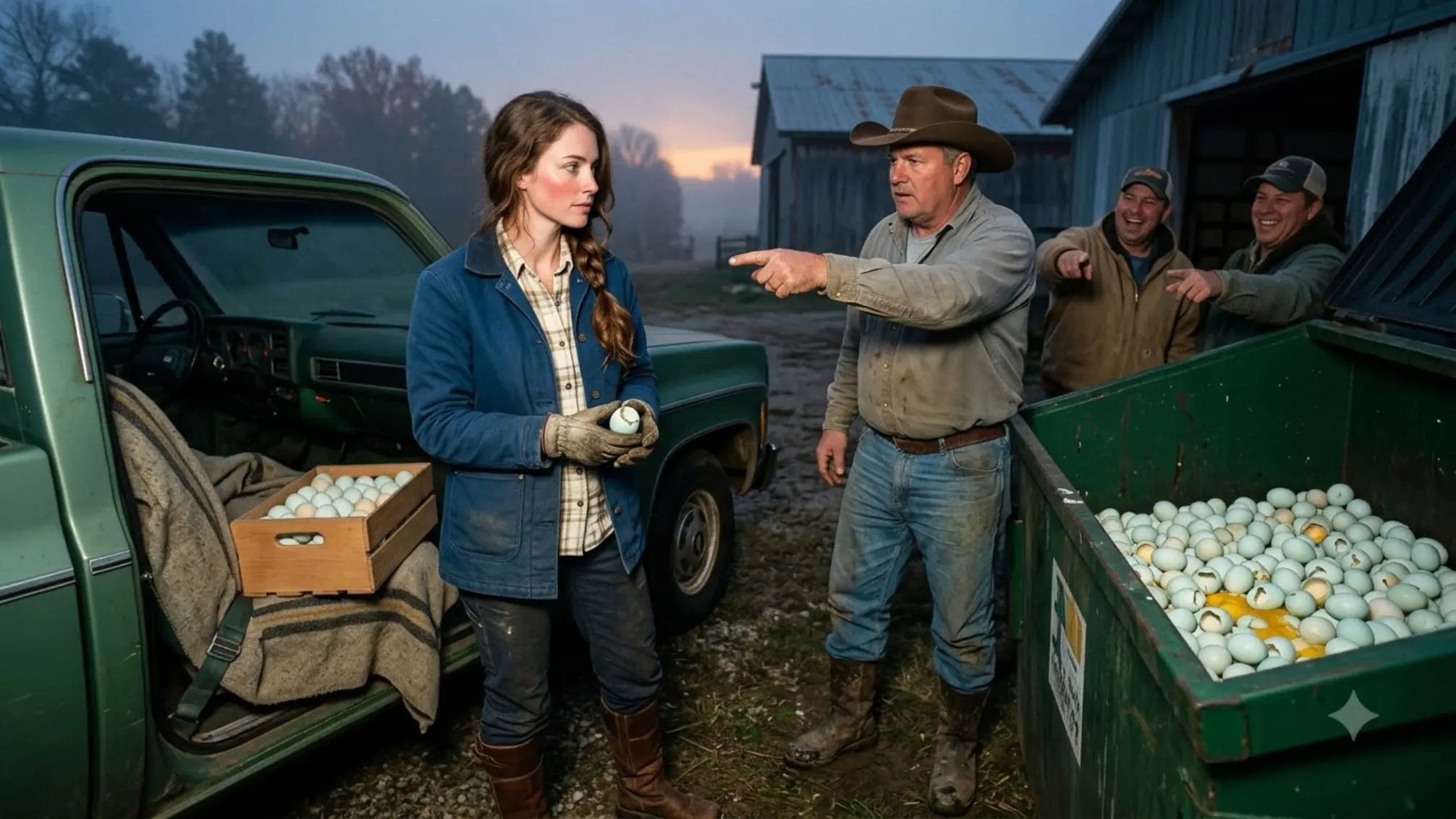
Evelyn had come for discarded pallets.
Instead, she found almost three hundred eggs.
She was thirty-two, strikingly beautiful even with mud dried beneath her fingernails and exhaustion settled beneath her blue-gray eyes. Long chestnut-brown hair had been tied into a loose braid beneath the collar of a deep-blue canvas farm coat, and a cream plaid shirt showed between the open buttons. Her brown work trousers and heavy boots were already marked by weeks of repairing fences at Calder Farm, but she moved with the deliberate care of someone who never allowed appearances to decide whether something still had value.
She reached into the closest crate.
The first egg was cold enough to sting her fingers through the thin gloves. The second felt the same. The third was different.
Not warm like an egg just laid beneath a duck, but warmer than the freezing shells surrounding it. Evelyn held it between both palms and remained perfectly still, feeling something she could not yet prove. The cracked shell gave no visible sign of life, but it had not surrendered completely to the cold.
She placed the egg inside the deep pocket of her blue coat.
Then she began checking the others.
For forty minutes, Evelyn worked through the crates one egg at a time. Most were cold all the way through, their temperature identical to the damp wood and metal around them. She returned those gently to the dumpster rather than pretending effort could save what was already gone.
Eighty-four eggs felt different.
Some retained faint warmth. Others had hairline cracks but intact membranes beneath the shell. Evelyn arranged all eighty-four in a low wooden produce box lined with dry straw salvaged from another discarded crate.
She carried the box toward her faded 1979 Ford pickup just as headlights swept across the loading area.
Harlan Briggs’s truck stopped behind her.
Harlan farmed cattle on the south side of Millbrook and rarely passed an opportunity to explain why someone else was making a mistake. He climbed down wearing a brown cowboy hat, faded plaid shirt, jeans, and mud-caked boots. Two farm-market workers followed him from the loading door, both holding coffee and grinning as they noticed the eggs.
Harlan stepped between Evelyn and the truck.
“Those three hundred cracked eggs are dead trash,” he said. “Put them back before your stupidity stinks up the whole county.”
Evelyn set the box carefully on the passenger seat.
She wrapped an old wool blanket around three sides and pulled the seat belt through the wooden slats. Only after the crate was secured did she turn to face him.
In her palm rested the first egg she had found.
“Move,” she said, “or I’ll make you explain why garbage still has a heartbeat.”
The workers laughed.
Harlan stepped closer until the brim of his hat nearly touched her forehead.
“Not one bird will hatch. When they rot, I’ll drag the whole box onto your porch.”
Evelyn opened the driver’s door.
“Come back on day twenty-eight,” she replied. “When the first shell breaks, bring every man who laughed with you.”
She climbed inside and started the engine.
Harlan remained beside the truck as Evelyn drove away at forty-five miles per hour, ten under the speed limit because the county road curved through frozen hills. The eggs rode beside her like a silent passenger, protected from sudden turns by the seat belt and blanket. Every few minutes, Evelyn reached across to steady the crate even though it had not moved.
Calder Farm lay eight miles east of town.
The property consisted of eighty-two acres, an aging white farmhouse, a red barn, and a spring-fed pond that had survived two dry summers. Evelyn had inherited the land from her grandmother after her mother moved to Springfield, along with overdue repairs and a farm account that seemed to lose money no matter how carefully she managed it. Twelve laying hens and a modest vegetable field kept food on the table, but neither produced enough income to protect the farm from another failed season.
Evelyn had already received one warning from the bank.
The operating loan was still current, but barely. If spring expenses rose before she found another source of income, she would be forced to sell fifteen acres along the road. That strip included the best pasture, the old orchard, and the only level ground suitable for expanding the farm.
She had not collected the duck eggs because she believed they were a miracle.
She collected them because one had not been cold.
The barn had once housed dairy cattle. Evelyn had repaired its roof, replaced several rotten boards, and converted one corner into a brooding area for chicks. A square wooden crate sat on a low pallet beneath an east-facing window, built from salvaged lumber and hardware cloth.
She cleaned it before sunrise.
Fresh straw covered the floor in a thin layer. Evelyn hung an infrared heat lamp from a ceiling beam and positioned it at an angle so one side of the crate would remain warmer than the other. She set a thermometer at egg level and placed a shallow pan of water beneath the lamp to increase humidity.
Then she began examining the eggs in darkness.
The small flashlight on her key ring was not designed for candling, but it was all she had. She pressed its beam against each shell and searched for a defined air cell, darker internal mass, or visible sign that the egg had begun developing before being discarded.
Fourteen eggs remained completely clear.
Evelyn removed them.
Seventy showed enough internal darkness or structure to justify continuing. She placed them inside the warmed crate, arranging them so no cracked surface carried the full weight of another shell.
In a spiral notebook, she wrote:
November 14. Eighty-four eggs retrieved. Fourteen clear and removed. Seventy placed under heat. Temperature: 99.5 degrees at egg level. Humidity: 65 percent.
Below that, she added the turning schedule.
6:00 a.m.
12:00 p.m.
6:00 p.m.
She underlined the noon turn twice.
The morning and evening turns could be connected to feeding the chickens, but noon fell in the middle of whatever work the farm demanded. Evelyn set an alarm on her phone and labeled it with one word.
TURN.
By breakfast, Millbrook already knew.
Gary Collins, one of the market’s delivery drivers, had seen Evelyn buckle the wooden crate into her truck. At the feed store, he told Phil Warwick that she had collected three hundred broken eggs from the dumpster and treated them like children.
“Buckled them in?” Phil asked.
“With the passenger seat belt.”
“What does she plan to do with them?”
“Hatch them.”
Phil stared at him.
“Cracked eggs don’t hatch.”
By noon, that sentence had become the official opinion of the county.
At the diner, customers described Evelyn as desperate. At the hardware store, someone claimed she intended to sell rotten duck eggs as organic food. By evening, the story had changed again, and people were saying she had stolen the eggs because she could no longer afford groceries.
Evelyn heard none of it that day.
She was inside the Millbrook library reading every book and agricultural pamphlet available about incubating waterfowl. Helen, the librarian, found an old extension-service booklet, a backyard duck guide, and a spiral-bound manual donated by a discontinued 4-H program.
Evelyn copied the most important information.
Duck eggs required approximately twenty-eight days of incubation. Temperature needed to remain near 99.5 degrees at egg level. Humidity should stay moderately high during development and increase during the final three days.
The eggs needed to be turned at least three times every day.
Candling should happen on days seven and fourteen.
The publications disagreed about cracked shells.
One advised discarding them immediately. Another explained that minor surface cracks could sometimes be sealed with beeswax if the membrane remained intact. The 4-H manual warned that the hatch rate would be lower but did not call survival impossible.
Evelyn read that section three times.
On her way home, she stopped at the hardware store and purchased a small beeswax candle and a box of toothpicks. The clerk asked whether she was preparing for a power failure.
“Something like that,” Evelyn said.
That evening, she examined every egg again.
Twenty-three of the seventy had visible hairline cracks without deep membrane damage. Evelyn melted small amounts of wax, placed each drop with the end of a toothpick, and spread it carefully across the crack. She marked every repaired egg with a small pencil X.
The work took four hours.
At midnight, Evelyn sat on the barn floor and checked the thermometer.
The eggs offered no movement, no sound, and no promise.
She turned them at six the following morning.
Then at noon.
Then at six in the evening.
Every day followed the same rhythm.
Evelyn fed the hens at dawn, checked the temperature, turned the eggs, repaired fences, cut firewood, answered calls from the bank, and returned before noon to turn them again. At night, she refilled the humidity pan and examined the waxed cracks for changes.
The alarm interrupted her in town, in the pasture, and once while she was halfway beneath the pickup repairing a leaking fuel line.
She never ignored it.
On the fourth day, Harlan drove past Calder Farm slowly enough for Evelyn to hear him shouting through the open window.
“Smell anything yet?”
She continued carrying feed toward the barn.
On day five, two schoolboys stopped their bicycles at her fence and asked whether they could see the dead eggs. Evelyn told them there was nothing to see until day seven.
They returned the following afternoon with three friends.
Evelyn did not let them inside.
“Come back when I have facts,” she said.
On day seven, she drove to the farm-supply store in the county seat and bought a proper LED egg candler for eleven dollars. The expense came from money she had set aside for replacing a broken gate hinge, but the hinge could survive another week. Uncertainty could not be measured with the weak beam of a key-chain flashlight.
That evening, Evelyn darkened the barn.
She lifted the first egg and placed its large end over the candler.
A clear air cell appeared beneath the shell.
Below it, a delicate branching network of red-orange vessels extended around a dark central point. Evelyn rotated the egg slowly and saw the pattern continue.
Development.
She checked the second egg.
Nothing.
The third contained the same visible network.
By the time Evelyn finished, forty-seven eggs showed unmistakable signs of growth.
Twenty-three showed none.
She removed the failed eggs, reduced the number in the crate, and wrote the results in her notebook.
Day seven: Forty-seven confirmed developing. Twenty-three removed. Blood-vessel networks visible. Continuing.
Evelyn remained in the barn after closing the notebook.
Forty-seven was far below three hundred.
It was also far above zero.
At the feed store the following Tuesday, she heard people discussing the eggs before she reached the mineral supplements.
“I heard she still has them under a lamp.”
“What does she think is going to happen?”
“She says some are growing.”
The speakers fell silent when Evelyn entered the aisle.
A cattle farmer named Raymond Keller cleared his throat.
“Morning, Evelyn.”
“Morning.”
“We heard you’re trying to hatch those dumpster eggs.”
“Yes.”
“Any luck?”
“Day-seven candling confirmed forty-seven developing.”
“Out of three hundred?”
“Out of seventy selected for incubation.”
Raymond absorbed the answer.
“Huh.”
Evelyn picked up the mineral supplement.
The woman beside him leaned forward. “How do you know they’re developing?”
“Blood vessels.”
“You can see them?”
“With a candler.”
The woman looked at Raymond.
Neither laughed.
At the register, Phil rang up the feed and straw.
“Forty-seven?” he asked.
“Forty-seven.”
“My grandmother hatched chickens. She said the first week was when you learned whether starting had been worth it.”
“What did she say about the second week?”
Phil handed Evelyn the receipt.
“That’s when you learned whether you had the patience to finish.”
Day fourteen arrived beneath freezing rain.
Evelyn waited until evening before candling the eggs, worried that the temperature drop inside the barn might affect them if she kept the crate open too long. She worked quickly, moving each egg from the warmth to the light and back again.
Development was easier to see now.
The embryos filled more of the shell. Air cells were larger and clearly defined. In several eggs, Evelyn saw tiny movements responding to the candler.
Eight showed no further growth.
Thirty-nine remained alive.
She recorded the number and removed the others.
For the first time since retrieving the eggs, doubt settled heavily inside her. The count continued shrinking. Three hundred had become eighty-four, then seventy, forty-seven, and now thirty-nine.
The farm still needed money.
The bank still expected payment.
The entire county was waiting for her experiment to fail.
Evelyn sat beside the crate until the heat lamp warmed the side of her face. She imagined opening the barn on day twenty-eight and finding thirty-nine silent shells.
Then she remembered the first egg in her hands.
Not warm enough to prove life.
Not cold enough to justify abandoning it.
She turned the eggs at six the next morning.
The rumors changed after day fourteen.
People no longer called them completely dead. Instead, they predicted that the embryos would fail before hatching. Harlan told everyone at the diner that developing inside a cracked shell was not the same as surviving outside it.
“The woman is raising disappointment,” he said.
Gary laughed.
Phil did not.
Evelyn continued working.
She cleaned the eggs gently when necessary, maintained the humidity, checked every wax seal, and recorded minor temperature changes. She studied diagrams showing how ducklings positioned themselves before hatching and how the air cell supported their first internal breaths.
On day twenty-two, a storm cut electricity to Calder Farm.
The heat lamp went out at 2:13 in the morning.
Evelyn woke immediately because the digital clock beside her bed disappeared. She pulled on the blue coat over her nightclothes, carried two blankets to the barn, and started the farm’s old gasoline generator.
The engine coughed but did not catch.
She tried again.
Nothing.
The cold inside the barn deepened.
Evelyn removed the side panel from the generator, cleaned the fuel connection with a cloth, tightened the loose fitting, and pulled the starter cord until her shoulder burned.
At 2:31, the engine finally started.
The lamp returned.
Temperature at egg level had fallen by less than four degrees.
Evelyn remained beside the crate until dawn.
At the feed store later that morning, Harlan stood near the register with Gary and Raymond. Evelyn entered carrying two empty fuel containers.
Harlan glanced at them.
“Preparing to burn the evidence?”
Evelyn placed the containers on the counter.
“No.”
“You know those eggs won’t hatch.”
“Then you should feel safe returning on day twenty-eight.”
He stepped closer.
“I don’t need to watch thirty-nine rotten shells prove me right.”
“You’ve spent three weeks talking about them.”
Harlan’s mouth tightened.
“Because the whole town is tired of hearing about your miracle.”
“I never called it a miracle.”
“What do you call digging through garbage for broken eggs?”
Evelyn held his stare.
“Checking before concluding.”
Day twenty-five began the final stage.
Evelyn stopped turning the eggs and increased the humidity by adding a second shallow pan and folded wet cloth. She removed the turning supports, arranged the shells on their sides, and sealed the crate.
For three days, she was not supposed to interfere.
That became the hardest instruction of the entire process.
Every instinct told her to inspect the shells, touch them, and search for movement. Instead, Evelyn watched through the hardware cloth and refilled the pans through a narrow opening.
The first day passed without change.
The second passed quietly.
At 5:47 on the morning of day twenty-seven, Evelyn heard tapping.
She was checking the thermometer when the sound came from somewhere inside the crate.
A tiny dry click.
Then another.
She crouched beside the hardware cloth and held her breath.
The tapping stopped.
Several seconds later, a different egg answered.
Evelyn reached for the notebook.
Day twenty-seven. First internal tapping at 5:47 a.m. At least two eggs. Temperature and humidity stable. Not opening.
At nine, a pencil-point hole appeared in one shell.
By noon, a second egg had pipped.
At three, Evelyn could see the tip of a dark bill moving through the first opening. The shell rocked each time the duckling pushed.
She placed an old wooden chair beside the crate.
At 4:19 p.m., the first duckling broke free.
It lay against the straw, wet and exhausted, its chest rising rapidly. Evelyn’s hands gripped the chair because every part of her wanted to lift the tiny animal.
The manual had warned against it.
Hatching required effort. Immediate interference could cause more harm than help.
She waited.
Within forty minutes, the duckling’s yellow-brown down began drying beneath the heat lamp. It lifted its head, failed, rested, and tried again.
A second duckling emerged before seven.
The third arrived shortly after nine.
Evelyn slept in the barn that night beneath the wool blanket she had used to protect the eggs inside the pickup. She woke every two hours to check the thermometer and record the number of hatched birds.
By dawn, there were seven.
On the morning of day twenty-eight, Harlan arrived.
He did not come alone.
Gary, Raymond, Phil, the two farm-market workers, and nearly a dozen other residents followed in separate trucks. Some remained by the fence. Others approached the barn after Evelyn opened the gate.
Harlan wore the same cowboy hat he had worn behind the market.
“I brought every man who laughed,” he said.
Evelyn looked toward the barn.
“Good.”
They gathered around the brooding crate.
By then, twelve ducklings had hatched. Several rested beneath the lamp while others stumbled through the straw on oversized feet. More shells rocked among them.
No one laughed.
Phil crouched beside the hardware cloth.
“They really came out of those eggs?”
“They came out of the eggs you called dead trash,” Evelyn said.
Gary stared at a shell still marked with a waxed X.
“That one was cracked?”
“Twenty-three were sealed.”
Harlan moved closer to the crate.
One egg rocked.
A thin crack spread around its upper half as the duckling inside pushed against the shell. Everyone watched in silence until the top shifted and a wet head appeared.
Evelyn looked at Harlan.
“You said not one bird would hatch.”
He kept his eyes on the duckling.
“I was wrong about one.”
Another shell moved behind it.
Then another.
By the end of day twenty-eight, twenty-two ducklings had hatched.
Evelyn waited through day twenty-nine.
Six more emerged.
The final count was twenty-eight.
Of nearly three hundred discarded eggs, only a fraction survived. Evelyn did not pretend otherwise. She wrote every number honestly inside her notebook.
Three hundred discarded. Eighty-four selected by temperature and condition. Seventy incubated. Forty-seven developing on day seven. Thirty-nine alive on day fourteen. Twenty-eight hatched.
Below that, she wrote:
Twenty-eight is not three hundred.
Twenty-eight is not zero.
The town’s conversation changed.
At the co-op, people no longer laughed before saying Evelyn’s name. They asked about humidity, temperature, and wax repairs. Parents brought children to see the ducklings once Evelyn decided they were strong enough for limited visitors.
Harlan did not return for two weeks.
When he finally appeared, he stood outside the barn holding a bag of starter feed.
“I heard ducks eat more than chickens.”
“They do.”
He placed the bag beside the door.
“You need this?”
“I can use it.”
He looked toward the brooding crate.
“I should not have called you stupid.”
“No.”
“Or threatened to dump the eggs on your porch.”
“No.”
Harlan removed his hat.
“How did you know?”
“I didn’t.”
“You sounded certain.”
“I was certain they deserved checking.”
“That’s different.”
“Yes.”
The ducklings grew quickly.
At three weeks, Evelyn moved them into a larger pen. They drank carelessly, splashed every water container, and ate with an enthusiasm that made her feed calculations meaningless by the end of each day.
Two failed to survive the first month.
Evelyn recorded both losses.
Twenty-six remained.
By March, the ducks had feathered enough to move outside during the day. Evelyn built a fenced run connecting the barn to the spring-fed pond. On the first warm April morning, she opened the gate.
One duck approached the water.
It paused at the edge before sliding in.
Three followed.
Then all twenty-six rushed forward together.
The pond erupted with splashing, beating wings, and excited calls. Evelyn stood beside the shore in her blue coat even though the air had grown mild enough that she no longer needed it.
For several minutes, she forgot the bank loan.
She forgot Harlan, the dumpster, and every voice that had called the eggs trash.
The ducks had discovered what they were built for.
In June, a specialty-food buyer named Marcus Dent visited Calder Farm. He supplied restaurants throughout Missouri, Arkansas, and Kansas with locally sourced meat, eggs, and produce.
Marcus inspected the barn, pond, feed records, and flock.
“How did you start with ducks?” he asked.
Evelyn told him the truth.
He lowered his clipboard.
“You raised them from cracked eggs behind the farm market?”
“Twenty-six of them.”
Marcus watched the flock.
“Restaurants like unusual sourcing stories.”
“They should like accurate ones more.”
“Can you expand?”
“With another breeding season.”
“How many birds by next spring?”
Evelyn gave him a conservative estimate.
Marcus wrote a proposed price and minimum order on his clipboard. The number would not make Evelyn wealthy, but it was enough to cover feed, improve the barn, and protect the roadside pasture from being sold.
“I’ll send a letter of intent,” he said.
Evelyn looked at the ducks.
“Send it.”
The next morning, she returned to Millbrook Farm Market through the front entrance.
Bill Tessaro, the manager, met her beside the produce counter. He had spent months hearing the story but had never spoken directly with her about the eggs.
“How many survived?” he asked.
“Twenty-six.”
Bill looked toward the loading area.
“We throw away cracked eggs every week.”
“I know.”
“You want them?”
“The fresh ones. I’ll assess the shells and membranes.”
He rubbed one hand across his jaw.
“I pay for disposal.”
“If I take some, you pay less.”
“I’m not charging you for something headed to the dumpster.”
Evelyn nodded.
They created a weekly collection schedule.
The market would place recently cracked eggs in marked refrigerated trays instead of throwing them directly into the dumpster. Evelyn would collect, inspect, and accept responsibility only for those she considered usable.
The arrangement reduced waste.
It also gave her a future supply.
Marcus’s letter of intent became a contract the following spring. Evelyn expanded the flock carefully, purchased a proper incubator, installed humidity controls, and built a larger brooding room inside the barn.
The original wooden crate remained in the corner.
She never dismantled it.
Two years after the November morning behind the market, Calder Farm supported a healthy duck operation. Local restaurants purchased processed birds and duck eggs, while a nearby bakery bought the larger eggs for specialty pastries.
Evelyn made the final payment that protected the roadside pasture.
The bank manager shook her hand and called the duck business an impressive turnaround. Evelyn did not remind him that he had once suggested selling the land before spring.
Harlan began raising ducks of his own.
He purchased healthy breeding stock rather than collecting cracked eggs, but he asked Evelyn to inspect his first incubator before he used it. She corrected the thermometer height, adjusted the humidity tray, and showed him how to record development.
“You going to tell everyone you taught me?” he asked.
“No.”
“Why not?”
“Because the hatch rate will tell them whether you listened.”
He laughed once.
This time, Evelyn did too.
Years later, visitors still asked about the first flock.
Evelyn showed them the notebook containing every number. She never allowed the story to become cleaner than the truth. Most of the three hundred eggs did not hatch, and several that developed did not survive.
Twenty-eight broke through their shells.
Twenty-six reached the pond.
Those numbers mattered because they were real.
One autumn morning, Evelyn drove past the market before sunrise and noticed another green dumpster behind the building. Its lid stood open beneath the same yellow loading light.
She pulled over.
For a moment, she considered checking inside out of habit.
Then Bill emerged through the loading door carrying two trays marked CALDER FARM — FRESH CRACKS.
“No dumpster today,” he called.
Evelyn smiled and opened the passenger door.
He placed the trays inside.
She secured them beneath the seat belt.
Across the road, Harlan slowed his truck and watched her.
“Buckling them in again?” he shouted.
Evelyn closed the door.
“Some people take longer to learn than eggs.”
He lifted one hand in surrender and drove on.
Evelyn rested her palm against the first tray.
The shells were imperfect.
Some would prove empty. Some would stop developing. Others might carry the small possibility she had felt on that first freezing morning.
She did not know which ones yet.
That was why she checked.
Cracked did not mean guaranteed.
It did not mean easy.
It did not even mean saved.
It simply did not always mean finished.