The first egg Clara Whitmore lifted from the refuse heap was still warm.
That alone should not have mattered. Spring sunlight had already reached the muddy yard behind Harold Briggs’s hatchery, and heat lingered in straw longer than most townsmen believed. Yet Clara knew the difference between the warmth of weather and the deeper warmth of recent life. When her gloved fingers curled around the pale shell, she felt it immediately: a faint stored heat that did not belong to mud, timber, or morning.
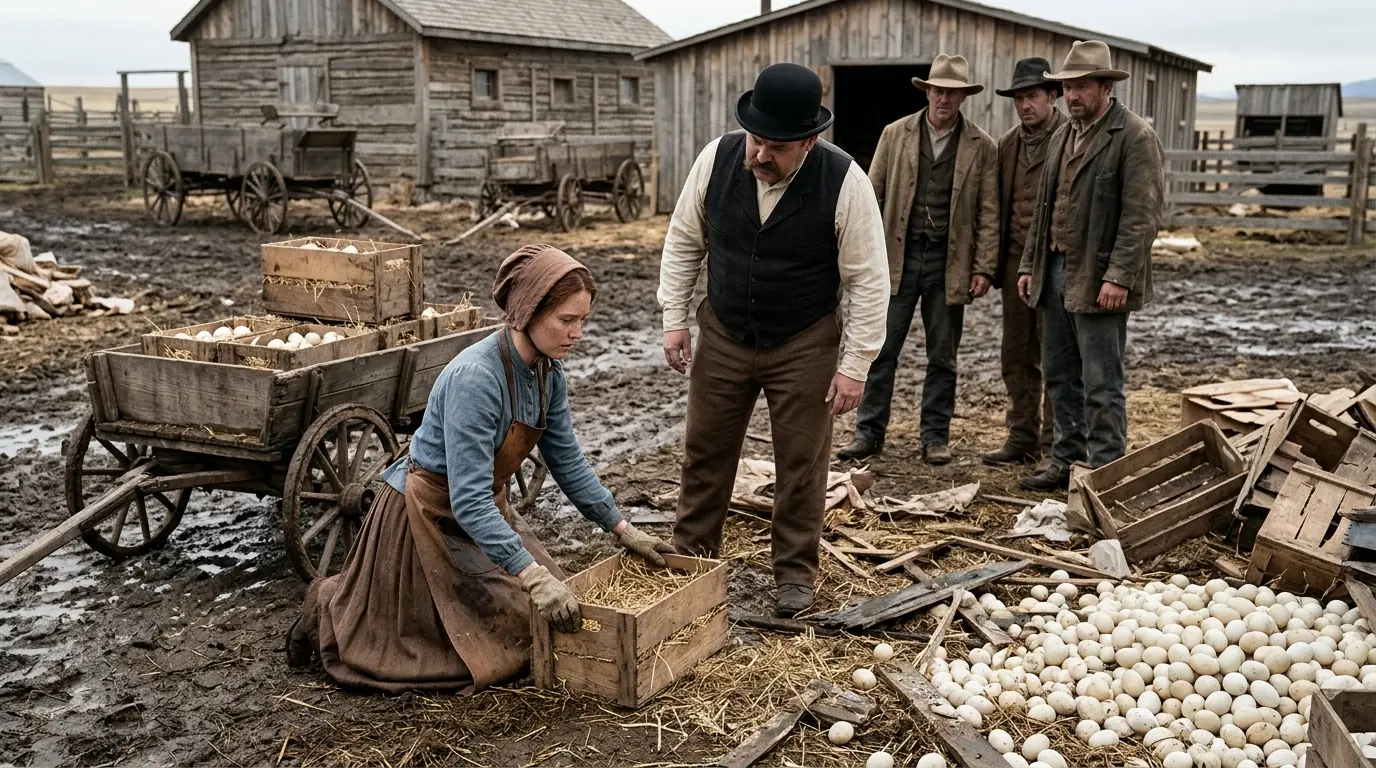
She turned the egg slowly in her hands and found the flaw. It was not shattered. It was not leaking. A thin crack ran along one side in a line no wider than a thread, the sort of damage a careless hand or a rough jolt might make while the living thing inside still had a chance. Clara brought the egg near her ear and stood very still.
Behind her, Harold Briggs laughed.
“Look at that,” he said, loud enough for the men gathered by the fence to hear him over the geese calling somewhere beyond the buildings. “She means to inspect garbage as though it were silverware.”
The three neighboring farmers standing beside him joined in. They had come for feed prices and gossip, and now found themselves rewarded with both. One of them, a red-faced wheat grower named Amos Diller, slapped his thigh and leaned against a broken wagon tongue with the comfortable satisfaction of a man certain somebody else was making a fool of herself.
Clara did not look up. She had long ago learned that some forms of dignity were easiest to keep if one did not pause to defend them.
It was not the sort of place respectable townspeople ever saw unless business required it. The front of Harold Briggs’s enterprise presented a different face: tidy wagons arriving, clerks in the office, customers discussing feed, hatch rates, and orders under the impression that commerce possessed cleaner hands than farming. The back lot corrected that illusion. Here lay the waste every efficient operation produced and preferred not to discuss. Broken shells glistened in clumps. Straw soured quickly when soaked. Flies found damp corners before noon. The labor of sorting life from loss happened out of public view, and the losses themselves accumulated where no one’s pride had to account for them.
Clara did not mind ugly places. Farms made honest use of them. Manure piles fertilized fields. rendering sheds smelled of necessity. A place could be rough and still honorable if what happened there acknowledged its own cost. What unsettled her about Harold’s refuse yard was not ugliness but carelessness dressed as superiority. It seemed to say that because something had been judged expendable, it no longer deserved decency in the handling.
She saw that same principle too often applied to people.
In town, the men most certain of their own practical intelligence were often the quickest to laugh at small failures in others. A crop lost through weather became proof that a farmer had misjudged timing. A widow struggling with accounts became an example of why women ought not manage land. A hired hand dismissed for drunkenness remained in conversation longer as a joke than as a cautionary sorrow. Once categories of worth hardened, mercy had a difficult time entering.