Under the blazing afternoon sun at a crowded farm-equipment auction outside McPherson, Kansas, forty-three-year-old Daniel Carter stood beside two neglected John Deere tractors moments after placing a five-hundred-dollar bid. Their green paint had faded beneath rust, both rear tires were cracked, and weeds were tangled around one tractor’s drawbar as though the machines had been dragged straight from an abandoned field.
Several men nearby laughed harder.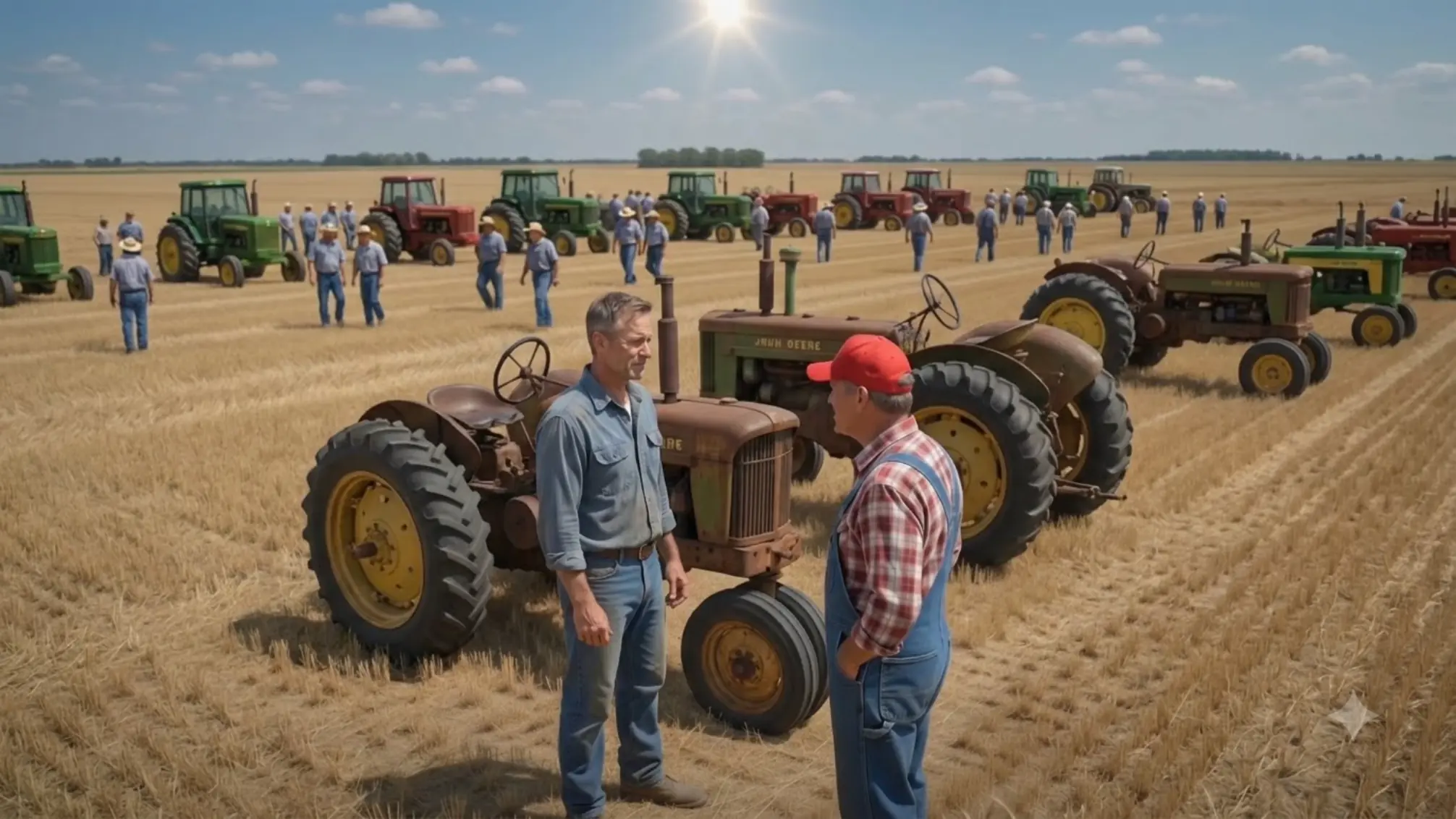
Daniel did not.
He crouched beside the first tractor and brushed another layer of dirt from a narrow metal plate hidden behind the left side of the engine housing. Most buyers had examined the tires, the rusted exhaust stacks, and the missing battery boxes. None had spent more than a few seconds near the identification plates.
Daniel had spent twenty minutes there before the bidding began.
The auctioneer called for another bid.
Nobody answered.
“Five hundred dollars for the pair,” the auctioneer shouted. “Going once. Going twice. Sold to bidder number forty-seven.”
Daniel lifted his card.
The red-cap farmer shook his head with theatrical disappointment. His name was Vernon Pike, and almost everyone in three surrounding counties knew him. He owned nearly two thousand acres, traded machinery frequently, and treated every auction as both a marketplace and a public stage.
“If you need help hauling them to the scrapyard,” Vernon called, “I’ll lend you a chain.”
Daniel slid the bidding card into his shirt pocket.
“You’ll need that chain for your jaw when you find out what you walked past.”
The laughter faded slightly.
Vernon stepped forward. “You really think you found treasure?”
“I think you were too busy performing to inspect what was in front of you.”
For a moment, the men stood nearly chest to chest.
Daniel remained calm, but his jaw was tight. Vernon looked as though he wanted the argument to become physical, especially with dozens of farmers watching.
Then an auction worker called Daniel toward the payment trailer.
He turned away without another word.
That angered Vernon more than any insult could have.
The two tractors had come from the estate of Harold Weller, an eighty-eight-year-old farmer who died the previous winter. His surviving relatives lived in other states and wanted the property cleared quickly. They hired an auction company to sell everything: trucks, livestock panels, grain equipment, tools, and several machines that had not moved in decades.
Most items attracted strong competition.
The two old John Deeres did not.
They sat at the edge of the harvested wheat field, apart from the polished combines and newer tractors. One had no visible seat cushion. The other had a damaged steering wheel and a hood darkened by years of oil, dust, and bird droppings.
The auction listing described them simply:
Two non-running vintage John Deere tractors. Condition unknown. Sold as-is.
To most buyers, that meant scrap.
Daniel saw several details that did not belong on ordinary abandoned machines.
The first tractor’s rear axle housing carried an unusual casting code. Its throttle linkage had been handmade but professionally finished. The hood showed faint marks where a different emblem had once been mounted, and the serial plate began with a number far lower than Daniel expected for the visible body style.
The second tractor carried the next number.
Consecutive serial numbers.
That alone did not guarantee great value, but it made the pair unusual. What interested Daniel more was a tiny stamped letter after each number.
He had seen that letter only once before.
Twenty-two years earlier, Daniel’s grandfather showed him a faded dealership photograph taken shortly before the Second World War. It showed two experimental tractors sent to a Kansas dealer for field demonstrations. John Deere engineers wanted feedback from wheat farmers before making changes to a production model.
The machines in the photograph looked almost identical to the tractors at the auction.
One detail remained in Daniel’s memory: each demonstration unit carried a small stamped letter beside the serial number to separate it from ordinary dealer inventory.
His grandfather claimed the tractors later disappeared.
Daniel never knew whether the story was true.
Now two consecutive machines sat in front of him for five hundred dollars.
After paying, Daniel called his friend Miguel Santos, who operated a towing and equipment-hauling business. Miguel arrived two hours later with a flatbed trailer and looked at the tractors without enthusiasm.
“You bought both?”
“For five hundred.”
“Did they pay you the five hundred?”
Daniel smiled. “You sound like everyone else.”
Miguel walked around the first tractor. “Do either of them roll?”
“Probably not.”
“Do they run?”
“Not today.”
“Do you have any evidence they ever ran?”
Daniel pointed toward the serial plate.
Miguel leaned closer.
“That number means something?”
“I believe it does.”
“You believe?”
“Yes.”
Miguel straightened. “That word becomes expensive around old machinery.”
They spent nearly three hours freeing the locked brakes, inflating tires that barely held air, and winching both tractors onto the trailer. Vernon remained at the auction long enough to watch.
As Miguel secured the final chain, Vernon approached again.
“I’ll give you six hundred for the pair,” he said.
Daniel looked at him. “You called them scrap.”
“I might use the wheels for yard decorations.”
“You don’t decorate.”
“Seven hundred.”
“No.”
Vernon’s smile disappeared. “You think those serial numbers make them rare.”
Daniel did not respond.
That silence gave Vernon confirmation.
He stepped closer to the trailer and attempted to examine the first plate. Daniel moved between him and the tractor.
“You had your chance before the sale.”
“It was a public auction.”
“And now it’s private property.”
Vernon looked past him. “If you found something valuable, the estate could challenge the sale.”
“The auction company listed the tractors. Every bidder had equal opportunity.”
“You knew something they didn’t.”
“I looked.”
Vernon’s face reddened.
Daniel lowered his voice. “That’s what auctions reward.”
Miguel tightened the last chain and climbed into his truck.
Daniel followed.
As they drove out of the field, he looked through the passenger mirror. Vernon stood among rows of expensive equipment, staring at the two machines he had mocked minutes earlier.
Daniel owned a modest four-hundred-acre farm fifteen miles north of McPherson. His father had raised wheat and sorghum there, but years of drought, rising input costs, and medical bills nearly forced the family to sell.
Daniel had spent a decade rebuilding the operation.
He repaired machinery instead of buying new equipment, leased unused ground to a neighboring cattle producer, and performed restoration work during winter to create another income stream. His farm was stable now, though hardly wealthy.
A five-hundred-dollar mistake would not destroy him.
A twenty-thousand-dollar restoration might.
Miguel unloaded the tractors inside Daniel’s old machinery shed before sunset.
Daniel’s wife, Rachel, watched from the doorway with both arms folded. She was forty-one, practical, patient, and accustomed to her husband bringing home machines everyone else considered hopeless.
She studied the pair.
“They’re worse than the last one.”
“The last one had been underwater.”
“These look like they were buried beside it.”
Daniel wiped his hands. “Consecutive serial numbers.”
Rachel raised an eyebrow. “That sentence is supposed to make me feel better?”
“They may be dealership demonstration units.”
“May be?”
“The casting dates match.”
“Do they run?”
“Not yet.”
“How much?”
“Five hundred for both.”
Rachel considered that.
“And the hauling?”
“Friendship rate.”
“How much is friendship?”
“Four hundred.”
“So we own nine hundred dollars of rust.”
Daniel placed an arm around her shoulders.
“We own a mystery.”
“Mysteries are usually more expensive than rust.”
Their sixteen-year-old daughter, Lily, entered the shed carrying her phone. She had inherited Daniel’s curiosity but not his patience.
“Mom says you bought dead tractors.”
“Your mother lacks imagination.”
Rachel pointed toward the machines. “My imagination is working perfectly.”
Lily turned on her phone flashlight and examined the first serial plate.
“What’s the little letter?”
“That’s what we need to prove.”
Daniel retrieved a metal box containing his grandfather’s old photographs and machinery records. For years, those papers had been stored in the farmhouse attic. He found the dealership photograph near the bottom.
The image showed two new John Deere tractors parked outside a brick implement building. Four men stood beside them, including Daniel’s grandfather at seventeen years old.
Across the back, someone had written:
Weller demonstration pair. Spring field trials, 1939. Returned after wheat harvest—or so they said.
Rachel read the note twice.
“Weller?”
“The man whose estate held the auction.”
Daniel placed the photograph beside the tractors.
The details aligned.
One tractor in the picture carried a small dent near the lower grille. The same dent remained beneath layers of rust on Daniel’s first machine. The second photograph showed a nonstandard support bracket under the fuel tank.
It remained on the second tractor.
Lily enlarged the image with her phone.
“These really could be them.”
Daniel nodded. “Could be.”
Rachel looked toward him. “What would that make them worth?”
“Restored and documented? I don’t know.”
“A little?”
“More than nine hundred.”
“That is not a number.”
Daniel smiled. “It’s the safest answer.”
The next morning, he began with the engines.
Both were stuck.
He removed the spark plugs and found heavy oil inside the cylinders. At first, he assumed rainwater had entered through the exhaust. Then he noticed that both stacks had been capped beneath the rusted covers.
Someone had protected the engines before storage.
The oil was intentional.
Harold Weller had filled each cylinder to prevent corrosion.
Daniel drained the old fluid, added a penetrating mixture, and allowed it to soak. He removed the valve covers, inspected the rocker assemblies, and found no catastrophic damage.
The magnetos were missing, but wiring tags remained attached near the mounting points.
On each tag, Harold had written a date.
Removed for indoor storage—October 1968.
Daniel called Rachel into the shed.
“These weren’t abandoned.”
“They look abandoned.”
“They were preserved.”
He opened a cabinet attached to the back wall. Inside, beneath seed catalogs and old glass jars, he found two wrapped packages.
Each contained a magneto.
A third package held carburetor components, brass fittings, and the original emblems removed from the hoods.
Rachel picked up one emblem.
“Why would he keep everything but let the tractors rot?”
“He protected the mechanical parts. The shed roof probably failed later.”
“Or he planned to restore them and got old.”
Daniel looked toward the photograph of Harold Weller as a young man beside the demonstration pair.
“Maybe he was waiting for someone to notice.”
During the following week, Daniel documented every casting number, modification, and handwritten tag. He contacted a historical machinery association and sent photographs to a retired John Deere dealership archivist named Elaine Porter.
Elaine called him the next morning.
“Do not repaint anything,” she said before greeting him.
Daniel held the phone away from his ear.
“I wasn’t planning to.”
“Do not remove the plates.”
“I won’t.”
“Do not let anyone sandblast the castings.”
“I understand.”
She took a breath.
“Where did you find these machines?”
He explained the auction.
Elaine asked him to read both serial numbers.
When he finished, the line went silent.
“Are you still there?” Daniel asked.
“Yes.”
“What do the numbers mean?”
“They do not appear in the standard production registry.”
“That sounds bad.”
“It could be very good.”
Elaine explained that John Deere sometimes assigned temporary numbers to preproduction or field-test machines. Most were returned to the factory, modified, dismantled, or reclassified before sale.
The additional stamped letter on Daniel’s plates suggested the pair belonged to a regional field-evaluation program.
Only incomplete records survived.
“There are references to two wheat-country demonstration tractors sent through a Kansas dealership in 1939,” she said. “The final disposition column is blank.”
“Could Harold Weller have bought them?”
“Possibly. During periods of high demand, demonstration machines sometimes remained with dealers or farmers. But you need documentation.”
Daniel looked at the old photograph.
“I have some.”
Three days later, Elaine arrived with two representatives from the machinery association. They spent six hours examining the tractors.
They measured parts, photographed castings, and compared modifications against engineering notes. One tractor had an experimental air-cleaner position. The other carried a transmission access cover that did not appear on standard production units until a later run.
More importantly, Harold Weller had preserved paperwork.
Daniel discovered it inside a sealed tin beneath a workbench drawer.
There were letters from the McPherson dealership, a handwritten field-test report, and a purchase receipt dated October 1939. The dealer sold both tractors to Harold’s father after the manufacturer decided not to pay the cost of returning them.
The receipt listed both temporary serial numbers.
Elaine read the document slowly.
“This is the proof.”
One association representative turned toward Daniel.
“You bought the pair for five hundred dollars?”
“Yes.”
He laughed in disbelief.
“What?”
“Nothing. I’m thinking about every bidder who walked past them.”
Daniel immediately thought of Vernon.
News traveled quickly through rural Kansas.
By the following weekend, trucks slowed along the road outside Daniel’s farm. People called asking whether the auction tractors were truly rare. Several collectors offered to buy them before restoration.
The first offered ten thousand dollars for both.
The second offered thirty.
Daniel refused.
Then Vernon Pike arrived.
He drove into the yard without calling and stepped out wearing the same red cap from the auction.
Daniel continued cleaning one of the original carburetors at his workbench.
“I hear you verified them,” Vernon said.
Daniel did not look up. “You hear quickly.”
“I know people.”
“So do I.”
Vernon walked around the first tractor.
“What are they worth?”
“Whatever someone will pay.”
“I’ll give you forty thousand for the pair.”
Daniel placed the carburetor tool down.
“You offered seven hundred last week.”
“That was before the documentation.”
“The documentation was visible in the serial plates.”
“Not to everyone.”
“Exactly.”
Vernon’s jaw tightened. “Forty-five.”
“No.”
“Fifty.”
“No.”
“You cannot afford a proper restoration.”
Daniel wiped his hands. “You don’t know what I can afford.”
“I know your acreage. I know your equipment loans.”
“You know old information.”
Vernon stepped closer.
“Don’t become arrogant because you got lucky.”
Daniel stood.
“I crawled through weeds, checked castings, and read plates while you stood ten feet away making jokes. That wasn’t luck.”
“You’re not a collector.”
“Neither are you.”
“I know how to move valuable equipment.”
“You know how to flip it.”
“And make money.”
Daniel pointed toward the driveway. “There’s the road.”
Vernon remained still.
“Sixty thousand.”
“No.”
“You’re making a mistake.”
“Maybe. But it’ll be mine.”
Vernon walked out angrily.
Before leaving, he turned toward the shed.
“You think starting them will make you a legend?”
Daniel smiled faintly.
“I only need them to prove you wrong.”
The restoration took nine months.
Daniel did not make the tractors look new. He preserved original surfaces wherever possible, stabilized the rust, rebuilt the engines, and replaced only what could not be safely reused.
Lily helped catalog every component. Rachel managed correspondence with collectors and museums, ensuring nobody pressured Daniel into a rushed sale.
Both engines eventually turned freely.
The first tractor started on a cold February morning.
Daniel poured fuel into the cleaned tank, checked the oil pressure line, and positioned a fire extinguisher nearby. Rachel and Lily stood several feet away while he pulled the starter.
The engine rotated twice.
Then it fired.
A deep uneven exhaust filled the shed before settling into a steady rhythm. Dust drifted from the rafters, and Lily shouted so loudly that Daniel could barely hear the machine.
Rachel covered her mouth.
Daniel rested one hand on the hood.
The tractor had been silent for more than fifty years.
Now it breathed again.
The second started three weeks later.
Daniel recorded both events but posted nothing publicly. He wanted their first appearance to happen where everyone had dismissed them.
At the annual McPherson spring machinery exhibition, hundreds of farmers gathered across the same auction grounds where Daniel had purchased the pair.
Vernon attended with a restored tractor worth nearly eighty thousand dollars. Its paint was flawless, its chrome polished, and a large sign listed every award it had won.
Then Daniel’s trailer entered the field.
The two old John Deeres rolled down the ramps under their own power.
They still carried faded paint, repaired metal, and visible marks from decades of work. Beside each steering wheel, Daniel mounted a copy of the original field-test paperwork and purchase receipt.
Crowds gathered immediately.
Elaine Porter spoke to the historical association and announced that the tractors were the only verified surviving pair from the Kansas field-evaluation program.
Their consecutive temporary numbers made them especially significant.
A collector approached Daniel after the presentation.
He offered one hundred and twenty thousand dollars for both.
Daniel declined.
Another offered one hundred and fifty.
He declined again.
Vernon stood near the edge of the crowd, no longer laughing.
Daniel eventually walked toward him.
Vernon looked at the tractors.
“They run.”
“I told you they would.”
“You could sell today and clear more money than most farmers make in two years.”
“I could.”
“Then why not?”
Daniel looked toward Lily, who was explaining the unusual intake system to a group of younger visitors.
“Because I don’t know what they’re worth to my family yet.”
Vernon folded his arms.
“You just enjoy proving me wrong.”
“That part is free.”
Vernon nearly smiled, then stopped himself.
“I should have checked the plates.”
“Yes.”
“I should not have called you stupid.”
“No.”
Vernon looked uncomfortable.
Daniel waited.
Finally, the red-cap farmer extended his hand.
“I was wrong.”
Daniel shook it.
“You were loud too.”
“I usually am.”
“I noticed.”
Several months later, Daniel reached an agreement with the Kansas Agricultural Heritage Museum. He sold one tractor for eighty-five thousand dollars under the condition that it remain publicly displayed with Harold Weller’s documents and family history.
He kept the second tractor.
Part of the sale paid off Daniel’s remaining machinery debt. Another portion funded Lily’s future agricultural engineering education. Daniel used the rest to repair the old machinery shed and preserve the family records that helped identify the tractors.
He did not buy a new truck.
He did not purchase more land.
He continued farming exactly as before.
The tractor he kept joined local parades, school demonstrations, and historical exhibitions. Daniel allowed children to sit on the seat and showed them the small serial plate hidden beside the engine.
He always asked the same question.
“What do you see?”
Most answered rust, numbers, or an old tractor.
Daniel would nod and say, “Look longer.”
Years later, the auction story became more famous than the tractors themselves. People told it as though Daniel possessed secret knowledge no one else could have found.
He corrected them.
“The plate was visible,” he said. “The casting numbers were visible. The old photograph came from a family that preserved its history. Nothing was hidden except by people’s assumptions.”
Vernon eventually purchased an old tractor of his own.
Before bidding, he spent nearly an hour examining it.
Daniel happened to be at the auction and watched from several rows away.
Vernon noticed him.
“Not laughing today?” Daniel called.
Vernon removed his red cap and wiped his forehead.
“Checking the damn plate.”
Daniel smiled.
“Now you’re learning.”
The two John Deere tractors had never been worthless.
They had merely become old, dirty, silent, and inconvenient.
Everyone at the auction judged them by what they looked like after decades of neglect. Daniel judged them by the clues they still carried.
He spent five hundred dollars because he was willing to kneel in the dirt while other men stood laughing.
One tractor eventually entered a museum.
The other remained on his farm, starting every spring beneath the Kansas sun.
And whenever its engine came alive, Daniel remembered Vernon’s warning that the machines would bury him.
Instead, they lifted his family out of debt, preserved a forgotten piece of farming history, and taught an entire auction crowd that rust could hide value—but arrogance could hide it even better.