In April 2017, a farm-equipment auction was held outside the small town of McPherson, Kansas.
The auction had been scheduled after a farmer named Robert Langley decided to retire following nearly forty-five years of farming.
Robert had spent most of his life working the same land his father once farmed.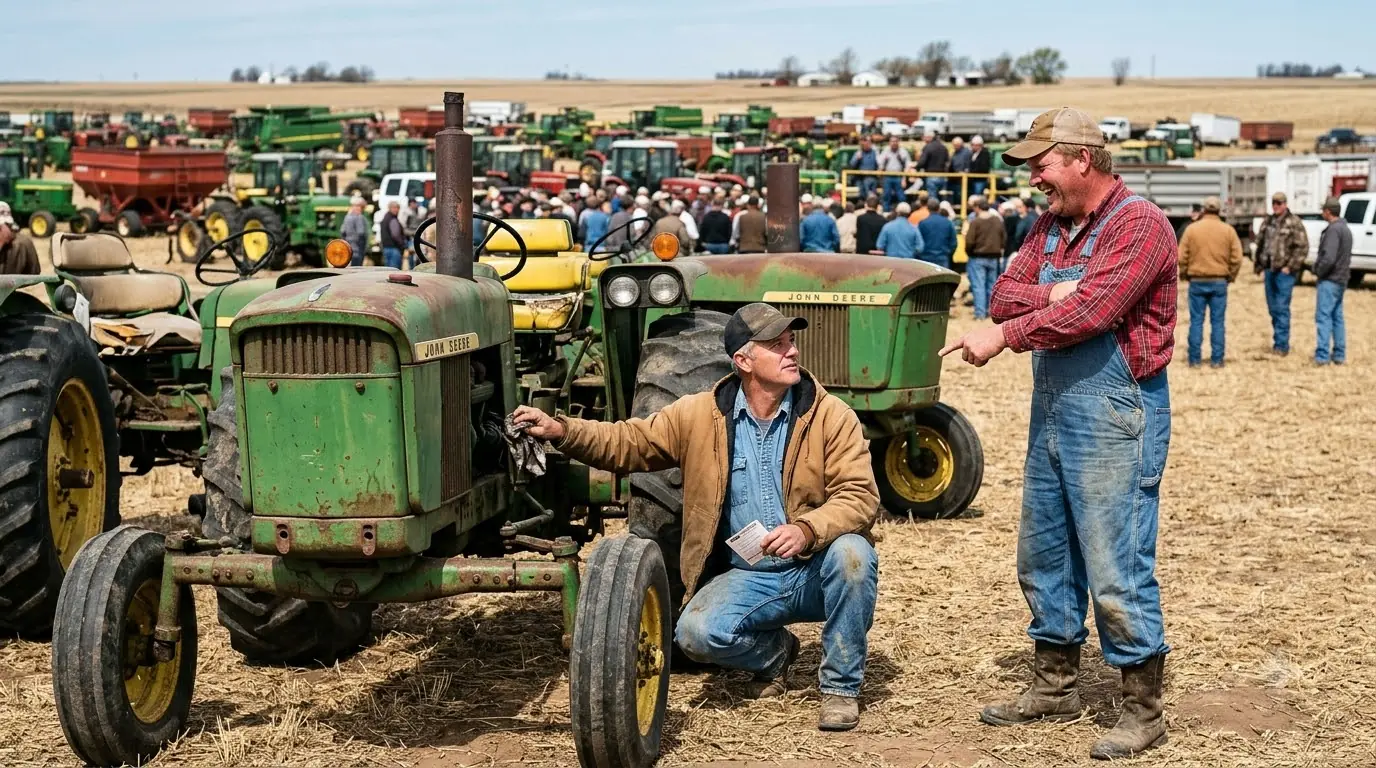
Over the decades, he had collected a large lineup of equipment. There were tractors, implements, grain wagons, and older machines that had been used season after season across nearly 1,700 acres of Kansas farmland.
When Robert finally decided it was time to step away, the entire collection was listed for auction.
By early morning, the dirt road leading to the farm was already filled with pickup trucks and trailers.
Farmers from three different counties had come to examine the equipment. The machines were parked in long rows across a harvested wheat field.
Near the front of the line stood the tractors most people had come to see. There was a John Deere 7810, a John Deere 8300, and a newer combine. Those machines drew the largest crowds.
Farmers walked around them slowly, checking the tires, looking for oil leaks, and studying the hour meters inside the cabs. Some quietly discussed prices with their neighbors, while others wrote notes inside small notebooks. Everyone knew those machines would sell for strong prices.
At the very end of the auction row, far away from the crowd, sat two tractors almost nobody bothered to inspect. They were both old John Deere machines. Their green paint had faded badly, and large patches of rust covered the metal hoods.
One tractor had a cracked seat and broken lights. The other had a dented fender and badly worn rear tires. Dust had settled across the engines as though the machines had been sitting unused for years.
A small paper sign was taped to the steering wheel of one tractor.
TWO JOHN DEERE TRACTORS SELLING TOGETHER.
Most farmers walking through the lineup barely slowed when they reached them. Machines that old could hide expensive problems. A bad transmission, weak engine, or failed hydraulic system could easily cost thousands of dollars to repair.
Many farmers had no interest in taking that kind of risk. They simply continued walking toward the newer tractors.
One man stopped.
His name was Daniel Carter.
Daniel was fifty-three years old and farmed approximately nine hundred acres nearly twenty miles south of McPherson. Unlike many of the farmers attending the auction that day, Daniel had always preferred older machines.
It was not because he believed they were perfect. It was because he understood how to repair them.
For several years before taking over his family’s farm, Daniel had worked inside a small tractor-repair shop. He had rebuilt engines, repaired transmissions, and replaced hydraulic systems. After years of working on farm equipment, he understood that the true value of a machine was not always visible at first glance.
Daniel walked slowly around the two tractors.
He did not say anything, but he studied them carefully. He examined the engine blocks, checked the exhaust pipes, and wiped dust from the side of one hood.
Two farmers standing nearby noticed him inspecting the tractors.
“You thinking about buying those things?” one of them asked with a laugh.
Daniel shrugged slightly.
“Maybe.”
The farmer shook his head.
“You would spend more repairing them than they are worth.”
Daniel did not answer.
He climbed onto the step of the first tractor and leaned inside the cab. The hour meter showed slightly fewer than 5,900 hours. For a tractor that old, the number was surprisingly low.
Daniel climbed down and approached the second tractor.
That machine clearly had problems. The transmission housing showed signs of wear and possible damage, but the engine itself appeared intact.
Daniel crouched beside the front axle and examined the engine block more closely. Something about it caught his attention.
It was a detail nearly every other farmer had ignored.
Daniel did not explain what he had seen.
By late morning, the auctioneer climbed onto a flatbed trailer being used as the bidding platform. A loudspeaker crackled to life.
“All right, folks,” the auctioneer announced. “We are going to get started.”
The bidding began with smaller items.
Old toolboxes sold first, followed by fuel tanks and grain wagons. Then the tractors began moving toward the front one at a time.
The larger John Deere tractors sold quickly. Some brought more than eighty thousand dollars. The combine sold for an even higher amount.
As the afternoon continued, many farmers who had purchased equipment began loading their machines onto trailers. Others started returning to the highway.
Eventually, the auction reached the final machines sitting at the end of the row.
The two old John Deere tractors were driven slowly toward the auction trailer. Both engines started after several seconds of cranking, releasing a cloud of black diesel smoke into the air.
The tractors rattled loudly as they idled beside the remaining crowd.
The auctioneer smiled as he looked down at the bidders.
“Well, folks,” he said into the microphone, “it appears we saved the oldest ones for last.”
Several people laughed.
Someone shouted from the crowd, “Are you selling those for scrap?”
The auctioneer chuckled.
He raised the microphone again.
“Who will start me at two thousand dollars for both tractors?”
The crowd remained silent.
The auctioneer waited.
“Fifteen hundred?”
Still nothing.
A few farmers turned and began walking toward their trucks.
The auctioneer lowered the price again.
“One thousand dollars for both?”
The tractors continued rattling beside him, but nobody raised a hand.
Finally, the auctioneer sighed.
“All right. How about five hundred dollars for both tractors?”
For several seconds, the entire crowd remained quiet.
Then one hand slowly rose near the back.
It belonged to Daniel Carter.
Several people turned toward him.
One farmer laughed loudly.
“Are you serious?”
Daniel nodded calmly.
The auctioneer pointed at him.
“Five hundred dollars. I have five hundred.”
He scanned the crowd.
“Does anyone want to go six hundred?”
Silence.
The auctioneer lifted the microphone again.
“Going once.”
He paused.
“Going twice.”
The hammer struck the podium.
“Sold.”
Just like that, Daniel Carter had purchased two old John Deere tractors for five hundred dollars.
Several nearby farmers shook their heads. One laughed as Daniel walked toward the machines.
“You just bought two piles of scrap.”
Daniel smiled slightly.
There was something about those tractors he had already noticed. It was something almost everyone else at the auction had missed.
Within a few weeks, the two machines would become something nobody at the auction expected.
After the auction ended, the crowd thinned quickly. Farmers who had purchased equipment were already backing trailers into position and loading their machines.
Dust rose from the gravel road as pickup trucks slowly departed from the farm.
The two old John Deere tractors Daniel had purchased remained near the edge of the wheat field.
Daniel approached them quietly.
Several farmers passing by looked at the tractors and shook their heads.
One man stopped beside him.
“You truly paid five hundred dollars for both of these?”
“That is right,” Daniel answered.
The farmer looked at the tractors again.
Rust covered parts of the hoods. The tires were worn. One machine had cracked lights and a torn seat.
“You could probably earn more by selling them for scrap,” the man said.
Daniel smiled.
“Maybe.”
The farmer chuckled and climbed into his truck.
Within a few minutes, the field that had been crowded all morning was nearly empty.
Daniel climbed onto the first tractor and turned the key.
The starter groaned for several seconds.
Then the engine fired to life.
A cloud of dark smoke rose from the exhaust pipe as the old diesel settled into a rough idle. The tractor rattled loudly, just as most older machines did.
Daniel was not listening to the general noise.
He was listening to the engine’s tone.
Farmers who had spent years around diesel engines could often hear small details other people missed. They heard the rhythm of the engine and the way it responded when the throttle moved.
Daniel pushed the throttle forward slightly.
The engine responded immediately.
The turbocharger produced a soft whistle.
The sound confirmed what Daniel had noticed earlier while inspecting the tractors.
The engine was stronger than it looked.
Daniel slowly drove the tractor toward the loading ramps on his trailer.
There was some looseness in the steering, but the engine pulled smoothly as the machine climbed the ramps.
Once the tractor was secured, Daniel walked toward the second machine.
That tractor took longer to start.
The engine eventually fired after several seconds of cranking, but as soon as Daniel attempted to move it forward, he heard something different.
The transmission produced a grinding noise.
Daniel stopped the tractor, shut down the engine, and climbed off.
The situation was now clear.
The first tractor had a strong engine but a badly worn exterior. The second tractor had serious transmission trouble.
For most farmers at the auction, that combination had been enough reason to ignore both machines.
Daniel viewed the situation differently.
To him, the second tractor was not useless.
It was a parts machine.
Between the two tractors, Daniel now possessed nearly everything necessary to create one dependable working machine. The second tractor contained hydraulic components, fuel-system parts, electrical wiring, panels, brackets, and numerous smaller pieces that could still be used.
If the engines matched closely enough, even more parts could be exchanged.
Daniel drove the second tractor slowly onto the trailer.
It moved roughly, but it managed to climb the ramps.
Within an hour, both tractors were secured and ready for the journey home.
The drive to Daniel’s farm took approximately twenty-five minutes.
By the time he pulled into the yard, the sun was already dropping toward the horizon.
Daniel parked the trailer beside a small metal workshop behind the house.
The building was not large, but it contained nearly everything he needed to repair farm equipment.
Tool cabinets lined one wall. An engine hoist hung from the center beam. Bright work lights illuminated the concrete floor.
Daniel unloaded the tractors one at a time and parked both of them inside the shop.
Under the stronger lights, the rust and dust became even more visible.
Daniel was not looking at the paint.
He opened the side panels of the first tractor and exposed the engine.
A large John Deere diesel engine sat beneath the hood.
Daniel wiped a layer of grime from the metal surface and leaned closer.
This was the detail he had noticed at the auction.
The markings on the engine block indicated that the original engine had been replaced years earlier with a heavier-duty industrial version.
That meant the tractor’s engine was likely stronger than the original factory configuration.
Daniel stepped back and smiled slightly.
His plan was now clear.
The first tractor would become the main machine.
The second would provide the components required to rebuild it properly.
New hoses.
Better hydraulic parts.
Electrical components.
Panels and mounts.
Between the two machines, Daniel possessed nearly everything necessary to transform one worn tractor into a reliable working machine.
He switched off the workshop lights and walked toward the house.
Inside, his wife looked up from the kitchen table.
“So?” she asked. “Did you purchase anything at the auction?”
Daniel poured himself a glass of water.
“Two tractors.”
She raised her eyebrows.
“Two?”
“Yes.”
“How much?”
Daniel sat down.
“Five hundred dollars.”
She stared at him.
“For both?”
“That is right.”
She shook her head and laughed quietly.
“I hope they run.”
Daniel leaned back slightly.
“They run.”
What he did not explain was that the two tractors were about to become something very different from the rusty machines people had mocked earlier that afternoon.
For the next several days, the old John Deere tractors remained inside Daniel Carter’s workshop.
From the outside, they still appeared to belong in a scrapyard.
Rust covered sections of metal. Dust had settled deep inside the engine compartments. Oil stains marked portions of the frames.
Daniel had already made his decision.
He was not trying to restore two tractors.
His objective was to construct one reliable machine using the strongest components from both.
On the first morning, Daniel began by removing the hood and side panels from the tractor with the better engine.
Once the panels were removed, the large diesel engine became completely visible beneath the workshop lights.
The block appeared solid.
There were no visible cracks and no major leaks.
That was already a good sign.
Daniel drained the old oil and removed the filters.
Years of dark residue poured from the engine pan. Machines that had remained unused for long periods often carried thick buildup inside their systems.
Replacing the oil and filters was the first step toward properly returning the engine to service.
Daniel then turned his attention to the second tractor.
This was the machine with the damaged transmission.
The transmission housing showed clear signs of wear and grinding. Repairing it could easily cost several thousand dollars.
Daniel had never intended to repair it.
He began removing parts instead.
Hydraulic hoses.
Fuel lines.
Electrical connectors.
Many of those components remained in good condition.
Over the next two days, tools clattered across the workshop floor while Daniel slowly dismantled sections of the second tractor.
Usable parts were cleaned and placed neatly on worktables.
Hoses were flushed.
Old bolts were replaced.
Electrical wiring was inspected carefully.
By the third day, Daniel had collected most of the parts he needed.
The tractor with the stronger engine received the better hydraulic pump from the second machine.
Several worn hoses were removed and replaced.
Daniel installed a cleaner fuel-filter system.
He also replaced the cracked seat and broken lights with parts taken from the second tractor.
None of the work happened quickly.
Daniel had spent years repairing equipment and understood that rushing a job usually created larger problems later.
He worked carefully throughout each day.
Every evening, he shut down the workshop and returned the following morning to continue.
By the end of the week, the tractor had begun to look different.
The rust remained.
The paint was still faded.
Mechanically, however, the machine was becoming far more dependable.
Daniel climbed into the cab and turned the key.
The diesel engine started with a loud rumble.
He pushed the throttle forward slightly.
The turbocharger responded with a soft whistle.
The engine sounded smooth.
It was much smoother than it had been at the auction.
Daniel slowly drove the tractor out of the workshop and into the open yard.
The transmission shifted normally.
The hydraulic system responded correctly.
For the first time since bringing the tractors home, Daniel felt confident enough to test the rebuilt machine under real working conditions.
Behind the barn stood an old grain wagon still loaded with corn from the previous harvest.
Daniel normally used a larger tractor to move it.
This time, he backed the rebuilt John Deere toward the hitch.
The drawbar connected with a loud metallic click.
Daniel returned to the cab and slowly released the clutch.
The wagon began rolling across the gravel yard.
The tractor did not hesitate.
The engine pulled steadily.
Daniel drove toward the dirt road running along the edge of his fields.
As the machine gained speed, the turbocharger whistled more loudly.
For several moments, the tractor sounded much more powerful than its rough appearance suggested.
Daniel drove the loaded wagon nearly half a mile down the road before turning back toward the farm.
By the time he parked beside the barn again, he knew something important.
The tractor was far stronger than anyone at the auction had expected.
Later that afternoon, Daniel’s neighbor, Calvin Reed, pulled into the driveway.
Calvin had heard about the auction earlier in the week.
The moment he stepped from his pickup truck, he noticed the tractor parked near the barn.
“Is that the five-hundred-dollar project you bought?”
“That is the one,” Daniel answered.
Calvin walked slowly around the machine.
“It looks a little better than it did at the auction.”
Daniel climbed into the cab and started the engine.
The diesel roared to life.
He connected the loaded wagon and pulled it across the yard once more.
Calvin watched quietly.
After a moment, he shook his head.
“Well, I will be.”
He looked at Daniel.
“That thing pulls better than it looks.”
Daniel smiled slightly.
“Most machines do once you repair what is wrong with them.”
Over the following days, word about Daniel’s tractor began spreading through the farming community.
People discussed it at the grain elevator, the local café, and the feed store in town.
They talked about the farmer who had purchased two rusty John Deere tractors for five hundred dollars and returned one of them to work within a week.
Daniel Carter was not finished.
Before long, that tractor would appear somewhere everyone could see it.
Over the following weeks, the rebuilt John Deere became part of Daniel’s regular work around the farm.
The first jobs he assigned it were simple.
It pulled wagons, moved equipment around the yard, and hauled seed and fertilizer between fields.
Every time Daniel used the machine, the same thing happened.
It performed better than anyone expected.
The engine pulled harder.
The hydraulic system responded more quickly.
Even under heavier loads, the tractor rarely seemed to struggle.
Daniel noticed its strength most clearly one afternoon while preparing a field for planting.
He connected the tractor to an old twelve-foot disc harrow that had been sitting behind the barn.
Daniel normally used a larger tractor for that job, but this time he wanted to see how the rebuilt machine handled real fieldwork.
The Kansas soil stretched across nearly forty acres of open land behind the farm.
Daniel lowered the disc blades into the ground and pushed the throttle forward.
The tractor moved steadily across the field.
Its diesel engine settled into a deep and powerful rumble.
Dust rolled behind the disc while the blades cut through the dry soil.
Even when the ground became heavier, the tractor did not slow significantly.
By the time Daniel finished the first pass across the field, he understood that the machine possessed far more strength than its appearance suggested.
Several days later, Calvin Reed stopped by again.
He leaned against the fence and watched the tractor working.
“You know,” Calvin said after a moment, “they are holding the tractor pull at the county fair next month.”
Daniel stopped the machine, shut down the engine, and climbed from the cab.
“I heard about it.”
Every summer, the McPherson County Fair held a tractor-pulling competition.
Farmers from across the area brought machines to test their strength against a heavy sled.
Some entries were ordinary farm tractors.
Others had been heavily modified for competition.
Calvin nodded toward the rebuilt John Deere.
“Have you thought about entering that thing?”
Daniel laughed quietly.
“That tractor was not built for competition.”
Calvin shrugged.
“Maybe not, but it certainly pulls harder than it looks.”
Daniel wiped dust from the hood and studied the tractor.
From the outside, it remained rough.
The paint was faded.
Rust covered portions of the metal.
Anyone passing by might assume it was simply another old tractor approaching the end of its useful life.
Daniel knew better.
The industrial engine inside the tractor was stronger than most people realized.
The parts he transferred from the second tractor had also made it more dependable.
Calvin smiled.
“You paid five hundred dollars for both tractors. What is the worst that could happen?”
Daniel chuckled.
“That is a fair point.”
Over the next several days, Daniel continued thinking about the idea.
He did not expect to win anything.
He was curious because the tractor had already surprised him once.
Perhaps it could surprise a few other people.
One week before the county fair, Daniel made several small adjustments.
He replaced the worn rear tires with a better pair that had been stored behind the barn.
He tightened the bolts around the drawbar frame.
Daniel checked the fuel system again to ensure everything was running cleanly.
The work was not complicated.
It was simple preparation.
When the day of the fair arrived, Daniel drove the tractor slowly down the road toward town.
The diesel engine echoed across the open Kansas fields as the machine rolled toward the fairgrounds.
By the time he arrived, dozens of tractors had already gathered near the pulling track.
There were machines with bright paint, large tires, and polished chrome exhaust pipes.
Most looked far more impressive than Daniel’s old John Deere.
Several farmers near the track noticed him arriving.
“That is the man who bought those junk tractors at the auction,” one of them said.
Another farmer smiled.
“I hope that thing reaches the starting line.”
Daniel parked near the edge of the field and climbed down.
He did not respond to the comments.
Instead, he approached the registration table and wrote his name on the entry form.
The official running the event glanced toward the tractor and raised his eyebrows.
“Are you planning to compete with that?”
Daniel nodded calmly.
“Why not?”
The official shrugged and handed him a number tag.
“All right.”
Daniel returned to the cab and waited near the track while the first tractors began making their pulls.
One by one, the machines moved forward.
The heavy sled dragged across the dirt behind them.
Some tractors completed strong runs.
Others stopped halfway down the track.
Daniel watched quietly from the side of the arena.
Eventually, the announcer’s voice echoed through the loudspeakers.
“Next competitor.”
There was a brief pause as he looked down at the list.
“Daniel Carter.”
Daniel started the old tractor and drove slowly toward the starting line.
Many people in the crowd began watching because the machine approaching the track looked like the least impressive tractor of the entire day.
Most expected the run to end quickly.
Daniel Carter knew something they did not.
The pulling track at the McPherson County Fair stretched nearly three hundred feet across a packed dirt lane in the center of the arena.
Wooden fences separated competitors from the spectators on both sides.
Families sat in folding chairs.
Farmers leaned against the rails with their arms crossed.
Children climbed onto fence posts to see the machines more clearly.
The air smelled of diesel fuel, dust, and hot engines.
By the time Daniel drove toward the starting line, several tractors had already completed their attempts.
Some of the newer machines had pulled the sled nearly two hundred feet.
A few stopped much earlier once the sled’s resistance increased.
The announcer’s voice came through the speakers again.
“Next, we have Daniel Carter from south of McPherson.”
Several people recognized the name.
One man near the fence leaned toward his friend.
“That is the person who bought those old tractors at Robert Langley’s auction.”
His friend laughed.
“I remember. He bought both for five hundred dollars.”
They watched as Daniel guided the John Deere into position.
From a distance, the machine still appeared rough.
Its green paint was faded.
Rust spots marked the hood.
The simple design made it obvious that the tractor was decades older than many of the competing machines.
An official stepped forward and attached the heavy sled chain to the tractor’s drawbar.
The sled weighed several tons.
At the beginning of a run, it rolled relatively easily. As the tractor moved forward, a mechanism gradually transferred more weight toward the front of the sled.
The farther the tractor traveled, the greater the resistance became.
The official stepped away and raised his hand.
Daniel sat quietly inside the cab.
He checked the throttle, pressed the clutch, and slowly released it.
The tractor began moving.
At first, the sled followed easily.
The John Deere passed the fifty-foot marker without difficulty.
The engine’s rumble deepened as Daniel advanced the throttle.
Dust rose from the rear tires.
The weight inside the sled began moving forward.
At the one-hundred-foot mark, several tractors earlier in the day had already begun slowing.
Daniel’s machine continued moving steadily.
The turbocharger released a sharp whistle as the engine worked harder.
People in the crowd leaned forward.
Several farmers along the fence exchanged curious looks.
The tractor passed the one-hundred-fifty-foot line.
Resistance increased again.
The rear tires began digging more deeply into the track.
The engine kept pulling.
Daniel reached the two-hundred-foot marker.
At that point, the sled had become extremely heavy.
Several earlier tractors stopped almost immediately after reaching that distance.
Daniel’s machine slowed slightly, but it did not stop.
The diesel engine roared more loudly.
Dark smoke rose from the exhaust pipe.
The tractor moved another twenty feet.
Then another ten.
Finally, the front of the sled crossed the two-hundred-thirty-foot marker before the tractor gradually came to a stop.
The official raised a flag.
The pull was over.
For a moment, the crowd remained quiet.
Many spectators looked toward the scoreboard near the announcer’s stand.
Daniel Carter’s tractor had pulled farther than every machine before it.
The announcer studied the measurement and laughed softly into the microphone.
“Well, folks, that old John Deere just took the lead.”
A wave of surprise passed through the crowd.
Several farmers near the fence shook their heads.
One laughed quietly.
“I suppose that five-hundred-dollar tractor is not scrap after all.”
Daniel slowly turned the tractor around and drove toward the parking area.
He did not celebrate.
He shut down the engine and climbed from the cab.
Calvin Reed approached with a wide grin.
“Well,” Calvin said, “it appears those two tractors became something fairly good.”
Daniel smiled.
“It looks that way.”
The competition was not finished.
Several more tractors were scheduled to pull.
Some were newer and appeared far more powerful than Daniel’s machine.
The final result remained uncertain.
One thing had already changed.
The tractor people had mocked was now the machine every farmer in the crowd was watching.
As the tractor pull continued, spectators remained focused on the scoreboard.
Daniel Carter’s pull measured two hundred thirty feet.
That was now the distance every remaining competitor had to beat.
Several tractors lined up behind the starting area.
Some were much newer.
A few had clearly been modified for pulling competitions.
They had larger tires, stronger engines, and additional weight mounted near the front frames.
The first of those tractors rolled toward the sled.
Its engine roared as the driver released the clutch.
The machine launched down the track with impressive speed.
For several moments, it appeared the tractor might easily pass Daniel’s distance.
The sled’s weight gradually moved forward.
Resistance increased.
The rear tires began digging into the dirt.
The tractor slowed and stopped slightly beyond the two-hundred-foot marker.
The announcer called the distance.
It remained short of Daniel Carter’s pull.
Another tractor moved forward.
This one had bright paint and polished exhaust pipes that reflected the afternoon light.
The crowd watched closely when the machine began its run.
Its engine screamed while the driver pushed the throttle hard.
Dust exploded from the rear tires.
Again, the weight inside the sled moved forward.
The tractor lost speed and stopped at two hundred fifteen feet.
Still not enough.
One by one, the remaining competitors attempted their pulls.
Every tractor fought the heavy sled.
Some came close to Daniel’s mark.
None passed it.
Finally, the announcer looked at the official measurements and lifted the microphone.
“Well, folks, it appears we have our winner.”
The crowd began applauding.
“First place in today’s tractor pull goes to Daniel Carter.”
Many farmers standing near the fence smiled.
Several had attended the auction only a few weeks earlier.
They remembered the moment Daniel raised his hand and purchased the two rusty tractors for five hundred dollars.
At the time, most people believed the machines were no more valuable than scrap.
Now one of those tractors sat quietly beside the track after pulling farther than every other machine in the competition.
Calvin Reed approached Daniel again.
“I think you proved something today.”
Daniel leaned against the tractor and wiped dust from the hood.
“What is that?”
Calvin nodded toward the machine.
“Sometimes the tractors everyone ignores are the ones worth repairing.”
Daniel smiled slightly.
“Sometimes.”
As the fairground slowly emptied that evening, several farmers walked over to inspect the old John Deere more closely.
They examined the engine.
They looked at the tires.
They studied the worn paint.
None of those things fully explained how the machine had pulled the sled farther than tractors that appeared much newer and more powerful.
Daniel did not attempt to explain it.
The real story was never about paint or outward appearance.
It was about recognizing something other people had overlooked.
The first tractor contained a strong industrial engine that almost nobody noticed.
The second tractor supplied the components needed to rebuild it.
Together, the two machines people laughed at became one powerful and dependable tractor.
Later that night, Daniel drove slowly along the quiet country road toward his farm.
The diesel engine echoed across the dark Kansas fields.
For Daniel Carter, the auction purchase had already paid for itself.
For the farmers who witnessed the competition, the story of the two five-hundred-dollar tractors would likely be remembered for years.
Sometimes the machines that look worst at an auction are the ones carrying the greatest potential.