The demolition foreman told Nora Whitcomb she was buying scrap, and his workers laughed as though the argument had already been settled. Six tractors stood inside the damaged Iowa barn, each one rusted, silent, and covered in years of dust. Nora was not expecting a fortune. She was wiping a patch of metal because she wanted to understand what she was buying—and then her cloth caught on something that made her stop.
“Lady, that’s scrap. They pay by the pound.”
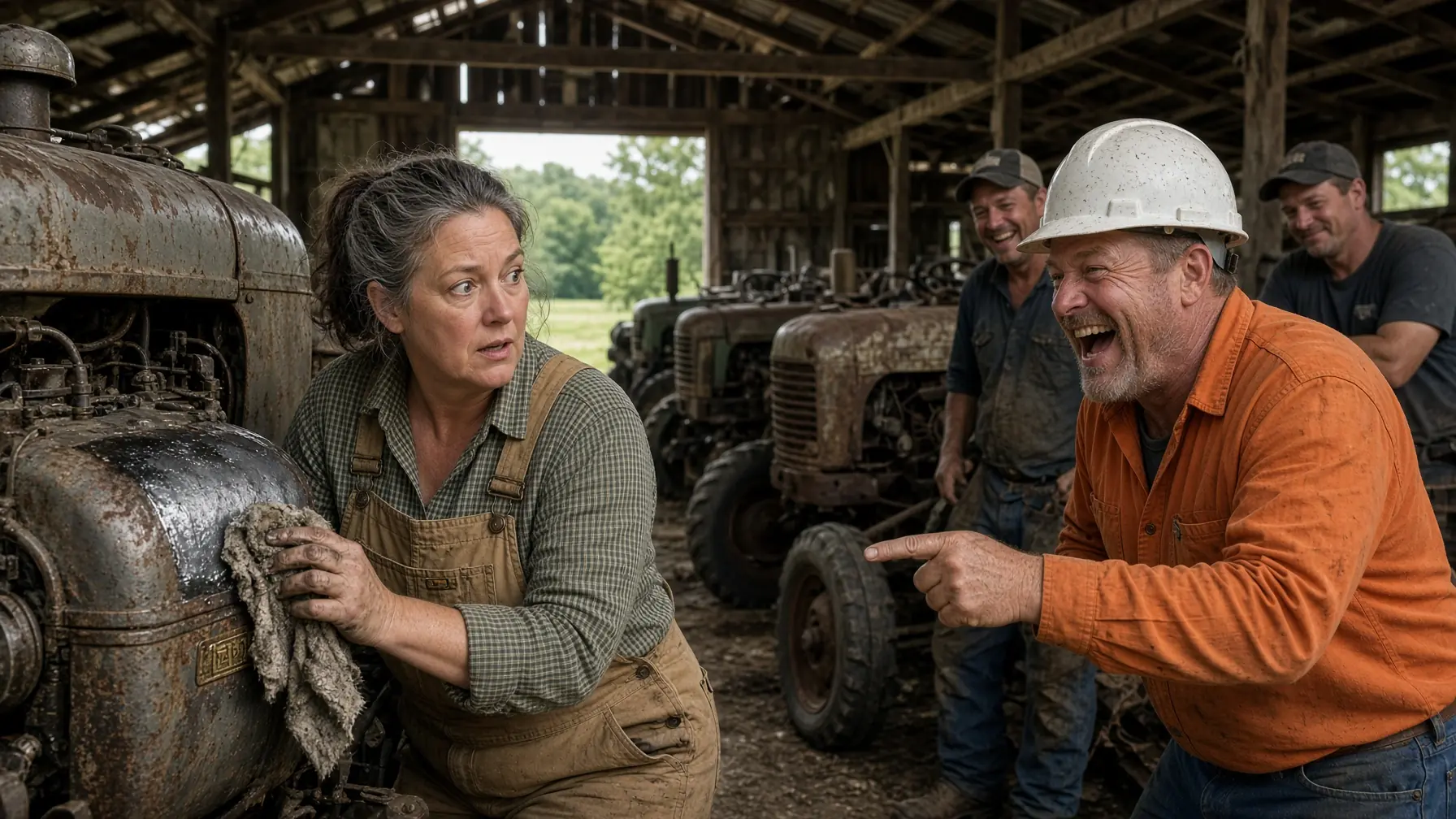
The foreman pointed toward the machines with a gloved hand. He wore an orange work shirt, jeans, and a white hard hat that looked almost too clean for the ruined building around him.
One of the workers laughed.
“Six tractors, and not one worth saving.”
Nora kept wiping.
Her gray-streaked brown hair had loosened from its tie, and dust clung to the faded green checks of her shirt. The knees of her tan canvas overalls were damp from kneeling near the tall gray tractor’s front wheel.
“Then you won’t mind me taking them.”
The foreman looked at his workers.
“Your money. Your mistake.”
Their laughter continued beneath the broken roof beams.
Outside the open doorway, green fields stretched toward a line of leafy trees. Birds moved along the fence, indifferent to the argument taking place inside.
Nora’s cloth caught on a raised edge.
She wiped again.
A narrow strip of brass appeared beneath the grease.
Beside it, low on the casting, she could make out a stamped number ending in four.
She stopped.
Her fingers hovered above it.
The foreman watched her.
“What?”
Nora leaned closer without touching the plate.
The exposed digits were small and uneven. They had not been stamped with the neat, deep impression she expected from a production engine.
She knew better than to turn a low number into a discovery.
Engines had numbers.
Repair shops had numbers.
Parts had numbers.
People who wanted a machine to be special could make nearly any number sound like proof.
Still, the brass plate did not look like the others she had seen.
“What did you find?” the foreman asked.
“Something I want to read.”
“Read it on your property.”
He pointed toward the doorway.
“We start clearing this side next week.”
Nora looked up at the roof.
The barn had suffered through two hard winters and a storm that twisted the rear wall. The demolition crew had marked the stable work area near the entrance, but the deeper section remained roped off.
The tractors stood inside the part they could access.
Getting them out would be difficult.
Leaving them would be simple.
Nora stood, knees protesting.
“Let me see the sale agreement again.”
The foreman sighed.
“You already saw it.”
“I want to see what it says about the machines.”
He took the folded papers from a clipboard and handed them over.
Nora read slowly.
The property belonged to an estate. The representative had authorized the sale of the six tractors and the loose equipment listed with them.
The foreman was arranging removal before the structure came down.
That mattered.
Nora did not want to spend money moving someone else’s property and discover later that the person who took her payment had no right to sell it.
She asked for the estate representative’s number.
The foreman looked annoyed.
“You think I stole a barn?”
“I think paperwork should say what people mean.”
One worker smiled.
This time, it was not entirely at her expense.
Nora stepped outside and made the call.
The representative confirmed the arrangement.
The six machines could be purchased as a group.
No guarantee of condition.
No promise that engines would turn.
No claim that identification was complete.
Nora asked for written confirmation that she could remove all six and the equipment specifically included.
The representative agreed.
When she returned, the foreman was waiting beside the gray tractor.
“You satisfied?”
“With that part.”
“There’s another part?”
“Getting them home.”
He laughed again.
“At least you understand one problem.”
Nora looked at the six machines.
She understood more than one.
The tall gray tractor had narrow front wheels and a long frame. A red machine behind it sat lower, with a bulky rear housing and a seat almost swallowed by weeds growing through a gap in the floor.
A faded blue tractor leaned slightly on a damaged tire.
One had no readable paint color left.
Another wore the remains of green.
The last, nearest the back of the permitted work area, looked so plain that her first thought was to use it for parts.
Six.
She had come intending to inspect one.
A neighboring farmer told her there were old machines in the barn and asked whether any might interest her before the demolition crew cleared them.
She did not come with a museum budget.
She came with a flashlight, work gloves, two clean cloths, and the hope of finding something she could repair without losing the month’s income.
Now she was considering all six.
She asked the price.
The foreman gave it.
Nora did not answer immediately.
It was not a fortune.
It was still money she could not pretend was spare.
The repair business she ran outside town paid the bills when enough customers chose fixing over replacing.
Recently, fewer did.
New equipment came with warranties and financing.