The tractor lurched so hard that Norah Whitam thought for one violent instant that the machine had snapped in half beneath her.
A metal shudder tore through the frame, climbed up through the seat, and punched into her spine. The rear wheels bit, spun once in the wet red clay, and then the old engine gave a choking groan that seemed to come from somewhere deeper than steel. The sound died all at once. The tractor stalled in the middle of the first long furrow, half the field behind her still untouched.
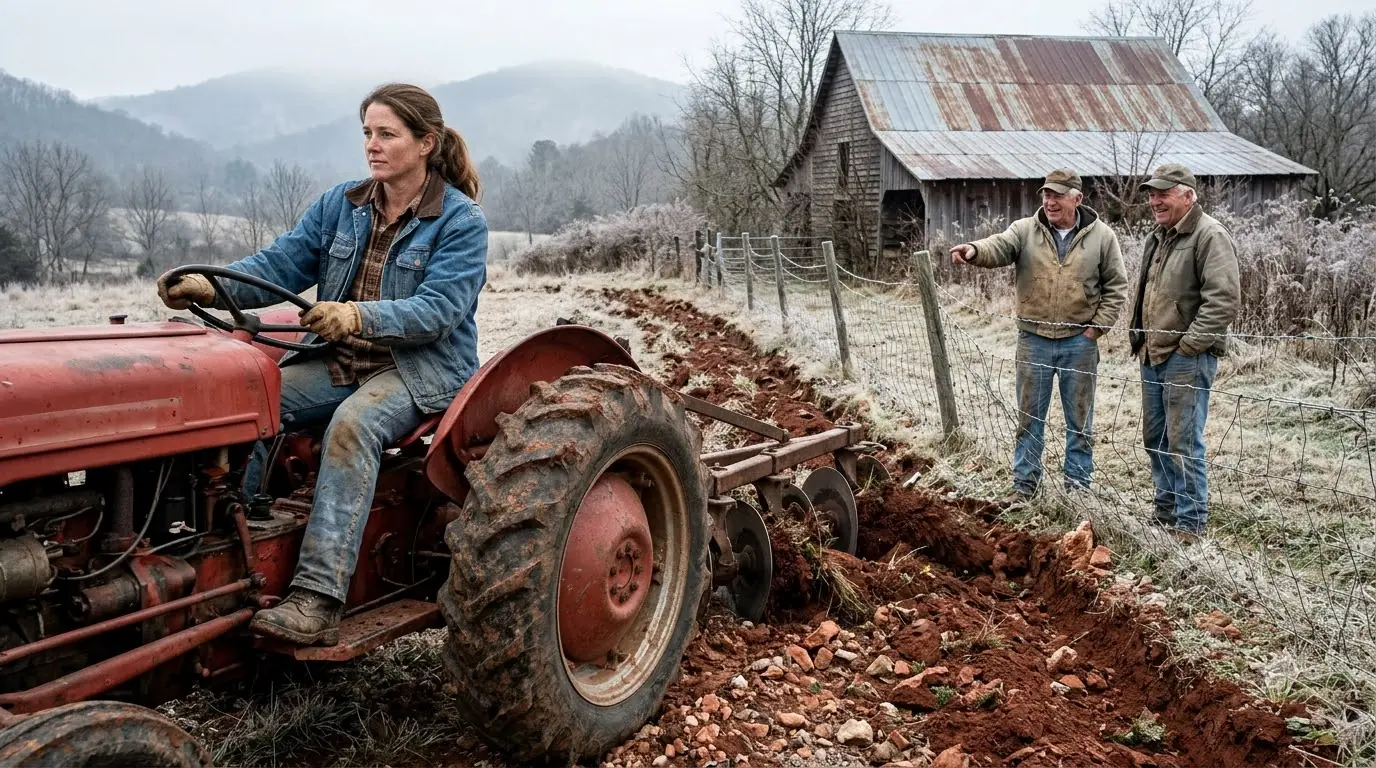
Norah was thrown sideways against the fender, caught herself on the steering wheel, and sat very still while her pulse hammered against the inside of her throat.
Cold autumn air moved across the pasture and through the torn strip of earth behind the plow. Beyond the wire fence, laughter cracked through the morning like dry sticks thrown into a fire.
Dale Hargrove had one hand braced on the top strand of fencing and the other pointed toward her tractor. The older farmer beside him bent at the waist as he laughed, shoulders shaking beneath his canvas jacket.
“That tractor won’t make this dead land worth a dime,” Dale had called a few minutes earlier.
Norah had not bothered to rise to it. She had kept both hands on the wheel and answered only once, eyes on the line she was cutting through the frost-hardened clay.
“It only needs to make one good pass.”
Now Dale’s voice carried across the field again, louder with fresh contempt.
“Looks like it finally found something it can’t move.”
Norah drew one breath, then another. She shut her eyes for half a second and felt the old habit return—the one she had learned after years of listening to supervisors, bank clerks, plant managers, and town gossips explain exactly what she could not do. Breathe first. React second.
She opened her eyes and looked over the hood of the tractor. Red clay clung in wet slabs to the plow assembly. The furrow behind her lay dark and raw against the pale field, a wound torn across eighteen acres everybody in Grayson County had long ago decided were hopeless.
Eighteen acres of rock, clay, wire, frost, and ridicule.
Eighteen acres that now held the first thing in years stubborn enough to stop her father’s tractor.
She twisted in the seat and looked back again. The plow shank was buried deeper than it should have been, its angle wrong, trapped by something below the churned surface. Nothing was visible but disturbed soil and clotted clay. Whatever had caught it remained hidden.
Norah swung one boot down to the tractor step. She climbed carefully to the ground, the cold striking harder after the engine’s heat. The field smelled of iron-rich earth, old grass, and the sharp mineral tang that rose whenever red clay was cut open.
Dale and the other farmer were still laughing by the fence.
Norah turned her head toward them. Her face gave away nothing.
“Come look at this,” she called.
The words surprised them enough that their laughter broke.