“Four hundred and ten dollars for scrap iron,” Roy Dutton announced, holding up the invoice so everyone near the flatbed could see. “Young lady, what exactly do you think you’re going to do with twelve dead augers?”
The farmers laughed as though the question had been asked for their entertainment. One slapped the side of his pickup. Another shook his head and said that a nineteen-year-old with more money than sense was about to receive an expensive education. Nobody stepped forward to help Hannah Brandt explain herself. Nobody knew enough about her to think an explanation might be worth hearing.
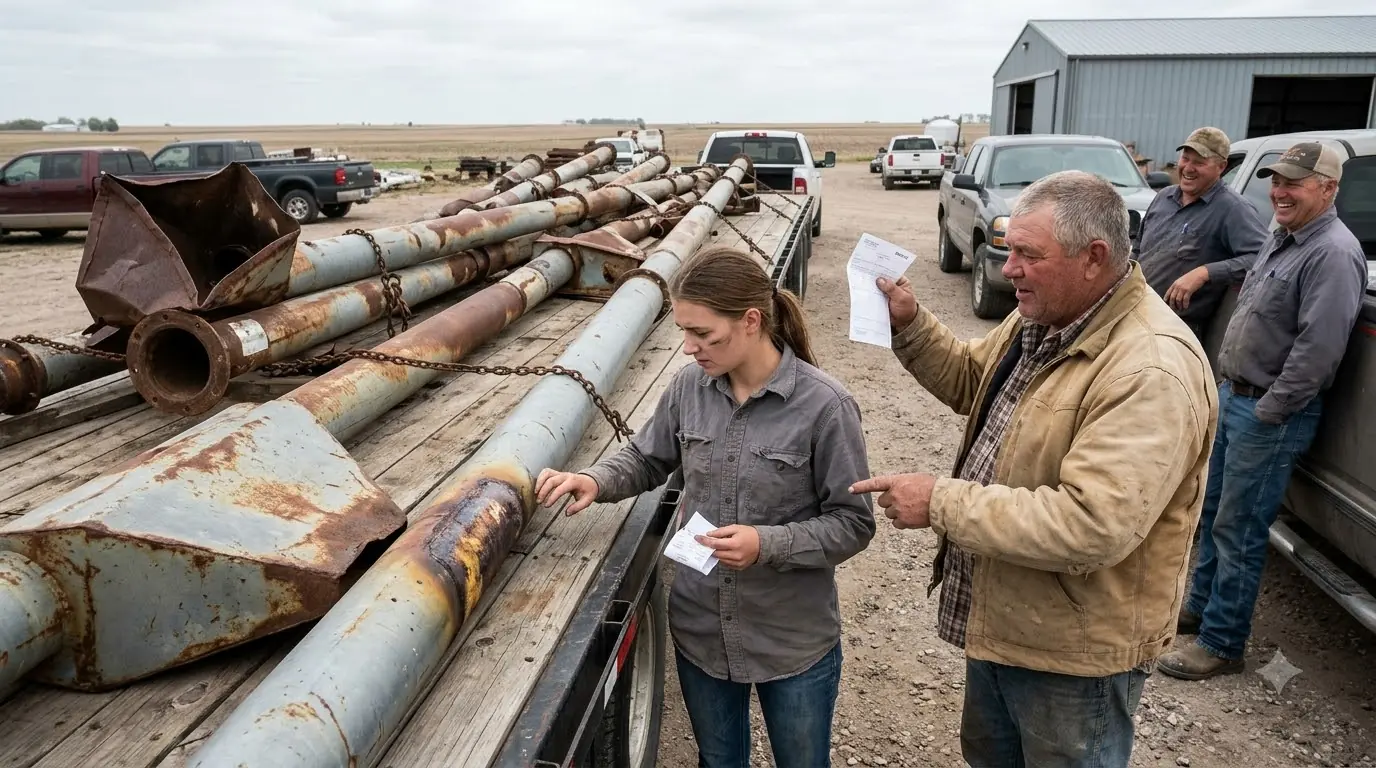
Hannah stood beside the trailer with the purchase receipt folded in her hand. She had worn her oldest jeans, steel-toed boots and a gray work shirt with a faded stain at one cuff. Her brown hair was tied away from her face. A thin stripe of dust already marked her cheek where she had brushed it with the back of her wrist. The auction had taken most of the morning, and the Nebraska wind had left her eyes watering, but she refused to blink away from the men looking at her.
The tubes on the trailer were rusty almost from end to end. Two hoppers had dents deep enough to hold rainwater. One set of flighting was bent as if a giant hand had seized the screw and twisted it into a ribbon. Not one of the twelve came with a working motor. A cautious buyer would have gone home empty-handed, as most of the bidders had done.
Hannah was cautious. That was what everyone failed to notice.
Beneath the rust near the weld seam of three tubes, almost invisible unless somebody knew where to look, were two stamped letters: WB. She had seen those letters hundreds of times on unfinished work in her grandfather’s shop. The sight did not guarantee that any of these machines could be repaired. It did not even mean the markings belonged to the parts she needed. It meant something had passed through Walt Brandt’s hands, and that possibility was worth examining before the metal went to a scrapyard.
“Maybe I’ll find out,” she said to Roy.
The answer brought another round of laughter. Roy Dutton was a heavy man with a weathered face and a voice that could carry from one end of a yard to the other without effort. He had managed the auction for the closing Dunning Farm Supply business, a store that had served the county for fifty-one years. He knew farm equipment well enough to judge a machine’s resale value at a glance and rarely had patience for anybody who wanted to look longer.
“Just don’t come back asking for a refund,” he said.
“I read the terms.”
“Then you understand these are sold as is.”
“I do.”
That answer quieted him for a second. It was not the nervous speech of somebody who had accidentally won an auction. She had already read the paperwork and inspected the lot. The only thing she had not done was tell anyone why she wanted it.