“Forty-six thousand seven hundred dollars? For a dead engine?”
Grant Voss made sure everyone in the auction yard heard him. Three farmers stood beside his pickup, watching the twenty-nine-year-old woman with the compact tool case. Beyond them, the green-and-white CLAAS LEXION 8900 towered over the gravel, its draper header detached and its engine silent for eleven months.
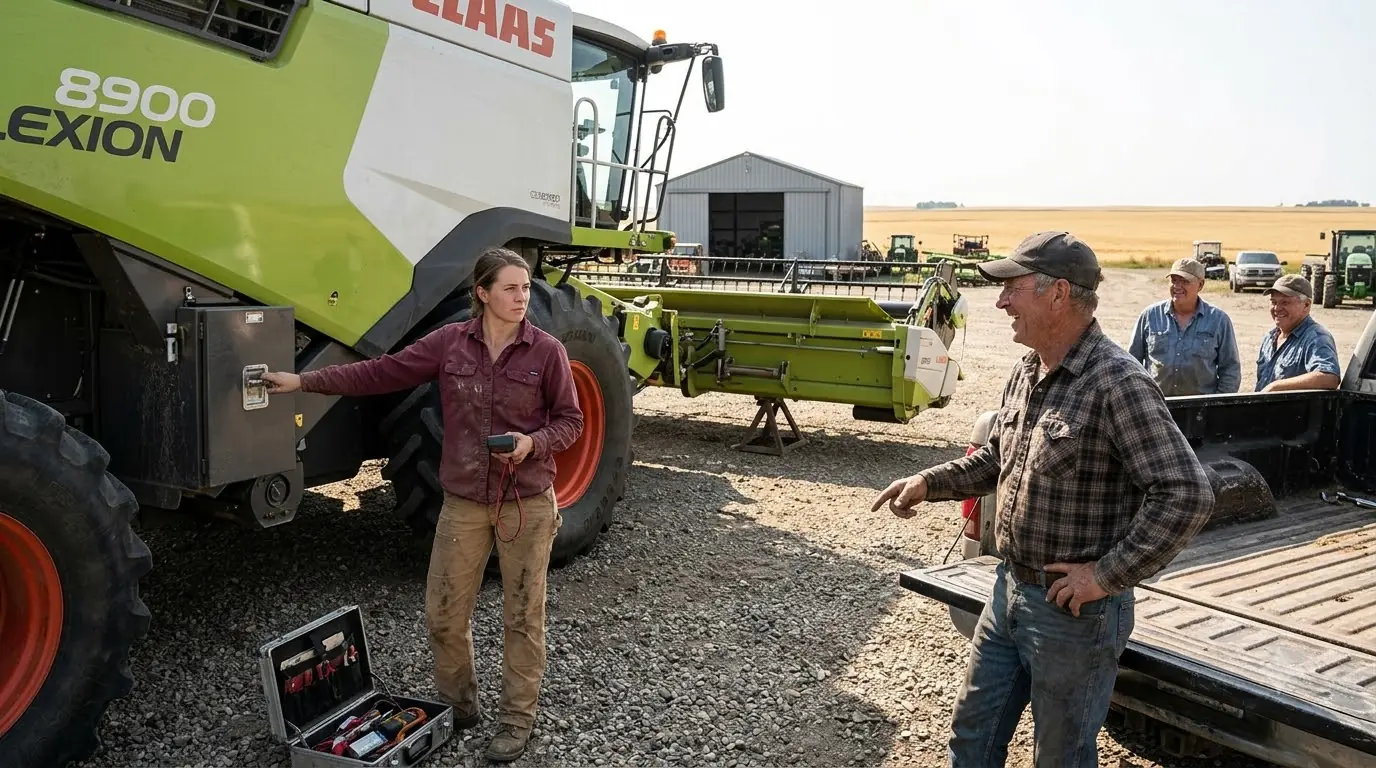
Banning set the case beside the electrical access panel. Her burgundy work shirt was dusty, her tan trousers stained from a morning of inspections. She looked up at Grant, who was smiling as though the machine had already proved him right.
“Give me twelve minutes,” she said.
The men laughed. Banning opened the panel anyway. A few minutes later, after a careful correction and a controlled first attempt that failed, she tried once more. The engine caught with a deep, sudden roar that cut through the auctioneer’s voice. Grant’s smile vanished. Banning, alone in the cab, did not celebrate. She watched the instruments because starting was not the same as surviving a wheat field.
That distinction was about to cost her more than she imagined.
Twelve hours earlier, she had sat in the kitchen of her small rented house outside Haven Crest, North Dakota, staring at the auction listing. The words nonrunning and sold as inspected were printed plainly. Eleven months since the engine had last been confirmed running. No operating warranty. Draper header detached. A buyer with enough money could acquire a very expensive mistake in the time it took an auctioneer to lower his hammer.
Her mother Ruth had texted before sunrise: You can come to supper without bringing another machine problem. Banning smiled, then opened her business ledger. Four years of independent agricultural-equipment assessment had built her a reputation and a modest savings reserve, but not the kind of money that allowed a catastrophic purchase to become a funny anecdote. She had taxes to pay, customers waiting, and an insurance renewal approaching. She wrote her maximum bid on an index card and promised herself that Grant’s opinion would not move the number upward by a dollar.
Her father, now dead, had taught her that the first job of a mechanic was not to be right. It was to make uncertainty smaller without injuring anyone. When she was fourteen, they had restored an abandoned seed cleaner together. She had declared the motor ruined because the equipment tag said so. He asked whether she had ever seen it tested. She had not. The machine eventually worked, but only after they corrected an electrical defect, discovered a failing bearing, and repaired a loose screen frame. On the evening it finally ran, her father listened to the vibrations instead of cheering.
“Starting is a door,” he told her. “Not the destination.”
She heard that sentence again as she approached the auction yard. The listing had attracted attention because the combine was nearly new by farm-equipment standards. Similar operational machines were far beyond what she could responsibly finance. This one was cheap precisely because its owner had not resolved the starting failure and the remaining condition could not be demonstrated. Banning had prepared three budgets: one in which the problem was manageable, one in which hidden defects consumed the bargain, and one in which she sold the machine for parts and spent years rebuilding her reserve.