“You’re wasting good soil on sticks, Clare,” Brad Cole said, leaning over the wire fence with a mocking grin. “This is why nobody takes your farm seriously.”
Clare Moss remained on one knee beside the narrow planting hole, her dirt-stained gloves wrapped around the roots of a young bur oak. Her faded gray cap shaded her hazel eyes, and her blue plaid shirt was already dark with sweat beneath the late-April sun. A tray of seedlings rested beside her, while hundreds more waited in damp bundles stretching along the barren eastern boundary of the family farm.
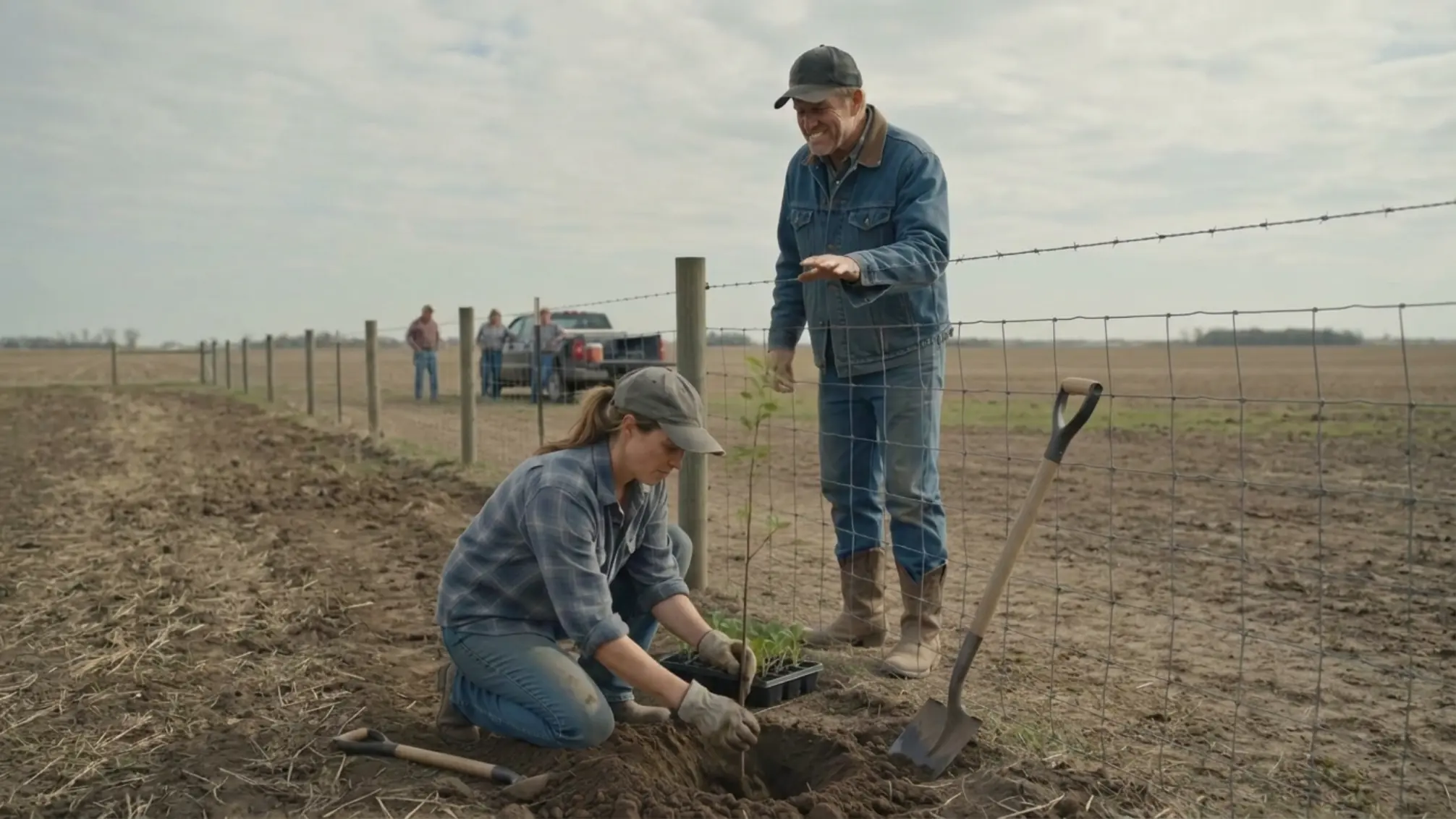
“Keep laughing,” Clare replied as she pressed soil around the roots. “Your fields are dying exactly where mine are about to change.”
Brad pointed toward the empty fence line. Behind him, two neighboring farmers stood beside a dusty pickup, watching with amused expressions. “When these trees fail, don’t come crying after ruining your father’s land.”
Clare looked up at him calmly. “Wait four years. Then watch this fence line bury your record.”
Brad laughed loudly enough for the other men to hear, then returned to his truck. Clare waited until they drove away before reaching for the next sapling. She had planted only thirty-seven trees that morning.
Four hundred sixty-three remained.
The Moss family farm sat outside a small agricultural community in Boone County, Iowa, where cornfields stretched so evenly across the landscape that nearly every tree looked accidental. Clare’s grandfather had purchased the original one hundred sixty acres in 1958, then added another eighty during a strong decade for grain prices. For most of Clare’s childhood, the farm had supported corn, soybeans, and a modest herd of cattle.
Her father, Henry Moss, had managed the operation for thirty-five years. He was patient with machinery, cautious with money, and deeply suspicious of any farming method that required a presentation before it required a tractor. He trusted weather reports less than the ache in his left knee and believed a soil test was useful only when it confirmed what he already suspected.
Clare had grown up beside him.
She drove a grain cart before she was old enough to obtain a license, repaired fence after school, and learned to recognize the difference between healthy and stressed corn by the angle of its leaves. Yet she also noticed problems her father accepted as permanent. The eastern edge of their largest field lost topsoil every spring, dried earlier than the center, and routinely produced twenty to thirty fewer bushels per acre.
The land there had once been protected by a mixed windbreak planted by Clare’s grandfather. Disease, ice storms, and decades of neglect had gradually killed the trees. Henry removed the final dead trunks when Clare was twelve and never replanted them.
Without protection, the eastern boundary became the weakest part of the farm.
Strong winds carried loose soil across the county road. Winter snow blew past instead of settling over the field. During dry summers, the exposed rows curled first, and even in normal years the corn remained shorter near the fence.
Henry treated the loss as unavoidable.
Clare did not.
She left Iowa at eighteen to study environmental agriculture and soil management at Iowa State University. Her interest in agroforestry began during a field visit to a farm where rows of trees protected crops without taking over productive ground. The farmer showed her moisture readings, wind-speed measurements, and yield maps proving that the acres nearest the windbreak had improved after years of decline.
Clare spent the next three years studying how trees affected agricultural systems. She learned that a properly designed windbreak could slow damaging winds, trap snow, reduce evaporation, support beneficial insects, and increase organic matter through roots and fallen leaves. The trees did not replace crops. They protected them.
She returned home after graduation with a notebook full of plans.
Henry was recovering from shoulder surgery that spring and had reluctantly allowed Clare to manage the eastern field. She spread maps across the kitchen table and proposed planting five hundred native trees in three staggered rows along the barren fence line.
The outer row would contain eastern red cedar for year-round wind protection. The middle row would combine hackberry, bur oak, and honey locust, while the interior row would include serviceberry, chokecherry, and native shrubs that could support pollinators and wildlife. Clare planned wide spacing, root barriers near drainage tile, and a grass strip between the trees and corn.
Henry read her budget twice.
“You want to remove six acres from production,” he said.
“I want to protect eighty.”
“You can’t harvest trees with a combine.”
“I’m not growing timber.”
“Then where’s the income?”
“In the corn that stops dying beside them.”
Henry leaned back in his chair. “Trees take decades.”
“Some benefits take decades. Wind reduction starts when they’re small.”
“You sound like your professors.”
“They showed me measurements.”
“I’ve farmed this ground longer than your professors have been studying it.”
Clare knew arguing directly would only harden him. She slid a four-year trial agreement across the table. She would pay for the seedlings through a conservation grant, perform the planting herself, document soil moisture and yield changes, and accept responsibility if the project failed.
Henry examined the page.
“What happens after four years?”
“If the data show no improvement, I remove what you want removed.”
“And if you’re right?”
Clare looked toward the eastern field through the kitchen window. “Then we stop calling that ground hopeless.”
Henry signed.
News traveled through the community before the first sapling arrived. Brad Cole heard about the plan at the co-op and announced that Henry’s college-educated daughter was converting corn ground into a forest. By the time Clare began planting, several neighbors had already formed opinions without seeing the design.
Brad owned the farm directly east of the Moss property. His family had competed with the Mosses for generations in the quiet ways farmers sometimes compete: first tractor, highest yield, cleanest fence lines, earliest planting date. Brad had held the county’s verified corn-yield record for six years and mentioned it whenever conversations allowed.
To him, Clare’s trees were not merely foolish. They challenged the idea that his way was the only serious way to farm.
Clare planted for eleven days.
She dug each hole by hand where the mechanical auger could not reach, checked root depth, installed protective tubes, and spread wood-chip mulch around every trunk. Her shoulders ached, blisters formed beneath her gloves, and the wind repeatedly tore the planting map from her pocket.
Henry watched from a distance during the first week.
On the eighth day, he silently brought the tractor with a water tank and began filling the irrigation buckets Clare had placed along the rows. He still did not say the plan was sensible, but he stayed until sunset.
The first year offered little proof.
Several cedars turned brown after transplanting. Rabbits chewed two dozen serviceberry stems despite the protective tubes, and a July heat wave forced Clare to haul water every third day. By autumn, forty-one trees had died.
Brad counted some of the empty tubes from the road.
“How many failures now?” he called.
“Forty-one.”
“That’s eight percent.”
“I know how percentages work.”
“You going to plant five hundred more every year until one survives?”
Clare lifted a replacement cedar from the truck. “I only need the wind to lose once.”
Brad shook his head and drove away.
Clare replanted every dead tree that fall. She also installed moisture sensors at different distances from the windbreak and marked six permanent soil-sampling sites. One set sat near the trees, another occupied the middle of the field, and a third remained in an exposed control section beyond the protected area.
She recorded rainfall, wind speed, surface temperature, organic matter, erosion loss, and yield. Every measurement went into a thick black binder stored beside the kitchen desk.
Henry called it her tree encyclopedia.
During the second spring, a powerful windstorm crossed Boone County before the young corn had developed enough cover to hold the soil. Dust rose from bare fields in long brown sheets, reducing visibility along rural roads. Brad’s eastern rows lost several inches of loose topsoil from the most exposed ridges.
The Moss field lost soil too, but less than the year before.
Clare placed erosion pins before the storm and measured the difference afterward. The area behind the young windbreak retained nearly one-third more surface soil than the exposed control section. The trees were still short, but the protective tubes, grass strip, and staggered rows had already disrupted the wind near ground level.
She showed Henry the numbers.
He studied the pages without speaking.
“It’s one storm,” he finally said.
“I know.”
“Don’t build a conclusion from one storm.”
“I won’t.”
He tapped the lower erosion figure with one calloused finger. “But keep measuring.”
That summer brought uneven rain. The center of the field received enough moisture to produce a respectable crop, while the eastern rows once again struggled. Yet the plants immediately behind the windbreak remained greener several days longer than the exposed rows farther south.
The difference was modest but visible.
Clare collected soil samples after harvest. Moisture retention had improved slightly, and organic matter near the mulch line had increased. The yield monitor showed an average gain of nine bushels per acre in the first protected strip compared with the previous five-year average.
Brad dismissed the result.
“Nine bushels won’t pay for your forest,” he said at the co-op.
“The trees are two years old.”
“Exactly. You’ve waited two years for nine bushels.”
“I’m measuring a system, not buying a lottery ticket.”
Several men at the counter smiled, but no one laughed as loudly as before.
The third year changed the conversation.
The trees had begun rising above their protective tubes, and the strongest cedars reached nearly eight feet. Native grasses filled the strip beneath them, stabilizing soil that had once blown into the road. Birds nested in the shrubs, and beneficial insects appeared in numbers Clare had never recorded near the open field.
More importantly, the snow stayed.
A heavy winter storm swept across the county in January. On Brad’s ground, snow crossed the exposed rows and piled in ditches. Along the Moss boundary, the windbreak slowed it enough to form a deep, even drift across the eastern field.
When spring arrived, the snow melted gradually into the soil.
Clare measured moisture before planting. The protected section held significantly more water than the control area. She adjusted the corn population slightly higher in the moist strip while keeping fertilizer rates unchanged.
Henry noticed.
“You’re planting thicker near the trees.”
“The soil can support it.”
“Maybe.”
“You want me to lower it?”
He looked at the dark ground beneath the planter. “No. Let it prove you right or wrong.”
The growing season began normally, then turned dry in June. Rain systems repeatedly divided before reaching Boone County, leaving farms with scattered showers instead of steady moisture. Corn leaves rolled by midday, and farmers began calculating crop-insurance claims.
The eastern edge of the Moss farm remained greener.
The windbreak reduced hot airflow across the soil, and the snowmelt reserve had carried moisture deeper into the season. Clare’s sensors showed lower surface temperatures and slower water loss near the trees.
County conservation agent Maria Ellis visited after seeing Clare’s data in an annual grant report. She walked the field, inspected the tree spacing, and compared soil conditions with the exposed control area.
“This is more improvement than I expected in year three,” Maria admitted.
Clare smiled. “That makes two of us.”
Maria asked permission to bring a small group of farmers for a field demonstration. Clare agreed, though she knew Brad would hear about it immediately.
He arrived before the official tour.
Clare found him standing near the fence, staring at corn that reached above his shoulders. Across the road, the eastern edge of his own field was shorter and visibly stressed.
“You changed the seed variety,” he said.
“No.”
“Extra irrigation?”
“There isn’t an irrigation line.”
“More fertilizer?”
“Same rate as the control strip.”
Brad folded his arms. “Then you manipulated the test somehow.”
Clare handed him a printed sheet containing planting records, rainfall totals, soil readings, and fertilizer applications.
“Find it,” she said.
He did not take the paper.
“You’ve been waiting three years to embarrass me.”
“No, Brad. I’ve been waiting three years for you to stop confusing doubt with knowledge.”
His face hardened. “One good strip doesn’t make you a farmer.”
Clare looked beyond him toward the acres his family had worked for generations. “Neither does one county record.”
He walked away without replying.
That autumn, the protected strip produced twenty-seven more bushels per acre than its historical average. It still did not break Brad’s record, but it became the most productive part of the Moss farm for the first time anyone could remember.
Henry stood beside the yield monitor during harvest and watched the numbers rise.
“That edge used to pull the whole average down,” he said.
“I know.”
“Your grandfather hated farming it.”
“I know.”
Henry looked toward the rows of young trees turning red and gold beyond the corn stubble. “He would’ve thought you were crazy.”
Clare laughed. “You thought I was crazy.”
“I said I needed to think.”
“For nearly three years.”
“A man should be thorough.”
The fourth year began with record input costs and warnings of another dry summer. Clare replaced only eleven trees that spring, meaning the survival rate had exceeded ninety-five percent. The cedars had thickened, the deciduous trees had established deep roots, and the three rows now formed a continuous barrier along most of the eastern boundary.
Clare expanded her monitoring system.
She installed additional moisture probes, hired an agronomist to verify sampling methods, and asked Maria Ellis to supervise the field records. If the trees produced another strong result, Clare wanted no one to dismiss it as selective measurement.
Brad heard about the verification and accused her of preparing a publicity stunt.
“You desperate for attention now?” he asked when they met at the seed dealership.
“I’m desperate for accurate numbers.”
“You think a government clipboard makes your crop better?”
“No. It makes your excuses smaller.”
The store went silent.
Brad stepped close enough that Clare could smell coffee on his breath. “When those trees start stealing moisture from your corn, don’t expect me to feel sorry for you.”
Clare did not move. “When my combine reaches that fence, keep your record book nearby.”
Rain stopped in early June.
For seven weeks, the county received less than an inch of measurable precipitation. Daytime temperatures repeatedly climbed above ninety-five degrees, and strong winds pulled moisture from exposed soil. Corn in several fields failed to pollinate properly.
Brad’s crop suffered badly along the western edge facing Clare’s farm. His plants rolled tightly by noon and remained stressed through the evening. The topsoil near the fence hardened and cracked.
The Moss farm also suffered.
Clare never pretended the windbreak could create rain. Plants in the central and western sections lost yield, and some lighter soil produced poorly. Yet the protected eastern acres held moisture longer, remained cooler, and completed pollination with less stress.
The difference widened each week.
By August, people began stopping on the county road to look.
From one side, Brad’s field appeared faded and uneven. Across the fence, Clare’s corn stood taller, darker, and more uniform behind the trees he had called useless sticks.
Brad stopped speaking to her.
Harvest began in October.
Maria Ellis arranged for a certified weigh wagon to measure a designated forty-acre section behind the windbreak. The county extension office verified field boundaries, grain moisture, test weight, and harvested acreage. Clare insisted on strict procedures because she knew any record would be challenged.
A small crowd gathered near the eastern fence on harvest morning.
Henry drove the combine while Clare monitored the yield system from the passenger seat. The first pass produced numbers high enough that she assumed the sensor required recalibration. The second pass climbed higher.
“Don’t celebrate inside the cab,” Henry warned.
“I’m not.”
“You’re breathing like you ran here.”
“Drive straight.”
“I have been driving straight since before you were born.”
Truck after truck carried grain to the certified scale. Maria recorded every weight, adjusted for moisture, and checked the acreage again. The final number would not be calculated until the last load crossed the scale.
Brad stood beside his pickup beyond the fence.
He had not been invited, but no one asked him to leave. His arms remained crossed as the final truck rolled toward the weighing station.
Clare climbed down from the combine with trembling legs. Four years of measurements, dead seedlings, ridicule, and uncertainty had narrowed into several figures on Maria’s clipboard.
Maria completed the calculation twice.
Then she looked up.
“Two hundred fifty-three point four bushels per acre.”
No one spoke immediately.
Brad’s county record had been two hundred forty-one.
Henry removed his cap.
“You sure?” he asked.
Maria handed him the page. “Verified acreage, adjusted moisture, certified scale. The Moss farm has the new Boone County non-irrigated corn-yield record.”
Someone behind Clare cheered. Another farmer clapped Henry on the shoulder, and several people walked toward the trees as though seeing them for the first time.
Clare did not look at Brad immediately.
She looked down the fence line.
The five hundred saplings were no longer fragile sticks surrounded by protective tubes. They had become a living wall of cedar, oak, hackberry, flowering shrubs, and native grass. Fallen leaves covered the soil beneath them, and the ground that once blew across the road remained dark and firm.
Henry stepped beside her.
“You were right,” he said.
Clare turned toward him. Her father rarely surrendered a belief in so few words.
“We were lucky too,” she replied.
“No.” He looked toward the verified field. “Luck is rain. You prepared for the lack of it.”
Brad approached slowly.
The crowd grew quiet when he stopped at the fence where he had mocked Clare four years earlier. His face was tired, and dust covered the boots that had once remained clean while she knelt in the soil.
“You broke it,” he said.
“The record?”
He nodded.
“Looks that way.”
Brad glanced at the trees. “How much did the protected acres beat the rest of your field?”
“Thirty-eight bushels on average.”
“And your moisture readings?”
Clare studied his face. He was no longer searching for a reason to laugh. He was searching for an answer that might help him.
“I have four years of records,” she said.
“Would you show me?”
Several neighbors watched, expecting Clare to remind him of every insult.
She considered it.
Then she opened the binder she had carried from the combine and handed him the first summary page.
“Start with the soil-moisture charts,” she said. “Then look at wind speed and snow retention.”
Brad accepted the binder carefully. “I was wrong.”
“Yes.”
“I treated you badly.”
“Yes.”
His jaw tightened, but he continued. “I thought admitting you might know something meant admitting I didn’t.”
Clare looked across the fence separating their fields. “Those aren’t the same thing.”
“No,” he said. “I suppose they aren’t.”
The following winter, Clare presented her findings at a county conservation meeting. She showed four years of soil tests, moisture measurements, erosion rates, input costs, and verified yields. She explained that the record harvest had come from an unusually strong combination of genetics, soil conditions, management, and protection from wind.
She did not promise every windbreak would break a record.
She promised that well-designed trees could make vulnerable farmland more resilient.
Twenty-three farmers requested site evaluations that year.
Brad was the first.
Clare helped him design a native windbreak along his most exposed boundary. He planted six hundred trees, including red cedar, bur oak, hackberry, and serviceberry. When someone at the co-op joked that Brad Cole had become a forest farmer, he did not laugh.
“Call it whatever you want,” he replied. “I’ve seen the numbers.”
The county later developed a cost-sharing program for farms restoring windbreaks and riparian buffers. Clare became an advisor, helping families select species, avoid drainage damage, and document long-term results.
The Moss farm did not break the record every year.
Some years brought too much rain, others brought pests, and several harvests were merely average. But the eastern field never returned to being the weakest ground on the farm.
Topsoil remained in place.
Moisture lasted longer.
Organic matter increased.
And each autumn, leaves fell beneath the trees Clare had planted while neighbors laughed.
Years later, Henry sometimes walked the windbreak alone in the evening. He would inspect trunks, pull weeds from protective cages, and complain when branches grew too close to equipment.
He still refused to call himself an agroforestry farmer.
Clare never corrected him.
She knew that labels mattered less than what people were willing to learn.
The county remembered the record harvest because numbers were easy to repeat. Farmers spoke about two hundred fifty-three bushels per acre, the weigh wagon, and the day Brad Cole asked Clare Moss to see her binder.
But Clare remembered the first tree.
She remembered kneeling beside the fence with Brad laughing above her, the roots of a fragile bur oak resting between her gloved hands. At that moment, she had possessed no record, no proof, and no guarantee that the tree would survive its first summer.
She had only research, patience, and the willingness to begin before anyone believed her.
Five hundred trees did not transform the farm overnight.
They changed it one season at a time, one root at a time, and one careful measurement at a time.
By the fourth harvest, the weakest edge of the Moss farm had become the strongest.
And the people who once laughed from the other side of the fence were now planting trees of their own.