At 6:15 on the morning of May 23, 1978, Mara Ellison carried twenty-three dollars’ worth of fish toward the most important rice field she owned and listened to three grown men laugh at her from the bed of a pickup truck.
She could hear them before she reached the irrigation gate.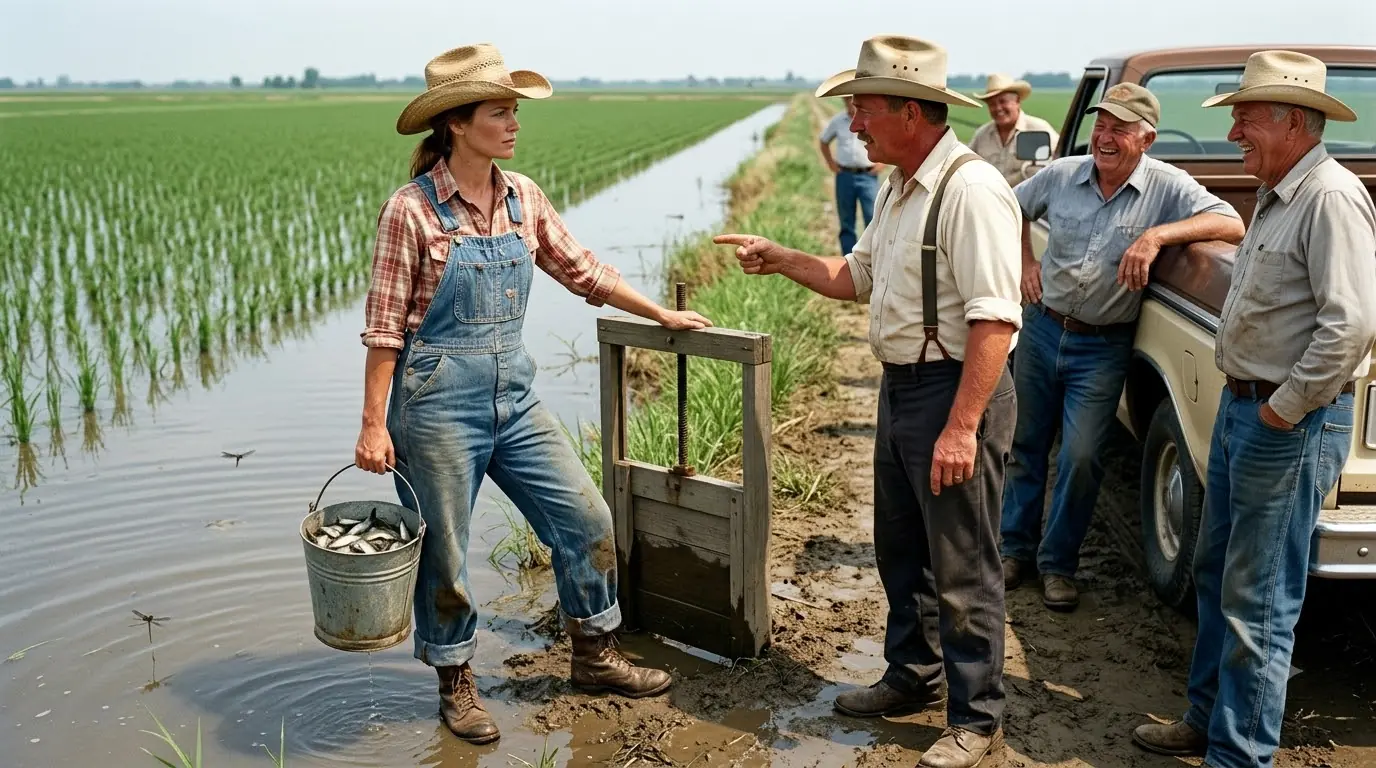
The laughter rolled across the flooded field, over the rows of young rice plants, and through the warm Arkansas air with the effortless confidence of men who had spent their entire lives assuming that if something sounded ridiculous to them, it probably was.
Mara kept walking.
The galvanized bucket in her right hand was heavy enough to pull against her shoulder. Water sloshed over the rim and soaked the leg of her worn denim overalls while dozens of small silver bodies twisted beneath the surface.
Behind her came another bucket.
Then another.
Her younger cousin, Luke Ellison, carried two at once because he was nineteen and still believed carrying more weight than necessary was a useful way to prove adulthood.
“Slow down,” Mara called.
“I’m fine.”
“You’re spilling them.”
“I’m not.”
A small fish flipped over the edge of Luke’s left bucket and landed in the mud.
Mara stopped.
Luke stopped.
They both looked down.
The fish flicked desperately against the wet earth.
Mara raised one eyebrow.
Luke sighed.
“Fine.”
He set the buckets down, picked up the fish, and dropped it back into the water.
“Still alive.”
“For now.”
From the pickup truck, Roy Bledsoe shouted, “That one already trying to escape your brilliant plan?”
More laughter followed.
Mara looked toward him.
Roy stood beside his old Ford with one hand hooked through a suspender strap and the other holding a paper cup of coffee. He was fifty-one, broad, sunburned, and built like a man who had spent thirty years moving sacks, gates, pumps, and machinery without ever considering whether his back might object later.
Beside him stood Calvin Pierce, sixty-three, and Homer Dale, fifty-eight.
All three grew rice.
All three owned more land than Mara.
All three had already told her the fish idea was stupid.
Repeatedly.
Roy pointed toward her buckets.
“Bait goes in the lake, Mara.”
She resumed walking.
“Morning, Roy.”
“Morning?”
He laughed.
“You’re turning a rice field into a fishing pond before breakfast.”
Calvin grinned.
“Maybe she’s planning to catch supper while she irrigates.”
Homer added, “Better put little saddles on them so they can ride the rice plants.”
Luke muttered something.
Mara looked at him.
“What?”
“Nothing.”
“Good.”
She reached the wooden irrigation gate and lowered the bucket.
The field stretched before her in long, shallow sheets of muddy water interrupted by evenly spaced rows of green rice. Morning sunlight reflected off the surface. Small insects hovered above it. Dragonflies moved in quick, sharp lines.
Mosquito larvae were there too.
Mara knew because she had been looking.
That was the part nobody laughing from the truck seemed interested in.
For three weeks, Mara had walked the field twice a day.
Not simply looked across it.
Walked it.
She carried a small white enamel cup tied to a stick.
At random points along the levees and shallow corners, she dipped water.
Then counted.
Wrigglers.
Mosquito larvae.
Some days a few.
Some days dozens in a single scoop.
She wrote the numbers in a notebook.
Roy called the notebook “Mara’s little science project.”
Mara called it information.
There had always been mosquitoes in rice country.
Of course.
Flooded fields were water.
Water attracted life.
But that spring felt different.
More standing water in roadside ditches.
Warm weather arriving early.
Heavy rain followed by sudden heat.
County extension had already warned growers that mosquito pressure could become unusually severe if summer stayed wet.
Most farmers responded the usual way.
Spray.
Treat.
Drain when possible.
Reflood.
Adjust.
Spend.
Mara did not object to chemicals simply because they were chemicals.
Her father had used them.
So had she.
Some worked extremely well when used properly.
But prices had climbed.
Diesel cost more.
Fertilizer cost more.
Pesticides cost more.
Repairs cost more.
Everything on the farm seemed to rise except the amount of money left in Mara’s checking account after bills.
And some treatments had become less reliable.
Not useless.
Less reliable.
The previous summer, Mara had treated one lower paddy twice for mosquitoes.
Within days after the second application, larvae were back in the protected corners near the drainage ditch.
Maybe reinfestation.
Maybe coverage.
Maybe timing.
Whatever the reason, it had bothered her.
She began reading.
Not university journals mostly.
She did not have access to many.
Agricultural bulletins.
Old farm magazines.
Extension pamphlets.
Library books.
One article mentioned rice farmers in other parts of the world using fish in flooded paddies.
Not as decoration.
For insects.
Larvae.
Weeds sometimes.
And as an additional crop.
The idea sounded strange enough that Mara nearly dismissed it herself.
Then she remembered something her father used to say.
A farm problem does not care whether the solution looks respectable.
Her father, George Ellison, had been dead four years.
Heart attack.
Fifty-seven.
Too young.
He had left Mara ninety-four acres, a modest house, one good tractor, one bad tractor, irrigation equipment in varying stages of betrayal, and a farm debt that looked manageable until she tried managing it.
Mara was thirty-two now.
People still referred to the property as “George’s place.”
She had stopped correcting them.
Eventually the land would outlive everybody’s vocabulary.
George had grown rice, soybeans, and occasionally winter wheat.
He believed in proven methods.
But he also believed proof had to begin somewhere.
In 1966, he had planted a soybean variety neighbors said would fail in their soil.
It did well.
In 1970, he tried laser-leveling part of a field through a contractor when several neighbors called the expense foolish.
It reduced water problems.
He was not a reckless innovator.
He simply hated repeating inconvenience because repetition made it familiar.
Mara inherited that.
She also inherited less money than George had possessed when making his experiments.
That changed the stakes.
Her fish cost twenty-three dollars.
The ditch screens another eleven.
The extra labor almost nothing because she and Luke provided it.
If the experiment failed completely, Mara would lose less than one pesticide application across the same acreage.
That was the arithmetic.
Roy did not care.
He walked closer.
“Tell me again.”
Mara looked at him.
“What?”
“What those little things are supposed to do.”
“Eat mosquito larvae.”
Roy nodded solemnly.
“And then?”
“Grow.”
“Then?”
“Maybe eat other insects.”
“Then?”
“Maybe I harvest some.”
Calvin burst out laughing.
Roy pointed at the rice.
“What happens when they eat your plants?”
“They’re not grass carp.”
“What happens when they muddy the water?”
“It’s already mud.”
“What happens when the field drains?”
“I built refuge trenches.”
Roy looked toward the shallow channels Mara and Luke had cut along the lower edges.
He had noticed them.
Of course.
“What happens when birds eat your fish?”
“Some will.”
“What happens when they all die?”
“Then they die.”
Roy blinked.
He expected defensiveness.
Mara continued.
“I lose twenty-three dollars and some labor.”
Roy frowned.
“That’s your answer?”
“Yes.”
“I thought you’d tell me they can’t fail.”
“They can.”
Calvin walked over.
“Then why are you doing it?”
Mara looked at the water.
“Because spraying costs more.”
“That simple?”
“No.”
She pointed toward the flooded rows.
“I’ve been counting larvae.”
Homer laughed.
“Of course you have.”
Mara ignored him.
“Pressure’s building faster in this field than last year.”
Roy sipped coffee.
“So spray.”
“I might.”
He looked confused.
“With fish?”
“If I need to.”
“What’s the point then?”
“To find out whether I need to.”
Roy shook his head.
“You're putting twenty-three dollars of fish in six acres so you can maybe save a treatment.”
“Yes.”
“That is the dumbest thing I have heard this month.”
Mara smiled.
“It’s only the twenty-third.”
Luke laughed.
Roy glared at him.
Then Mara picked up the first bucket.
She stepped down the muddy slope.
Water reached the bottom of her boots.
Rice plants stood around her.
She slowly tipped the bucket.
The first fish slid into the paddy.
Silver shapes flashed.
Some vanished instantly into cloudy water.
Others hovered briefly near her boots before darting toward the rice rows.
Calvin whistled.
“There goes supper.”
Homer said, “There goes common sense.”
Roy raised his voice.
“When those things rot in there, don’t come begging us to fix your field.”
Mara emptied the bucket.
Then turned.
“The joke is watching grown men lose the same fight every summer and brag because they lose it traditionally.”
Roy’s expression changed.
Luke went silent.
Calvin stopped smiling.
Mara did not usually speak like that publicly.
Roy stepped closer to the levee.
“What did you say?”
Mara put down the bucket.
“You heard me.”
“I’ve farmed rice since you were learning to walk.”
“And mosquitoes still know your address.”
Calvin covered a laugh with a cough.
Roy pointed toward her.
“You think a college pamphlet makes you smarter than every farmer in Arkansas?”
“I didn’t say that.”
“You’re acting like it.”
“No.”