“Close the trailer, Emily. You can still stop this.”
Ray Donnelly stood beside the orchard fence with a coffee cup in one hand and a smile that made his warning sound like a joke. Behind him, neighboring growers waited to watch eleven thousand dollars become five hundred separate problems. Emily Carter looked toward her father, hoping for the smallest sign of encouragement, but Mark stood twenty feet away with his arms crossed. At 7:12 on that cold October morning, she opened the latch anyway.
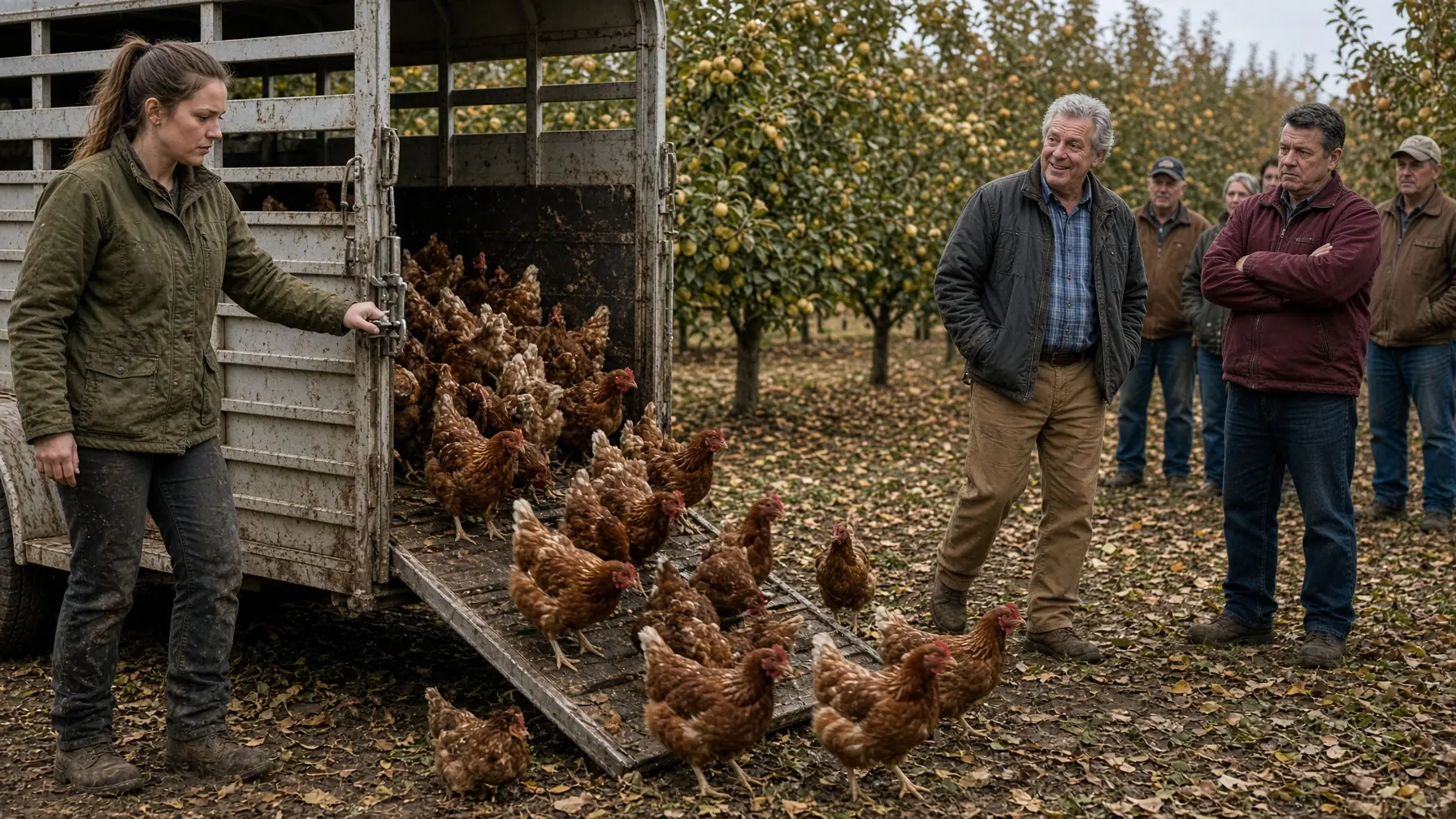
The ramp struck the ground. A brown hen rushed down, stopped abruptly, and was pushed forward by the birds behind her. Within a minute, chickens were pouring beneath the apple trees, their feathers flashing white, red, black, and brown against the wet grass.
Some stayed close to the trailer. Others hurried toward damaged fruit lying beneath the branches, pecking at split skins before Emily had finished securing the door.
Ray laughed.
“You actually did it.”
“Yes.”
“Five hundred chickens.”
Emily looked at him. “You helped me count them.”
“In an apple orchard.”
“That is generally where we’re standing.”
Mark turned away before Ray could see his mouth twitch. Emily caught the movement, and for a moment, it steadied her. Then somebody near the lane shouted that she ought to charge admission, and several men laughed loudly enough to startle the nearest hens.
She had heard versions of the same joke for eight months. At the feed store, at growers meetings, beside the packing shed, and occasionally across her own kitchen table, the idea had become entertainment before it had become a trial.
Ray pointed toward a hen standing on a bruised Gala.
“What is this supposed to prove?”
“That depends on what happens.”
“That sounds reassuring.”
“A trial,” she said. “Not a promise.”
Two hens tore into the damaged apple. Beetles scattered from underneath, and the birds chased them into the grass. Emily watched closely, fighting the temptation to point as though the first useful minute could vindicate the whole expense.
Ray noticed anyway.
“They don’t know which insects you want them eating.”
“I know.”
“They’ll scratch the ground.”
“I know.”
“And manure everywhere.”
“That’s something I have to manage.”
He looked toward Mark. “You’re allowing this?”
“Twelve acres,” her father said.
Ray shook his head, still smiling. Emily closed the trailer’s final latch, wiped her cold hands against her jacket, and picked up the notebook she had left on the fender.
“You asked for numbers,” she said.
“I did.”
“Come back after the season.”
Six weeks later, nobody would be laughing. The rain would still be falling, the apples would still be dropping, and Mark’s tractor would be sitting in mud deep enough to make every familiar solution look suddenly less dependable.
But that first morning, Emily knew none of that.
She knew only that she had opened the trailer in front of people whose respect she wanted, and that five hundred living animals were now depending on whether her planning was good enough.
The Carter family had grown apples for more than fifty years. Emily’s grandfather planted the first twenty acres in 1968, choosing rows and varieties with the confidence of a man who expected his children to work land he might never see reach its full potential.
Mark expanded the orchard to one hundred forty acres. The additions came slowly, through loans, difficult seasons, machinery purchases, and arguments conducted at the kitchen table after Emily was supposed to be asleep.
She grew up recognizing changes in the household by the way her parents spoke about weather. A forecast could make her mother quiet. A late frost could send her father outside before dawn, returning with a face that discouraged questions.
At ten, she could distinguish a Gala from a Fuji before either had fully colored. At fourteen, she could drive a tractor, although Mark continued giving instructions long after she no longer needed most of them.
At sixteen, she announced that she would never become a farmer.
Her father looked up from his supper. “Good.”
Emily stared at him. “Good?”
“Every farmer needs at least one child smart enough to leave.”
Susan told him not to make a joke out of it. Mark shrugged, but Emily remembered that he did not try to persuade her to stay.
That troubled her later.
At the time, she wanted him to argue. An argument would have let her defend the future she imagined for herself. His acceptance suggested that leaving might be what he wanted for her too.
She went to college two years afterward and studied environmental systems. Mark described the degree to neighbors as something involving dirt and spreadsheets, a phrase that reliably made Emily roll her eyes and Susan tell him to learn the proper name.
Emily did not spend college planning a return to the orchard. She liked classrooms where a problem could be examined without a machine breaking halfway through the discussion. She liked knowing when assignments were due and that completing one did not depend on whether it rained.
Then, during her final year, a class on agricultural waste began asking questions she could not leave in the classroom.
One afternoon, the professor wrote a sentence on the board.
When does something become waste?
Emily thought the answer obvious. When nobody wanted it, when there was no buyer, when the thing had stopped being useful.
The professor listened, then asked what the material still contained.
That question stayed with her during the drive home for a weekend visit. She passed harvested fields, livestock buildings, processing facilities, and places where something useful arrived by truck while something unwanted left by another route.
At home, the orchard was finishing a difficult cleanup. Damaged apples remained beneath several rows, and Mark was trying to arrange equipment and labor around ground that would not dry.
Emily stood near a pile of rejected fruit and looked at it differently.