By the last week of March, nearly everyone who traveled County Road 18 had seen Clara Whitlock’s truck.
It was difficult to miss.
The old white Chevrolet had been part of the Whitlock farm longer than some neighboring families had lived in the county.
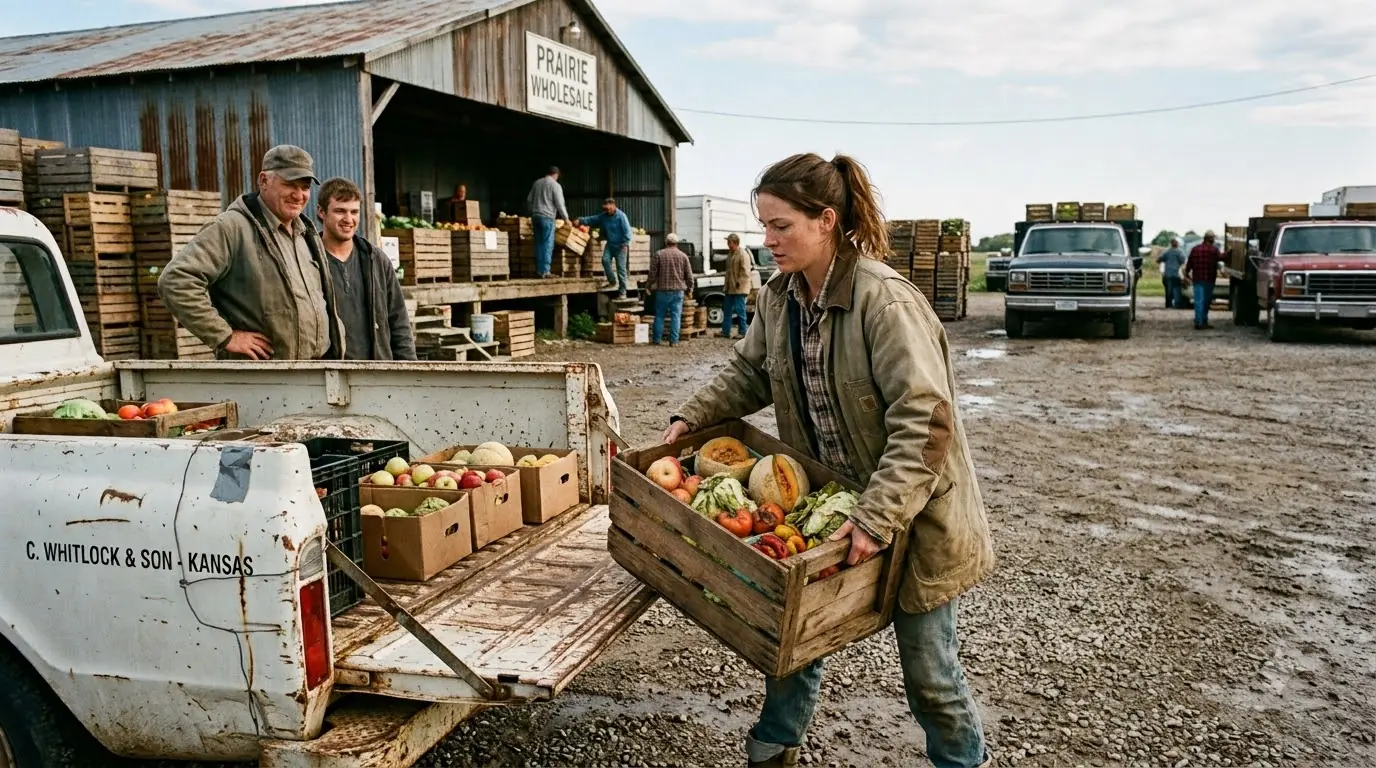
Rust had eaten through the paint above both rear wheels, the passenger-side mirror was held together with black electrical tape, and the tailgate had not latched correctly since Clara was sixteen.
Her father had repaired it with a length of baling wire one harvest afternoon.
“I’ll replace the latch when things slow down,” Daniel Whitlock had promised.
Things never slowed down.
Eight years later, the latch was still broken.
The same twisted piece of wire still held the tailgate closed.
And every morning before sunrise, Clara drove that truck fourteen miles into town, turned behind Walker Produce Market, and came back with the bed stacked higher than the cab with food nobody wanted.
Bruised tomatoes collapsed against split cantaloupes.
Lettuce had browned around the edges.
Cabbage leaves peeled away from damaged heads.
Wrinkled peppers filled the gaps between wooden crates.
Cracked squash rolled against apples that had softened past the point where customers would buy them.
Most of it was not dangerous waste.
It was produce that had become commercially useless.
Too soft.
Too ugly.
Too damaged.
Too old to sit another day beneath fluorescent grocery lights.
Anything contaminated with packaging chemicals, meat, dairy, plastic, or obviously unsuitable material was kept out.
Clara had learned to insist on that distinction.
But from the road, nobody could see distinctions.
They saw garbage.
And Clara was spreading it across eighteen acres of farmland.
Not behind the barn.
Not in a hidden compost pile.
Across the field.
Tomato pulp stained the pale soil red.
Cabbage leaves lifted and fluttered in the prairie wind.
Melon rind shone beneath chopped straw.
On warmer afternoons, a sour fermented smell drifted toward the ditch.
Small flies gathered above wetter patches.
Crows came at dawn.
Sometimes steam rose faintly where damp plant material sat beneath straw in the early morning cold.
It looked ridiculous.
It smelled worse.
Within three weeks, people had given the eastern eighteen acres a name.
The garbage field.
Clara never used it.
Everyone else did.
At the feed store, conversations paused when the Chevrolet rattled into the parking lot with melon juice streaking the tailgate.
At the diner, men who had known Daniel Whitlock for decades shook their heads over coffee.
At the grain elevator, somebody joked that Clara was trying to grow a landfill.
One neighbor suggested she could save time by putting a sign along County Road 18 that said DUMP HERE.
Another said Daniel would roll over in his grave if he saw what his daughter was doing to good Kansas soil.
That comment reached Clara.
She did not answer it.
She simply put another pair of work gloves in the truck and went back to Walker Produce Market the next morning.
What nobody laughing from the road understood was that the eighteen acres were not an experiment Clara had started because she had extra land to waste.
They were the opposite.
That field might be the only thing standing between her and the sale of the farm her family had held for seventy-three years.
Clara Whitlock was twenty-four when Daniel died.
He died in November, after years of heart trouble that everyone knew about and nobody managed to prepare for.
His final decline had been slow enough to create false confidence.
There had always been another appointment.
Another medication change.
Another morning when Daniel insisted he felt better.
Another afternoon when Clara found him sitting on an overturned bucket beside the machine shed pretending he had stopped only to look across the western field.
“You’re breathing hard.”
“I walked uphill.”
“There is no hill.”
“Then I walked aggressively.”
She would glare at him.
Daniel would smile.
That was how they handled fear in the Whitlock family.
Jokes first.
Reality later.
Then one November morning, Daniel did not come into the kitchen.
Clara found him sitting on the side of his bed, one hand pressed against his chest.
By evening, he was in a hospital room in Wichita.
Two days later, he was gone.
For weeks after the funeral, Clara continued seeing pieces of him everywhere.
Not ghosts.
Worse.
Ordinary objects.
His coffee mug remained on a narrow shelf inside the machine shed because she could not bring herself to wash it.
His work gloves stayed folded inside the Ford tractor.
A pair of reading glasses sat beside the farm account books.
His old gray canvas coat still hung behind the kitchen door.
When Clara was little, that coat had smelled like diesel, cold air, dust, leather gloves, and her father.
By January, the smell was beginning to fade.
That frightened her more than she expected.
Some mornings she would press her face briefly against the collar before putting it on.
The sleeves hung over part of her hands.
One elbow had been patched twice.
The zipper caught halfway up.
But on mornings when the kitchen felt too quiet, wearing Daniel’s coat gave Clara something practical to do with grief.
Put on coat.
Tie boots.
Make coffee.
Check weather.
Feed barn cats.
Start truck.
Keep moving.
Daniel left her 119 acres.
He also left almost $86,000 in operating debt.
That number did not include everything.
There was an irrigation pump already making a grinding sound.
Two miles of fence needed different levels of repair.
The Ford tractor had 9,000 hours and a hydraulic leak.
The grain drill was older than Clara.
A roof panel on the north barn lifted whenever the wind came from the southwest.
Medical bills had taken most of the family’s savings.
Two difficult growing seasons had done the rest.
The farm had survived drought before.
What worried Clara was that the soil no longer seemed capable of surviving it the same way.
The eastern eighteen acres had been Daniel’s worst field for years.
When Clara was eight, it had produced wheat nearly as well as the center acreage.
When she was fourteen, Daniel began complaining that the east side dried too quickly.
By eighteen, runoff had become obvious.
Hard summer storms struck the field and sat briefly in shallow brown sheets.
Then water moved toward the lowest ground.
By the time it reached the county ditch, it carried fine soil with it.
Three days later, Clara could walk into the same field and find the surface almost brick-hard.
That contradiction bothered her.
Too wet during rain.
Too dry immediately afterward.
The soil had stopped behaving like a sponge.
It behaved more like a plate.
Water hit it.
Spread.
Ran away.
Then the sun baked whatever remained.
Daniel responded the way many farmers would.
More fertility where soil tests indicated need.
Different tillage timing.
Residue management when possible.
A cover crop trial one year.
Then medical problems worsened and experimentation stopped.
Farming became triage.
Which bill had to be paid?
Which repair could wait?
Which field could carry another season?
Which problem could be postponed?
By the time Daniel died, Clara inherited not a ruined farm, but a farm tired enough that one more bad year could ruin it.
Winter became a season of envelopes.
Clara sat at the kitchen table after dark with piles arranged beneath the yellow overhead light.
BANK.
SEED.
FERTILIZER.
FUEL.
MEDICAL.
EQUIPMENT.
TAX.
INSURANCE.
Every envelope represented something her father had once handled while she assumed the farm simply continued because farms continued.
Now she understood.
Farms continued because somebody worried about them every night.
The bank statement was always last.
Clara developed a habit.
She would open everything else first.
Do the easier fear before the larger one.
In January, she calculated how much operating credit remained.
Then calculated again.
One season.
There was enough room for one more season.
Not two.
If the next crop failed badly, the farm could not continue in its current form.
In February, a developer from Wichita sent a letter.
Clara almost threw it away unopened.
Then she saw the property description.
Twenty-two acres along County Road 18.
The most accessible section of the Whitlock property.
Flat.
Close to utilities.
Easy road frontage.
The developer wanted it for a small residential project.
The offer was not insulting.
That made it more dangerous.
Clara came inside that afternoon after repairing a fence where two posts had rotted below ground.
Mud had dried around her fingernails.
A shallow cut crossed one knuckle.
She laid the developer’s offer on the kitchen table.
Bright white paper.
Heavy stock.
Clean black print.
Purchase price.
Enough to eliminate most of the operating debt.
Enough to repair machinery.
Enough to give Clara breathing room.
All she had to do was remove twenty-two acres from a farm that had survived intact since Clara’s great-grandfather bought the original property in 1951.
She sat there for nearly an hour.
Her dirty thumb rested beside the number.
Sell.
Breathe.
Keep farming the rest.
That was the rational argument.
The emotional argument came immediately after.
Daniel had never sold an acre.
Neither had his father.
Neither had Clara’s great-grandfather.
But Clara knew sentiment could become another form of irresponsibility.
Dead people did not have to make loan payments.
Living farmers did.
She folded the offer along its original crease.
Placed it beneath the bank statements.
Then gave herself one month to find another answer.
The answer did not begin with rotten vegetables.
It began with Daniel’s notebook.
Clara found it in the bottom drawer of an old desk in the farm office.
The drawer was so full it stuck halfway open.
She pulled harder.
Seed receipts spilled onto the floor.
Machinery manuals.
Old cattle vaccination records from the years Daniel still kept livestock.
Weather notes.
Invoices from businesses that no longer existed.
At the bottom lay a brown leather notebook.