Dale Mercer laughed so loudly that two cattle lifted their heads from the pasture beyond the pond. He stood on the dry side of a split-rail fence, his heavy body leaning into the top board, one finger pointed toward the narrow figure straining at the edge of the muddy water. His gray beard jumped with every laugh. Beside him, Otis Reed wore the thin smile of a man who had come to observe somebody else's mistake and intended to get his afternoon's worth.
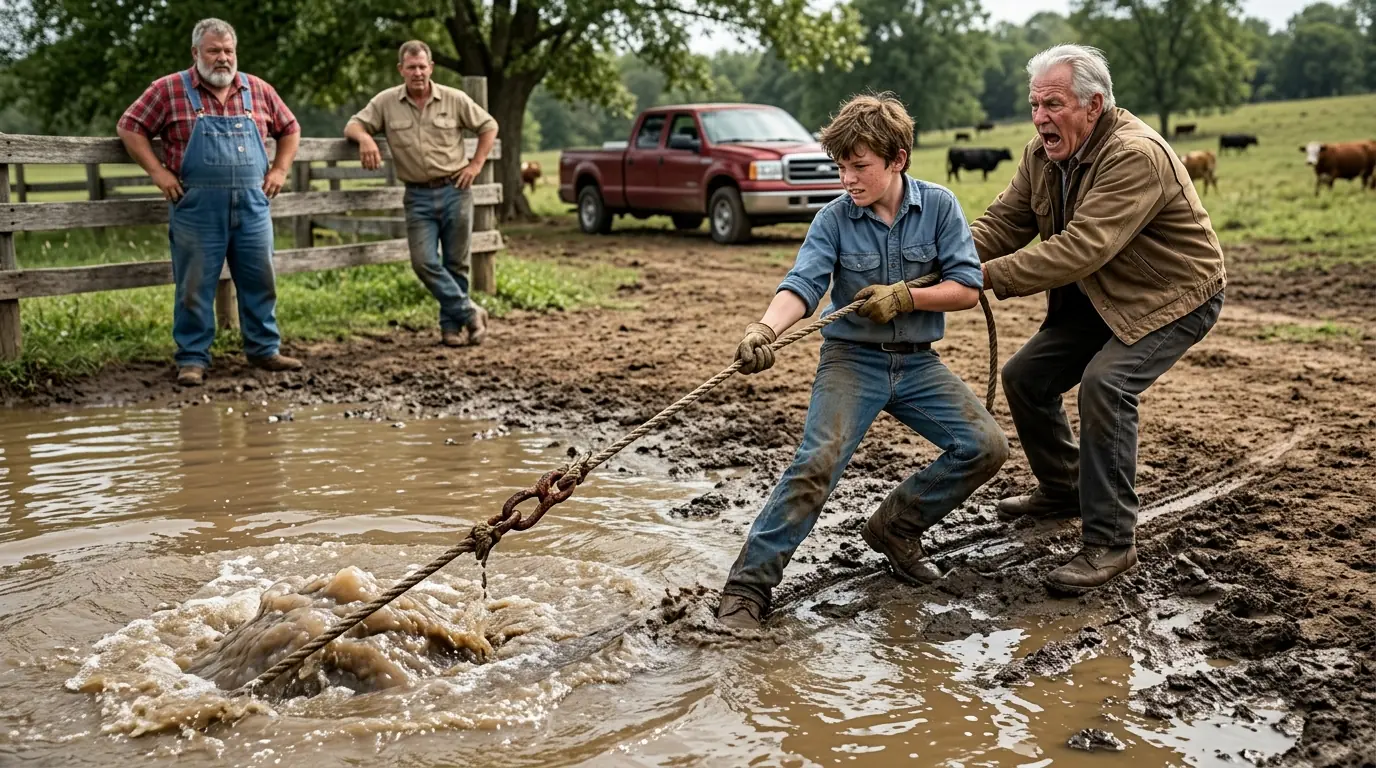
Eli Voss did not answer. He was thirteen years old, slim and freckled, and the thick rope in his hands seemed determined to drag the rest of him into the pond. He leaned back until his shoulders nearly touched the slope behind him. His brown boots cut twin trenches through the mud. Under the faded blue sleeves of his work shirt, his arms trembled. Whatever held the submerged end of the rope was astonishingly heavy, and the brown water refused to give him even a glimpse of it.
His father stood several yards away with the helpless expression of a man trying to decide whether pride or danger had reached his son first. Daniel Voss had spent the whole afternoon helping repair a pasture gate and had only come down to the pond because he'd heard Dale laughing. His dark green work shirt was damp across the back; his jeans still carried a line of pale dust from the cattle lot. He knew Eli's stubbornness well enough to respect it, and he knew water well enough to fear it.
At the fence stood Samuel Voss, Daniel's father, seventy-two years old, silver-haired and weather-cut, wearing a faded brown jacket despite the late-summer warmth. He had been still for several minutes. Unlike the others, he was not watching Eli's feet or the taut line of rope. He was staring at the pond's surface, his eyes searching the little rings that formed when something moved far below.
A deep scraping sound came through the water.
Samuel's expression changed. It was not the cautious puzzlement of a farmer hearing machinery he could not identify. It was recognition, immediate and terrible. His face drained of color. His lips parted, but no words emerged.
Eli planted his heels and pulled again.
To understand why the boy was still hanging on, and why the old man looked as if the past had risen to meet him, it was necessary to go back to the beginning of that summer, when the pond had seemed no more dangerous than a place where thirsty cattle gathered and red-winged blackbirds argued in the reeds.
The Voss farm occupied a broad tract of rolling pasture in the American countryside, far enough from town that the road carried more feed trucks than commuters. Its white farmhouse stood behind tall shade trees, with a long gravel drive running past a machinery shed and toward the cattle lots. Daniel raised beef cattle and made hay on the ground his father had worked before him. The operation was large enough to demand constant attention and small enough that one bad season could upset the household's finances for years. In dry weather the ponds mattered almost as much as the fences. Every animal needed water, and every gallon had to come from somewhere.
There were three ponds on the property. Two were broad and open, with reliable drainage from upper pasture. The third, behind the lower cattle fence, was shallow, brown, and crowded with reeds. It had been dug decades earlier, or perhaps enlarged from an older depression; the family papers were unclear. Its muddy bank sloped gently on the southern side and fell away into a darker pocket on the north, where a line of willows kept the ground cool. Cattle used it when the main water trough ran low. Children had been warned not to swim in it, partly because of the mud and partly because its bottom could not be trusted.
Eli had grown up hearing that warning. It never frightened him as much as adults hoped. He imagined hidden snapping turtles, soft silt, and discarded fencing wire—ordinary pond hazards that belonged to farm life rather than mysteries. His father taught him not to step into water he could not see through and never to reach for something submerged with his bare hand. Those rules had been repeated so often that Eli thought of them less as commandments than as the background music of childhood.
Samuel had a different rule. He avoided that pond when there was any other way to cross the property.
At first Eli had not noticed. His grandfather had arthritis in one knee, and the southern bank became slippery after rain. There were dozens of practical reasons an old farmer might prefer the higher track. But as Eli got older, he began to see patterns: Samuel always took the long path around the tree line, never stopped to inspect the reeds, and turned serious if anyone mentioned draining the shallow pond. During a spring conversation about water improvement, Daniel suggested cleaning the silt and extending a pipe to the lower trough. Samuel answered so sharply that Eli remembered it months later.
“Leave that pond alone.”
Daniel looked up from his ledger. “It barely serves half the herd when August gets hot.”
“Then move the cattle.”
It was not a useful answer. Daniel said so, politely at first. Samuel closed the subject with silence.
At thirteen, Eli was old enough to recognize that silence could mean something other than anger. He could not decide what. His grandfather had an unusual tenderness toward small injured animals and an equally unusual hardness when confronted by certain memories. He could describe the birth of a calf forty years earlier down to the color of its ears. He could not be persuaded to speak at length about one wet winter long before Daniel took over the farm. Eli had learned not to force either kind of story. Still, the unexplained rule about the pond caught in his mind like a burr.
That summer began with a dry June. The pastures greened well after spring rain, then stopped growing. Daniel watched the forecast every evening and kept his hay equipment ready for a narrow cutting window that never seemed to arrive. The heat was not disastrous yet, but it tightened everything: grazing rotation, feed purchases, fuel, and the schedule for moving cattle between lots. The two larger ponds dropped slowly. The shallow pond dropped faster, exposing brown shelves along the southern bank and an irregular line of dead reeds.
For Eli, school was out. His days opened before sunrise with feed chores and ended after supper with the tired satisfaction of work he had chosen, or at least chosen more often than he admitted. He was not big enough for every job, but he had learned to be useful. He could carry mineral sacks one at a time, check electric fence voltage, set a gate latch properly, and spot a calf moving stiffly before its limp became obvious to adults moving too quickly. He took pride in noticing things.
His father valued that pride but feared its sharp edge. Eli wanted to be treated as a worker instead of a child, and sometimes he mistook the two for opposites. A careful adult could say, “Not yet,” without insult. Eli often heard it as, “You aren't strong enough.” Daniel remembered being that age and hated how easily a warning sounded like contempt when spoken from a taller body.
One early morning, father and son walked the south fence carrying a roll of wire and a post driver. The sun had only begun to touch the cattle's backs. Eli walked ahead, stopping at each weak section to test the tension. At the lower gate he pointed to a leaning post near the pond and said the cattle had pushed against it again.
Daniel examined the post. “We'll set a new brace before the weekend.”
“I can do it today.”
“You can dig the hole. Don't drive the brace alone.”
“Dad, I know how.”
“I know you know how. That's not the question.”
Eli scowled without looking up. Daniel watched him for a moment, then handed over the marking paint.
“Put a line where you want the new post. Make me agree with it.”
That changed the job. Eli stepped back, checked the angle of the gate, traced the pull of the wire, and marked a point a little farther uphill than Daniel would have chosen. When asked why, he explained how the cattle gathered at the low spot after drinking. A post placed there would suffer the same sideways pressure. A post higher on the bank, with the brace toward dry soil, might hold better.
Daniel considered, then nodded. “Good call.”
The praise meant more because it came after a question rather than as a reward for obedience. Eli tried to hide how pleased he was and failed.
Later that week the same habit of close observation led him to the pond's first odd sign. He was checking the water line at dawn, using a marked stick Daniel had made for tracking depth, when he saw a dark length of old cord tangled around a root below the bank. At first he thought it was baler twine washed down during a storm. He pulled it loose with a hooked branch and discovered a tough, weathered rope with fibers unlike the plastic line kept in the machinery shed. It was thick, stiff with mud, and frayed at one end. The other end vanished under silt and water.
Eli tugged gently. Nothing moved.
He tugged harder. The line tightened, then went slack when his boots slid. He left it where it lay and walked back to the house, telling himself it was probably tied to some lost scrap. All ponds collected things. Daniel had once dragged half a broken stock gate out of the main pond after a flood. The rope did not seem especially important, except that it was strong and buried deeper than Eli expected.
At breakfast he mentioned it casually.
“Found an old rope in the lower pond.”
Daniel passed him the eggs. “Leave it. Could be attached to wire.”
“Looks like heavy rope. Not ours.”
Samuel, seated at the far end of the table, set his coffee cup down with a soft, exact click.
“Which bank?” he asked.
“The shallow one. By the reeds.”
Samuel held Eli's gaze a moment too long. “Don't pull on it.”
Eli looked toward his father. Daniel shrugged slightly, an expression that meant he had not expected this reaction either.
“Why?” Eli asked.
“Because you don't know what's on the other end.”
The answer was reasonable. It was also insufficient, and everybody at the table seemed to know that.
Eli pressed his lips together and went back to eating. Samuel picked up his coffee but did not drink. Daniel changed the subject to a heifer due to calve within a week.
The rope stayed in Eli's mind.
He had found nails, chain fragments, rusty pails, and enough broken wire on the farm to fill a scrap barrel. No one reacted to them like that. Samuel's order had sounded less like caution and more like fear. Eli was not proud of the curiosity that sparked in him. He knew curiosity could make a boy reckless. Yet he also knew that adults sometimes used safety as a lid over stories they did not want opened.
When he returned to the pond two days later, he did not pull. He stood on dry ground and studied the place. The rope lay partly exposed where he had left it, dark against the mud. Its wet end pointed into a narrow patch of brown water beneath overhanging reeds. A small ring of bubbles rose and disappeared nearby, but ponds did that when warm silt released gas. Nothing about the scene justified his grandfather's expression.
Eli took a photograph with the old phone his father had given him for emergencies. The lens had a scratch, and the picture showed mostly glare. He crouched carefully, noted the position relative to a fence post, and left.
That should have been the end of it.
But the summer kept drying the pond, and with the retreating water came more questions.
The Voss family did not have the luxury of thinking about one pond in isolation. Daniel spent the first two weeks of July trying to balance water demand against cattle numbers and forage conditions, calculating things in his notebook that looked simple until he stood outside among living animals. A cow did not reduce her thirst because a spreadsheet demanded savings. A field did not grow grass because a man needed it to pay a note. Every decision had consequences that arrived wearing hooves, weather, or invoices.
Daniel sold six animals earlier than he wanted, not because the market offered a generous price but because those six represented pressure he could relieve before conditions worsened. Dale Mercer, who owned adjoining pasture and talked like a man with answers for everyone, heard about the sale and commented on it at the feed store. According to the clerk, Dale said Daniel was losing his nerve over a little dry weather. Daniel heard the remark two days later and said nothing. Eli heard it and went red with anger.
“Why do you let him talk about us?” he demanded as they loaded mineral tubs into the pickup.
Daniel lifted one tub, set it into the bed, and shut the tailgate before answering. “Because talking doesn't move cattle or make rain.”
“He thinks we're failing.”
“Then he's free to think wrong.”
Eli hated the calmness. He wanted his father to march into the feed store and lay out the accounts, the pasture plan, and the reasons for selling early. He wanted everyone to understand that their family had made a difficult choice instead of a foolish one. Daniel had spent enough years in farming to know explanations often only invited another round of judgment from men who had never asked the right questions.
“Work we can prove later,” Daniel said. “For now, help me unload.”
That lesson joined the others Eli was collecting without realizing it. Adults could be silent because they feared something, because they hid something, or because they simply refused to waste strength. Learning which silence meant which would take him longer than one summer.
He had grown up under three generations' overlapping ideas of manhood. Dale Mercer, loud at every fence line, treated strength as a thing other people must witness. Daniel treated it as a thing a person should spend carefully. Samuel treated it as something dangerous when pride got ahead of judgment. Eli admired parts of all three without quite recognizing how often they contradicted one another. He wanted to be strong enough to do difficult jobs. He wanted people to stop calling him “kid.” He also wanted his grandfather to look at him with approval rather than caution. Those desires did not always pull in the same direction.
One evening he found Samuel in the machinery shed repairing a leather strap on an old harness that no longer had an obvious use. Samuel's hands were broad and knotty, but surprisingly delicate with an awl and needle. He worked slowly, glasses slipping down his nose. Eli perched on a turned-over bucket and watched for a while.
“Did you ever pull anything out of the lower pond?” he asked.
Samuel's hands stopped. It was such a tiny pause that Eli might have missed it if he were not watching.
“Plenty of things get into farm ponds.”
“I know. But did you?”
Samuel pressed the needle through leather. “Why are you back on that rope?”
“Because you won't tell me why it bothers you.”
The needle emerged. Samuel pulled the thread tight and looked up. “I said don't pull. I didn't say you weren't allowed to wonder.”
“That's almost the same thing.”
“No, boy. Those are very different things.”
Eli rubbed his gloved thumb against the edge of the bucket. “What if it hurts a cow?”
“Then you tell your father, and he decides how to handle it.”
“What if Dad doesn't know what it is?”
“Then he finds someone who does. Knowing when to stop is a kind of knowledge too.”
Eli could not argue with that without sounding childish, which irritated him. He slid off the bucket and walked to the doorway. Before he left, Samuel spoke again.
“There are things down deep that stay harmless as long as folks quit hauling at them.”
Eli turned around. “Things like what?”
Samuel's face closed. “Things.”
Outside, the evening light had turned the pasture gold. Eli crossed the yard, aware of the familiar sounds—the bawl of a calf looking for its mother, a gate chain ticking in wind, chickens settling near the coop—and felt unaccountably far from them. His grandfather had not told him a story. He had given him the outline of one and refused the middle.
Daniel found him later near the water trough and asked what was wrong. Eli explained what Samuel had said, trying not to sound as though the whole matter mattered too much. Daniel listened, frowned, then looked toward the shallow pond barely visible beyond the far fence.
“Granddad's had that habit for years,” he said. “He doesn't like going near that bank.”
“Do you know why?”
“No. And I won't pretend I do.”
“Why don't you ask him?”
“I have. He answers what he wants to answer.” Daniel rested a forearm on the gate. “People his age grew up in a different kind of farm life. More things happened without anybody writing them down. Sometimes their reasons are practical. Sometimes they just don't want another argument.”
“Could be something valuable.”
“Could be a buried tire.”
“Then why's he scared?”
Daniel considered. “Maybe he's scared of you getting hurt. That's not a mystery.”
Eli wanted to believe that was all. His father's steady way of speaking made it tempting. But he had seen Samuel's hands stop at breakfast, and no ordinary worry about a child slipping on mud quite explained it.
The next week they repaired the lower gate together. Eli dug the hole where he had marked it earlier, carefully keeping the sides plumb and the spoil pile out of the way. Daniel helped set the brace, then let Eli tamp around the new post as though the whole job belonged to him. They tightened the wire, checked the swing, and tested the latch a dozen times.
“Better than the old one,” Daniel said.
Eli grinned before looking toward the pond. The water level had dropped enough to expose another strip of bank. The reeds now stood partly on mud rather than in water. The rope he had found hung across a narrow channel, but its submerged end still disappeared into brown shadow.
Daniel followed his gaze. “Leave it alone, Eli.”
“I am.”
“Good.”
They walked back toward the house, neither mentioning that Eli had not promised to leave it forever.
Two days later a cow got stuck in soft ground near the pond. She had followed fresh grass to the edge where the receding water had left a deceptive crust over deep silt. Her front legs sank almost to the knees. Daniel and Eli reached her in time to back her out with patient pressure and a rope looped around her shoulders; no forceful jerking, just slow coaxing and firm footing from the bank. By the time she stood clear, all three were coated in mud.
The incident changed the pond from nuisance to immediate concern. Daniel moved the cattle to a higher trough and strung temporary electric tape to keep the lower bank clear. He told Eli they would have to drain or fence the pond properly before another animal got caught. Samuel overheard that plan from the yard and came down to the fence at a pace unusual for his bad knee.
“Fence it,” he said. “Don't drain it.”
Daniel wiped mud from his wrist. “Water's already low. We could pump it down, clean the edges, and make it safer.”
“No.”
“Dad, we need usable water.”
“Then dig a new one.”
Daniel stared at him. “With what money?”
Samuel looked from Daniel to Eli and back again. For a moment it seemed that he would finally explain. He opened his mouth, then shut it. The color in his cheeks diminished.
“Please,” he said, so quietly that both younger Vosses went still.
Samuel did not plead often. In his grandson's memory, perhaps never.
Daniel lowered his voice. “All right. We won't drain it today.”
Samuel nodded and turned away without another word.
For the rest of the evening Eli kept replaying that “please.” There was no authority in it, no grandfatherly command. It was the sound of someone asking to be spared a consequence he knew too well. Eli felt sorry for him and more curious than ever. A frightening story was one thing. A frightening story trapped inside a loved person was another.
The temporary fence solved the cattle problem but caused fresh work. Water had to be hauled farther, a trough had to be shifted, and Daniel lost an afternoon rerouting a hose through a gate opening. When August arrived without significant rain, the farm's finances began to tighten in earnest. Daniel hauled hay from a neighboring county at a price high enough to make him stare at the receipt before filing it. A bearing went bad on the hay baler. An older cow needed veterinary attention. The shallow pond continued to fall, its brown surface shrinking toward the dark north pocket.
Eli watched his father at the kitchen table most nights, pencil moving over numbers. He offered to help with chores before being asked. He grew more careful about wasting feed or leaving gates partly latched. He also began dreaming, in the vague earnest way children do, of some hidden solution that might relieve the pressure. Perhaps the old rope was attached to a lost pump, a piece of useful equipment, or a blocked outlet that explained why the pond behaved strangely. He did not believe in buried treasure. His mind had been shaped by repair, so he imagined buried things worth fixing.
One afternoon he asked Daniel whether a rope under pond silt could last for decades.
“Depends what it's made of and what happened to it,” Daniel said. “Why?”
“Just wondered.”
“Natural fiber rots. Some treated lines hold longer. Old cable lasts differently. Why?”
Eli looked away. Daniel caught the evasion and set down the wrench he had been using.
“You're not planning to go pull that thing, are you?”
“No.”
Daniel let the pause stretch. “I need your word.”
Eli swallowed. “I won't go into the water.”
“That isn't what I asked.”
Eli felt his face heat. “I won't do anything dangerous.”
Daniel's expression tightened. “Dangerous is often what somebody calls a mistake after it happens. You cannot promise it won't be dangerous if you don't know what it is.”
The rebuke stung because it was fair. Eli looked down at his boots. For a moment he considered telling his father how often he had returned to look at the rope, how much he wanted to understand why Samuel feared it. Instead he nodded.
“Okay.”
“Okay what?”
“I won't pull it.”
Daniel studied him, then put a hand on his shoulder. “You don't have to prove you're useful by getting yourself hurt.”
The touch left Eli more ashamed of his curiosity than the warning did.
For nearly two weeks, he kept his word.
That time mattered. It taught him how an unsolved question could linger without becoming an action, and how much of farm life depended on leaving unfinished things alone until conditions were right. He checked fences, cleaned water troughs, hauled salt, and helped repair the baler. He spent one whole morning sorting mixed bolts and nuts into jars while Samuel watched without offering comment. At the end the old man nodded once, which somehow felt like applause.
But the pond kept changing, and sooner or later the changing water brought the question back to the surface.
After three more hot days, the old rope showed a second dark segment near a narrow shelf of mud. The exposed portion was longer than before. Eli saw it from the high bank while carrying a fence tester, and a thought landed with startling force: if the water dropped farther, whatever held the rope might become visible without anyone pulling it at all.
He moved closer, staying on firm ground. The surface lay still beneath a film of pollen and dust. Cattails clustered near the northern edge. Brown bubbles surfaced occasionally, each breaking quietly. The rope lay stiff and stained, with one part running under the reeds before angling toward the dark pocket.
He took another photograph. This time the late sun reflected less, and the picture showed the line clearly. He compared it with his earlier photo at home and realized the rope had shifted position slightly, even though no one had been near it as far as he knew.
That detail bothered him.
Things tied to buried junk generally stayed where they were until disturbed by water or animals. The pond had neither flooded nor supported cattle near that edge since the temporary fence went up. The rope's subtle movement might have been silt settling as the water receded. Eli knew that. But there was enough uncertainty to keep him awake thinking about it.
Samuel caught him staring at the photograph at breakfast one morning and said, without asking what it showed, “Put that away, boy.”
Eli looked up. “You don't even know what I'm looking at.”
Samuel's eyes moved to the phone, then to Eli's face. “I know when a question's eating a person.”
“Then answer it.”
“Not every answer makes a boy safer.”
“Not knowing doesn't either.”
Daniel, standing at the sink, turned around at the sharpness in Eli's voice. “Enough.”
Eli pushed back his chair. He regretted the tone almost before the chair legs scraped, but pride kept him from saying so. He left the table with his breakfast half-finished and spent the morning working faster than necessary, as though speed could burn away the argument.
That night he found a folded note on the workshop bench beside a length of fresh rope. Samuel had written only three words in his shaky block handwriting: ASK BEFORE PULLING.
Eli picked the note up and stood for a long time with it in his hand. It was not an explanation. It was an invitation delayed, or perhaps a boundary drawn in gentler language. He tucked it into his shirt pocket and tried to decide whether it made him feel trusted or watched.
The answer was both.
It was Dale Mercer who turned the lower pond into a public argument. Before that, it had been a family problem, like a broken gate or a tractor tire losing pressure overnight. Dale made it entertainment because entertainment, to him, was the only payment worth collecting for questions he did not care to help answer.
He owned property along the western boundary and had never been shy about reminding Daniel that his own hay equipment was newer, his cattle heavier, and his sons grown enough to run tractors without supervision. Those advantages were real, though their meaning depended on how generously a man interpreted them. Dale had inherited most of his land from a father whose decisions he now preferred to describe as his own. He had married into another tract. He was also a capable farmer when he set down his opinions long enough to work. This combination made his cruelty especially irritating. Daniel could not dismiss him as a fool; Dale knew enough to know better.
Otis Reed was different. Tall, forty-eight, leaner than Dale, and more inclined toward quiet scorn than open shouting, Otis farmed leased pasture north of the road. He had worked alongside Daniel during a difficult calving season years earlier and had been helpful then. Their relationship had cooled after a disagreement over a shared fence repair, when Otis accused Daniel of charging too much for labor and Daniel proved he had charged below actual cost. Otis disliked being corrected in front of other men. The offense lasted longer than the fence.
Together Dale and Otis formed an audience that made ordinary farm problems feel like a tournament of pride. They were often at the county auction barn, talking louder when Daniel entered. When prices rose, Dale said a good operator should have seen it coming. When prices fell, Otis said small farmers should never have bet on that class of cattle anyway. Their forecasts rarely cost them anything; Daniel's decisions did.
The first time Dale saw the lower pond that summer, he parked beside the pasture fence and watched Daniel moving a trough to higher ground. His grin arrived before his greeting.
“Water trouble?”
“Managing it,” Daniel said.
“Looks like your pond's trying to walk away.”
“That's one way to describe a dry spell.”
Dale leaned over the fence. “I'd clean that mud hole out. Rent an excavator. Deepen the pocket. Put the spoil on the east bank. Be done with it.”
Daniel kept tightening a hose coupling. “Maybe.”
“Maybe? What else are you waiting for?”
“An estimate that doesn't sound like a second mortgage.”
Dale laughed, but there was advice hidden in the mockery. In most circumstances he was right about cleaning a failing pond. Daniel knew it and resented the fact that the advice was tangled in a show of superiority. He had wanted to drain and improve that pond himself before Samuel objected. Yet taking Dale's advice blindly would have meant forcing a family conflict he did not understand.
“Your father still running things?” Dale asked.
Daniel stopped turning the coupling. “No.”
“Then why's he got you leaving that pond alone?”
Daniel straightened. “Because I respect him.”
Dale's smile thinned. “Respect is one thing. Letting old fear waste water's another.”
That phrase stuck. Old fear. Daniel had not told Dale much, yet the man seemed to know Samuel disliked the pond. Was that common knowledge from before Daniel's time? Or had Dale simply seen enough to guess? Daniel kept his expression steady.
“If you need to cross my fence to improve the pond,” he said, “I'll let you know.”
Dale laughed and drove away, leaving a trail of gravel dust behind the pickup.
Eli had heard the conversation from the trough line. He watched his father stand motionless a moment after the truck left, looking toward the shallow water. There was a small muscle working in Daniel's jaw. Eli recognized that sign: his father was doing arithmetic inside his head, and some of the numbers were emotional.
That evening Daniel and Samuel spoke alone on the back porch. Eli was not eavesdropping at first. He had gone outside to collect work gloves left on a railing and heard his father's voice through the kitchen window.
“I need something better than 'leave it alone,' Dad.”
Samuel answered too softly to catch.
“We've got cattle, we have a dry season, and I can't keep hauling water uphill forever.”
Another low answer.
Daniel's voice rose. “Then tell me why. Just once. I can respect a reason. I can't plan around a silence.”
Eli froze by the door, gloves in hand. He felt guilty and unable to move.
Samuel finally spoke loudly enough. “I made a mistake a long time ago.”
Daniel waited.
“That's all I'm ready to say.”
“Was somebody hurt?”
Silence.
“Dad.”
“I said that's all.”
The porch boards creaked. Eli moved away quickly before either man came inside. In his room he stared at the ceiling long after dark. A mistake. A long time ago. The words were suddenly heavier than the rope, heavier than drought or equipment. He understood that he had been treating a family wound like a puzzle. The understanding made him feel ashamed but did not remove his curiosity. If anything, it made the puzzle urgent in a different way.
He thought about asking Samuel to tell him directly, without accusations. The next morning he tried. He found his grandfather at the barn doorway sharpening a small pocketknife on a stone, an action so habitual that it calmed the old man's hands.
“Granddad?”
Samuel looked up.
“Did something bad happen at the pond?”
For a moment Eli thought he would be sent away. Instead Samuel set the knife carefully aside and looked toward the pasture.
“Bad things happen on farms,” he said. “Most don't arrive announced. One minute you're doing an ordinary job and the next minute you wish you'd left something untouched.”
“Is that what happened?”
Samuel turned back to him. “I don't want you to be the one who learns that lesson for me again.”
Again. Eli caught the word but did not press. His grandfather's eyes looked bright and tired, and the boy suddenly wanted to protect him from the question. He nodded and walked away. The old man did not call him back.
The drought did not ease. By the middle of August, the shallow pond's waterline was down several more inches. The temporary fence kept cattle off the soft bank, which prevented new trouble but also exposed a strange sight. Where hooves no longer churned the mud, delicate tracks of birds and raccoons appeared undisturbed. The rope lay across the lower slope, now visible for several feet before entering the water. The portion that remained submerged pointed toward a darker region surrounded by a few persistent reeds.
The rope was not fraying as Eli expected. When he studied it from a safe distance, he could see a braided structure with dark flecks under the mud, suggesting something treated or synthetic rather than ordinary old hemp. He asked at the feed store what kinds of rope farmers used decades ago. The clerk showed him newer polyester and nylon lines, a length of old cotton rope from a display, and a piece of wire cable. None offered certainty. Age, water, and sunlight changed appearances. Eli left without buying anything and felt slightly foolish.
At home he borrowed a library book about ponds and agricultural water systems. The book explained sediment, water stratification, oxygen loss, and how organic material decomposed under shallow water. He read the sections on submerged debris twice. Bubbles could be released by trapped gas in silt. Dark cloudy water could appear when fish disturbed bottom mud. Scraping noises might come from moving debris, especially if a rope pulled against rough metal or stone.
Every explanation made the pond seem more ordinary. None explained Samuel's fear.
That tension began to shape Eli's thinking. He learned two things at once: physical mysteries sometimes had simple explanations, and human reactions could remain complicated even after the physics was understood. A metal pipe buried in silt might be just a pipe. For someone who had buried it—or watched it sink—it might be the last remaining sign of a whole history.
His father noticed the library book on the table one evening and turned through its pages. Eli braced for another warning. Daniel sat beside him instead.
“You really want to know what's down there.”
Eli nodded.
“Wanting to know isn't wrong.”
“I know.”
“What matters is how you go after the answer.”
Eli stared at the picture of a pond cross-section. “Would you help me look if we could do it safely?”
Daniel hesitated. “Maybe. We'd start with asking Granddad again. Then we'd make a plan. No wading, no yanking blind, no treating a deep mud hole like a game.”
“Okay.”
Daniel put the book down. “You say that like you're disappointed.”
“I'm not.”
“Eli.”
The boy looked up. “I just don't understand why everybody acts like a rope is a disaster. If it's dangerous, tell me what it is. If it's not, why can't we look?”
Daniel's expression softened. “Because I don't know. I'm supposed to have answers, and I don't. That's uncomfortable for me too.”
The admission startled Eli. Adults almost never said that. He realized his father was not trying to win a contest with him. Daniel was caught between a son asking a fair question and a father guarding a painful truth. Both deserved respect. Neither made the other disappear.
They agreed not to touch the rope until they understood the risk better.
The agreement might have held if the weather had changed or if the pond had stopped revealing new details. Neither happened.
A small storm passed north of the farm without bringing useful rain. Wind drove dry leaves across the lane and knocked a dead branch into the shallow pond. When Eli came down the next morning, the branch was caught against the exposed rope. He could see that the line dipped under it before continuing into the water. He used a long pole from the bank to lift the branch clear, careful not to disturb the rope itself. As the branch came free, the rope shifted a fraction of an inch and then tightened again.
Eli took a step backward.
There had been no pulling on the submerged end, no deliberate force from him. Yet the line had moved in a way he could feel through the pole. He stared at it, thinking of his photograph. It might be buoyancy, current, or a trapped log settling under the surface. It might be nothing. Still, his heart quickened.
A low bubble broke the water several feet out.
Eli watched until the surface went still.
He could not say he was frightened then. He was too focused on the discrepancy between what he expected and what the water did. Later he would remember that concentration as its own kind of danger. When a problem becomes fascinating, the mind can narrow until it discounts everything outside the frame. His father had warned him about that during tractor work: people get hurt most often doing something familiar while thinking about something else. Eli was now doing something unfamiliar while thinking of nothing else.
He moved away before temptation became a choice. That evening he told Daniel exactly what happened. Daniel listened without interrupting and praised him for leaving. Then he walked down to the pond himself with a flashlight, stayed behind the temporary tape, and studied the rope from the bank. He returned looking troubled.
“Whatever it is,” he said, “it isn't going anywhere tonight.”
Eli nodded. “Did you see anything?”
“Water and mud.”
“Did the rope look strange?”
Daniel met his eyes. “Yes.”
That one word changed the boy's excitement into apprehension. The mystery was no longer something only he noticed. It had entered his father's practical world.
Daniel called a man who cleaned farm ponds for a living. The contractor could not visit for nearly two weeks. He suggested marking the rope, keeping stock away, and resisting any attempt to pull it with a tractor until they knew whether it was attached to old fencing, a culvert, or something that might damage the bank. Daniel wrote the advice down. Samuel was within hearing when the call ended. He said nothing, but the hand holding his coffee trembled enough that a small drop fell onto his shirt.
That night Eli sat beside Samuel on the porch steps. They watched lightning bugs come out around the yard and heard cattle shifting in the distance.
“I'm not going to make fun of you,” Eli said suddenly.
Samuel looked down. “What?”
“If you tell me what happened. I won't laugh or tell anybody.”
The old man studied the boy's serious face. A long silence settled between them, gentler than the earlier ones.
“You think laughing is what I'm afraid of?” Samuel asked.
“I don't know.”
“Good answer.” He looked toward the pasture. “Sometimes people don't speak because they have told themselves silence is a way of protecting everybody. Then the silence gets old enough that speaking feels like doing the harm all over again.”
Eli considered. “But what if the silence makes somebody do something worse?”
Samuel closed his eyes briefly. When he opened them, he looked older than he had at breakfast.
“That's the question, isn't it?”
Eli waited, but the old man went inside before answering.
By the end of August the rope had become a boundary in the family. Eli kept his distance. Daniel planned a professional inspection. Samuel watched the weather and moved through the house with a stiffness that had little to do with his knee. Even Dale's remarks seemed to aim at a target none of the men wanted to name.
The pond remained shallow and murky, a quiet patch of brown water ringed with reeds and mud. It gave away almost nothing. But every inch of retreating water made the waiting harder.
The contractor's delay became a problem sooner than Daniel expected. A truck broke down on the man's way to another job, which pushed his schedule back another week. Then rain finally reached the region—but not the Voss farm. Thunderheads passed to the south, giving distant pasture a dark, wet sheen while leaving the Voss gravel lane dusty. By morning the radio forecast promised more dry weather. Daniel wrote another feed order into his ledger and crossed out a repair he hoped the cattle would not force him to make before winter.
Eli watched the numbers accumulate. He did not understand every line of the farm accounts, but he understood enough to recognize strain. His father sometimes waited to open mail until after the evening chores, as though postponing a figure might make it smaller. The adults stopped talking when they caught Eli listening. He hated that more than the bills themselves. He was old enough to carry mineral sacks and help pull calves through long nights. Why was he not old enough to know whether the family was in trouble?
One Saturday he decided to ask directly.
Daniel was standing at the workbench grinding a burr off a bent gate latch. Orange sparks lifted and vanished beside his boots. Eli waited until the grinder stopped, then said, “Are we going to lose cows?”
Daniel removed his safety glasses slowly. “We've already sold a few.”
“I mean more.”
“Maybe. If we need to.”
“Because the pond doesn't hold enough?”
“Because dry weather changes what the grass can carry. The pond is one part of it.”
“What if we fixed that pond?”
Daniel wiped the latch with a rag. “Then we'd have one less problem.”
“Why don't we?”
“Because I promised my father we wouldn't disturb it until we knew what was safe.”
Eli looked toward the door. “And if he never tells us?”
Daniel set the latch down. “Then we use what we know. We don't guess our way into something we can't undo.”
Eli nodded, but the calculation in his own head felt incomplete. If they were losing money because of water trouble, and if the rope marked whatever caused trouble in the pond, then leaving it alone might be its own expensive choice. He thought of the contractor who couldn't come, the water trough hauled uphill, the sold cattle, and Dale's laughing voice. His thirteen-year-old mind, gifted with observation but not yet with experience's caution, began compressing a complicated problem into a single possible act.
What if he could pull the obstruction free?
He did not say the thought aloud. He knew Daniel would reject it before hearing the reasoning. That was one of the dangers of a family's protective habits: sometimes they trained a child to conceal ideas rather than test them in conversation. Eli loved his father and knew Daniel's warnings came from love. But he wanted to contribute something decisive, something no one could dismiss as a boy's small chore.
The farm gave him examples of decisive labor every day. Daniel repaired engines rather than replace them. Samuel had spent years coaxing a difficult cow to accept her calves. A blocked water line could be cleared with patience. An old fence could be reset with a brace and enough pulling force. From such examples, Eli built the seductive belief that anything jammed or buried could be solved by a stronger, better-placed tug. He knew, intellectually, that some things broke under force. He had not yet felt how quickly the world could break a person back.
The morning after that conversation he found Samuel in the kitchen writing a letter. It was unusual enough to make Eli stop in the doorway. Samuel disliked phones for matters he considered serious but rarely wrote unless prompted by birthdays or funeral arrangements. Now he sat with lined paper before him, one hand steadying the page while the other moved in short, deliberate strokes.
Eli took a glass from the cupboard. “Who are you writing to?”
“Somebody I should've written years ago.”
“Is it about the pond?”
Samuel laid the pen down. His expression sharpened, then softened. “What makes you ask?”
“Because that's the only thing everyone acts strange about.”
The old man looked at the paper as though seeing a mistake there. “I suppose it is.”
“Can I help?”
Samuel looked up. “With what?”
“Whatever you're doing.”
For a moment his grandfather seemed on the edge of telling him everything. The expression was so brief Eli might have imagined it. Then Samuel folded the paper in half and slid it into an envelope without sealing it.
“You've already helped more than you know,” he said.
Eli felt the same frustration return, but this time there was tenderness inside it. His grandfather was struggling with something. The old man was not merely obstructing the family for sport. Perhaps Eli's help ought to be patience. He tried to believe that.
The next day a fence post failed near the shallow pond, and the choice between patience and action became less abstract.
The temporary electric tape Daniel had strung across the approach to the muddy bank sagged when a wooden corner post cracked near the ground. The wire lost tension, then shorted against wet grass. Several cows from the lower paddock moved through the gap to reach fresh growth. By the time Eli noticed, three animals stood beyond the line with their heads low, grazing near the exposed shelf. He called Daniel from the far pasture and hurried to head them off, careful not to run and spook them toward the water.
The cows resisted gently, more interested in grass than rebellion. Eli circled wide, lifted his arms, and moved them back toward the gate in the slow, steady manner his father had taught. One older red cow followed. A younger heifer hesitated near the reeds, stepping toward a patch of green shoots almost at the water's edge. Eli kept his distance, angled his body, and spoke softly until she turned. The rescue took only five minutes but left his heart racing. A few steps more and an animal might have entered the mud where another had already become stuck.
Daniel arrived while Eli was resetting the temporary tape. He praised the boy's handling of the cows, then examined the broken post and frowned.
“This bank keeps giving us work.”
“We should make a proper fence,” Eli said.
“We will.”
“Before another one breaks.”
Daniel rested a hand on the post. “You're right.”
The admission pleased Eli, but the danger had reminded him of something else. The exposed rope lay close to where a cow might step if the fence failed again. Even if the buried end was harmless, the line itself could tangle a hoof or trip an animal on soft ground. He pointed it out.
“Shouldn't we at least move that?”
Daniel followed his finger. “Not by pulling on it. We can cut the exposed part if it's a hazard.”
“What if the other end comes loose?”
“Then it comes loose when we know what it is.”
Daniel marked the place, then went to fetch stronger fencing materials. Eli stayed back from the bank and watched him go. The plan was sensible. But there was a delay between sensible plans and finished jobs, and farm life had taught him that delays were where losses happened.
He spent the rest of the afternoon repairing posts with his father. The work was tiring and precise. They dug out the rotten stump, tamped a replacement into firmer soil, fitted diagonal bracing, and drew the tape tight again. By sunset the section was secure. Yet Eli felt no relief. The rope still lay there, part of an unresolved hazard in water the family needed but feared to touch.
At supper Samuel asked about the fence. Daniel described the broken post and the cattle getting through. Samuel listened with unusual attention. When Daniel said the exposed rope was now close to the grazed bank, the old man's knuckles whitened around his fork.
“We need to take care of the line before winter,” Daniel said carefully. “Could be wire. Could catch a leg.”
Samuel looked toward Eli. “You stayed away from it?”
“Yes, sir.”
“And you'll keep staying away.”
Eli stared at his plate. “Dad says we can cut the exposed part.”
Samuel's head turned sharply. “No cutting.”
Daniel set down his fork. “Dad, you cannot have it both ways.”
“Leave the rope.”
“And leave a trip hazard for the cattle?”
“Keep the cattle away.”
“We are. Fences fail. You know that.”
Samuel's breathing grew shallow. The room went still. Daniel seemed to realize he was pressing too hard and lowered his voice.
“Tell me what you need us to understand.”
Samuel looked at the dark window, not at either of them. “That rope was not meant for cattle.”
Eli's fork stopped midway to his mouth.
Daniel leaned forward. “What was it meant for?”
Samuel shut his eyes and remained silent.
That sentence was the closest he had come to telling the truth. It was also enough to transform Eli's assumptions. The rope had a purpose. It was not a forgotten line thrown into the water, or a random piece of scrap caught in silt. Someone had put it there for a reason. The question sharpened from what lay on the other end to who had placed it and why Samuel knew.
Samuel left the table before dessert. Daniel followed him out to the porch, then returned alone a few minutes later looking unsettled.
“Is he okay?” Eli asked.
“He needs some quiet.”
“Did he tell you?”
“No.”
“Does he know?”
Daniel considered. “I think so.”
For the first time, Eli's curiosity frightened him enough to make his stomach feel hollow. He had wanted an ordinary farm explanation: a pipe, a pump, an old anchor. The truth might still be ordinary in its materials, but it was connected to his grandfather's pain. He began to understand that finding it would not be the same as solving it.
The following week they made a compromise. Daniel would not cut or pull the rope. He would install a rigid wire panel well back from the soft bank, secure enough that cattle could not reach it even if the temporary tape lost power. He would mark the rope's location on the pond map and wait for the contractor. Samuel agreed to that plan reluctantly, insisting the panel not be anchored in the muddy shelf itself.
Eli helped carry the panel and set the posts. The work gave him something useful to do with his nervous energy. He measured twice, held the level while Daniel tamped, and fetched staples without being asked. When the barrier stood straight across the approach, Samuel came down to inspect it from a distance. He nodded once and thanked Eli in a voice that sounded tired but sincere.
For several days after that, the household relaxed slightly. The cattle stayed clear. Daniel planned repairs elsewhere. Eli returned to school preparation, helping his mother pack his bag and complaining about the early bus. Samuel's letter disappeared from the kitchen table, and he went back to routine chores around the yard. The pond seemed to have accepted the barrier as the final decision for now.
Then a night of heavy wind changed the bank again.
The wind carried little rain, but enough to wash loose material off the slope and send a small wave of muddy water across the shelf. By morning the exposed rope was stretched tighter along the bank than Eli remembered. Near its emergence point, fresh mud had slumped away, revealing a short additional section and a dark loop where the fibers crossed over themselves. The rigid panel remained intact. Cattle were safe. But the line looked as if something below had pulled against it.
Eli saw that on the way to the bus and stopped dead.
He did not cross the panel. He did not touch the rope. He took a photograph and left for school, carrying the image in his mind all day. During math he drew the pond in the margin of his notebook and tried to imagine why a rope attached to stationary debris would change angle after a small storm. The possibilities multiplied: shifting silt, trapped wood, a submerged drum, a dragged tree root, a partly buried machine. He rejected each for a different reason without having enough evidence to reject any honestly.
When he showed Daniel the photograph that evening, his father enlarged it and frowned.
“The contractor is coming Saturday,” he said.
“Are we going to pull it?”
“We're going to look before we do anything.”
Eli nodded. He had wanted that answer for weeks. Now that it had arrived, he felt more anxious than pleased.
Saturday became the day toward which the whole family looked, each for different reasons. Daniel wanted a professional assessment and a plan. Eli wanted understanding without disgrace. Samuel seemed to want time to stop before the appointed morning. The drought held the pond low, the rope tight, and the water brown enough to conceal whatever lay beneath.
By Friday evening Dale Mercer had heard about the planned visit. His pickup slowed at the gate, and he called across the yard while Daniel was closing the shed.
“Heard you're bringing somebody to fish your pond.”
“Just getting it checked.”
Dale grinned. “Hope the fish is worth the bill.”
Daniel shut the shed door. “Good evening, Dale.”
But Dale did not drive on immediately. He looked past the house toward the lower pasture, then back at Daniel with a little more interest than his joke warranted.
“Your dad still making a fuss about that water?”
Daniel's expression went flat. “It's a private matter.”
Dale gave an exaggerated shrug. “Everything's private until it needs a tractor.”
He drove away laughing, leaving Daniel staring after him.
Eli heard from the porch. For the first time he wondered whether Dale knew the story too. If the secret had existed long enough to shape Samuel's habits, perhaps other men had heard fragments. Dale might be hiding ignorance behind mockery, or hiding knowledge behind the same thing. The distinction mattered more than ever.
Long before the contractor's appointment, there had been a different Saturday on the farm that Samuel never described in full. Daniel remembered pieces of it only as a child remembers an adult emergency: the wrongness of faces, the sound of trucks where trucks did not normally park, the sight of a blanket brought into the kitchen from a place where no blanket should have been. His memory was fragmentary enough that he had never confidently attached it to the lower pond. Perhaps that uncertainty was why he had allowed his father's silence to persist for so long.
Daniel was eight when the farm entered its hardest period. His mother had grown ill that spring, and Samuel took on more work than one man could safely carry. Money was tight. Repairs waited. Weather alternated between storms and hot spells that baked cracks into clay. Daniel remembered his father leaving the house before daylight and coming home with mud up to his knees, his face drawn with a fatigue that seemed to belong to somebody much older. Once Samuel sat at the kitchen table with a paper folded so small it barely covered his palm. Daniel asked what it was, and Samuel told him some papers were too important to read with dirty hands.
That answer seemed funny then. His father's hands were almost always dirty.
As an adult, Daniel had wondered about those papers from time to time. He had never found them in the farm files. Samuel kept some documents in a locked cabinet in the bedroom and others in a tin box under his bed. Daniel knew better than to search them without permission. Trust mattered in a house where three generations shared walls and work. Yet the lower pond strained that trust. What if the missing explanation affected the family land itself? What if danger remained below the surface because respecting Samuel's privacy had become indistinguishable from avoiding responsibility?
The week before the contractor was due, Daniel sat beside his father on the porch after supper and finally asked about the old paper he remembered. They watched bats move over the yard as light drained from the trees.
“Do you remember a time when I was little, maybe eight, and there were trucks at the farm after dark?”
Samuel did not turn. “There were lots of trucks at this farm.”
“I know. I remember one night you came in wet and wouldn't let me go down the lane.”
His father's fingers tightened around the arm of the chair.
Daniel waited. He was trying not to interrogate him. He was also past the point of being satisfied by vague reassurance. “Was that about the pond?”
Samuel sighed. “You remember more than I wanted you to.”
“Then help me remember it properly.”
The old man looked toward the dark trees. “A person can spend forty years trying to convince himself that keeping a thing quiet is the same as keeping people safe. Then one day his grandson finds a rope, and the whole argument starts again.”
Daniel's pulse quickened. “Tell me what happened.”
Samuel shook his head, not as a refusal exactly but as though the needed words would not fit through his throat. “I thought I could fix a wrong by working harder. That was the mistake.”
“What wrong?”
“I am trying to find a way to tell you without making you live it.”
Daniel leaned back, frustrated and moved at once. His father had always been a hard man to comfort. Work made sense to him. An apology might sit in his mouth for days before emerging as a repaired hinge or an offer to take an unpleasant chore. Hearing him admit he had been wrong after all these years shook Daniel more than another command would have.
“You don't have to protect me from a story,” Daniel said.
Samuel looked at him, and for the first time there was something like anger in his eyes. “You think the story is the dangerous part?”
Daniel fell silent.
The old man stood with effort and went inside, leaving his son alone with the cicadas and the little light still caught along the horizon. Daniel did not follow. He realized he had learned one thing beyond doubt: Samuel feared an action that might follow knowledge, not simply the telling of knowledge itself. The difference mattered.
The next morning Daniel called the county records office to ask whether the old pond had ever appeared in drainage or improvement plans. The clerk searched property files, then asked him to wait while she checked an older index. The answer was unsatisfying. A farm pond showed on a survey dating back several decades, but the precise date of excavation was uncertain. There were no modern permits linked to the pond and no registered utility line crossing that portion of the pasture. The clerk warned that incomplete old records could not establish that nothing was buried or installed there.
Daniel drove to town and requested copies of the available maps anyway. The oldest plat showed a shallow oval at the edge of the lower pasture, near the same fence where Eli now found the rope. It carried no useful note beyond a rough water mark. A later map shifted the pond's outline slightly north, suggesting it had been enlarged or that the surveys were inconsistent. Daniel stared at the two shapes, trying to place his memory of childhood trucks against them. He could not.
At the feed store afterward, he ran into a retired equipment operator who had worked on pond excavations in the county during the seventies. Daniel showed him neither the rope photographs nor Samuel's letter, only the rough map, and asked about buried obstacles in older farm ponds. The man listed the usual suspects: timber pulled into an excavation, abandoned pipe, sections of fence washed in during floods, old machinery tipped too close to a bank, stones dropped from a scoop. Then he added a caution.
“Some ponds get used as places to hide mistakes because water makes people think they won't have to answer questions again.”
Daniel stared at him. “What kind of mistakes?”
The man shrugged. “All kinds. Mostly expensive ones. But never put a chain on something you can't see and drag blind with a tractor. I've watched men turn a manageable problem into a crushed hand that way.”
That warning confirmed his instincts. It did not tell him what was in the lower pond. He thanked the man and went home, more determined than ever to wait for a professional assessment.
Eli, meanwhile, had been learning an entirely different set of lessons in his efforts to be useful. He had started helping Lena Brooks, an older neighbor who lived near the school route, with small chores that did not demand adult strength. Her husband had died the previous winter, and a loose gate and a vegetable plot gone to weeds weighed more on her than she admitted. Eli offered to fix the gate latch one Saturday after finding her struggling with it. She insisted on paying him five dollars; he tried to refuse, then accepted because she said a good worker should not make a customer's gratitude into a negotiation.
He came home with the money folded neatly in his pocket and told Daniel about the job. His father inspected the repair the next day when they drove past, not because he doubted Eli, but because verifying work was part of respecting it. The latch closed cleanly. The post still needed attention, but Eli had identified the real problem instead of forcing the gate harder.
“Good work,” Daniel said as they got back into the truck.
Eli looked down, pleased. “She wanted me to take more.”
“Then you did right to agree on the price before going back.”
“I didn't agree before. I just fixed it.”
“Next time ask first.”
Eli made a face. “I was helping.”
“You were. And you can still learn from the arrangement.”
The conversation gave Eli an unwelcome new awareness of how responsibility worked. A task could be done well and still contain a lesson. He began keeping notes about his smaller jobs, listing materials, time spent, and anything that needed adult help. That habit made his father trust him with more. He was allowed to check a separate mineral feeder alone, with a radio and a clear route. He helped map the electric fence breakages after a storm. He learned how to calculate whether a hay rack would fit a gate before anybody tried to pull it through.
Each small success strengthened his confidence. It also made the lower pond more frustrating. There, he saw a problem he could not solve through the tools he understood. Every adult gave him caution rather than work. Even the contractor's visit, when it came, would likely leave him standing behind a fence while professionals decided what to do.
He feared that more than he admitted. Not missing a secret, but being excluded from a family decision made on ground he loved.
His grandfather noticed the change. One Sunday they sat together under a shade tree while Samuel cleaned a set of old fishing reels for a church sale. Eli helped separate the usable line from line too brittle to keep. They worked without speaking for a long while. Then Samuel handed him a spool and said, “You know why a rope breaks?”
“Because you pull too hard.”
“Sometimes. Mostly because the pull finds the weakest place, and the person pulling never knows where that place is.”
Eli turned the spool in his hands. “You could check the rope first.”
“You can check what you see. The rest is faith, and faith is not a substitute for a plan.”
Eli glanced toward the lower pasture. Samuel followed the glance and sighed.
“I'm not giving you a clue,” he said. “I'm trying to teach you not to let a good question become a foolish answer.”
“I know.”
“Do you?”
Eli looked at the worn line in his lap. “I'm trying.”
Samuel reached across and squeezed the boy's shoulder. The tenderness in the gesture nearly undid him. His grandfather had been afraid, yes, but his fear belonged not only to the pond. It belonged to the possibility of watching somebody he loved repeat an old mistake. Eli sensed that much, even though the particulars remained hidden.
The days narrowed toward the contractor's visit. They also brought the first hints of changes elsewhere on the farm. A heifer calved without trouble in the upper paddock, and Eli helped keep the cow calm while Daniel checked the newborn. An old water trough valve failed, sending a thin stream into the yard overnight; father and son repaired it before lunch. One hay delivery arrived short of the listed weight, and Daniel contested the invoice politely but firmly, recovering enough money to buy several days of feed. None of those events solved the drought, but they reminded the household that useful work still mattered even while one large question remained open.
Eli took special pride in the calf. She was small, dark-eyed, and remarkably determined to stand before her legs agreed on the method. He watched her try three times, fall twice, and finally reach her feet shaking from nose to tail. Daniel laughed quietly beside him.
“See? Stubborn can be good.”
Eli grinned. “I knew you'd come around.”
“Only if you remember she waited until her legs could hold her.”
It was a fair addition. Eli pretended not to hear it.
On the evening before the appointment, the sky turned a dusty peach and the pond lay flat as old glass. Daniel and Eli checked the rigid fence together, then walked along the higher path to mark a safe access route for the contractor. They stayed well back from the soft edge. Daniel explained what he wanted the man to do: assess the pond, determine the likely attachment point of the rope, identify any hazard before applying force, and recommend a way to secure or remove it without endangering livestock or people.
“Do you think they'll let me help?” Eli asked.
“You can help by keeping cattle away and writing down what he finds.”
“That's not much.”
“That's a real job. A man doing inspection needs somebody paying attention to what he says.”
Eli considered. “Can I ask questions?”
“Good ones.”
“How do I know if they're good?”
“Start by listening.”
They reached the turn in the path where the fence ran above the reeds. Daniel stopped and looked toward the nearly invisible rope. He did not touch it. Eli did not either. For a moment they stood side by side in the fading light, both wanting to understand and neither certain that understanding would be kind.
“You know,” Daniel said after a while, “I was proud of the way you handled those cows when the post broke.”
Eli looked up. “You said that already.”
“I know. I wanted to say it again.”
The boy smiled faintly. Daniel rested a hand on his cap, then withdrew it before Eli could complain that he was not a little child. They walked home as the first bats crossed overhead.
That night Samuel sat awake after the household went quiet. He had taken out the envelope from the kitchen table and laid the unfinished letter beside a photograph so old that its corners had curled. He studied the photograph without touching its face. Once he reached for the pen, then set it down again. The bedroom clock ticked. From outside came the distant sound of cattle settling and a loose shutter moving in the night wind.
He remembered a day decades earlier when the air had smelled just like this—hot mud, dry reeds, summer grass—and a man had said something in a tone meant to sound amused. Samuel could still hear the laughter. It was a cruel thing about memory: sometimes it preserved a sound with greater fidelity than a face. He closed his eyes, pressed the heels of his hands against them, and opened the letter again.
He wrote one line.
If anything happens at the lower pond, tell Daniel before anyone else takes hold of that rope.
He stared at the line until the words blurred. Then he folded the paper, tucked it beneath the photograph, and left the envelope unsealed. The act was imperfect, inadequate, but it was more than silence. He told himself he would speak after the contractor looked, when there would be someone else present who could describe the physical danger without forcing Samuel to carry all of it alone.
For the first time in years he went to bed believing he might manage to tell the truth the next day.
Two days before that hoped-for visit, Dale Mercer and Otis Reed had shared coffee at the little diner near the county road intersection. It was an ordinary gathering in all outward respects. The men talked about hay prices, drought, a tractor dealership that had changed owners, and whether the fall cattle market would reward anyone who managed to hold animals through the dry spell. Yet Otis noticed Dale returning again and again to Daniel Voss's lower pond. What began as a joke acquired an edge that made him uncomfortable.
“Sam's never liked that water,” Dale said, stirring cream into coffee he had no intention of drinking slowly.
Otis shrugged. “Old men keep odd habits.”
“Not like this.”
“What do you know about it?”
Dale studied his spoon. “Enough to know people used to keep off that bank.”
“Everybody keeps off a soft bank. That's what soft banks are for.”
Dale smiled, but the expression did not reach his eyes. “You remember how things were when we were boys? Half a county could know a thing happened, and nobody would tell the children exactly what.”
Otis took a sip. “If you've got something to say, say it.”
The heavyset farmer leaned back. “I'm saying there's a reason Sam doesn't want anybody fooling around down there.”
“That's a warning, not a reason.”
Dale's grin returned. “Maybe the Voss kid'll figure it out before his daddy does.”
Otis looked at him sharply. The remark seemed too eager for his taste. Dale had a habit of turning other people's pain into a test of his own importance. If he had heard some old story about the pond, he would enjoy possessing the information even if he did not dare speak it. Otis disliked that, though he was not above standing beside Dale when laughter came easily.
“Leave the boy out of it,” he said.
Dale spread his hands. “I'm just talking.”
“That's what worries me.”
The exchange ended there, but Otis carried it home. He remembered Samuel Voss as a younger man, quiet and strong, capable of spending a whole day on a broken water system without saying a word of complaint. He also remembered a change that came over Samuel sometime when Otis himself was a boy: a more guarded manner, a reluctance to use the lower field, and a sudden unwillingness to laugh at certain kinds of practical jokes. Otis had been too young to know what caused it. Later, like most people, he stopped asking. A farm offers plenty of current trouble without inviting old trouble to dinner.
Now, with the drought shrinking the pond and Dale acting strangely interested, Otis wondered whether he should warn Daniel. The thought passed through him several times during chores that week. Each time he found a reason to postpone it. He had no firsthand facts. He did not want to repeat gossip. He had once argued with Daniel about a fence and did not want to arrive uninvited with half a story. Those were legitimate reasons individually. Together they amounted to silence.
The silence bothered him more than he expected.
Daniel, meanwhile, used the same two days to prepare for an inspection that might accomplish very little. He cleared access along the high bank, fitted a sturdy latch on the rigid panel, and marked a walking path that avoided the soft shelf. He checked the first-aid kit in the pickup and added clean dressings. He found a length of bright marking tape and tied it to the fence posts at the points where the bank grew unstable. He also borrowed a small notebook with waterproof pages from a friend who used it while checking irrigation systems. Every preparation reflected a simple principle: if professionals were going to examine the pond, they should be able to work without wasting time discovering hazards the family already knew.
Eli helped with the preparations enthusiastically. He measured the distance from the safe approach to the visible rope. He noted where the reeds concealed the steeper north side. He set a clean bucket near the fence for hand tools and arranged a short length of replacement rope that could be used to mark distances without touching the submerged line. When Daniel asked him why the tools were arranged in that order, Eli explained that a person arriving with wet hands would want the marker before the notebook and the notebook before loose metal tools. Daniel smiled at the thoughtfulness.
“Maybe you ought to charge the contractor for organizing him.”
Eli grinned. “Think he would pay?”
“Not if he's smart.”
For a few hours the work felt like the kind of father-and-son project Eli had hoped for. He did not need to pretend to be older than he was. Daniel gave him tasks he could complete, checked them without belittling him, and explained why each mattered. The rope remained untouched but no longer seemed forbidden merely because adults refused to speak. It seemed like an object around which a safe job could be built.
At lunch Eli asked whether professional inspectors ever encountered things they could not identify.
“Constantly,” Daniel said. “A good one tells you what he knows, what he suspects, and what he needs to verify.”
“Wouldn't that make customers nervous?”
“Less nervous than a man pretending certainty until his guess hurts somebody.”
Eli wrote that in the waterproof notebook under the heading Questions to Ask. Daniel saw it and said nothing, which was another kind of praise.
Samuel watched the preparations from the shade of the barn. He did not participate beyond offering Daniel a spare flashlight with a fresh battery and reminding him that the old gate near the willow line had a rotten hinge. His face seemed calmer once the plan took shape. That evening, when Eli set the notebook on the kitchen table, Samuel picked it up and read the questions carefully. He lingered over one: How can you know what is attached without pulling?
The old man closed the notebook and handed it back. “That's the right question,” he said.
Eli felt warmth rise in his face. “I thought so.”
Samuel studied him for a moment. “I owe you a better answer than I've given.”
Eli looked up, startled. “You can tell me now.”
Samuel shook his head gently. “Soon. After we know the bank is safe.”
“Promise?”
The old man swallowed. “Yes.”
A promise from Samuel mattered. He did not use the word lightly. Eli believed him, and for one night the desire to pull the rope went quiet. He could wait until Saturday. He had a job to do on Saturday. He might finally learn what frightened his grandfather without having to hurt anyone's pride or break a rule.
It was a peaceful evening by the family's recent standards. Daniel grilled supper outside rather than heating the kitchen. Eli helped Samuel carry plates to the porch. The cattle settled in the upper pasture under a fading orange sky. A low breeze stirred leaves in the maples, bringing welcome cool after the heat of day. They ate slowly, talking about school, hay, and the newborn calf's increasingly reckless attempts to chase birds. Nobody mentioned the lower pond until the dishes were cleared.
Then Samuel looked at his son and grandson and said, “If the man finds something and says stop, you stop. No questions until everybody's clear.”
Daniel nodded at once. Eli did too. The warning did not seem alarming within the context of a planned inspection. It sounded like ordinary caution. Samuel appeared to relax after saying it.
Eli went to bed carrying the next day's notebook and imagining the moment when the contractor might explain the rope. He pictured a skilled man with measuring tools, perhaps a small camera, perhaps a winch set at a safe distance. He imagined standing behind the fence taking notes while Daniel asked practical questions. He imagined Samuel listening, then finally telling the family why he had been afraid. In none of those imagined scenes did Eli see himself pulling with all his strength. In none did Dale stand laughing nearby. The plan was good enough that the boy let himself trust it.
That was why the cancellation hurt so much the next morning. It did not only postpone information. It dismantled the careful arrangement through which the family had almost learned to face the mystery together.
Saturday morning arrived warm and clear.
The contractor did not.
A mechanical failure on another job had sent his service truck to a repair shop. Daniel received the cancellation before breakfast. No new date was certain. The family ate quietly. Samuel looked almost relieved, which made Daniel's jaw tighten. Eli said nothing at all.
Some delays resolve a problem by allowing patience to return. This one removed the structure holding everyone's anxiety in place. The appointment had given them a responsible next step. Without it, the pond reverted to a hazard, a mystery, and a symbol of all the things the family did not know how to say.
Daniel planned to spend the afternoon finishing pasture repairs. Eli was assigned to check the high troughs and help with a gate. Samuel went out toward the lower fence after lunch, moving slowly with his cane. None of them expected Dale and Otis to turn up together.
Yet by late afternoon, with the sun bright on brown water and the cattle grazing beyond the wooden fence, the two neighbors would be there, and the old rope would no longer be resting untouched beneath the reeds.
The canceled appointment hung over breakfast like weather that would not break. Daniel tried calling a second pond contractor, but the first available inspection was several weeks away. Another man offered to send a truck with a winch if Daniel could guarantee what was on the other end of the rope. Daniel thanked him and declined. Hiring force before identifying the problem would be exactly the mistake everyone sensible warned against.
Eli sat with the waterproof notebook beside his plate. He had written four questions in careful handwriting and underlined the first. He felt foolish now looking at them. He had arranged tools and measured distances for a visitor who would not arrive. His grandfather's promise to explain after the inspection had become a promise without a date. It was not fair to blame Samuel for that, but disappointment needed somewhere to live, and Eli's mind kept circling the old man's silence.
Samuel pushed his eggs around his plate and finally looked up. “The delay doesn't change the rules.”
Eli set down his fork. “I know.”
“I only said—”
“I know, Granddad.”
The sharpness surprised even him. Daniel looked over but did not scold. Perhaps he understood the disappointment. Samuel lowered his eyes. Eli instantly regretted speaking that way, yet he could not bring himself to apologize in front of the whole table. He finished breakfast without tasting it and went outside to feed the chickens.
His first assignment was checking the high water trough. The pump pressure remained good, though a fitting near the hydrant had developed a slow leak. He tightened it, noted the repair in the ledger, and tested the float valve twice. Then he carried mineral blocks to the east paddock and counted cattle against the gate sheet. Every animal was present. One black heifer stood apart from the others, watching the trees with such solemn concentration that Eli wondered whether she expected a storm. He leaned on the fence and watched her for a while, grateful for an animal problem that could be solved by looking carefully.
Around midmorning Daniel came out with the post-hole digger and told Eli they would finish the southern gate brace before the heat grew worse. They worked in companionable silence. The soil there was hard and dry, but the new post settled straight. Eli checked the level and handed over staples. Daniel tightened the wire carefully, pulling until it sang but not until it strained. When they finished, the gate closed square without needing a shove.
“Good,” Daniel said. “Now we can move those cattle without fighting the latch.”
Eli looked toward the pond beyond the lower pasture. “What are we doing about that rope?”
“Nothing today.”
“Not even cutting the loose part?”
“No. We've made the bank safe enough for cattle, and there's no reason to force a bad decision because somebody canceled on us.”
Eli nodded, then asked, “Do you think Granddad really will tell us?”
Daniel rested the post-hole digger against the fence. “Yes. I think he means to.”
“Then why is he taking so long?”
“Because sometimes the hardest thing isn't the work itself. It's saying what the work means.”
That answer might have comforted an older person. Eli found it unsatisfying. It sounded like another adult truth that required waiting. He wanted a world where reasons could be given before consequences. He had not yet learned how often people discover their own reasons only when forced to face the consequences.
They went back toward the yard for lunch. On the way they passed Samuel sitting under the maples with a folded envelope in his hands. He looked up at them and made an effort to smile. Daniel waved. Eli managed a small wave back. The old man lifted the envelope slightly, as though about to say something, then lowered it.
After lunch Daniel left for the upper pasture to finish a gate repair that required the truck and a coil of heavier wire. He told Eli to check the feed shed for mice and sweep loose grain before helping him later. Samuel said he would walk along the lower fence once the afternoon heat eased. No one planned to go near the pond itself.
Eli worked alone for a while. He swept the grain, checked the barrel lids, and found a small hole at the base of the feed shed wall where mice had begun nesting. He stuffed steel wool into the gap as a temporary measure and wrote down the need for a metal patch. The work should have satisfied him. He was useful, trusted, busy. Instead his thoughts drifted toward the pond every time he paused.
He went to the barn for a hammer and noticed the fresh length of rope Samuel had left on the bench with the note ASK BEFORE PULLING. The note was still folded beneath it. Eli picked it up and read the three words again. He thought about the promise at breakfast and felt a complicated tug of affection and impatience. His grandfather was frightened. His father was cautious. Both had made plans that had now slipped out of reach. Eli did not want to disobey them. He wanted something to change.
The first change came from outside the family.
Dale Mercer's pickup rolled past the property line shortly after two, followed by Otis Reed's older truck. The two men had been checking fencing on their adjoining land and saw Daniel's service trailer near the lower gate. Dale slowed and looked toward the pond. Otis, who had listened to Dale all morning, tried to continue down the road, but Dale waved him into the turnout.
“Looks like the fishing expedition's canceled,” Dale said as he climbed out. “Maybe we'll see what that Voss boy's working on.”
Otis hesitated. “He doesn't need an audience.”
“Then he can tell us to leave.”
Dale crossed to the wooden fence as if the invitation were already granted. Otis followed at a distance, his tan jacket hanging open in the heat. They could see Eli carrying a bucket and a pair of gloves along the pasture edge. He was heading toward the high trough, not the pond, but Dale called to him anyway.
“Hey, little Voss. Your pond man lose his nerve?”
Eli stopped. “Truck broke down.”
Dale chuckled. “Always a truck when somebody wants to put off a job.”
Otis said nothing. He watched Eli's expression and noticed the boy trying hard to sound older than he was.
“Dad's getting somebody else,” Eli answered.
“Maybe you ought to do it yourself. Save him the bill.”
“Leave it,” Otis said quietly.
Dale waved a hand. “I'm teasing.”
Eli turned away. He had lived beside Dale long enough to recognize the performance. Still, the remark struck the part of him already raw from the morning's disappointment. He hated the idea that his family looked helpless while a rope lay waiting a few yards from home. He hated that Dale called their caution fear. Above all he hated that he could not answer with evidence of work completed.
He finished checking the trough and began walking back toward the yard. From the lower pasture came a sudden clatter. One of the temporary metal panels near the pond had shifted under pressure from a loose gate chain and dropped partway down the bank. The panel had not crossed into the water, but its lower corner lay against the muddy shelf where the exposed rope ran. Eli saw the movement and stopped. The barrier was supposed to keep cattle away, and now part of it no longer stood correctly.
He radioed Daniel. Static answered. The upper pasture lay behind a low ridge where reception sometimes failed. Eli tried again. Nothing.
He could have walked back to the house and called on the landline. He could have waited for his father to return. Both would have been sensible, and both would have taken time. But the panel was not heavy enough to frighten him, and he had helped build it. He set the bucket down and approached along the firm side of the bank, staying behind the main fence.
Dale watched from the property line. “What broke now?”
“Panel slipped,” Eli said.
“Always something.”
Otis looked toward the muddy shelf. “Don't go down there.”
“I'm staying on the hard ground.”
Eli used a short hook pole to lift the fallen corner enough to see what had caught it. The bottom wire was tangled with a short section of the old rope, apparently pulled sideways when the panel shifted. He worked the pole gently. The panel loosened, but the rope tightened. Now the rope formed a low taut line where an animal could catch a leg if the panel failed completely.
He felt urgency sharpen. The immediate hazard had increased. If he could pull enough slack to free the panel, perhaps he could reset the barrier and leave the mystery undisturbed. It sounded reasonable because it was built around a real problem. He did not fully acknowledge that he was starting to redefine “not pulling the rope” into “not pulling it very much.”
He tried lifting the rope with the hook. It barely moved. The line seemed fixed farther into the pond. He pulled the panel clear and laid it flat on the higher bank, then stood looking at the exposed length. A few feet of slack would make the whole problem easier. The water was low. The rope looked strong. And Dale Mercer was standing at the fence laughing about another failed farm repair.
For a moment Eli remembered the words on Samuel's note. ASK BEFORE PULLING.
He looked toward the upper pasture, where his father was out of sight, and toward the house, where Samuel was resting. He could wait. He knew that. He also knew how much he hated the sound of Dale's voice each time he chose patience. At thirteen, the difference between waiting wisely and looking weak sometimes felt impossible to bear.
He knelt on firm ground and took hold of the exposed rope.
At first he only lifted it to move the line away from the panel. The rope was wet and stiff under his gloves. He raised it a few inches, then felt resistance. He adjusted his footing and pulled toward himself. A small length came free from the mud, bringing a thin stream of brown water and silt with it. That movement surprised him. He had expected the line to be completely stuck. If he could free another foot, he could lay it over the bank and get the panel back into position.
Dale's laugh came over the fence. “Careful, kid. That pond might decide to keep you.”
Eli ignored him and took a second grip. He pulled again, harder. The line tightened with a weight that was not simply friction from mud. Something far below resisted as a single mass. Eli felt the strain in both arms and stopped.
He should have released it then.
But now Dale had stepped closer to the fence, and Otis was looking toward the house as if searching for Daniel. Eli pictured the panel lying flat, the exposed rope waiting to catch another animal, the whole job undone if he walked away. His mind made the dangerous leap from “this is difficult” to “this only needs more effort.”
He wrapped the rope once around his gloved palms, braced one boot behind a clod of firmer earth, and leaned back.
The line went straight as a fence wire.
Nothing emerged. No object appeared. The brown pond held its secret.
Yet the rope moved a fraction, and that fraction told Eli that whatever lay beneath was not wholly fixed.
Dale saw it too. His grin widened as though the boy had invented a new form of entertainment.
“Look at him,” he said to Otis. “He's actually trying to haul that thing out.”
Otis did not smile. “Eli, put it down.”
“Just trying to move it off the bank,” Eli said through clenched teeth.
“Then stop. Get your father.”
Eli heard the warning. He also heard the condescension he imagined beneath it. He had made real progress, however slight, and stopping now would mean conceding that he could not finish what he started. He pulled again, and the line came tight enough to hum faintly when his glove shifted along it.
The pressure on his hands frightened him. He did not admit that to himself until much later, if ever. At the time he translated it into excitement. It was moving. Not enough, but moving. If he could get another foot, then another, the end might finally lift from the mud, or at least the line might clear the fallen panel.
His boots slid, carving two wet trenches. He recovered and stepped higher onto firmer ground. The heavy rope cut across his gloves. He bent his knees and leaned backward with all the strength his narrow body could gather.
Behind him, Dale laughed again.
The laughter traveled farther than the words, across the fence and over the shallow pond, into the reeds where an old man was just beginning to walk down from the yard.
Samuel had been resting in the shaded room behind the kitchen when the noise reached him. The farmhouse windows were open to catch what little afternoon breeze crossed the yard. He heard a truck door slam, a man's voice rise in laughter, and then the faint sound of something dragging across the lower bank. None was extraordinary on a cattle farm. But the direction of the sound troubled him before he fully registered why.
He stood and went to the window. Through the trees he could see Dale Mercer's pickup parked near the boundary fence. Otis Reed's truck sat behind it. The lower pasture gate was open enough for a narrow figure in a blue shirt to pass. Samuel's heart gave a hard beat as he recognized Eli.
He moved toward the porch, using the handrail on the steps to steady his knee. He had not reached the bottom when Dale's laugh came again, followed by a small, distant voice that Samuel could not quite make out. The old man gripped the railing. He knew the direction of the laughter. He knew where his grandson stood. He knew that Daniel was working beyond the upper ridge. A sensation of dread moved through him with the force of recognition, though he did not yet know exactly what Eli was doing.
He reached for his cane and began walking toward the lower fence.
Across the farm Daniel was still fighting the old gate brace. The wire on the northern paddock had slackened, and the replacement post would not settle true in the dry soil. He had hauled gravel and packed it in around the base, trying to give the footing enough stability to take tension without twisting. One hand held a pry bar. The other worked the ratchet strap. Sweat ran down his neck beneath his cap. He had heard the radio squawk earlier but not understood Eli's call through static. He assumed the boy had finished the trough checks and returned to the house.
The farm was full of distances that looked small on a map and felt large when something went wrong. The upper ridge blocked direct sight of the pond. The old barn masked sound from the south. A man could work ten minutes away from danger and hear only ordinary machinery. Daniel knew that in the abstract. Today the knowledge had not yet become urgency.
He tightened the final strap, stepped back, and inspected the new post. It stood square. The gate swung better. He felt a moment of satisfaction, then a faint unease he could not identify. Maybe it was the heat. Maybe it was the unanswered radio call. He unclipped the ratchet and reached for the handset again.
“Eli, you copy?”
Static crackled. No answer.
He waited, tried once more, then put the radio on his belt. The boy might have turned the volume down near the noisy trough pump. Daniel considered driving to check but decided to put the tools away first. The choice cost no more than a minute. He had no way of knowing how much the next minute might matter.
At the pond Eli was learning the difference between lifting a weight and being joined to it. The rope did not come up in clean, cooperative increments. Instead it resisted, then yielded a tiny amount, then locked again with an elasticity that made his arms spring forward. Each small movement felt like an achievement, but none reduced the overall load. He had pulled more than once now and could not say whether the far end was truly rising, sliding through silt, or merely tightening against something fixed. The uncertainty should have sent him for help. He was young enough to treat uncertainty as a challenge instead.
His boots dug into the mud, leaving deep angled marks. He worked the rope around his gloves to get a firmer hold, careful not to wrap it completely around a wrist as Daniel had taught him. Even so, the line pressed painfully into the bases of his fingers. He moved farther up the bank, creating more space to lean. Mud shifted under his soles, forcing him to reset before every effort. He began to breathe through his teeth, making a thin, fierce sound he scarcely heard himself.
Dale, on the far side of the fence, thought the scene harmless. He saw a farm boy tugging on a rope and imagined an old tractor tire or lost tree limb stuck under the pond. The boy's determination amused him. It also offered a chance to display the easy authority he favored: the authority of the man who never had to test his claims because somebody else was doing the work in front of him.
“You'll drag half the bottom out if you keep that up,” he called.
Otis shot him a look. “Quit encouraging him.”
“I'm not telling him to do it.”
“You're giving him a crowd.”
Dale spread his arms. “It's a rope, Otis. He'll get tired and go home.”
“Then let him get tired without you.”
Eli heard the disagreement and felt shame rise under his excitement. Otis sounded as though he was pleading for a small child to be rescued from play. Dale sounded as though the boy's effort was too ridiculous to matter. Neither view matched the importance Eli felt in his hands. He had a real load on the line. He knew it. The rope had shifted. Something underwater had responded. He wanted his father there to see the movement, not to stop it before it could mean anything.
He planted his left boot higher and pulled again.
The line answered with a small violent twitch. Eli stumbled forward, caught himself, then leaned back harder before the sudden slack could disappear. For half a second the load felt lighter. Hope flashed through him. He imagined he had broken something free. The rope stiffened again and nearly pulled him down the slope.
A sharp fear reached him then, clean and undeniable.
He considered letting go. His hands had gone numb at the fingertips. Sweat ran into his eyes. The angle of the rope was changing, and he could no longer be certain that the ground beneath him would support another sudden jerk. Yet releasing it meant the line might snap backward into the water, catch the fallen panel again, or disappear beneath the silt before anyone identified the attachment point. He did not know whether those fears were reasonable. He only knew they made letting go feel like failure.
He looked toward the farmyard, searching for Daniel. No sign of his father. Then he saw Samuel approaching along the fence, small at first beneath the shade of a leafy tree. His grandfather's pace seemed unusually quick for the bad knee. Eli felt a sudden relief. Perhaps Samuel would finally explain. Perhaps the old man would see what the rope was doing and decide the truth had become necessary.
Dale noticed Samuel too. “Well, here's the boss,” he said, grinning. “Come see what your grandson's caught.”
Samuel did not answer from a distance. He walked straight toward the gap in the fence, eyes fixed not on Dale but on Eli's shoulders and the tight diagonal line running down into the murky pond. Eli watched his grandfather's face and sensed the relief begin to drain away. Samuel was not coming to supervise an ordinary job. He looked like someone approaching the edge of a remembered disaster.
Otis stepped away from Dale and toward the gate. “Sam, he started pulling before we could stop him.”
Samuel's lips moved without sound.
The old man reached the fence and grasped the top board with one hand. For a moment the motion steadied him. Then he looked at the rope again. The recognition in his eyes sharpened, though he had not heard anything but laughter and the soft movement of mud so far. There was something about the line's angle, perhaps, or the way its submerged end disappeared beneath the dark pocket. Whatever it was, the sight carried him backward across decades.
“Eli,” he said.
The boy turned his head slightly but did not release his grip. “Granddad, it's moving.”
Samuel swallowed. “Put it down.”
“I almost got it.”
“No. Listen to me.”
Dale smirked. “He isn't hurting anything.”
Samuel looked at him with an expression so stark that Dale fell silent mid-breath.
“Not another word,” Samuel said.
The order came out low, but it left no room for argument. Dale's face flushed. Otis looked between the two men, perhaps recognizing at last that the old man's fear was not a quaint habit. Samuel released the rail and stepped carefully along the higher bank toward his grandson, keeping his weight off the unstable shelf. He raised one hand as if approaching a frightened animal, not because Eli was frightened yet, but because sudden movement could make a person strain in exactly the wrong direction.
“Eli. Look at me.”
The boy turned his head. His arms shook visibly under the load.
“I'm looking.”
“Set your feet. Don't pull again.”
“I know how to pull.”
“I know you do. This isn't about strength.”
That answer might have reached Eli if he had been less exhausted and less publicly humiliated. Instead he heard another warning that failed to explain. He was not trying to lift a weight for fun; he believed he was moving a hazard that had already snagged the fence panel. Dale was watching. Otis was watching. His grandfather was watching. The rope had shifted. All those facts pressed together until they felt like a demand.
“I can get it loose,” Eli said.
Samuel shook his head, struggling to keep his voice calm. “You cannot know that.”
“It's moving.”
“That's why I want you to stop.”
The sentence struck Eli as absurd. If something had begun to move, surely that was proof the work was succeeding. He opened his mouth to argue, then felt another tremor pass through the line. It was so faint that he might have mistaken it for his own shaking arms if the mud near the water had not stirred at the same instant.
He stared at the surface.
For several seconds nobody spoke. A breeze lifted the reeds. A blackbird called from the fence line. Water lapped softly against the lower bank. Eli's heart hammered. The rope remained rigid as though it connected him to a weight too large to recognize through touch alone.
Samuel saw the boy's gaze change and understood what he was about to do. He moved closer despite the pain in his knee, one hand outstretched.
“Son,” he said, using a word that belonged to another generation of worry, “you've done enough.”
Eli felt something tighten inside his chest. Done enough. He had heard that phrase when the smallest children were sent inside while adults finished work. He knew Samuel intended kindness. But in the presence of Dale's mocking smile, the words sounded like dismissal.
He shifted his footing higher on the slope.
Otis took one step toward the gate. “Eli, listen to him.”
Dale had stopped laughing, though his eyes still held the expectation that the boy would make an ordinary fool of himself. He watched Eli set his boots, then glanced at Samuel's face. The glance caught on something. For the first time, Dale seemed to see not an argument about farm chores but an old man's terror.
“What is it, Sam?” he asked.
Samuel did not answer. He was watching the rope.
In the few seconds before Eli moved, Samuel saw two summers superimposed upon one another. There was the present, bright and ordinary in its outward details: the wooden pasture fence, leafy trees, cattle grazing beyond a shallow brown pond, his grandson in a faded blue shirt with boots buried in mud. And there was an older afternoon, almost equally bright, when he himself had been young enough to mistake control for competence. The faces from that time came to him in fragments, but the sensation of a taut line and the danger of not knowing what it held came back whole.
He had spent years trying to arrange the memory into something manageable. Sometimes he told himself the damage belonged to a chain of small decisions rather than any one dramatic mistake. Sometimes he blamed the weather, the condition of the bank, an equipment choice, or a stubborn man who should have listened. At other times he rejected every excuse and returned to the simplest verdict: he had been there, he had believed he could handle it, and the world had refused to obey him. The exact object, buried where no one could now see it, had become inseparable from the decision that put it there.
Samuel had not told Daniel because he feared the story would become instructions. He had not told Eli because he feared the boy would mistake an old man's caution for proof that bravery required disobedience. Those fears had fought inside him until silence looked safer than speech. Now he watched Eli brace himself against the rope, and the terrible flaw in that reasoning was plain. Silence had left the child to invent the danger for himself.
The old man wanted to say all of that in one breath. He wanted to reach backward and offer the truths he should have given the family before the pond grew shallow and the rope surfaced. He wanted to tell Daniel that respecting him did not require protecting his secrets. He wanted to tell Eli that he was not weak, not childish, not in need of a test to prove his worth. Most of all he wanted to change one fact about the scene: the boy's hands were already locked around the line.
He reached for Eli's arm but stopped short. Grabbing the child while a heavy load pulled in the other direction could throw him off balance. Samuel knew that. Age had not erased the physics of farm work from his body. Even through fear he understood that an uncontrolled intervention could be as dangerous as the pull itself. He needed Eli to loosen his grip willingly.
“Your father trusts you,” Samuel said. “So do I.”
Eli blinked. It was the wrong sentence and perhaps the only useful one.
“Then let me do this.”
“Trust isn't the same as letting you make a mistake.”
“Maybe it's not a mistake.”
Samuel looked toward the dark end of the rope. “It is.”
There was no accusation in the word. Its certainty came from a place so old that Eli felt it even through his resentment. He hesitated. A sensible part of him rose, asking whether the best thing might be to stop while nothing irreversible had happened. He could put the line down. He could walk home with his grandfather. He could apologize to his father, who would be angry but relieved. He might still find out the truth eventually. Those possibilities flashed through him in the narrow instant between breaths.
Then a fresh murmur of laughter came from the boundary fence.
It was not the full-bodied roar Dale had given earlier, only a nervous, disbelieving chuckle at the sight of grandfather and grandson arguing over a piece of rope. Still, it reached exactly the wounded part of Eli's pride. He felt every occasion when a man had called him kid, every morning he had been sent to fetch tools while the older workers handled the difficult part, every careful warning he had interpreted as doubt. He wanted this afternoon to end with the line moving, with the adults seeing he had done something important, with the family's problem one step closer to solved.
He knew that want was not entirely honorable. He was old enough to recognize vanity in another person and almost old enough to see it in himself. But knowing a desire is unwise does not always quiet it. It can make the decision to act feel even more desperate, as though admitting the weakness would make the whole effort meaningless.
Samuel watched the boy's expression harden and felt his heart drop.
“Eli,” he said again.
The boy looked over the pond instead of at him. From the dark pocket rose a tiny circle of bubbles. One popped, then another. The surface shivered briefly. It was not enough to identify the disturbance. It might have been mud releasing gas under strain or some submerged piece shifting through silt. Yet to Eli it felt like an answer. Something down there was reacting to him. The line was not lifeless. He could feel it.
Daniel, still above the ridge, finally put away his last tool and turned the pickup toward home. As he came around the bend he saw two trucks by the western fence. His stomach tightened. Dale's truck he recognized immediately; the other belonged to Otis. He knew where they were standing without needing to see over the rise. The lower pond drew men who liked to talk because the family had made a point of keeping everyone else away.
He pressed the accelerator a little harder than the lane allowed, tires popping over gravel. From the open window came the sound of distant voices, too blurred to understand. He thought he heard his father's voice, then Eli's. He reached for the radio. Static answered. He called the boy once and got no response.
He swore softly and drove faster.
At the water's edge Samuel was trying to cross the short distance between fear and action without causing the accident he dreaded. He moved one step closer. His bad knee protested. He set his cane into the firmer bank and reached out another hand. The rope's taut angle brought it between them like a boundary no one had planned. Eli's arms trembled so much that the muscles seemed to have a life of their own.
“Please,” Samuel said.
Eli's breath caught. His grandfather had used that word once before during the argument over draining the pond. Hearing it now was worse. It stripped the scene of the noisy contest he had imagined and revealed the old man's fear in its plainest form.
He almost let go.
The rope gave another tiny twitch.
Instinct made Eli tighten his grip before he consciously decided. That tightening became a pull, and the pull pulled the rest of him into the motion. He leaned back, boots digging grooves into mud, shoulders set, jaw clenched. The line resisted, then shifted under a force that seemed to come from below as much as from his own body.
For one heartbeat Eli felt triumphant. The thing was moving. He had not imagined it. His strength mattered.
Then he felt how little his strength might matter if the motion continued beyond his control.
A tremor ran through the rope. It traveled from the submerged end into his hands, passed up his forearms, and shook his shoulders. Eli gasped and tried to reset his feet. Wet earth slid beneath his left boot. His right boot sank nearly to the ankle. He leaned back farther to keep the line from dragging him forward.
Otis's expression changed immediately. “That's enough. Let it go.”
Dale began to say something, but stopped. The boy's struggle no longer looked like a silly attempt to lift a tire. The rope held a weight that seemed to pull from somewhere farther and deeper than the visible bank. Dale could see the strain running through Eli's narrow frame and, suddenly, the risk of being the man who laughed while a child was hurt.
He stepped toward the gate without speaking.
Samuel saw Dale move and threw out an arm to keep him from rushing blindly onto the mud. The older man did not have time to explain. Otis came around the far side, careful where he put his boots, eyes fixed on the boy. Everybody wanted to help. Nobody knew how to touch the problem without making the pull worse.
The pond answered with a low movement beneath the surface.
Not an object rising. Not anything visible. Only the brown water vibrating above an unseen load, faint ripples spreading from a point hidden among dark reeds. A few bubbles appeared and drifted outward. Silt began to swirl upward, clouding the water further. Eli stared, his chest rising and falling in short bursts. If he had expected a branch or an old piece of fencing to come free, the sight should have corrected him. Instead he was too deeply joined to the effort to step outside it.
“It's moving,” he whispered.
Samuel heard the words and felt the distance between this afternoon and the past close to nothing.
He could hear his own younger voice from decades earlier, making a claim just as certain, just as ignorant of the full weight below. He had not told anyone the words of that old exchange because they sounded harmless when separated from what followed. Now his grandson was speaking in the same confident register. The repetition frightened him more than the water.
Daniel's pickup appeared at the top of the lane. The truck braked hard beside the upper gate, and he was out before the engine had settled into idle. From the rise he saw the whole scene at once: Dale Mercer at the fence with his mouth finally closed, Otis Reed moving toward the bank, Samuel limping faster than Daniel had seen him move in years, and Eli locked onto a rope that vanished into brown water.
Anger hit Daniel first. Fear replaced it before he had taken three steps.
"Eli! Don't pull again."
The boy looked over one shoulder, his face wet with sweat, his gloves darkened by mud. "Dad, it's moving."
"I can see that. Let it down slowly."
"If I let go, it might slide."
That answer told Daniel how frightened his son had become. Eli was no longer trying to impress Dale. He was trying to control a situation that had grown beyond him, and he had begun believing that releasing control would be more dangerous than keeping it.
Daniel slowed as he reached the firmer part of the bank. He did not grab the rope. He did not grab his son. He remembered every lesson he had ever taught about machinery under tension: a loaded line could punish the person who touched it without warning. Instead he crouched several feet away and kept his voice level.
"Listen to me. You're not holding the pond together. You're holding one end of something we don't understand. Ease the tension. One inch at a time."
Eli's arms trembled. "I can't tell if it's rolling."
Behind Daniel, Samuel heard the word and made a sound that was almost a gasp.
The old man had reached the gap in the fence. His cane lay somewhere behind him, forgotten. He stared not at Eli but at the narrow wake spreading through the mud-colored water. Then came the scrape again: low, metallic, dragged out beneath the surface.
Samuel went white.
"Let go of that rope—NOW!"
The force in his voice shocked everyone, including Eli.
The boy's hands opened.
The rope did not leap away. It slid forward six inches, hissed through wet mud, and stopped. A dark pulse of silt rolled outward from the reeds. Daniel crossed the remaining distance in two strides and caught Eli around the chest, pulling him backward onto firmer ground.
Eli stumbled against him. For one terrible second his legs seemed unable to remember how to stand. Then he turned and clung to his father's shirt.
Daniel held him hard enough to feel the boy shaking.
"I'm sorry," Eli said into his chest. "I'm sorry. I thought I could just move it off the bank."
Daniel closed his eyes. There were a dozen things he wanted to say, most of them too angry or too frightened to be useful. He chose the only one that mattered first.
"You're here. That's what matters right now."
Samuel had stopped at the edge of the firm ground. He stared at the rope where it disappeared into the pond. His breathing was shallow. Dale came away from the fence at last, his expression stripped of amusement.
"Sam," Dale said. "What is down there?"
Samuel did not answer immediately.
Otis looked from the old man to the water. "You know."
It was not a question.
Samuel bent, put both hands on his knees, and fought for breath. When he straightened, his face looked older than it had that morning. For more than forty years, he had protected the secret by refusing to shape it into words. Now the words came because his grandson had nearly been hurt by the silence itself.
"It's a winch," he said.
Dale frowned. "A winch?"
"Not one you'd buy. One we built."
Samuel looked at him.
"Ray and me."
Dale's expression changed so completely that Eli, still pressed close to Daniel, noticed despite his own fear.
"My brother?"
Samuel nodded.
No one spoke for several seconds.
Dale Mercer had mentioned an older brother only rarely. Eli knew the name Ray from old county stories and from a faded photograph in the feed store showing a line of young men beside tractors. Ray Mercer had been nearly fifteen years older than Dale and had left the county before Dale was grown. He had died years later in another state. That was almost all Eli knew.
Samuel looked toward the pond.
"He didn't leave because he got tired of farming. He left because of what happened here."
Dale's jaw tightened. "What happened?"
Samuel's eyes closed briefly.
"We were nineteen. Maybe twenty. Young enough to think knowing how to run equipment meant knowing what force could do. There'd been rain for a week. A loaded wagon sank near the north bank. Your father told us to unload it and wait until the ground dried. Ray and I decided that was wasting a day."
Daniel listened without moving. His hand remained on Eli's shoulder.
"We had an old truck differential, a steel drum, and a frame we'd welded ourselves," Samuel continued. "We made a winch. No guard. No proper anchor. No engineer. Just two boys who'd seen enough machines to think we understood all of them."
Dale stared at him.
"Ray said the frame would hold if we chained it to the oak. I said the rope was strong enough. We were both wrong."
The pond seemed unnaturally quiet around the confession.
Samuel pointed toward the darker pocket of water.
"The drum is round steel. The frame is heavier than it looks. We ran the rope from the wagon to the drum and used the tractor to turn it. The wagon moved. That was all the proof we thought we needed. So we pulled harder."
His voice thinned.
"The anchor shifted. The whole winch rolled. Ray was standing where he shouldn't have been."
Dale's face had lost its color.
"His leg," he said.
Samuel nodded.
"The frame caught him below the knee. Crushed it against the bank."
Otis looked down.
Daniel remembered a childhood image he had never understood: a blanket carried through the kitchen, the red edge of something beneath it, men speaking in low voices, his father soaked to the waist. The memory clicked into place so sharply that he felt dizzy.
"That's the night I remember," he said.
Samuel looked at him. "Yes."
"The trucks. The blanket."
"Yes."
Daniel's anger rose, but he held it behind his teeth.
Samuel continued before courage failed.
"Ray lived. They saved the leg at first, but infection took more of it later. He never walked right again. He never forgave himself for ignoring his father. I never forgave myself for telling him one more pull would do it."
Dale swallowed. "And you put the winch in the pond."
Samuel's shoulders sagged.
"That night."
"Why?"
The question came out harsh.
Samuel accepted it.
"Because your father was afraid. Afraid of what the insurance man would say. Afraid people would know we'd built something unsafe. Afraid they'd blame Ray or me or him. Mostly, I think, he was afraid that seeing it again would make Ray worse. He told us to get it out of sight. I agreed."
Daniel stared at the muddy water. "You sank the evidence."
"Yes."
There was no defense in Samuel's answer.
"We dragged it into the deepest pocket with a tractor. We meant to come back and cut the rope after the water settled. Then Ray went back to the hospital. Your grandmother got sick. The weeks passed. The pond filled. Nobody wanted to touch it."
He looked at Eli.
"And I spent forty years calling that silence protection."
Eli's throat tightened. The story was worse than the treasure or old machine he had imagined, but not in the way he expected. The object under the pond was not evil. It was steel. The danger came from what people had demanded of it and from what they had refused to say afterward.
Dale stepped closer to Samuel.
"My father told me Ray got hurt pulling a wagon. That's all. He said you were there. He never said this."
"I know."
"Ray never told me either."
"He wrote me once after he moved," Samuel said. "Said he wanted the thing left buried because he couldn't stand the thought of boys turning it into a story about how tough we were. He said if anybody ever found it, tell them the truth. I didn't."
Dale laughed once, but there was no humor in it.
"So all these years I thought you were scared of a pond."
Samuel met his eyes. "I was scared of the truth being smaller than my shame and bigger than my excuse."
That answer seemed to take the fight out of Dale more effectively than anger could have.
Daniel looked toward the rope. "Is it still attached to the drum?"
"It was when we sank it."
"And if Eli had kept pulling?"
Samuel's gaze moved to his grandson.
"The frame could've rolled up the shelf. Or the rope could've slipped around the drum and snapped free. Either way, a boy standing in line with it had no business being there."
Eli looked at his hands.
His gloves had protected him from rope burn, but the skin beneath his wrists was red where the cuffs of the gloves had rubbed. The marks suddenly seemed very small.
"I could've gotten crushed," he said.
Daniel did not soften the answer.
"Yes."
Eli swallowed.
Dale turned away and walked several steps toward the fence. His shoulders rose and fell. Otis followed but stopped short of touching him.
"You knew something," Otis said quietly.
Dale shook his head. "Not this. I heard bits. My dad used to say Sam Voss owed Ray more than he could pay. I thought it was money. I thought Sam was ashamed because Ray got hurt helping him."
He looked back toward Samuel.
"That's why I kept asking."
Samuel nodded. "You had a right to ask."
Dale's face hardened again. "I had a right to an answer."
"Yes."
The word landed without resistance.
Daniel looked at the four men around him and then at Eli. The situation had changed. The pond was no longer a mystery, but it remained a hazard. Knowing what lay below did not make it safe to pull.
"Nobody touches the rope again today," he said. "Not with hands, not with a tractor, not with anything. We mark the area and call somebody with the right equipment."
Dale glanced at the water. "My excavator could—"
"No."
The firmness in Daniel's voice stopped him.
"You've spent all summer telling us how easy this is. It isn't. We're not turning the next hour into another version of the same mistake."
Dale opened his mouth, then closed it.
Otis nodded. "He's right."
Daniel looked at Eli. "You and I are going to reset that panel from the safe side. Then you're going to the house and washing those hands."
Eli nodded.
"And after that?"
"After that, we're going to talk."
The sentence frightened him more than shouting would have.
Samuel bent to retrieve the note that had fallen from Eli's shirt pocket during the struggle. The paper was muddy at one corner but still readable.
ASK BEFORE PULLING.
The old man stared at his own handwriting.
Then he folded it once and gave it back.
"I should've written more," he said.
Eli took it. "I should've listened to what was there."
Neither statement erased the other.
They spent the next hour making the bank safe. Daniel drove fresh stakes well back from the mud and strung bright tape across the approach. Otis helped reset the rigid panel without complaint. Dale carried posts and tools in silence. Samuel sat on an overturned bucket under the shade, exhausted by the confession and the walk, but he refused to return to the house until the rope was out of reach.
When the work was done, Daniel took Eli home.
The conversation happened at the kitchen table, where so many smaller farm problems had been measured against money, weather, and common sense. Eli's mother listened from the other side of the table while Daniel described what had happened. He did not exaggerate. He did not protect the boy from the dangerous parts either.
Eli admitted every step.
He admitted the panel had slipped.
He admitted he could have walked back to the house.
He admitted Otis had told him to stop.
He admitted Dale's laughter had mattered.
That last admission cost him the most.
"I didn't want him to think I was a little kid," Eli said.
Daniel rubbed both hands over his face.
"Son, there will always be a Dale somewhere. If a man can make you risk your body by laughing, then he owns more of you than you do."
Eli stared at the table.
"I know."
"You know it now. That's different from knowing it before."
Daniel's voice was tired rather than cruel.
Eli looked at his grandfather, who had joined them after resting. "I'm sorry I broke my word."
Samuel nodded slowly. "And I'm sorry I asked you to trust a silence I hadn't earned."
Daniel looked at him.
The old man did not look away.
"I should've told you years ago," Samuel said. "Both of you. I kept saying I was protecting the family when what I was protecting was the version of myself that didn't have to say what I'd done."
Daniel's anger finally surfaced.
"You let me make water decisions around a hazard you understood."
"Yes."
"You watched Eli get more curious every week."
"Yes."
"You knew Dale's family had a connection to it."
Samuel's eyes filled. "Yes."
Daniel pushed his chair back and stood. For several seconds he looked as though he might leave the room. Then he gripped the back of the chair instead.
"I don't know how long it's going to take me to forgive that."
Samuel nodded. "You don't owe me speed."
That answer kept Daniel from leaving.
The next morning, Daniel called the pond contractor again and told him the situation had changed from an unknown obstruction to a known heavy steel winch frame attached to an old rope. That description got attention. The contractor arranged to come with a compact excavator, a rated recovery line, and a second man experienced in pulling submerged machinery.
Daniel also called the county office. He did not know whether a decades-old improvised machine needed to be reported, but he wanted the recovery documented. A clerk advised him to photograph the site before disturbance and keep people outside the work zone. He did both.
Dale arrived before the contractor.
He carried a small metal box.
Samuel met him by the porch.
"Found this in my father's things years ago," Dale said. "Never knew why he kept it."
Inside were two black-and-white photographs. One showed Samuel and Ray Mercer as young men beside a squat welded frame with a steel drum mounted across it. The second showed the same frame chained near a large oak, a heavy rope running from the drum toward a wagon just outside the picture.
Eli stared.
The curved edge in the photograph matched exactly what he had imagined beneath the pond, except now it had a shape and purpose.
Dale handed the photographs to Samuel. "That's it?"
Samuel's hand shook as he touched the edge of the first picture.
"That's it."
Dale's face tightened. "Ray looks happy."
"We were proud of it."
"Before it hurt him."
"Yes."
Dale looked toward the pond. "I spent half my life thinking he left because he hated this place."
Samuel swallowed. "He hated what happened. That's not the same thing."
Dale nodded once.
The contractor arrived near noon. He refused to begin until everyone except Daniel and Samuel stood behind the upper fence. He inspected the bank, checked the rope without loading it, and used a long probe to locate the submerged mass. Then he positioned the excavator on firm ground and attached a rated recovery line to the old rope through a controlled connection that would allow the machine to take tension without putting anyone in line with it.
Eli watched from behind the fence with his notebook.
This time, he wrote before anything moved.
No one stood downhill from the line.
No one wrapped rope around a hand.
No one guessed what force would do.
The contractor lifted slowly.
The old rope tightened.
Brown water trembled.
The same deep scrape rolled through the pond.
Samuel flinched but did not turn away.
A dark curved edge broke the surface.
Eli stopped breathing.
For weeks that edge had existed only as possibility. Now rusted steel rose through mud and weeds, first the rounded rim of a drum, then the heavy rectangular side of a welded frame. Water poured from cavities in the metal. Old chain hung from one corner like a black root.
The contractor paused twice to reposition the recovery line. Each time he lowered the load until it rested securely before anyone approached. The process took nearly an hour.
At last the entire machine came free.
It was smaller than Eli expected and heavier than it looked: a homemade winch built from mismatched steel, a truck differential, a cable drum, angle iron, and rough welds browned by decades underwater. One side of the frame was bent inward. A section of metal near the drum carried a deep flattened scar where the structure had struck something hard.
Samuel looked at that mark and covered his mouth.
Dale stood beside him.
Neither spoke.
The contractor set the winch on blocks well away from the pond. Nobody touched it until he declared the load stable.
Eli approached only when Daniel nodded.
He saw the rope wound around the drum under layers of mud. It was the same line he had held, not attached loosely to a random piece of junk but wrapped into a machine designed to multiply force. The discovery made his stomach turn.
"I thought I was pulling it," he said.
Daniel stood beside him. "You were."
"But it was pulling me too."
"That's the part people forget."
Samuel came closer.
He placed one hand on the old frame, then removed it almost immediately.
"Ray stood there," he said, pointing to the bent side. "When the anchor slipped."
Dale's eyes filled.
Samuel looked at him. "I'm sorry."
Dale did not answer at first.
Then he said, "I believe you. I don't know yet what to do with it."
Samuel nodded. "That's fair."
The county office sent a deputy later only to document the recovered machinery and confirm there was no immediate environmental hazard. No crime scene emerged from the mud, no hidden fortune, no body, no sensational secret worthy of the stories Eli had once imagined. There was only an old unsafe machine, a family lie, and the consequences of pride carried forward through generations.
That ordinariness made the truth heavier, not lighter.
Daniel had the contractor inspect the pond before leaving. The man found no other large debris in the dark pocket. He recommended reshaping part of the bank, removing accumulated silt, and installing a proper livestock watering point away from the soft edge. The work would cost money the family did not have easily available, but now they could plan around a known problem instead of a forbidden one.
Dale surprised everyone by offering his excavator at cost for the bank work.
Daniel looked at him skeptically.
"This isn't charity," Dale said. "And it isn't me trying to run your place. Ray was my brother. If that thing sat there because both families kept quiet, then I can help fix the ground it sat in."
Daniel considered before nodding. "At cost. And we do it to the contractor's plan."
"Fine."
Otis volunteered two days of labor without being asked.
"Call it payment for standing at a fence laughing when I should've told a kid to go home sooner," he said.
Eli heard the adults turning guilt into work and recognized something his grandfather had failed to do for years: repair required action, but action came after truth, not instead of it.
The pond project began the following week. They pumped the water down under supervision, reshaped the dangerous shelf, removed loose wire and old debris, and installed a fenced access point with a trough supplied from a safer intake. The cattle no longer had to walk onto soft mud to drink.
Eli helped, but his tasks were deliberately limited.
He measured posts.
He recorded depths.
He carried tools.
He was not allowed to operate the excavator, handle recovery lines, or work alone near the bank.
At first the restrictions embarrassed him. Then Daniel asked him to write the safety plan in the waterproof notebook.
Eli took the job seriously.
Under the heading LOWER POND, he wrote:
Identify the load before applying force.
Keep people out of the line of pull.
Use rated equipment.
Stop when conditions change.
Ask before pulling.
He hesitated, then added one more line.
If the answer is wait, waiting is still doing something.
Samuel read it that evening.
He nodded.
"That's the part I never learned when I was your age."
Eli looked at him. "Did Ray ever forgive you?"
Samuel sat down slowly at the kitchen table.
"Some days, yes. Some days, no. He forgave me enough to write. Not enough to come back. I used to think I needed one final answer from him so I could know what kind of man I was. Eventually I understood that wasn't his job."
He went to his bedroom and returned with the unfinished letter and an old photograph.
The photograph showed Samuel and Ray beside the homemade winch, both thin, sunburned, and grinning like boys who believed steel respected confidence. The letter was the one Samuel had begun before the contractor's canceled visit.
He handed both to Dale the next day.
"This was meant for you," Samuel said.
Dale read the letter alone by his truck.
When he finished, he folded it carefully and put it back in the envelope.
"You should've given me this years ago."
"I know."
"I would've hated you for a while."
Samuel gave a tired half smile. "I know that too."
Dale looked toward the repaired pond bank. "I might still. Some days."
"You get those days."
Dale nodded.
That was not forgiveness, but it was the first honest thing between them.
The old winch did not go back into the pond.
For a week it sat on blocks near the machinery shed while the family decided what to do with it. Dale wanted one of the photographs. Samuel wanted the machine cut up for scrap. Eli, surprisingly, argued against both immediate destruction and preservation as a trophy.
"If we scrap it today, it becomes another thing we don't have to look at," he said. "If we polish it and keep it, somebody will turn it into a cool story."
Daniel looked at him. "What do you suggest?"
"Take pictures. Write down what happened. Then scrap it."
Samuel's eyes filled.
"Ray would've liked that answer."
So they documented the machine. Daniel wrote the account with Samuel beside him, correcting dates and details. Dale added what he knew from his family. Otis signed as a witness to the recovery. Eli included his own part without minimizing it: he had broken his word, responded to mockery, and pulled a line he had been told not to pull.
Then they cut the frame for scrap.
Samuel kept one harmless piece: a six-inch section of the old rope, cleaned and dried. He mounted it on a small board above the workbench. Beneath it he placed his original note.
ASK BEFORE PULLING.
Eli added a second strip of paper below it.
LISTEN TO THE ANSWER.
The drought finally broke in early September.
Rain came first as a dark line on the western horizon, then as a steady soaking fall that drummed on the barn roof and turned dust into the smell of wet earth. The repaired pond began filling slowly. Water spread across the reshaped basin without reclaiming the dangerous shelf. The new trough worked as planned.
Eli stood under the shed roof with Daniel and watched the rain.
"You think Dale's going to stop making fun of us now?" he asked.
Daniel laughed. "No. Dale's still Dale."
Eli smiled.
"Then what changed?"
Daniel looked toward him. "Hopefully you."
The boy considered that and nodded.
Several weeks later, Dale drove past while Eli repaired a gate. He slowed, lowered the window, and looked toward the pond.
"Water's holding," he said.
"Yeah."
Dale glanced at the gate repair. "Brace is too low."
Eli looked at it, checked the angle, and realized the man was right.
A year earlier he might have defended the work just because Dale had criticized it.
Instead he said, "I'll move it."
Dale raised an eyebrow.
"That's it? No argument?"
Eli shrugged. "You being annoying doesn't make you wrong."
For once, Dale laughed without cruelty.
"Fair enough, kid."
Eli did not even mind the word.
That evening Samuel found him at the workbench beneath the mounted rope. The old man looked healthier than he had during the drought, though his knee still troubled him. He ran one finger along the edge of the board.
"You know what I was most afraid of when you found that line?"
Eli thought. "That I'd get hurt."
"That too."
"That we'd find the winch."
Samuel shook his head.
"I was afraid you'd find out I wasn't the grandfather I wanted you to think I was."
Eli looked at him.
"You aren't."
Samuel blinked.
The boy smiled faintly.
"You're the one who actually happened. That's better."
Samuel let out a sound halfway between a laugh and a sigh.
They stood together in the workshop while rainwater dripped from the eaves outside. Above them, the old rope no longer led into dark water. It led to two sentences on a board, one written by a frightened old man and one by a boy who had nearly repeated his mistake.
The mystery had been solved. The pond had been made safe. Ray Mercer's story had been returned to his family instead of buried beneath Samuel's shame. Daniel had the truth he needed to forgive at his own pace. Dale had an answer that hurt but no longer required mockery to circle around it. And Eli had learned the thing none of them had managed to teach him with warnings alone: strength was not proved by how hard a person could pull.
Sometimes it was proved by knowing when to let go.