The ranchers gathered outside Dela Puit’s barn were still laughing when she walked through the open doors carrying a heavy wooden basket against her chest. Rusted horseshoes rose above the rim in a tangled mass, some cracked at the toe, others bent from years beneath working animals, and several still holding old square nails in their holes. Dela was twenty-three, slender but strong from wheat harvests and years beside a forge, with sharp green eyes and long chestnut-brown hair tied into a practical braid. Her faded overalls, soot-darkened shirt, and worn boots did not resemble the polished uniform of a professional farrier, which was exactly why the men believed the morning would end in humiliation.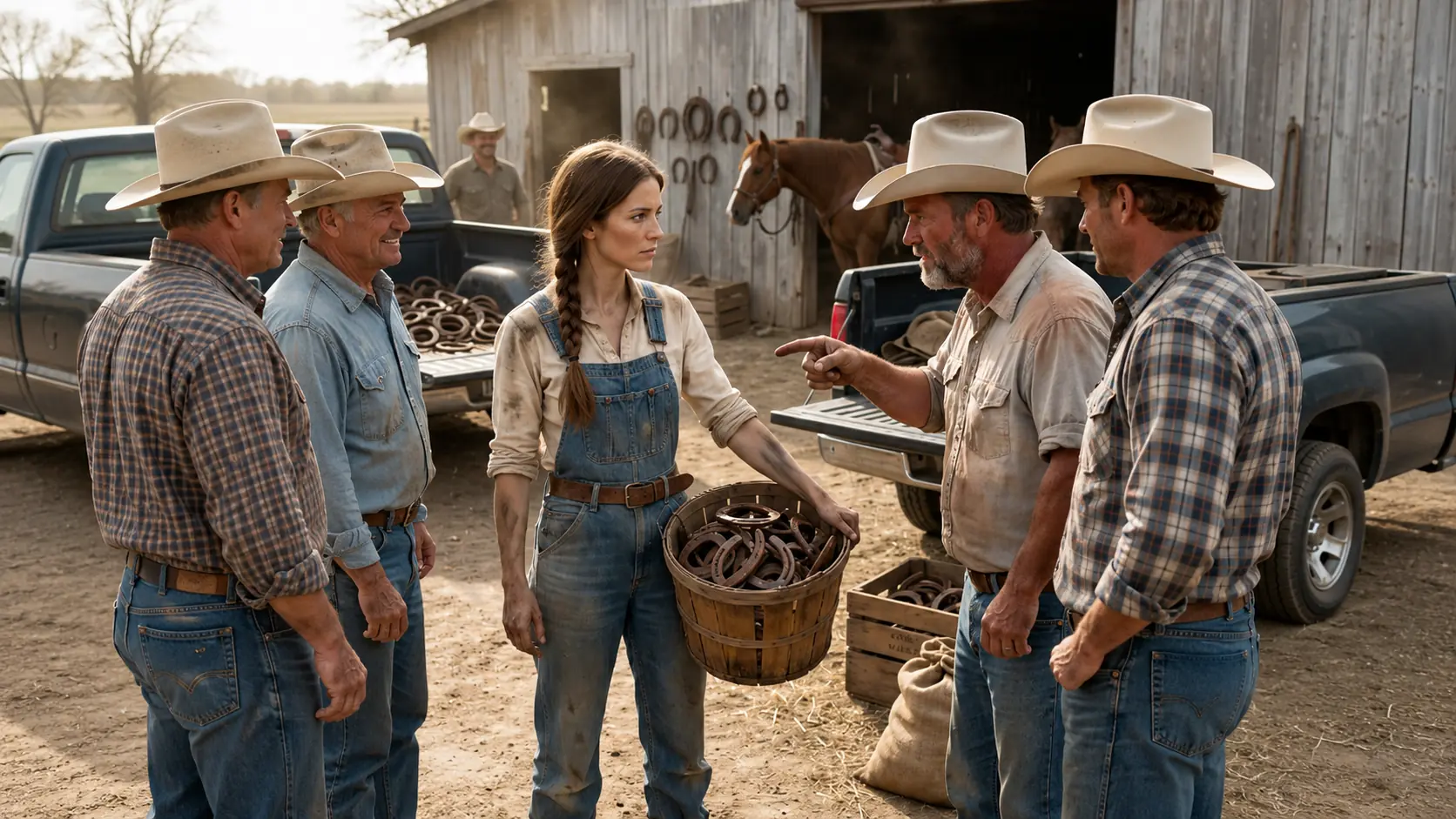
Virgil Yancey stood directly in her path, broad shoulders filling the barn entrance while his injured cutting horse shifted uneasily behind him. The bay gelding favored his left front hoof, lifting it every few seconds before placing it down with visible discomfort. Virgil had waited nine weeks for a traveling farrier from Kingman, and his patience had disappeared long before he arrived at the Puit farm. He had come only because his wife heard at the cooperative that Harlon Puit’s daughter had begun shoeing horses.
“You wasted years collecting scrap and now call yourself a farrier?” Virgil asked.
Several ranchers laughed behind him.
Dela tightened her arms around the basket.
“Move—or keep watching your best horse go lame.”
Virgil’s smile disappeared.
“Ruin that hoof, and I’ll shut this barn myself.”
Dela stepped close enough that he could see there was no uncertainty in her eyes.
“Then bring him inside and try stopping me.”
For several seconds, no one moved. The morning wind pushed dust across the yard, rattling loose boards on the red barn and carrying the smell of forge coal through the doors. Two pickup beds overflowed with horseshoes the ranchers had delivered as a joke after hearing Dela wanted old iron. They expected her to admit that the piles were useless.
Instead, she walked past Virgil.
She placed the basket beside the forge, tied on her leather apron, and examined the gelding from shoulder to hoof. The old shoe had twisted, pulling two nails partially free while forcing pressure against the outer wall. The hoof had begun splitting near the heel, and every additional day threatened permanent damage. Dela ran one hand down the horse’s leg, waiting until he relaxed before lifting the hoof onto her knee.
Virgil watched every movement.
“You learned this from your father?” he asked.
“My father taught me to see metal.”
“That wasn’t my question.”
“No,” Dela replied. “It was the answer.”
Harlon Puit had spent his life refusing to buy anything he could repair or make himself. His shop stood behind the farmhouse, a forty-foot concrete-block building with an oak workbench running along the north wall and tools arranged above it with the precision of a library. Every hammer, vise, rasp, drill, and pair of tongs had a history. Harlon told those histories to Dela as other fathers told stories beside a child’s bed.
When Dela was nine, he took her to a farm liquidation outside Pratt, Kansas. The auctioneer eventually reached a large Maxwell House coffee can filled with rusted horseshoes pulled from a dead man’s barn. He raised the container by its metal handle and looked across the crowd with little enthusiasm.
“Somebody want this?” he asked. “It’s heavy.”
Dela raised her hand.
She had thirty-five cents in her coat pocket, two dimes, a nickel, and five pennies. She placed every coin on the tailgate of the auctioneer’s truck. The men around her laughed as she carried the can toward Harlon’s pickup, struggling beneath its weight while refusing every offer of help.
The story traveled across Pratt County before sunset.
At the feed store, men repeated that Harlon Puit’s youngest daughter had spent her entire allowance on dead horses’ shoes. At the diner, someone claimed she planned to hang them over every door on the farm for good luck. At church, older women smiled indulgently and described it as one of those foolish childhood decisions a family would remember fondly.
Harlon never laughed.
He placed the coffee can on his workbench and helped Dela separate the shoes. He showed her how to identify the stronger iron, how to recognize heat damage, and how to determine whether a crack made a shoe useless or merely changed what it could become. Then he lit the forge and held one bent shoe inside the coal until it glowed orange.
“Rust isn’t death,” he told her. “It’s time.”
He placed the heated shoe on the anvil and struck it with controlled blows.
“Time can be reversed with heat, work, and patience.”
Dela watched the iron straighten beneath his hammer.
“Most people see a horseshoe and think luck,” Harlon continued. “I see forty years of metallurgy.”
From that day forward, Dela attended every farm sale she could reach. She searched through miscellaneous scrap piles that auctioneers bundled together because no one considered the individual pieces worth sorting. She purchased horseshoes with allowance money, harvest wages, and coins earned helping neighbors repair fences.
By sixteen, she had more than two hundred shoes.
She sorted them by size, weight, nail pattern, iron quality, and condition. Coffee cans lined the eastern wall of Harlon’s shop, each labeled in her handwriting. Some shoes could be reheated and fitted again, while others were valuable only as raw material for hooks, brackets, hinges, and tools.
The people who remembered her first purchase did not know she had continued collecting.
To them, the story remained a harmless joke about a little girl and thirty-five cents.
To Dela, it had become an education.
Her two older brothers eventually left the farm. Gene moved to Wichita, while Dale followed a woman to Oklahoma City and found work in an auto plant. Dela remained beside Harlon, first because she loved the shop and later because the farm needed someone who understood more than one job.
By eighteen, she ran harvest equipment.
By twenty, she managed the books.
By twenty-two, she made most daily decisions after Harlon’s heart began failing.
He died on a Tuesday morning in March 1974.
Dela found him seated beside the oak workbench with a neighbor’s irrigation pump resting fully repaired in front of him. Coffee she had brought went cold beside the door while she stood in the silence and understood that every unfinished conversation between them would remain unfinished. Yet the pump was cleaned, reassembled, and ready for installation.
Even at the end, Harlon had completed the job.
Dela inherited three hundred twenty acres of paid-for wheat ground, the farmhouse, the shop, and fourteen thousand two hundred dollars in savings. There was no mortgage, no machinery note, and no operating line of credit. Her brothers suggested that she sell part of the property and place the money somewhere safer.
Dela thanked them.
She sold nothing.
Six months after Harlon’s death, she drove to an abandoned farm outside Medicine Lodge and purchased a seized Champion post vise for eight dollars. The jaws were slightly sprung, the screw would not turn, and the mounting plate had cracked along one edge. The farmer selling it called the vise scrap.
Dela called it repairable.
She loaded it into her truck herself.
Several months earlier, she had purchased tools from an eighty-one-year-old retired farrier named Elden Shrock. For twenty-two dollars, she received his turning hammer, driving hammer, nail pullers, pritchel tools, and clenching block. Elden spent two hours explaining how he used each one.
Dela listened without interrupting.
During the winter of 1974, she rebuilt the Champion vise using the slow-heating method Harlon taught her for cracked cast iron. She restored Elden’s tools, replaced damaged handles, and worked through hundreds of horseshoes collected over fifteen years. Every night, the forge illuminated the same corner of the shop where Harlon had once stood.
Her total investment was less than eighty-five dollars.
The nearest reliable farrier lived forty miles away and charged more than most small ranchers wanted to pay. Waiting lists often reached two months, leaving working horses without proper care. Dela saw the gap long before anyone else noticed her preparation.
Virgil Yancey’s gelding became her first public test.
Inside the barn, she removed the twisted shoe carefully, trimmed the damaged wall, cleaned the sole, and examined the hoof angle. The surrounding ranchers stopped laughing as soon as they saw the confidence of her hands. She moved neither too quickly nor too cautiously.
Dela searched her collection and selected an old shoe close to the correct size. She heated it inside the forge until the rust darkened and the metal began glowing. Then she placed it on Harlon’s anvil.
Each hammer strike changed its shape.
Virgil folded his arms.
“That shoe was already worn out.”
“It was worn for another horse.”
“And now?”
“Now it’s material.”
She adjusted the heels, widened one branch, and corrected the toe to match the gelding’s hoof. When she briefly pressed the hot shoe against the trimmed surface, smoke rose with a sharp hiss. The horse remained calm.
Virgil looked toward the other men.
No one smiled now.
Dela cooled the shoe, nailed it carefully, clipped the ends, and smoothed every clinch against the hoof wall. When she released the leg, the gelding placed his weight down slowly. He took several uncertain steps through the barn aisle before moving evenly.
Virgil followed him outside.
He walked the horse in a circle, then turned him more sharply.
The gelding no longer limped.
Virgil removed his hat and rubbed the back of his neck.
“You learned that from Harlon.”
“Harlon and six hundred horseshoes.”
“What do I owe you?”
“Fourteen dollars.”
Virgil paid without arguing.
Before leaving, he stopped beside the truck bed full of rusted shoes.
“You can use all those?”
“Some.”
“And the rest?”
“I’ll make them useful.”
Virgil nodded once.
By the end of the week, three ranchers called.
Within a month, Dela cared for eleven horses across Pratt County. She charged less than the farrier in Kingman and usually arrived within seven days. More importantly, she understood working animals because she had spent her life around them.
The story traveling through town changed.
People no longer laughed about a child buying scrap iron. They spoke about a young woman who could reshape a discarded shoe with greater precision than men using factory-made stock. Farmers who once left rusted shoes in fence corners began dropping them beside Dela’s shop.
She accepted nearly all of them.
By 1978, Dela served forty-three horses across four counties. She never advertised, borrowed money, or purchased the expensive truck-mounted forge promoted in farrier catalogs. Her overhead consisted mainly of coal, nails, rasps, files, and fuel.
The truck was paid for.
The farm was paid for.
The shop was paid for.
Every year, she deposited several thousand dollars into the same Pratt County bank where Harlon had kept his savings. The wheat harvest covered the farm’s expenses, while the farrier work created cash that remained untouched unless something truly required it.
Around her, the county moved in the opposite direction.
Commodity prices were strong, land values were rising, and bankers encouraged farmers to expand. Men who once cultivated two hundred acres borrowed against their farms to purchase neighboring ground, larger tractors, and wider equipment. The implement dealer in Pratt sold machines faster than the manufacturer could deliver them.
Dela watched quietly.
Virgil financed a new tractor and additional acreage in 1978. When he visited for shoeing work, he proudly described his projections and asked why Dela had not upgraded her old equipment.
“What’s wrong with what I own?” she asked.
“It’s slow.”
“It finishes.”
“You could farm twice as much.”
“Then I’d need twice as much machinery.”
“That’s how you grow.”
“That’s also how the bank grows.”
Virgil laughed.
“You sound like Harlon.”
“Good.”
By 1979, Dela had forty-seven thousand dollars in savings. She remained cautious even when neighbors called her unambitious. Every part of her operation could survive a weak harvest because nothing required a monthly payment.
Then the economy changed.
Interest rates climbed, grain prices weakened, and land values began falling. Farmers who had borrowed against rising property discovered that their loans remained large even as their collateral collapsed. Equipment that seemed affordable during prosperous years became impossible to support when income declined.
Foreclosure notices appeared across Pratt County.
The first auction drew a quiet crowd. The second drew a larger one. By the third, people stopped pretending these were isolated failures.
Virgil lost half his acreage in 1983.
He had not been lazy or careless. He worked from before sunrise until after dark, maintained his equipment, and produced respectable crops. Yet the debt demanded payment regardless of weather or grain prices.
When his property was posted, Virgil arrived at Dela’s shop carrying his hat in both hands.
“I need the gelding done.”
“I can come tomorrow.”
He remained in the doorway.
“I may have to sell him.”
Dela lowered her hammer.
“I heard about the ground.”
“Everyone heard.”
“There’s no shame in being caught by bad prices.”
Virgil’s jaw tightened.
“I threatened to shut down this barn.”
“You were worried about your horse.”
“I laughed at you.”
“A lot of people did.”
“You remember?”
“I remember everything worth learning from.”
Virgil looked across the wall of sorted horseshoes.
“I thought you were wasting your life on scrap.”
Dela returned the glowing metal to the forge.
“So did the men selling it.”
That autumn, one hundred sixty acres bordering the Puit farm went to foreclosure auction. It had belonged to the Shrock family, the same family from whom Dela purchased farrier tools years earlier. The soil was clean, the wheat ground level, and a functioning irrigation well stood in the northeast corner.
The bank opened bidding at two hundred eighty dollars an acre.
A land speculator from Wichita raised his catalog.
A neighboring farmer made the second bid.
Dela waited.
The bidding reached three hundred ten dollars before hesitation spread through the crowd. Most farmers already carried more debt than they wanted, and few lenders were eager to finance additional land. The speculator appeared confident he had nearly won.
“Three hundred forty,” Dela said.
Everyone turned.
The auctioneer paused.
“Three hundred forty dollars an acre from Miss Puit. Do I hear three hundred fifty?”
Silence settled over the yard.
The speculator studied Dela, waiting for uncertainty.
She showed none.
The hammer fell.
Dela purchased the entire one hundred sixty acres for fifty-four thousand four hundred dollars. She walked to a folding table, opened her checkbook, and paid the full amount from savings. No banker approved the purchase, no lender added a lien, and no interest calculation followed her home.
The crowd became quieter than it had been when she first carried the horseshoes from the barn.
Virgil stood near the back.
The same men who once mocked Dela’s basket now watched her sign the papers for ground they could no longer afford. No one mentioned the thirty-five cents she spent as a child, but everyone remembered.
The farmer who had placed the second-highest bid approached.
“I knew your father.”
“Most people did.”
He looked across the newly purchased acreage.
“Harlon would’ve liked this.”
Dela signed the final page.
“He already knew I’d do it. I just had to wait for the price.”
The story traveled from the auction to the feed store, the cooperative, and the diner. This time, it was told carefully because repeating it forced people to admit how badly they had misunderstood her.
The rusted horseshoes had never been the fortune.
They became tools that allowed Dela to build a skill without debt. The skill created income. The income became savings. The savings allowed her to purchase land during a crisis when indebted operators had no flexibility left.
The real value was patience.
Dela eventually farmed four hundred eighty paid-for acres. She continued farrier work until age and experience convinced her to limit the number of horses she handled. The shop remained almost exactly as Harlon built it, with the forge in the southeast corner and his tools arranged above the oak bench.
Years later, Dela’s niece Cassie began spending summers on the farm.
At twelve, Cassie swept the shop and sorted scrap.
At fourteen, she operated the drill press.
At fifteen, she fired the forge herself for the first time.
Dela watched from the doorway as the girl heated a damaged horseshoe and placed it on Harlon’s anvil. Cassie studied the metal before raising the hammer, seeing not what the object had been, but what it could still become.
Dela smiled.
The farm, equipment, shop, and newly purchased land carried no debt when Cassie eventually assumed responsibility for the operation. The coffee cans remained on the eastern wall, their faded labels surrounded by newer containers Cassie added herself.
At a county farming meeting, Dela was once asked to explain how she survived when so many good farmers lost their property. She stood before the room without prepared notes and placed one old horseshoe on the podium.
“What do you see?” she asked.
No one answered.
“Most people see the end of something. My father taught me to see what it can still become if somebody is willing to do the work.”
She lifted the shoe.
“The difference between scrap and material is often only the person looking at it. The same is true of land, money, and time.”
Virgil sat in the third row.
Dela looked across the room.
“I wasn’t smarter than the farmers who lost ground. I had a father who taught me that a paid-for thing is the only thing a bank cannot take. I believed him.”
When she returned to her seat, Virgil met her eyes and nodded slowly.
She nodded back.
No apology was necessary.
The men outside the barn had once laughed because they saw a beautiful young farm woman carrying a basket of rusted iron. They did not see fifteen years of training, hundreds of sorted shoes, a repaired forge, or a financial plan built around refusing debt.
They saw scrap.
Dela saw the beginning.
And when the foreclosure hammer finally fell across Pratt County, she was the one holding enough cash to buy what everyone else had lost.