“A farm boy with a notebook does not overrule twenty million dollars in surveys.”
Victor Callahan stood in the muddy access road wearing a white hard hat, a spotless reflective vest, and the expression of a man offended by being questioned. Behind him, a steel drilling rig towered over the cornfields of northern Iowa, surrounded by excavators, dump trucks, fuel tanks, and dozens of workers. The Prairie Horizon Energy Project had already cost nearly two hundred million dollars, and Victor had no intention of delaying it because a sixteen-year-old boy claimed the ground was moving.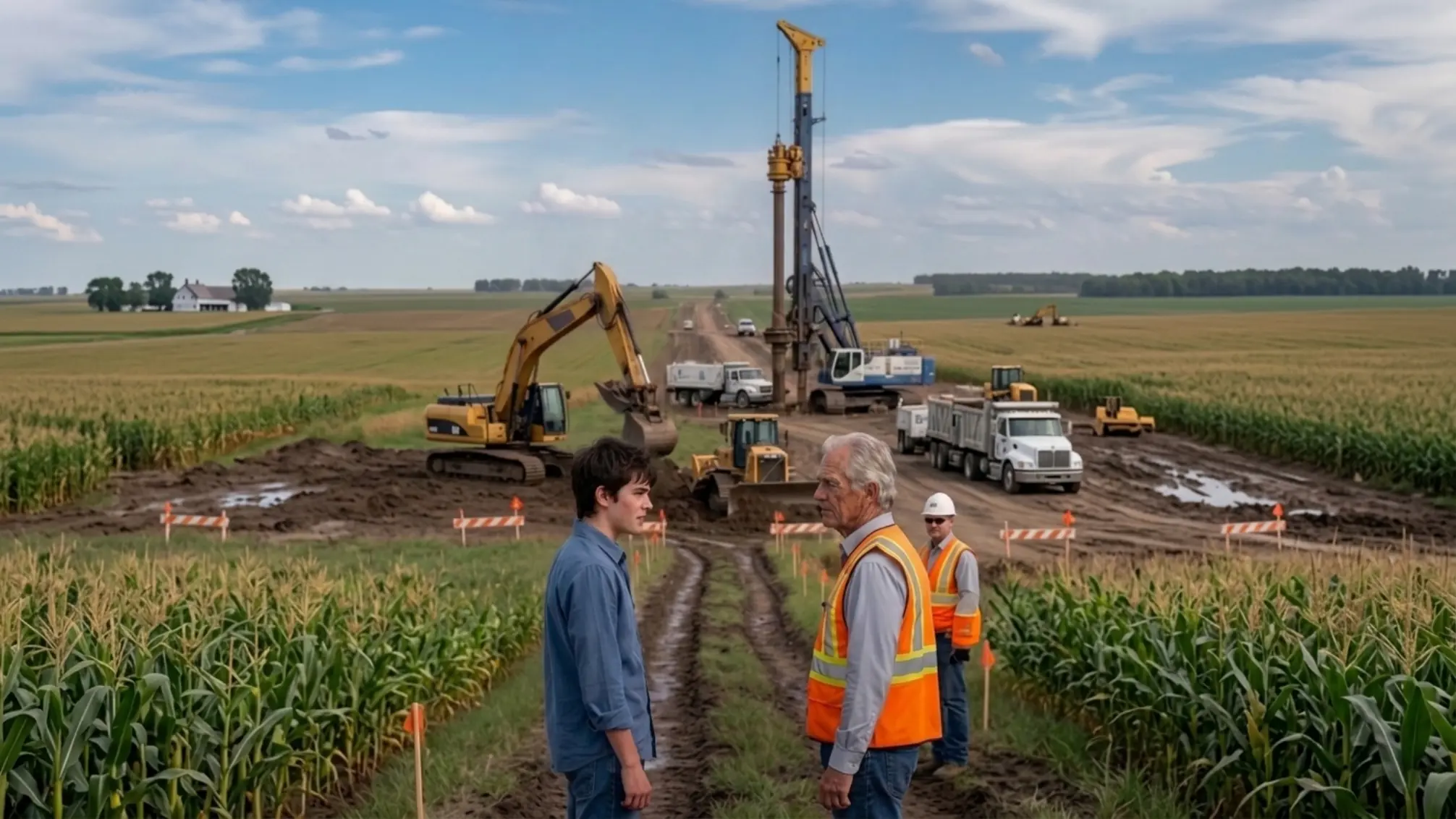
Eli Hargrove held his battered spiral notebook against his chest. His green plaid shirt was damp with sweat, his jeans were stained at the knees, and black mud covered both farm boots. Five years of dates, measurements, sketches, rain totals, disappearing puddles, cracked fence lines, and sinking soil filled the notebook’s pages.
“Your surveys measured the surface,” Eli said. “I watched this ground move for five years.”
Victor glanced toward the three engineers standing behind him. One smirked, while another lowered his eyes as though embarrassed on Eli’s behalf. The project manager pointed toward the county road.
“Leave now, or security removes you before you delay my project.”
A deep metallic groan rolled across the field.
Eli looked past Victor toward the drilling rig. One of its stabilizing pads had sunk several inches into the mud, and a thin crack was spreading away from it like a dark vein.
“Don’t bother,” Eli said. “The ground is about to remove your rig for you.”
Victor turned.
For one second, nobody moved.
Then the drilling platform dropped.
The left side plunged nearly two feet, throwing workers against railings and sending tools skidding across the steel deck. Hydraulic lines snapped tight, a generator screamed, and the enormous vertical mast leaned toward the eastern service road. Men began shouting over one another while warning alarms erupted across the site.
Eli was already running.
“Get everyone off the west platform!” he yelled. “The next break will open beneath the fuel trucks!”
Victor grabbed his arm. “Stay back!”
Eli tore free. “Move those trucks now!”
The lead engineer looked toward the fuel area. The ground there appeared firm, but Eli had marked that exact strip in red ink. Beneath the grass lay a shallow depression that filled after storms and emptied within minutes, not through evaporation but through cracks hidden beneath the soil.
Victor hesitated.
A worker near the rig screamed as another stabilizer shifted.
Eli pointed toward the vehicles. “If that section drops, the tanks roll into the rig!”
Victor finally seized his radio. “Clear the fuel trucks! Evacuate the west side! Move!”
Engines roared to life. Two drivers pulled away from the site while workers descended ladders and ran toward the county road. The first fuel truck reached stable ground seconds before the surface behind it folded inward.
Mud, grass, and gravel vanished into a widening hole.
The second truck’s rear wheels slipped toward the collapse. Eli sprinted beside the cab, waving the driver forward while the engine strained. A construction worker grabbed Eli by the back of his shirt and dragged him away just as the final wheels cleared the edge.
The ground dropped another six feet.
A section of access road disappeared with it.
The rig’s mast leaned farther, steel cables snapping under the strain. The project’s emergency siren began wailing across the fields, sending workers toward assembly points. Victor stood motionless in the mud, watching the earth consume the area his reports had described as suitable for heavy industrial construction.
Eli opened his notebook to a hand-drawn map.
The sink line beneath the rig matched his red markings almost perfectly.
The Hargrove family had farmed that land for four generations. Their own eighty acres ended at the drainage ditch west of the project, but Eli knew the neighboring field almost as well as his family’s property. He had crossed it to retrieve cattle, repair fences, hunt for lost tools, and study the strange ways water behaved after heavy rain.
When he was eleven, a newborn calf disappeared into what looked like an ordinary patch of weeds. Eli and his father found it trapped chest-deep inside a narrow collapse in the soil. They pulled the animal out with ropes, then filled the hole with gravel.
Two months later, the same ground sank again.
That was when Eli began keeping records.
His first notebook had contained childish sketches and misspelled observations. By thirteen, he was measuring cracks with a ruler, recording rainfall from a gauge beside the barn, and placing wooden stakes along the depressions. He noticed that each failure formed part of a curved line stretching from the northern creek toward the abandoned Henson quarry.
His father believed an old underground stream ran beneath the fields. Eli suspected something worse.
The project’s engineers arrived two years later.
Prairie Horizon planned to drill more than ten thousand feet into the earth, using deep geothermal heat to generate electricity for nearly one hundred thousand homes. County officials celebrated the project as an economic miracle. Landowners received generous leases, restaurants filled with contractors, and politicians posed for photographs beside scale models of the future facility.
The Hargroves were offered money for a permanent access road across their eastern pasture.
Eli’s father refused.
Thomas Hargrove did not oppose the energy project, but he refused to sign anything until the company investigated the sink line. He brought Eli’s first notebook to a public meeting and tried to show the project representatives where the soil had collapsed.
Victor Callahan had attended that meeting.
He never opened the notebook.
“The region has passed a professional geotechnical review,” Victor said. “Anecdotal observations do not outweigh engineered data.”
Thomas left furious but unsurprised. He told Eli that educated men sometimes believed a certificate protected them from being wrong. Three months later, Thomas suffered a severe back injury when a grain wagon overturned, leaving most of the farm work to Eli and his mother.
The company purchased access through the neighboring property instead.
Construction began in spring.
Eli watched bulldozers strip away the topsoil and compress thousands of tons of gravel over the exact line he had tracked since childhood. He sent photographs, measurements, and copies of his notes to the company’s field office. Each letter received the same polished response.
The site had been professionally evaluated.
No unusual subsurface risks had been identified.
When the first heavy equipment arrived, Eli began visiting the construction fence every morning before school. He photographed small cracks opening beside the road and marked the places where standing water vanished too quickly. Workers sometimes listened, but supervisors told them not to discuss project matters with a minor.
The morning the rig was scheduled to begin full-depth drilling, Eli skipped his first class.
He carried his fifth notebook directly onto the access road and demanded to speak with the lead engineer. Victor agreed only because several county officials and investors were touring the site, and he wanted the boy removed without creating a spectacle.
Instead, Victor created one.
He opened Eli’s notebook, laughed at the hand-drawn maps, and held it up for the workers behind him.
“This is what you brought me?” he asked. “Mud sketches?”
“They’re measurements.”
“You used fence posts and a school ruler.”
“I used the same points for five years.”
Victor flipped through the pages more quickly. “Where are your soil borings? Ground-penetrating radar? Seismic readings?”
“I don’t have million-dollar machines.”
“Then you have guesses.”
Eli pointed toward a map shaded in red. “The rig sits over a collapse channel. The road crosses it twice, and your fuel station is on the weakest section.”
Victor closed the notebook and pushed it back against Eli’s chest.
“A farm boy with a notebook does not overrule twenty million dollars in surveys.”
Now the rig stood tilted inside a growing basin of mud.
Victor’s surveys had not protected anyone.
The site was evacuated within twelve minutes. No worker died, though two were taken to the hospital with broken bones and another suffered a serious head injury. Emergency crews shut down the power systems, isolated the drilling equipment, and established a half-mile exclusion zone.
The project froze before noon.
County deputies blocked the access road while news helicopters circled overhead. Photographs of the leaning rig spread across television stations before company executives had finished their first emergency call. Reporters gathered beside the Hargrove fence, asking who had predicted the failure.
Workers pointed toward Eli.
Victor tried to stop them.
“This was an unforeseeable localized settlement,” he told the cameras. “We have no evidence that any prior warning accurately identified the failure.”
Eli stood twenty yards away with mud on his shirt and his notebook under one arm.
A reporter approached him. “Did you warn the company?”
“Yes.”
“When?”
“For two years.”
“Can you prove that?”
Eli opened the notebook.
Every page carried a date. Photographs had been taped beside measurements, and copies of mailed letters were folded inside the back cover. Several entries included the names of company employees who had accepted his reports.
The most recent map showed the rig pad, access road, and fuel area.
All three collapse points were marked in red.
The reporter turned the notebook toward the camera.
Victor’s face tightened.
Prairie Horizon’s corporate office released a statement that afternoon promising an independent investigation. The company insisted that safety remained its highest priority, though construction records showed managers had accelerated the schedule to qualify for a federal funding deadline.
State geologists arrived the next morning.
Dr. Naomi Brooks led the investigation team. She was a hydrogeologist who had spent twenty-five years studying sinkholes, abandoned mines, and subsurface water movement across the Midwest. Unlike Victor, she did not begin by explaining why Eli had to be wrong.
She asked him to show her the land.
Eli led Naomi, two surveyors, and his mother along the northern fence. He pointed out shallow curves in the corn rows, dead grass above places where moisture disappeared underground, and small depressions that always returned after being filled.
Naomi crouched beside one crack and pushed a steel probe into the soil.
It sank almost four feet without resistance.
“How long has this one been here?” she asked.
“First opened in 2022. Closed after a dry summer, then returned last April.”
“You recorded that?”
Eli turned to the correct page without searching.
Naomi read his measurements, then followed the line toward the creek. She noticed the pattern immediately.
“These are not separate sinkholes,” she said. “They follow one subsurface feature.”
“That’s what I told them.”
Victor, who had accompanied the group under orders from corporate headquarters, crossed his arms. “Our borings showed competent material beneath the site.”
“How deep were the shallow borings?” Naomi asked.
“Thirty feet.”
Eli answered before Victor could.
“The failures begin below thirty-two.”
Victor glared at him. “You cannot know that.”
Eli opened another page. “When the Miller well collapsed, the pipe dropped thirty-four feet before catching. The old quarry shaft flooded at thirty-seven. I thought the soft layer started between them.”
Naomi looked at Victor. “Did your team review local well failures?”
“We reviewed county geological databases.”
“The Miller well was privately drilled,” Eli said. “It was never entered into the county file.”
Naomi turned toward him. “How did you find it?”
“I helped Mr. Miller pull the pipe.”
The investigation expanded.
Ground-penetrating radar found a long underground void running beneath the project site. Deeper seismic testing revealed that the void was not natural alone. It connected to a forgotten limestone excavation abandoned nearly a century earlier, before modern recordkeeping.
Water had slowly eroded the remaining support pillars.
The project’s enormous weight finished the job.
Victor’s team had drilled between the voids and mistakenly interpreted the solid columns as continuous bedrock. Their model assumed the entire layer was stable because the test points were stable. They never examined the subtle surface pattern connecting the dangerous spaces between them.
Eli had.
His measurements were simple, but they were consistent. He had observed the same land across droughts, floods, freezes, and planting seasons. The company’s consultants spent six weeks studying the site.
Eli had spent five years listening to it.
Three days after the collapse, Prairie Horizon executives held a closed meeting inside the county administration building. Victor entered through a side door, while Eli and his mother were asked to wait outside despite having been summoned as witnesses.
The decision angered Naomi.
“You invited him because his records are evidence,” she told the company attorney. “He enters with the evidence.”
They allowed him inside.
The conference room held company directors, insurance representatives, county officials, engineers, and attorneys. A large screen displayed an aerial photograph of the tilted rig surrounded by the collapsed ground. The estimated recovery and redesign costs already exceeded forty million dollars.
Eli sat beside his mother in a borrowed button-down shirt.
Victor presented first.
He described the collapse as an unprecedented geological anomaly and emphasized that standard industry practices had been followed. He referred to Eli’s observations as “informal community data” that had not met technical review standards.
Naomi waited until he finished.
Then she placed Eli’s notebook beneath a document camera.
“This entry was made fourteen months ago,” she said. “It identifies the first rig location within nine feet of the actual collapse.”
She displayed another page.
“This map predicts the secondary failure beneath the fuel road within six feet.”
Another.
“This photograph shows a surface crack reported to your office seven months before construction.”
The company president looked toward Victor. “Was this received?”
Victor adjusted his tie. “A large project receives many unverified claims.”
Naomi opened the letters folded inside the notebook. “Three were signed for by your field staff. One carries your assistant’s initials.”
Victor’s expression hardened. “The boy had no credentials.”
Eli finally spoke. “Did the ground ask for mine before it collapsed?”
Nobody laughed.
The company president leaned forward. “Mr. Callahan, was the warning evaluated?”
Victor hesitated.
“We compared it to the professional survey.”
“That was not the question.”
“No independent investigation was opened.”
“Why?”
“Because the information came from a sixteen-year-old farmer using homemade methods.”
Eli’s mother placed one hand over her son’s clenched fist.
Victor continued, more defensively. “If every corporation stopped work because a local resident drew lines in a notebook, nothing would ever be built.”
Naomi’s voice remained calm. “He did not draw random lines. He produced a longitudinal field record showing seasonal movement, drainage anomalies, repeated subsidence, and a consistent collapse axis.”
“With respect, Doctor, that interpretation benefits from hindsight.”
“No,” she replied. “The dates prevent hindsight.”
The insurance representative closed the report in front of him. “Your policy requires documented community hazard reports to be included in risk review.”
Victor looked toward the company attorney.
The attorney did not help him.
The board suspended Victor before the meeting ended.
The drilling site remained closed for five months. Engineers stabilized the rig, removed it piece by piece, and redesigned the entire project two miles south on land Naomi’s team confirmed was safe. The original field was declared unsuitable for industrial construction and placed under permanent monitoring.
The company offered the Hargroves a settlement.
The first agreement required them to remain silent about the ignored warnings. Eli’s mother pushed it back across the attorney’s desk without reading the final page.
“My son was mocked in front of your workers,” she said. “Then he helped save those same workers while your engineer stood frozen. We will not sell the truth back to you.”
The second agreement contained no silence clause.
Prairie Horizon paid for the damage caused to surrounding farmland, funded the injured workers’ medical treatment, and created an independent local safety board. Eli received no personal fortune, but the company established a scholarship in his name for rural students studying geology, agriculture, or environmental engineering.
Eli accepted only after the scholarship rules were changed.
He insisted that applicants would not be judged solely by grades or expensive academic programs. Field journals, farm experience, mechanical knowledge, and long-term local observations would count as legitimate evidence of ability.
“Some people learn from land before they learn from classrooms,” he told the board.
Naomi later arranged for Eli to spend Saturdays with the state geological survey. She taught him how to use professional instruments, but she never asked him to abandon his notebook.
“A machine gives you a reading,” she said. “Observation tells you which reading matters.”
Victor resigned from Prairie Horizon after an internal review found that he had dismissed two other local safety concerns during previous projects. He later claimed schedule pressure influenced his decisions, but recordings from the construction site captured his humiliation of Eli clearly.
The video spread online.
Millions watched him call the teenager clueless moments before the rig sank behind him.
Eli refused most interview requests. He returned to school, worked the farm before sunrise, and helped his father through physical therapy. The sudden attention embarrassed him more than Victor’s mockery ever had.
He had not wanted fame.
He wanted someone to move the rig.
By the following spring, grass had begun growing around the collapsed field. The pit was fenced and monitored, its shape visible from the Hargrove barn. Scientists installed sensors that measured underground movement and water pressure.
They hired Eli to check them after school.
On the first anniversary of the collapse, Naomi visited the farm with a package wrapped in brown paper. Inside was a new leather-bound field journal, waterproof and strong enough to survive years of mud.
Eli ran one thumb over the blank cover.
“My old notebook still works.”
“Keep both,” she said. “One reminds you where you started. The other reminds you that people finally learned to listen.”
His father joined them beside the fence. Thomas still walked with a cane, but the strength had returned to his shoulders.
“I should have fought harder when they ignored us,” he said.
“You did fight.”
“Not enough.”
Eli looked across the field toward the sensor towers. “They wouldn’t have listened sooner because the truth was quieter than the project.”
Thomas rested a hand on his son’s shoulder. “You made it loud.”
The redesigned geothermal facility began operating two years later. It produced power safely from the new site and employed dozens of local workers. Before construction resumed, every engineer attended a meeting where community members could present concerns without being dismissed based on education, age, or income.
A framed copy of Eli’s red-marked map hung inside the project’s safety office.
Beneath it was a sentence chosen by the workers evacuated that morning:
THE LAND WARNED US. ONE BOY LISTENED.
At eighteen, Eli graduated from high school and received offers from several universities. He chose Iowa State, where he studied geology and agricultural engineering while returning home every weekend he could.
He carried both notebooks with him.
Professors taught him the mathematics behind subsurface pressure, soil mechanics, and groundwater flow. The knowledge strengthened what he already understood, but it never replaced the lessons written in mud cracks and disappearing puddles.
Years later, Eli returned to Arlen County as a licensed geological engineer.
His first major assignment involved a proposed industrial complex near farmland west of town. The developers arrived with advanced surveys, computer models, and confidence that their site was safe.
Eli reviewed every report.
Then he walked the fields.
He spoke to farmers, well drillers, children who played near the creek, and an elderly woman who remembered where cattle refused to cross after spring rains. He marked their observations before placing a single machine in the ground.
A junior engineer asked why he spent so much time listening to people without technical credentials.
Eli looked toward the old Prairie Horizon collapse visible in the distance.
“Because the ground does not care who has the most expensive report,” he said. “It fails beneath whoever refuses to hear it.”
The sixteen-year-old boy Victor Callahan mocked had never claimed to know everything. Eli only knew that water disappeared where it should have remained, fences shifted without wind, and the earth cracked along the same hidden line every year.
Those facts had not sounded impressive beside a two-hundred-million-dollar project.
They were still true.
The drilling rig did not sink because a farm boy cursed it, sabotaged it, or got lucky with a prediction. It sank because powerful men trusted the cost of their surveys more than the evidence missing from them.
Eli’s notebook did not defeat engineering.
It exposed engineering weakened by arrogance.
And when the ground finally opened exactly where he had marked it, every expert on that road learned the same lesson at once:
Knowledge does not become worthless because it arrives in muddy boots.
Sometimes the person who understands the land best is not the man standing above it in a white hard hat.
Sometimes it is the boy who has spent half his life watching the earth breathe.