The auctioneer held the old draft-horse harness above the dirt as though he were displaying something dead.
The leather had dried into hard, twisted shapes. Rust covered the iron hames, one trace chain was missing its clevis, and mice had chewed two holes through the collar lining. Most of the farmers gathered outside the Fleming County sale barn had already turned toward the next lot before the auctioneer finished describing it.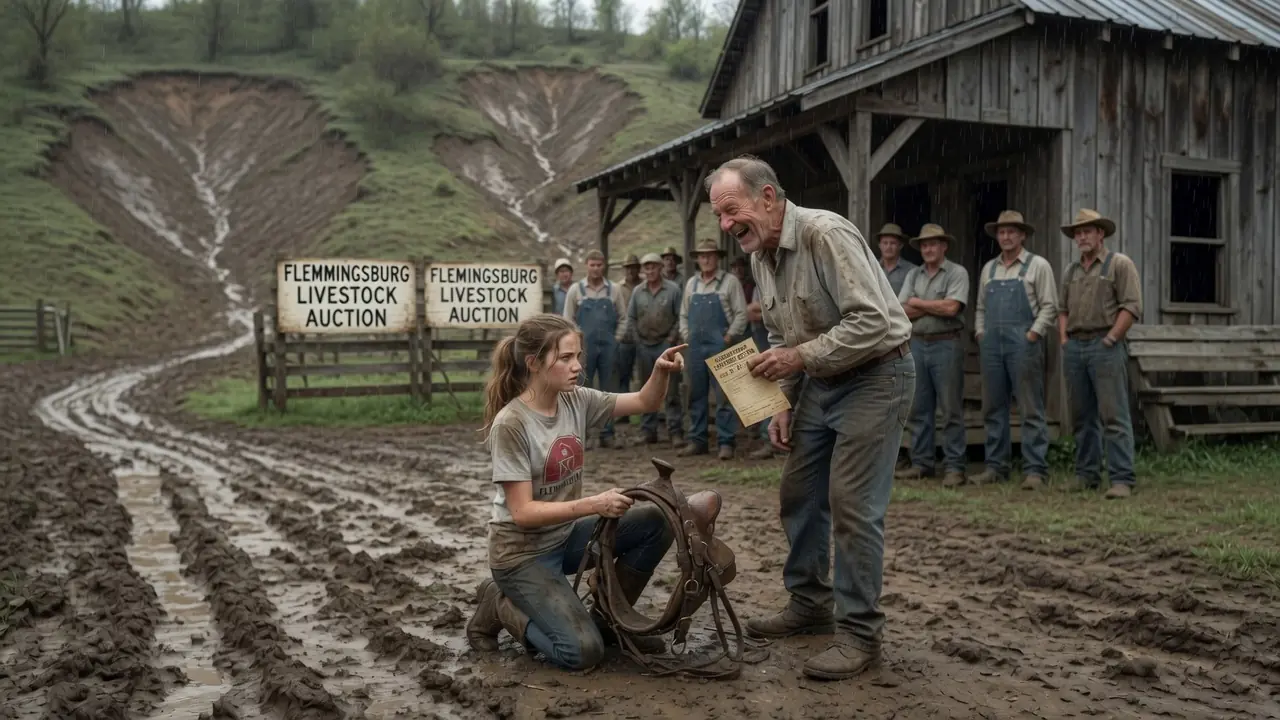
“Four dollars for the scrap man,” he called. “Anybody want to save him the trouble?”
Thirteen-year-old Clara Vickers raised her hand.
The laughter began immediately.
Men near the equipment shed turned to look at the slim farm girl standing beside her mother. Clara wore a faded gray shirt with a worn red farm emblem, dark jeans stained at the knees, and brown boots carrying half the mud from their hillside property. Her long light-brown hair had slipped loose from its ponytail, but her green eyes remained fixed on the harness.
The auctioneer lowered it slightly. “You understand this is horse equipment, young lady?”
“Yes, sir.”
“And you have a horse?”
Clara hesitated only long enough to make several men laugh again.
“Yes, sir.”
That answer was technically true. A nine-year-old Belgian gelding named Porter stood in the back pasture of Vickers Farm, hidden behind the old tobacco barn where passing vehicles could not see him from the county road. Clara and her mother had purchased him two months earlier for sixty-five dollars from a farmer who was selling his final workhorses and replacing them with machinery.
Nobody in Flemingsburg knew.
Clara had learned from her father that plans were sometimes safest before other people had a chance to laugh them apart.
A scrap dealer raised his hand and offered four dollars. Clara bid four dollars and fifty cents. The dealer examined her, shrugged, and walked toward the coffee table.
The auctioneer dropped the harness at Clara’s boots.
“Sold to the little horse farmer.”
The men beside the shed applauded sarcastically.
Vernon Pike pushed his way through them. He was sixty-two, broad through the middle, and owned more cultivated acreage than any farmer within ten miles. His new red tractor had appeared on the cover of a regional equipment catalog, and he mentioned that fact whenever conversations became too quiet.
He picked up one dried strap and snapped it between his fingers.
“This is what you spent your mother’s money on?”
Clara took the broken leather from him. “I spent my own money.”
“Then you wasted it all by yourself.”
Her mother, Ruth, stepped closer, but Clara gently touched her sleeve. Vernon had spent the year since Earl Vickers’s death telling everyone that Ruth would eventually sell the farm. He believed the Vickers women were delaying the inevitable.
The family owned one hundred and twelve acres outside Flemingsburg. Thirty acres lay across a steep northern hillside that became slick whenever spring rain touched the clay. Clara’s father had nearly rolled their Farmall tractor there twice.
After the second incident, he stopped planting the slope.
Broom sedge and thorny multiflora rose took over the ground. Every unused acre meant less tobacco, less corn, and less money for a family already living carefully. Vernon knew that, which was why he had offered Ruth less than half the property’s value three weeks after Earl’s funeral.
Ruth refused.
Vernon kept waiting.
He looked at Clara’s muddy clothes and smiled. “When that hillside swallows your little farm, remember that I tried to help.”
Clara lifted the harness from the ground. The weight nearly pulled her sideways, but she refused to let him see her struggle.
“You tried to buy us cheap.”
“I offered what failing ground is worth.”
“The ground isn’t failing.”
“Your father couldn’t farm it with a tractor.”
“My father knew a tractor wasn’t the only answer.”
Vernon laughed so loudly that everyone nearby heard him. “The horse era is over, child. The rest of us learned that before you were born.”
Clara looked down at the iron hames, the damaged collar, and the heavy traces hidden beneath years of dirt. She did not see trash.
She saw thirty silent acres.
Her father had taught her to recognize useful things beneath neglect. Earl Vickers had grown up behind a team of Belgian mares and never completely trusted tractors on wet slopes. He used machines where they worked best, but he never confused modern equipment with perfect equipment.
“A tractor knows power,” he used to tell Clara. “A horse knows ground.”
Earl’s workshop remained behind the farmhouse exactly as he had left it. The concrete floor was cracked beside the wood stove, the oak workbench bore deep marks from decades of tools, and the wall held leather punches, harness needles, cutting gauges, rivet setters, and a hand-operated drill press older than Ruth.
Clara grew up there.
Before she could multiply fractions, she could thread a harness needle and pull a saddle stitch evenly through thick leather. Her father taught her how to feel the direction of the hide, how to recognize damage caused by dryness rather than rot, and how to restore leather slowly with soap and oil.
“The enemy isn’t work,” Earl said. “The enemy is neglect.”
When he died from a winter illness, Clara stopped entering the workshop for nearly four months.
Every tool reminded her of his hands.
Then Ruth received a letter from the bank warning that their savings would not carry the farm through another poor year. Clara opened the workshop door the next morning.
She swept the floor, lit the stove, and began studying the hillside problem her father had left unfinished.
That investigation led her to Porter.
The Belgian gelding had broad shoulders, calm brown eyes, and feet large enough to leave dinner-plate prints in soft earth. His former owner said Porter had spent most of his life pulling logging sleds and cultivating steep ground. He was slower than a tractor but safer on hills where wheels lost their grip.
Clara understood that a horse without harness was only an expense.
That was why she raised her hand at the auction.
She and Ruth carried the harness into Earl’s workshop that evening. Under the single hanging bulb, it looked worse than it had outside. Two breaching straps cracked when Clara tried to bend them, and the collar lining released a cloud of dust.
Ruth folded her arms. “Can it be saved?”
Clara remembered the way her father inspected damaged equipment. He never began by listing what had failed.
He began by identifying what remained sound.
“The iron is straight,” Clara said. “Most of the buckles are good. The traces are thick. The collar shell isn’t broken.”
“The leather looks dead.”
“It’s dry.”
“Is that different?”
Clara touched the heavy trace with both hands. “Dead leather tears through the grain. Dry leather can sometimes remember.”
Ruth looked toward Earl’s old tools. “Then help it remember.”
For the next eleven weeks, Clara worked after school and farm chores.
She cleaned each section with saddle soap and warm water. She applied neatsfoot oil with a cloth, waited for the leather to absorb it, and applied another thin layer. Some straps softened after three treatments. Others required nearly two weeks.
The restoration could not be hurried.
If she soaked the leather, it would weaken. If she bent it too soon, it would crack. If she reused a damaged strap because replacement cost money, the harness could fail with Porter pulling uphill.
Clara recorded every part in her father’s ledger.
Harness: four dollars and fifty cents.
Replacement clevis: thirty cents.
Wool fleece for collar lining: one dollar and twenty-five cents.
New harness leather: six dollars.
The rest came from materials Earl had stored carefully for years.
Clara removed the old collar lining and replaced it with clean fleece purchased from a neighboring sheep farmer. She cut new breaching straps using Earl’s draw gauge, punched the holes, transferred the original buckles, and set every rivet twice.
When her hands became sore, Ruth held the leather steady.
When Clara’s stitches leaned unevenly, she cut them out and began again.
Word of the project spread.
Boys from school rode their bicycles past the farm hoping to see the “horse girl.” Men at Wanda’s Diner joked that Ruth should sell tickets. Someone left a toy wooden horse beside the mailbox with a note reading:
FOR WHEN THE REAL ONE RUNS AWAY.
Clara placed it on a shelf in the workshop.
She never answered the jokes.
The cruelest visit came from Vernon Pike.
He entered the barnyard one Saturday while Clara was fitting the restored collar around Porter’s neck. The Belgian stood calmly as she checked the spacing between his shoulder and the leather. Sunlight reflected from the cleaned hames, while the traces hung dark and flexible behind him.
Vernon stared.
For a moment, even he appeared impressed.
Then he recovered.
“You put lipstick on a corpse,” he said.
Clara tightened one buckle. “The leather is sound.”
“You think that old animal will pull a plow up thirty degrees of wet clay?”
“He has before.”
“Not your slope.”
“He’ll read it.”
Vernon slapped the side of his boot. “Horses don’t read.”
Clara rested one hand against Porter’s broad neck. “That explains why you understand your tractor better.”
Ruth covered a smile.
Vernon stepped closer to Clara. “You listen carefully. When that horse falls, you’ll lose the animal, the harness, and maybe your life. Then your mother will sell to me because there won’t be anyone left pretending this farm has a future.”
Porter shifted between them.
The gelding did not threaten Vernon. He simply moved his weight closer to Clara, placing hundreds of pounds of quiet muscle beside her shoulder.
Clara looked at Vernon across the horse’s back.
“Spring rain starts Tuesday.”
“So?”
“Come Friday.”
“To watch you fail?”
“To see what your tractor can’t do.”
Rain began Monday night and continued through Thursday morning.
Water filled the roadside ditches. Low fields disappeared beneath shallow pools, and the Fleming County clay turned slick enough to pull boots from a person’s feet. Farmers parked their tractors beneath sheds and waited.
The north hillside of Vickers Farm glistened under gray clouds.
Ruth stood beside the barn while Clara harnessed Porter before dawn on Friday. She had slept very little. Every creak from the roof sounded like another reason to stop her daughter.
“You don’t have to prove anything today,” Ruth said.
“I’m not doing it for Vernon.”
“Then why today?”
“Because this is the ground we bought Porter for.”
Clara fastened the final trace and connected it to Earl’s old walking plow. The wooden handles had been polished smooth by his palms. She had repaired one cracked brace and sharpened the plowshare herself.
Porter followed her toward the hill.
By the time they reached the lower boundary, six vehicles were parked beside the county road. Vernon stood in front of his red tractor, which he had brought on a trailer. Several farmers gathered around him, expecting entertainment.
Vernon pointed toward the hill. “Still time to stop acting foolish.”
Clara examined the slope.
Water moved in thin streams through the weeds, but the soil beneath the upper crust remained firm enough to work if Porter followed the contour rather than climbing directly. She had walked the route three times the previous day and marked the safest line with small sticks.
She positioned the plow.
Porter lowered his head.
“Walk on.”
The Belgian stepped forward.
The traces tightened gradually. The restored collar settled across his shoulders, the hames held, and the plowshare entered ground untouched for almost six years.
Dark earth rolled aside.
A murmur moved through the spectators.
Clara guided Porter along the slope instead of fighting upward. His large feet sank only slightly, spreading his weight across the wet ground. When one hoof slipped, he adjusted before Clara could react.
The horse felt the hillside through every step.
Vernon’s tractor could generate far more power, but its narrow contact points and high center of gravity made it dangerous there. Porter carried his strength close to the ground.
By the end of the first pass, Clara had opened a clean furrow across the hillside.
Nobody laughed.
She turned Porter carefully and began the second pass. The leather stretched under load but did not crack. Every stitch held.
Vernon walked closer, studying the harness as though it had betrayed him personally.
“That soil is too wet,” he called.
Clara did not stop. “It’s turning clean.”
“You’ll cause erosion.”
“I’m following the contour.”
“You don’t know what you’re doing.”
Clara looked toward the straight dark furrow behind Porter. “The ground disagrees.”
Vernon climbed onto his tractor.
Several men warned him not to drive onto the slope, but pride had made the decision before caution could reach him. He started the engine and unloaded the machine from the trailer.
“I’ll show you what real equipment does.”
The tractor entered the lower field safely. Vernon accelerated toward the hillside, keeping the wheels nearly perpendicular to the slope. For the first twenty yards, the machine climbed.
Then the rear tires began spinning.
Mud flew behind them. The tractor moved sideways instead of forward. Vernon turned the steering wheel, but the front end slid downhill.
The men beside the road shouted.
Vernon braked.
The uphill rear tire lifted several inches from the ground.
For one terrifying moment, the tractor balanced near the point of rolling. Vernon shut off the engine and jumped into the mud. The machine settled at an angle, wheels buried deep enough that it could not move without assistance.
Silence covered the hillside.
Clara stopped Porter twenty yards above him.
Vernon stood beside his trapped machine, his expensive trousers splashed with clay.
“Need help?” Clara asked.
His face darkened.
“With that animal?”
“With the horse whose harness you wanted burned.”
Vernon looked toward the gathered farmers. Refusing would leave his tractor stranded. Accepting meant allowing the thirteen-year-old he had mocked to rescue it.
He chose silence.
Clara guided Porter down the contour path. Two men connected the restored trace chains to the tractor’s rear drawbar. Clara inspected every link before giving the command.
“Easy, Porter.”
The Belgian leaned into the collar.
The harness tightened, transferring the load across his shoulders. Porter stepped once, stopped, and adjusted his footing. On the second command, he moved forward steadily.
The tractor’s rear wheels broke free from the mud.
Clara guided Porter downhill until the machine reached level ground. The spectators watched the horse pull thousands of pounds using equipment purchased for four dollars and fifty cents.
When the tractor was safe, Vernon disconnected the chain himself.
His hands shook slightly.
Clara waited for him to speak.
He looked at Porter, the restored harness, and the clean furrows crossing the hillside above them.
“What did you spend on all this?” he asked.
“Seventy-seven dollars and five cents.”
“Including the horse?”
“Yes.”
Vernon glanced toward his tractor. The machine had cost more than four thousand dollars and still carried loan payments.
“You got lucky.”
Clara shook her head. “Luck didn’t restore the leather.”
She returned to work.
By sunset, Porter had opened almost four acres. Over the following weeks, Clara and Ruth planted burley tobacco along the contour furrows. The crop was smaller than what the lower fields produced, but it came from ground that had earned nothing for six years.
The following season, they planted eight more acres.
Vernon’s jokes disappeared from the diner.
Other farmers began visiting the Vickers workshop. At first, they asked about the horse without mentioning the harness. Then they wanted to know how Clara judged old leather, how often she oiled it, and what signs made a strap unsafe.
She answered plainly.
She did not humiliate them for learning late.
Within three years, the north hillside returned to full production. The income allowed Ruth to pay the taxes, repair the barn roof, and avoid every purchase offer Vernon sent.
Clara grew taller, but she never outgrew Porter.
At sixteen, she designed a horse-drawn cultivator using parts from a broken corn planter. At eighteen, she managed the farm accounts and entered every expense in Earl’s ledger. At twenty-one, she purchased an adjoining twenty-acre slope with cash.
Vernon attended that auction.
He stopped bidding when Clara raised her hand.
Years later, during an agricultural recession, high interest rates trapped farmers who had borrowed heavily for equipment and expansion. Vernon’s operation carried payments on tractors, combines, and land purchased during prosperous seasons.
Vickers Farm carried no machinery loans.
Clara used tractors on safe lower ground and horses on wet slopes. She never rejected technology, but she refused to finance equipment simply because other people considered it modern.
When Vernon’s bank foreclosed on part of his property, Clara purchased forty acres bordering her farm. She paid with savings accumulated slowly from land brought back into production by Porter and the restored harness.
Vernon stood beside her fence three days after the sale.
He appeared smaller without the confidence of ownership surrounding him.
“I suppose you were right,” he said.
“About the horse?”
“About not owing money on everything.”
Clara looked toward the hillside where a younger Belgian now worked beneath Porter’s old harness.
“My father taught me that.”
Vernon removed his cap. “I laughed at him too.”
“I know.”
“And you.”
“I remember.”
He studied the dark furrows climbing land his tractor had once failed to work.
“I’m glad the property went to you.”
Clara did not offer him easy forgiveness. “You wanted my mother desperate enough to sell.”
“Yes.”
“You threatened to erase our name.”
Vernon lowered his eyes. “Yes.”
“The ground remembered us longer than you expected.”
He nodded and walked away.
Clara maintained the harness for the rest of her farming life.
Every winter, she cleaned the leather, inspected the stitching, treated it with oil, and replaced damaged sections before they failed. Porter retired at nineteen and spent his final years in the upper pasture.
When he died, Clara buried him beneath a maple near the barn.
The harness remained in service.
Decades after the auction, Clara spoke at a county farm meeting. By then, people described her as an innovative land manager, though many in the room had once called her a foolish child.
She carried the original auction receipt to the podium.
“Four dollars and fifty cents,” she said. “That is what everyone thought this harness was worth.”
She held up one restored trace.
“The value wasn’t in what it looked like that day. The value was in the ground it could work, the horse it could guide, the tools already waiting in our shop, and the knowledge my father left in my hands.”
The room remained silent.
Clara looked toward several young farmers seated in the back.
“People will tell you old things are useless because newer things exist. Other people will tell you new things are better simply because banks are willing to finance them. Neither statement is a plan.”
She placed the receipt beside Earl’s ledger.
“A useful tool is the one that solves your actual problem without creating a larger one.”
After the meeting, the auctioneer’s grandson approached her. He had heard the story throughout his childhood.
“Did everybody really laugh?”
Clara smiled faintly. “Loud enough that I remembered every voice.”
“What made them stop?”
She thought of Porter’s first step into the harness, the wet hillside opening beneath the plow, and Vernon’s tractor hanging sideways in the mud.
“The ground answered them.”
The harness eventually returned to the workshop where Clara had restored it as a girl. She hung it above Earl’s oak workbench beside the original sale receipt and the toy wooden horse someone once left at the mailbox.
Visitors often focused on the tiny price.
Clara focused on the cracked tools, careful stitches, and fifty years of use that followed.
The people at the auction saw ruined leather from an era they believed had ended.
The little girl holding it saw a living horse, thirty abandoned acres, her father’s knowledge, and a future nobody else could recognize.
They were looking at what the harness had been.
Clara Vickers was already looking at what it could pull.