“You get that ink out of a cereal box, old-timer?”
The voice was young, sharp, and soaked in the kind of arrogance that only comes from being very good at something and knowing it.
Glenn Patterson did not look up from his coffee.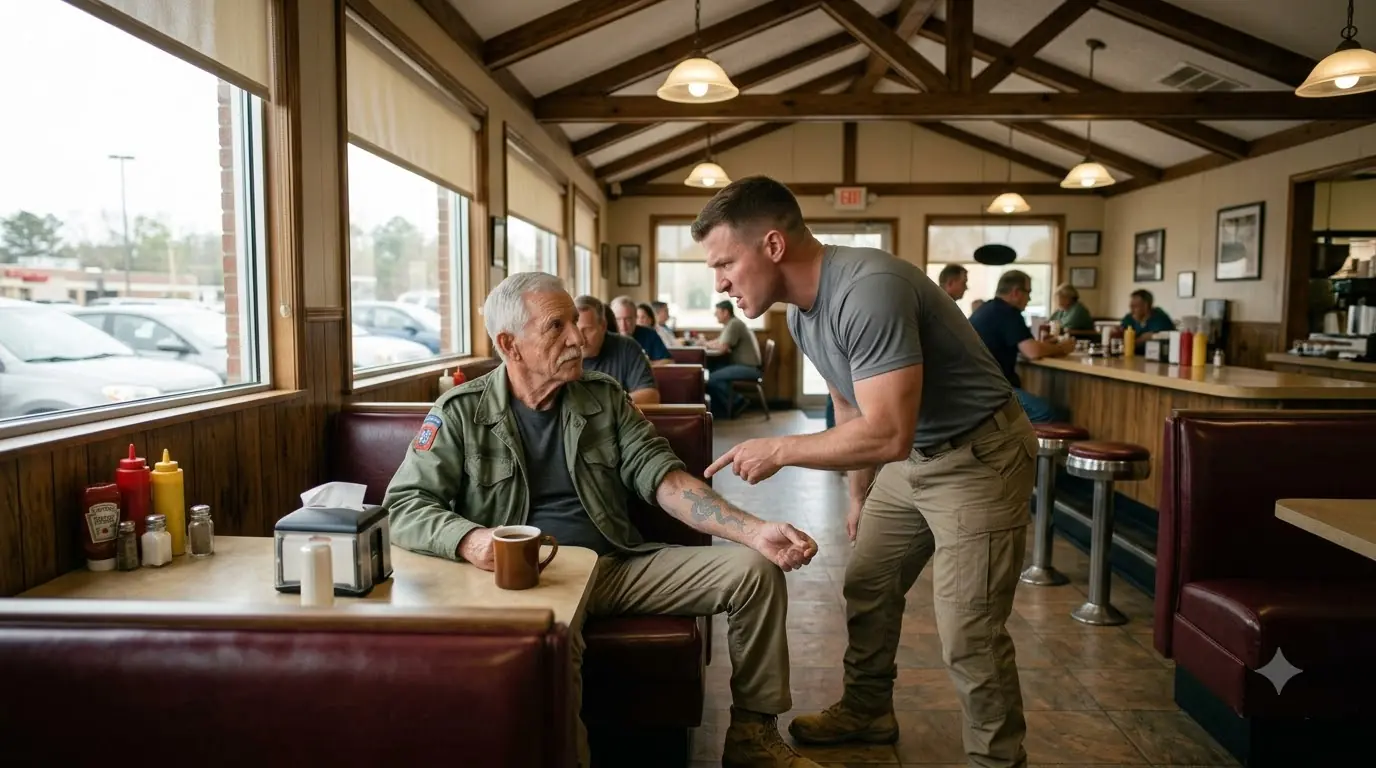
He was eighty-one years old, and the simple act of stirring two cubes of sugar into the dark liquid deserved more of his attention than the pair of mountains standing over his booth.
He could feel their presence, the sheer physical density of them.
They were big men carved from granite and confidence, wearing civilian clothes that did a poor job of hiding what they did for a living.
The one who had spoken was a hard-jawed man with eyes that seemed to miss nothing. He leaned forward and planted both palms on the table.
His knuckles were scarred.
“I’m talking to you.”
The tattoo, he indicated with his chin.
Glenn’s left forearm rested on the worn vinyl edge of the diner table. On the sun-spotted, wrinkled skin was a faded tattoo.
It was a simple design.
A black serpent swallowing its own tail.
Inside the circle it formed sat a single, unadorned five-pointed star.
The lines were thick and blurred by decades. It looked less like a proud military emblem and more like some forgotten doodle from another lifetime.
“What about it?”
Glenn’s voice was raspy, a low rumble that seemed to cost him some effort.
He finally raised his eyes.
They were pale blue and clouded with age, but there was a placid stillness in them that seemed to make the younger man uncomfortable.
The second operator, quieter and more thoughtful, nudged his partner.
“Cutler, leave it alone.”
Cutler ignored him.
“I’m just curious what it’s supposed to be. Some kind of biker thing? You in a club?”
He smirked.
“What’s it called? The Geriatric Guzzlers?”
The diner was called The Scrambled Egg, a cozy little place just a few miles from Fort Liberty. It had been humming with the normal breakfast rush until the exchange began.
Now a pocket of silence was spreading outward from Glenn’s booth.
Sarah, the waitress, stood several feet away holding a coffee pot. She was in her fifties, with a permanently tired but kind face.
She had stopped moving.
Regulars who knew Glenn, the quiet old man who came in for coffee and toast every Tuesday and Thursday, began exchanging nervous glances.
Glenn took a slow sip from his mug.
He placed it back on the table with a steady hand.
“It’s just something from a long time ago.”
“A long time ago,” Cutler repeated mockingly, drawing out every word. “You serve?”
Glenn looked at him.
“What were you? A cook? Quartermaster Corps? Maybe pushing papers in Saigon?”
The condescension was thick enough to feel physical.
Cutler was testing him.
Prodding him.
Enjoying the imbalance.
He and Reyes were among the best of the best, part of the sharpest edge of the modern military. Glenn, by comparison, looked like a relic who had somehow survived long enough to become invisible.
“Something like that,” Glenn said.
His eyes drifted toward the window as if the conversation were already becoming a distant memory.
That seemed to irritate Cutler more than an argument would have.
He had expected deference.
Maybe fear.
At minimum, a flicker of embarrassment.
Instead, he was getting calm indifference.
“You know, we don’t like it when people pretend to be something they’re not,” Cutler said. “It’s called stolen valor. People wearing things they didn’t earn.”
He pointed toward Glenn’s arm again.
“That ink. I’ve never seen it. Not in any book. Not connected to any unit. And trust me, I know them all.”
Reyes spoke again, more firmly this time.
“He’s not claiming anything, man. We’re on downtime. Let him drink his coffee.”
Cutler’s focus remained locked on Glenn.
“I want to know. I want to hear the war story that goes with your fifty-cent tattoo.”
He leaned closer.
“What does it mean, old man?”
Glenn looked back at him.
There was no challenge in his expression.
Only a deep weariness.
As if he were not seeing one arrogant young operator, but a whole line of them stretching backward through decades.
“It means something,” Glenn said quietly, “to the people it’s supposed to.”
Cutler barked a laugh.
“That’s it? That’s all you got?”
He leaned in even closer and lowered his voice.
“I think you’re full of it. I think you spent your war peeling potatoes, then got that thing done in some back-alley shop in Fayetteville to impress girls.”
The disrespect hung in the air, thick and sour.
Sarah placed the coffee pot down with a sharp clink.
The cook in the back had stopped turning pancakes.
The quiet conversations around the diner had disappeared completely.
Everyone was watching.
Cutler straightened with a look of satisfaction.
In his mind, he had won.
He turned toward Reyes.
“See? Nothing. Just another phony.”
Then he made his final mistake.
Cutler reached down and dismissively tapped one finger against Glenn’s tattoo.
The touch was light.
Almost casual.
But to Glenn, it felt like a lightning strike.
The smell of stale coffee and bacon grease vanished.
For one terrible instant, the diner disappeared.
He smelled wet earth.
Smoke.
Rain.
Metal.
The clatter of dishes became the distant rhythm of helicopter rotors.
Glenn was no longer sitting in a vinyl booth.
He was young again.
Crouched beneath a suffocating jungle canopy while rain dripped from enormous leaves.
A muddy hand was gripping his shoulder.
A voice whispered near his ear.
“Stay with me, Pat. Just stay with me.”
Then came another memory.
A makeshift needle.
A sliver of bamboo.
Black ink mixed by men with nothing proper left to use.
Five exhausted survivors gathered in silence inside a hidden camp deep in a country their mission officially never acknowledged.
The serpent eating its own tail.
The circle.
The endlessness of the war.
The five-pointed star.
Them.
Five men.
Five points in a lonely constellation beneath a blacked-out sky.
It had never been decoration.
It was a scar.
A promise.
Glenn blinked.
The jungle vanished.
He was back inside The Scrambled Egg.
Cutler’s finger was still touching his forearm.
Glenn slowly pulled his arm away.
His expression did not change.
But something beneath the calm had shifted.
An ancient tide had turned.
While Cutler continued talking, enjoying his own performance for the silent diner, Sarah was already moving.
She had seen enough.
Glenn Patterson was more than a customer.
He was part of the place.
He always asked how her grandchildren were doing.
He always left a tip far too generous for a cup of coffee and toast.
He had once fixed the loose handle on the diner’s back door without accepting a dime.
Watching two men humiliate him ignited a cold anger inside her.
Sarah knew she could not physically confront them.
But she was not helpless.
She slipped into the cramped office behind the kitchen and pulled the door closed.
Then she reached for an old flip phone.
She did not call the police.
What would they do?
Ask the men to leave?
This felt like a different kind of problem.
Her cousin Stacy worked as an administrative assistant inside a JSOC command office on post.
It was a long shot.
But it was the only one Sarah had.
Stacy answered on the second ring.
“General Thorne’s office. Senior Airman Miller speaking.”
“Stacy, it’s Sarah.”
Sarah kept her voice low.
“Listen, I don’t have much time. Two of your guys are here at the diner, I think. They’re harassing one of my regulars. An old man.”
“Sarah, I’m in the middle of something,” Stacy began. “If they’re causing trouble, call the MPs.”
“No. You don’t understand.”
Sarah glanced toward the office door.
“The old man’s name is Glenn Patterson.”
There was a pause.
“I don’t recognize that name. Is he some retired general or something?”
“I don’t know what he is. But they’re mocking a tattoo on his arm.”
Stacy sighed.
“What tattoo?”
“A snake in a circle. Eating its own tail. There’s a star in the middle.”
Silence.
Three seconds.
Four.
Five.
When Stacy spoke again, her voice had changed completely.
“Say that again.”
“What?”
“Describe the tattoo again.”
Sarah did.
“And you said his name is Glenn Patterson?”
“Yes. Now, are you going to do something or not?”
“Stay where you are.”
Stacy’s voice had become tight.
“Don’t let them leave.”
The line went dead.
Inside the sprawling headquarters of the Joint Special Operations Command, Senior Airman Stacy Miller felt cold sweat forming along her forehead.
The name was not in any ordinary database she could access.
Neither was the symbol.
But Stacy had worked in that office for three years.
She had heard stories.
Not official histories.
Whispers.
Ghost stories told by old sergeants major after long nights.
Stories about men who had existed before many of the modern units had official names.
Men who wrote parts of the playbook in places no public record would ever properly explain.
Project Omega.
General Marcus Thorne, the four-star commander responsible for some of the nation’s most sensitive special operations forces, was in the middle of a highly classified briefing.
The conference room was soundproof.
Its walls glowed with maps, satellite imagery, and restricted material.
Stacy knew the protocol.
You did not interrupt General Thorne during a secure briefing unless something truly extraordinary had happened.
She decided this qualified.
She walked to the heavy door.
Took a breath.
Then knocked.
A colonel opened it a few inches, annoyance visible immediately.
“What is it, Airman?”
“I need to speak with the general. It’s urgent.”
“It can wait.”
“Sir, with respect, it cannot.”
She stepped past him before her courage disappeared.
Every person in the room turned toward her.
Senior officers.
Commanders.
People accustomed to entire organizations moving when they spoke.
General Thorne looked up from the head of the table.
His eyes were hard.
“Airman, this had better be important.”
Stacy walked directly to him.
Her training took over.
She leaned down and spoke quietly enough that only he could hear.
“Sir, I apologize for the interruption. I just received a call from someone off post. A man named Glenn Patterson is being harassed at The Scrambled Egg by two active-duty operators.”
General Thorne’s expression remained neutral.
“They’re questioning his service, sir.”
Still nothing.
“They’re mocking a tattoo.”
Stacy hesitated.
“A serpent in a circle with a star inside.”
The change in Marcus Thorne was immediate.
His composure did not merely crack.
It vanished.
The color drained from his face.
Then something much darker replaced it.
The other commanders saw it and went still.
Thorne stood so quickly that his chair scraped backward.
“Get my detail.”
His voice was low.
“Get my vehicles. Now.”
He turned toward the rest of the room.
“This briefing is over.”
Back at the diner, the tension had reached a breaking point.
Cutler, frustrated by Glenn’s refusal to give him the reaction he wanted, decided to escalate.
“All right, Grandpa. I think we’ve had enough of your stolen valor act.”
His voice hardened.
Then he grabbed Glenn by the upper arm.
“Let’s take a walk outside. You and me. We can talk about respect.”
A collective gasp moved through the diner.
Reyes grabbed his partner’s shoulder.
“Cutler, no. What are you doing?”
Cutler pulled away from him.
He had gone too far to admit it.
He started trying to bring Glenn out of the booth.
That was when everyone heard the engines.
Not sirens.
Something deeper.
Several powerful vehicles arriving almost at once.
Heads turned toward the diner windows.
Three black government-plated Chevrolet Suburbans swept into the parking lot and stopped in disciplined formation near the entrance.
Doors opened immediately.
Men in immaculate service uniforms stepped out.
They were not ordinary patrol personnel.
They moved with synchronized precision, scanning entrances and surroundings as they established a security perimeter around the diner.
Cutler froze.
Reyes froze beside him.
They recognized the vehicles.
More importantly, they recognized several members of the command security detail.
All color vanished from Cutler’s face.
The rear door of the lead Suburban opened.
General Marcus Thorne stepped out.
Four silver stars gleamed on his uniform.
He did not look toward the patrons gathered at the windows.
His attention remained fixed on the front entrance.
The security detail followed several steps behind as he walked toward the diner.
The bell above the door jingled when he entered.
In the dead silence, the tiny sound seemed enormous.
The general filled the doorway.
He ignored the shocked customers.
Ignored the staff.
Ignored Cutler and Reyes.
His eyes swept once across the room.
Then stopped on Glenn Patterson.
He walked straight toward the booth.
His polished shoes stopped inches from the table.
Cutler still had one hand gripping Glenn’s arm.
General Thorne looked down at it.
Whatever Cutler saw in the general’s expression caused him to release Glenn instantly.
Then Marcus Thorne did something nobody inside The Scrambled Egg expected.
He brought his heels together.
Straightened his back.
And in the middle of that small diner, surrounded by the smell of coffee, toast, bacon, and old vinyl seats, the four-star general raised his hand.
He rendered Glenn Patterson a perfect salute.
Time seemed to stop.
Glenn looked at him.
After a long moment, Thorne lowered his hand.
His voice carried an emotion none of the people around him had expected to hear.
“Glenn.”
A faint, sad smile appeared on the old man’s face.
“Marcus. You got old.”
For the briefest moment, Thorne smiled back.
Then he turned.
The warmth vanished.
He faced Cutler and Reyes.
“You.”
Cutler swallowed.
“You questioned this man.”
No answer.
“You questioned that tattoo.”
Cutler attempted to speak, but only a broken sound came out.
Thorne did not wait.
Slowly, deliberately, he unbuttoned the cuff on his right sleeve.
Then he rolled it upward.
Past his wrist.
Past his watch.
Up his forearm.
There, on the skin of the four-star general, was the same tattoo.
A serpent swallowing its own tail.
A circle.
A five-pointed star.
Thorne’s tattoo was newer and clearer.
But it was unmistakably identical.
A wave of shock moved across the diner.
“Let me tell you who you were speaking to,” General Thorne said.
His voice was low but carried to every corner of the room.
“This is Glenn Patterson.”
Cutler stared.
“Before many of the units you know today had taken their modern form, there were small groups of men sent into places where conventional answers didn’t exist.”
He glanced toward Glenn.
“One of those efforts was known internally as Project Omega.”
The diner remained silent.
“They operated without recognition. Without public ceremonies. In some cases, without records that ordinary service members would ever see.”
Thorne stepped closer to Cutler and Reyes.
“Glenn Patterson was one of the original men attached to that legacy.”
He let the words settle.
“In 1968, his team was compromised during an operation deep inside hostile territory. They spent weeks evading forces that vastly outnumbered them.”
Glenn looked down at his coffee.
He did not seem proud.
Only tired.
Thorne continued.
“I was a young lieutenant then.”
His eyes shifted toward the tattoo on his own arm.
“I was wounded. Glenn carried me through the final stretch toward extraction when I could no longer move properly on my own.”
The general looked directly at Cutler.
“Five men wore this symbol.”
His voice lowered.
“Only two of us are still alive.”
He glanced toward Glenn.
“You are looking at both.”
The weight of the revelation settled across the room.
Customers who had known Glenn for years stared at him as though they were seeing him for the first time.
The quiet old man who ordered coffee twice a week.
The man who asked about grandchildren.
The man who sat in the same booth near the window.
He had carried a history none of them knew existed.
General Thorne turned back toward the two operators.
His rebuke was not loud.
That made it worse.
“You wear the uniform of the quiet professional.”
Neither man moved.
“That word means something.”
Thorne’s eyes hardened.
“Today, you forgot the quiet part.”
A pause.
“You forgot the professional part.”
Another pause.
“You forgot that much of what you inherited was built through the sacrifices of people whose names you may never know.”
Cutler’s eyes dropped.
“You saw an old man and decided his age made him beneath you.”
Thorne looked toward Reyes.
“And you recognized something was wrong but waited too long to stop it.”
Reyes’s jaw tightened.
“Yes, sir.”
The general looked between them.
“My office. Zero-five-hundred tomorrow.”
Cutler swallowed.
“Sir…”
“Be prepared for reassignment and a complete review of your status.”
The words landed harder than shouting could have.
Glenn finally moved.
He slid slowly out of the booth and stood on unsteady legs.
Everyone expected anger.
Maybe satisfaction.
He showed neither.
He looked at Cutler first.
Then Reyes.
“The tattoo doesn’t make the man,” Glenn said.
His voice was soft.
“The man makes the tattoo mean something.”
Cutler raised his eyes.
Glenn gestured vaguely toward the uniforms around them.
“All this comes and goes. Units change. Leaders change. Gear changes. Titles change.”
His pale blue eyes held Cutler’s.
“But your character, son, that’s the only thing you truly own.”
He paused.
“Try not to lose it.”
Then he turned toward Marcus Thorne.
“Buy me a coffee, Marcus. It’s been a while.”
Thorne put one steadying hand on Glenn’s shoulder.
And in that moment, another memory passed through Glenn’s mind.
Not combat.
Not fear.
A quiet moment afterward.
A temporary aid station.
A much younger Marcus Thorne sat with one arm bandaged while Glenn carefully finished the tattoo on his forearm using the improvised tools they had available.
Glenn remembered the words he had spoken more than half a century earlier.
“It’s a promise.”
Marcus had looked at him.
“To what?”
“To remember the ones who aren’t here.”
Glenn had finished the final line of the circle.
“And to never quit.”
Then he had tapped the younger man’s arm gently.
“Now you’re one of us for life.”
The fallout from the incident at The Scrambled Egg was swift.
But General Thorne did not see Cutler and Reyes as the entire problem.
He saw them as symptoms.
Young operators had become so focused on present-day excellence that some had stopped understanding the history beneath the institutions they served.
Within a month, Thorne ordered the creation of a new mandatory instruction block for special operations candidates.
It was called Legacy.
The course focused on the history and lineage of their profession, including the sacrifices of earlier generations whose missions were rarely discussed publicly.
The classes were not taught only by active-duty instructors.
Vetted veterans from Vietnam, Grenada, Panama, and other eras were invited to speak directly with younger service members.
They talked about mistakes.
Fear.
Duty.
Restraint.
Brotherhood.
And the difference between confidence and arrogance.
Glenn Patterson was among those invited.
He did not particularly enjoy speaking in front of groups.
At first, he refused.
Marcus called him personally.
“You owe me,” the general said.
“For what?”
“For carrying me.”
“That debt expired fifty years ago.”
“Then do it for the kids.”
Glenn was quiet for a while.
Eventually, he agreed.
Cutler and Reyes were not dishonorably discharged.
General Thorne believed simply throwing them out would teach them less than forcing them to confront what they had failed to understand.
They were reassigned away from their previous elite operational roles.
Then they were placed on the permanent administrative staff supporting the Legacy program.
Their responsibilities were not glamorous.
Travel arrangements.
Classroom preparation.
Schedules.
Equipment.
Transportation.
Making sure elderly veteran speakers had everything they needed.
For three years, Cutler and Reyes served the very generation they had once failed to respect.
Day after day, they listened.
A Green Beret from Vietnam who had never told his children what he had done.
A medic who spent decades carrying guilt over one man he could not save.
A reconnaissance veteran who still remembered every name from his team.
Men who wore no medals to the grocery store.
Men who walked with canes.
Men who forgot where they left their glasses but could still remember coordinates from fifty years ago.
Gradually, something changed.
Reyes adapted first.
His natural caution turned into humility.
He began asking questions.
Then he began staying after sessions to help veterans pack their materials and escort them back to their transportation.
Cutler changed more slowly.
His arrogance had been harder.
More deeply attached to his identity.
But there was only so long a man could listen to quiet stories of sacrifice before realizing how little his own reputation actually meant.
About a year after the incident, Glenn was inside a local hardware store searching for a particular bolt for his old lawn mower.
He moved slowly down an aisle lined with drawers and bins, holding an old part in one hand for comparison.
Behind him, someone cleared his throat.
Respectfully.
Glenn turned.
A young man stood several feet away wearing a simple Army physical training uniform.
It took Glenn a moment.
Then he recognized him.
Cutler.
He looked leaner than before.
The hardness around his eyes was gone.
So was the swagger.
“Sir,” Cutler began. “Mr. Patterson.”
Glenn waited.
“I don’t know if you remember me.”
“I remember.”
Cutler swallowed.
He had clearly rehearsed the words.
Then decided not to use the rehearsal.
“I wanted to say what I did that day was wrong.”
Glenn said nothing.
“There’s no excuse for it.”
Cutler looked directly at him.
“I was arrogant. I thought being good at my job meant I was better than people I didn’t understand.”
His voice remained quiet.
“I humiliated you because I wanted to feel important.”
Glenn watched him.
“I’m sorry.”
There was no dramatic speech.
No attempt to explain everything away.
No demand to be forgiven.
Just an admission.
Glenn studied the younger man for a long moment.
Then he extended his hand.
Cutler took it.
He was surprised by the strength still remaining in Glenn Patterson’s grip.
“We all have things to learn, son,” Glenn said.
His voice was the same quiet rumble it had always been.
“The important thing is that you keep learning.”
Cutler nodded.
“Yes, sir.”
Glenn released his hand.
Then turned back toward the wall of hardware drawers.
He compared the old mower bolt against another one.
The conversation, as far as he was concerned, was finished.
Cutler stood there for another second.
Then he quietly walked away.
Glenn never became famous.
He never wanted to.
There was no public monument outside The Scrambled Egg.
No giant ceremony.
No parade.
Most people who passed him on the street still saw only an elderly man moving carefully beneath the weight of eighty-one years.
That suited Glenn perfectly.
Every Tuesday and Thursday, he returned to the diner.
Coffee.
Toast.
Two cubes of sugar.
Sarah usually had the mug waiting before he reached the booth.
Sometimes Marcus Thorne joined him when his schedule allowed.
A four-star general sitting across from an old man in a worn jacket drew more attention than Glenn preferred, but he tolerated it.
They rarely talked about 1968.
There were enough ghosts between them without inviting them to breakfast.
Instead, they talked about ordinary things.
Weather.
Cars.
Sarah’s grandchildren.
Glenn’s lawn mower that never seemed to stay fixed.
Sometimes silence.
Especially silence.
The old tattoo remained on Glenn’s forearm.
Faded.
Blurred.
Easy to misunderstand.
A serpent swallowing its own tail.
A five-pointed star.
To almost everyone who saw it, it meant nothing.
To the people it was supposed to, it meant everything.