The sun had barely risen when Frank Matthews placed his old cap on his head.
The gold letters had begun to fade, but Frank could still feel them beneath his fingers.
He looked at himself in the mirror.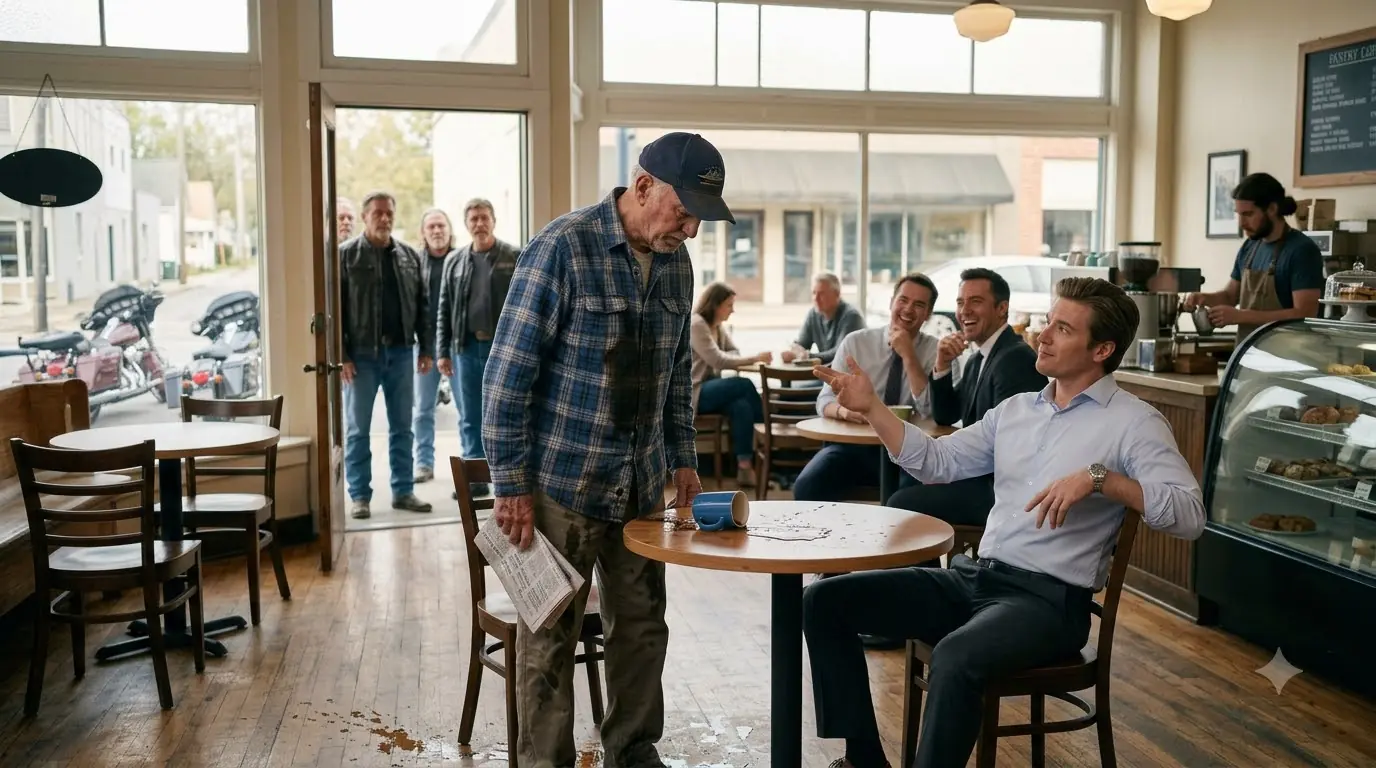
White hair stuck out beneath the cap, and deep lines crossed his face like a map of every place he had been.
Frank was seventy-eight years old now.
His blue eyes, however, remained sharp and clear.
Every Tuesday morning for the previous ten years, Frank walked six blocks to Joe’s Coffee Shop.
Rain or sunshine, heat or cold, he never missed his Tuesday coffee.
The walk helped his stiff legs, even though they hurt more than they used to.
Joe’s Coffee Shop stood at the corner of Oak and Main.
The red-brick building had been there for more than fifty years.
Above the entrance hung a hand-painted sign showing a large steaming coffee cup.
The bell jingled when Frank pushed open the door at exactly 8:15 in the morning.
“Morning, Frank,” Marissa called from behind the counter.
Her bright red hair was tied in a ponytail, and her smile was as warm as the coffee she served.
“The usual?”
Frank nodded and walked toward his corner table beside the window.
From there, he could see the entire shop and watch people passing outside.
The wooden chair creaked beneath him.
The table had a small chip along one edge that Frank’s thumb always found, like greeting an old friend.
“One black coffee, no sugar, in your blue mug,” Marissa said as she placed the cup before him.
Steam rose from the dark liquid, carrying the rich smell of freshly brewed coffee.
“Thank you, dear,” Frank said.
His voice was slightly rough from not speaking much at home.
“How is that boy of yours doing in school?”
“Tommy earned an A on his history test about World War II,” Marissa said proudly.
“He remembered all those stories you told him.”
Frank smiled.
He enjoyed sharing stories with Tommy.
The boy listened with wide eyes, unlike many children who seemed interested only in phones and games.
Frank opened his newspaper and took a sip of coffee.
Warmth spread through his chest and pushed away the chill of the morning.
The shop slowly filled with its regular customers.
The hiss of the coffee machine and the low murmur of conversations made Frank feel less alone.
His fingers briefly touched the metal hidden beneath his flannel shirt.
He never showed it to anyone, but he always wore it.
Twenty-seven men.
That was how many he could not save when the great storm struck their ship in 1972.
Some nights, he still heard their voices in his dreams.
“More coffee, Frank?” Joe asked.
Joe was a large man with kind eyes and hands made rough by years of work.
He had opened the shop after returning home from the Gulf War and always made time for Frank.
“Not yet, Joe.”
Frank held up the blue mug.
“I am still working on this one.”
He looked toward Joe’s leg.
“How is that knee?”
“Better since the new medication.”
Joe leaned against the table.
“Are you coming to the Veterans Day ceremony at the park next week?”
Frank nodded.
“I have attended every one since they began.”
Morning sunlight now filled the shop and made the wooden floor glow.
Frank could smell fresh muffins coming from the kitchen.
His newspaper contained stories about places he had visited many years before.
Some memories were good.
Others were not.
The bell above the door jingled again.
Three young business professionals entered while talking loudly.
They wore expensive, perfectly pressed shirts and polished shoes that appeared never to have touched hard work.
Frank could tell from the way they carried themselves that they believed they were important.
“I am telling you, these budget cuts are necessary,” the tallest one said while joining the line.
“The military receives too much money anyway.”
“Exactly,” the second man answered.
“Half those elderly veterans do nothing except sit around collecting government checks.”
Frank pretended not to hear.
He had learned long ago that some fights were not worth beginning.
He turned a page of the newspaper, although his hands were no longer completely steady.
The three men collected their drinks and searched for somewhere to sit.
The shop had become crowded.
Frank could feel them looking at him and at the Navy cap on his head.
“Look at Grandpa Navy over there,” the tall man said without lowering his voice.
“I bet he has occupied that table all morning.”
Frank’s jaw tightened.
He kept his eyes fixed on the newspaper.
The words became slightly blurred.
It was not because of tears, he told himself.
His eyes were simply tired.
“Hey, old-timer,” the tall man called as he approached Frank’s table.
“Did you ever do anything in the Navy, or do you only wear that cap to receive free coffee?”
Several customers lowered their eyes.
Others pretended not to hear.
Marissa frowned from behind the counter, but customers were waiting for service.
“I asked you a question, sir,” the man said.
He stood directly beside Frank’s table while his two companions laughed behind him.
“Are you still living on our tax money after all these years?”
Frank slowly looked up.
The man wore a smug expression and a smile that never reached his eyes.
Frank thought about everyone with whom he had served.
The men who returned home.
The men who did not.
The medal felt heavy against his chest.
His hand trembled slightly as he lowered the newspaper.
“I served twenty-two years in the United States Navy,” Frank said quietly.
“I enlisted when I was eighteen.”
He met the man’s eyes.
“But I do not owe you my story, son.”
The tall man leaned closer.
Frank could smell expensive cologne mixed with coffee on his breath.
“I suppose you only moved paperwork around some safe little base.”
He laughed.
“My tax dollars at work.”
Frank’s fingers touched the edge of the newspaper.
He remembered the storm that struck the Nimitz.
Waves rose like buildings.
Water and wind roared across the deck while men cried out as they were swept toward the sea.
Frank had tied himself to a rail with his belt so he could reach three young sailors.
He had not reached the other twenty-seven in time.
“You may believe whatever you want,” Frank said.
His voice had become steady again.
“I know what I did.”
“We have a tough man here,” the second professional said.
He laughed and intentionally allowed some of his coffee to spill across Frank’s newspaper.
“Sorry about that, Grandpa.”
Frank watched the brown stain spread across the paper.
It was not truly about the newspaper.
It was about respect, something that seemed increasingly difficult to find.
“I was a rescue swimmer and later became a chief petty officer,” Frank said.
“I served during Vietnam and two Gulf conflicts.”
He looked toward the men.
“I lost good friends, but you would not understand that kind of friendship.”
The third man, who had remained quiet until then, removed his phone.
“This is excellent.”
He aimed the camera at Frank.
“The old man is getting upset about his glory days.”
Several customers looked uncomfortable.
An elderly woman shook her head.
A young mother drew her children closer, but nobody intervened.
“Please leave me alone,” Frank said.
He suddenly felt extremely tired.
“I only want to drink my coffee in peace.”
“This is a public place,” the tall man answered.
He pulled out a chair and sat at Frank’s table without permission.
“Free country.”
He spread his arms.
“Is that not what you fought for?”
Frank’s hands began shaking.
It was not fear.
It was anger and pain.
He thought about his wife, Sarah.
She had waited through three tours and raised their son mostly alone while Frank remained at sea.
When he came home with nightmares, Sarah held him through the darkness.
She had been gone for five years.
Cancer.
Some nights, Frank still reached toward her empty side of the bed.
“That is my table,” Frank said.
“I sit here every Tuesday.”
“I do not see your name on it.”
The man spread his arms wider.
His sleeve struck Frank’s blue mug.
Hot coffee spilled across the table and into Frank’s lap.
Frank jumped up as the liquid soaked through his pants.
His newspaper became saturated.
Coffee dripped onto the floor.
“Careful, Grandpa Navy,” the tall man said, laughing without offering assistance.
“Do not break a hip.”
Marissa hurried over carrying a cloth.
“Are you all right, Frank?”
She looked angrily toward the three men.
“You need to leave him alone.”
“We are paying customers,” the second man replied.
“We are only having a friendly conversation with the veteran.”
Frank tried to dry his pants with a napkin.
His hands shook so badly that he dropped it twice.
The burn against his leg hurt.
The humiliation hurt more.
Inside his pocket was a photograph of his former crew.
Eighteen men stood proudly on the deck of the Nimitz.
Only seven had lived long enough to attend their final reunion.
“I think I should leave,” Frank said.
He reached toward the floor for the cap that had fallen from his head.
As he bent down, his back tightened painfully.
The sharp sensation forced a gasp from him.
The medal around his neck slipped from beneath his shirt and became visible.
“Well, look at that,” the tall man said.
He pointed at it.
“Grandpa has a fancy medal.”
“What did you receive that for?”
The second man laughed.
“Keeping an office chair warm?”
Frank quickly tucked the medal back beneath his shirt.
It was the Navy Cross, awarded after the storm rescue.
It was the nation’s second-highest decoration for valor.
Frank never discussed it.
He never displayed it.
For him, it had never been about glory.
It had been about duty.
“That is a Navy Cross,” Joe said.
He had come over to help clean the table, and anger tightened his voice.
“You do not receive one of those for pushing papers.”
The three men exchanged glances.
They still refused to back down.
The tallest one scoffed.
“He probably bought it at a pawn shop.”
“These old men enjoy playing dress-up.”
Frank’s face burned.
He thought about his son, Michael, who had followed him into the Navy.
Michael died when his helicopter went down in Afghanistan.
Frank had given him his first Navy cap, just like the one now lying on the coffee-stained floor.
“I need to use the restroom,” Frank said.
His voice cracked slightly.
He needed a moment alone.
He needed to breathe.
“Do you need help finding it?” one of the men called as Frank limped toward the back.
“Try not to fall in.”
Frank closed the restroom door and leaned against the sink.
The mirror showed a face red with shame and anger.
He held the edge of the sink until his knuckles turned white.
Frank had faced enemy fire.
He had survived storms capable of swallowing ships.
Somehow, this felt more difficult.
Those men had made him feel small.
They made his service seem small.
Frank splashed cold water across his face.
His pants were still wet with coffee.
When he looked up again, he saw the old Navy cap reflected in the mirror.
He had placed it back on his head.
That cap had remained with him through everything.
It was more than fabric and thread.
It represented who he was.
“Pull yourself together, Chief,” Frank whispered, using his former rank.
“You have survived worse than this.”
When Frank opened the restroom door, he heard the three men laughing from his table.
His table.
They had taken more than his seat.
They had taken his dignity.
For the first time in years, Frank Matthews wondered whether all the sacrifice had been worthwhile.
He drew a deep breath and returned to the front of the shop.
The men were still sitting at his table and speaking loudly.
His blue mug had been pushed aside.
Coffee continued dripping onto the floor.
Frank’s shoulders lowered slightly.
Perhaps he should simply leave.
He could return the following morning.
Marissa met his eyes from behind the counter.
She appeared both angry and heartbroken.
“I am so sorry, Frank,” she mouthed silently.
Frank nodded.
None of it was her fault.
He looked around the shop.
Most customers stared at phones or coffee cups and pretended not to see.
An older woman in the corner shook her head sadly.
A man in a business suit frowned, then returned his attention to his laptop.
Nobody wanted to become involved.
“I think I will go home,” Frank told Joe quietly.
“Those men are behaving terribly,” Joe said.
“Let me speak to them.”
Frank shook his head.
“They are not worth the trouble.”
“I will return tomorrow.”
As Frank turned toward the entrance, the bell above the door jingled.
The sound cut through the room.
Everyone looked up.
Five large men stood inside the doorway.
They wore black leather vests bearing patches across their backs.
Each patch displayed a winged skull.
Words curved above and below it.
HELLS ANGELS MOTORCYCLE CLUB.
The men had long beards and heavily tattooed arms.
Their boots struck the wooden floor with heavy sounds as they entered.
The shop became silent.
Even the three professionals at Frank’s table stopped speaking.
Only the quiet hiss of the coffee machine remained.
The largest biker had broad shoulders and a salt-and-pepper beard.
He slowly examined the room.
His eyes moved from customer to customer until they stopped on Frank, who stood alone beside the counter.
The biker narrowed his eyes when he noticed Frank’s Navy cap.
Then he looked toward the three men occupying Frank’s table.
His attention returned to Frank.
The large biker walked directly toward him.
Each step landed heavily against the floor.
He stopped one foot away.
Frank did not step backward.
He had faced more frightening things in his life than a man wearing leather.
“That is a Nimitz cap,” the biker said.
His voice was deep and rough.
“You served aboard her?”
Frank nodded.
“Twenty-two years.”
“Chief petty officer.”
The biker’s expression changed.
Some of the hardness disappeared.
He extended one large hand.
It was covered in calluses, with old scars crossing the knuckles.
“Mike Reynolds.”
He nodded toward Frank’s cap.
“My father served in the Navy.”
“Pacific Fleet, 1968 through 1972.”
“He was aboard the Constellation.”
Frank accepted the hand.
The handshake was firm and warm.
“Frank Matthews.”
He looked into Mike’s eyes.
“I was there during the same years, on another ship.”
Mike nodded slowly.
His gaze returned to the three men.
Then he noticed Frank’s wet pants, the coffee stains, and the blue mug pushed aside.
“Is that your regular table?”
He nodded toward it.
“Every Tuesday for ten years,” Frank said.
Mike looked toward the four bikers who had entered with him.
He gave a small nod.
They moved toward Frank’s table together.
“Excuse me, gentlemen,” Mike said.
His voice was polite.
His eyes were not.
“I believe you are sitting at this man’s table.”
The tall professional looked up.
His expression mixed surprise with fear.
“We are drinking coffee.”
He tried to sound confident.
“There are other tables.”
“Not for him.”
Mike placed one hand against the back of a chair.
“This is his table.”
“Every Tuesday.”
He looked at the three men.
“It is time for you to move.”
The professionals exchanged nervous looks.
For several seconds, it appeared that they might argue.
One of the other bikers stepped closer and crossed his arms.
His leather vest creaked with the movement.
“We were leaving anyway,” the tall man said quickly.
He stood and collected his coffee.
His companions followed.
They moved to a small table beside the door, as far from the bikers as possible.
Mike pulled out Frank’s chair.
He wiped it with several napkins until it was dry.
“Sir.”
He gestured toward the seat.
“Your chair.”
Frank felt a lump forming in his throat.
He returned to his table and sat.
The other bikers brought chairs over and positioned themselves around him like a protective wall.
“Joe,” Mike called toward the counter.
“Could we have fresh coffee and something to eat?”
He looked toward Frank.
“What would you like, sir?”
“An apple Danish,” Frank answered.
His voice was slightly rough.
“But you do not have to buy anything.”
“Five black coffees and one apple Danish,” Mike called.
He turned back toward Frank.
“My father would return from the grave to correct me if I failed to show proper respect to a chief.”
Frank looked around at the bikers sitting beside him.
Their faces were hard, marked by difficult years.
Their eyes were kind when they looked at him.
“Tell us about the Nimitz,” one of the younger bikers said.
“My uncle served in the Navy.”
“He always told the best stories.”
Frank smiled slightly.
He had not spoken about his experiences in a long time.
The last time was when Marissa’s son Tommy asked him for help with a history assignment.
Frank glanced across the shop.
The three professionals sat crowded around their small table, looking uncomfortable.
Other customers now watched openly.
Some wore small smiles.
“Well,” Frank said, touching the brim of his cap.
“I began as a rescue swimmer in 1969.”
He looked down into the coffee.
“The things I saw on that water.”
As Frank began speaking, Mike and the others leaned closer.
Their expressions showed genuine interest.
For the first time in years, something tight inside Frank’s chest began to loosen.
Surrounded by leather and tattoos rather than uniforms, he discovered a kind of respect he believed had disappeared.
For the next hour, the coffee shop filled with Frank’s stories.
His voice became stronger with each one.
He described the enormous waves during the 1972 storm.
They rose like mountains made of black water.
Frank told them what it felt like to enter the violent sea to reach three young sailors.
He explained how he tied himself to the ship with his belt so he would not be carried away.
“The water was so cold that it burned,” Frank said.
Both hands rested around a fresh blue mug.
“The storm was so loud that you could not hear a man shouting beside you.”
The bikers listened in respectful silence.
Nobody interrupted.
When Frank spoke about the twenty-seven men lost that day, Mike placed a hand on his shoulder.
“My father told me about that storm,” Mike said.
“He called it the worst he had ever witnessed.”
Mike’s hand remained there.
“He said the men who entered the water to save others were the bravest men he had ever known.”
Frank looked down.
“Not brave enough.”
His voice became quiet.
“I could not reach all of them.”
“You did what nobody else could,” Mike said firmly.
Across the shop, the three business professionals listened.
The tall one wore a strange expression, as though he were seeing Frank for the first time.
When Frank mentioned the Navy Cross beneath his shirt, the young man’s eyes widened.
Frank did not notice.
He was back on the deck, feeling the movement of the ship beneath his feet.
He could smell diesel fuel mixed with salt air.
The bikers nodded as he spoke.
They asked questions showing that they cared about the answers.
People entered and left the coffee shop, but many remained longer than usual to listen.
A young woman with a small child sat at a nearby table.
“That man is a hero,” she whispered to her daughter.
“Listen to his story.”
When Frank finally stopped speaking, the shop felt different.
Warmer.
Friendlier.
Even the sunlight through the windows appeared softer.
“Sir,” Mike said, “we have a veterans’ charity ride this Saturday.”
“It raises money for the veterans’ hospital.”
He looked at Frank.
“You would honor us by joining.”
Frank blinked in surprise.
“Me?”
He shook his head.
“I do not ride anymore.”
“My hips are too bad.”
Mike smiled.
“One of my friends has a motorcycle with a comfortable sidecar.”
“We will collect you from this coffee shop.”
He removed a card from his vest and placed it on the table.
“That is my telephone number.”
“You call anytime you need something.”
“Day or night.”
The three business professionals stood from the table near the entrance.
For a moment, Frank expected them to leave without speaking.
Instead, the tall man slowly crossed the shop.
He stopped at the edge of Frank’s table.
His face was red with embarrassment.
“Sir,” he said.
His voice was quiet now.
Nothing remained of the earlier arrogance.
“I want to apologize.”
He struggled to continue.
“I was wrong.”
“What you did matters.”
Frank looked up at him.
The man was still young.
In that moment, he did not seem so different from the sailors Frank had once tried to save.
Young, foolish, and convinced he understood more than he did.
“We all make mistakes, son,” Frank said.
“The important thing is learning from them.”
The young man nodded.
Then he turned and quickly left the shop.
His two companions followed.
The bell jingled as the door closed.
“Well,” Mike said, examining his large silver watch.
“We should leave as well.”
He stood.
The other bikers followed.
“Will we see you Saturday, Chief?”
Frank nodded.
A small smile appeared on his face.
“I will be here.”
Each biker shook Frank’s hand before walking outside.
Mike remained until last.
At the doorway, he turned and gave Frank a sharp salute.
Frank straightened in his chair and returned it.
The old sense of pride moved through him again.
After they left, Frank remained at the table.
Marissa brought him another Danish.
“On the house.”
She smiled.
Joe stopped beside him and placed one hand on his shoulder.
“You have quite a group of supporters now, Frank.”
Frank chuckled.
“I never imagined becoming friends with Hells Angels.”
“Good men arrive in many different forms,” Joe said.
“Will we see you tomorrow?”
“Count on it.”
When Frank finally left the coffee shop, he walked slightly taller than when he had entered.
The pain in his hips seemed less severe.
The air felt fresh inside his lungs.
He nodded to people along the sidewalk.
They returned the gesture with new respect in their eyes.
The following morning, Frank returned to Joe’s Coffee Shop.
His corner table was empty and waiting.
Something had changed.
A small sign rested on top of it.
RESERVED FOR CHIEF PETTY OFFICER FRANK MATTHEWS, USN, RETIRED.
The sign was made from polished wood with brass corners.
“Joe placed it there this morning,” Marissa said as she brought the blue mug.
“He said it was long overdue.”
On Saturday, the rumble of motorcycle engines filled the street outside.
Five Hells Angels arrived.
One motorcycle carried a comfortable sidecar, exactly as Mike had promised.
Frank emerged wearing his best Navy cap.
For the first time in years, the Navy Cross was displayed proudly against his chest.
The ride through town gave Frank a feeling he had not experienced in decades.
Wind crossed his face and made him feel young again.
People along the sidewalks waved.
Frank smiled and waved back.
At the veterans’ hospital, former service members welcomed him with handshakes and salutes.
Some were young and recently returned from distant countries Frank had never visited.
Their eyes carried the same expression Frank recognized inside his own mirror.
A week later, Frank sat at his table reading the newspaper.
The bell above the door jingled.
He looked up and saw Mike entering with two other bikers.
Behind them walked the tall young man who had mocked Frank.
“Chief,” Mike said with a nod.
“This young man wants to ask you something.”
The young professional stepped forward.
He carried a small box wrapped in blue paper.
“Sir,” he said.
His voice was gentler now.
“Today is my brother’s birthday.”
“He is leaving for Navy service next week.”
The man looked down at the package.
“I was hoping that, if it is not too much trouble, you might share some wisdom with him.”
“Perhaps advice that could help keep him safe.”
Frank folded his newspaper.
Then he smiled and tapped the empty chair beside him.
“Pull up a chair, son.”
He pushed the chair outward.
“I have a few stories your brother may want to hear.”