He stepped inside slowly, deliberately, as if every step had been measured before he ever reached the glass doors.
His shoes were scuffed from years of wear, the leather cracked near the toes, the soles repaired more than once by a cobbler who still worked out of a narrow shop in Houston’s Third Ward. 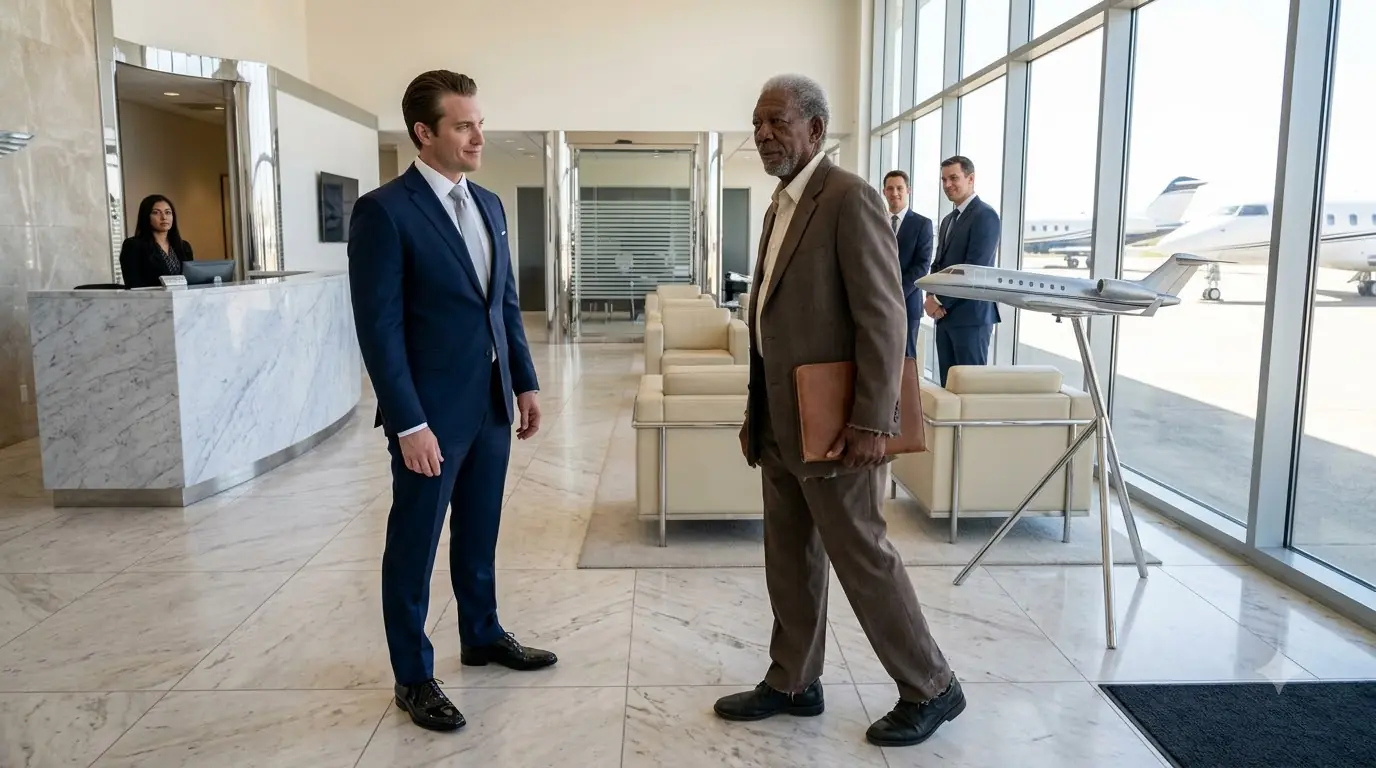
They tapped softly against the polished marble floor of Wellington Jets, a quiet defiance against the gleaming perfection surrounding him.
The showroom was cool enough to make a man aware of his own breath.
The air carried a crisp, artificial chill, thick with the scent of wealth, the kind of wealth that was not merely possessed, but displayed. Every inch of the space had been designed to tell visitors one thing before a single salesperson opened his mouth.
This was not a place for ordinary men.
Towering floor-to-ceiling windows framed the tarmac outside, where sleek private jets glistened under the Texas sun. Silver wings caught the afternoon light. White fuselages shone as though they had never known dust, weather, distance, or work.
A massive Gulfstream model dominated the center of the showroom, its wings stretching outward like the arms of giants.
A silent proclamation of power.
This was a place for the elite.
The untouchable.
The ones who did not ask for price tags because asking would imply the number mattered.
James Carter did not look like he belonged there.
He knew it the moment he stepped through those glass doors.
And so did they.
The first look came from the receptionist, a young woman behind a curved white desk with a headset tucked neatly against her blond hair. Her painted smile faltered for half a second before she recovered and gave him the kind of expression service workers reserve for people they have already decided will become inconvenient.
Then came the second look from a young salesman adjusting the cuff of his thousand-dollar suit. His eyes flicked up from his phone only long enough to widen with barely concealed amusement.
The third came from deeper inside the showroom, where two men in tailored jackets stood near a display, exchanging a glance before one of them let out a low chuckle.
The laughter was subtle at first.
Tucked behind smirks.
Hidden under polite disinterest.
Disguised as professionalism.
But James Carter had spent a lifetime reading rooms.
He felt the shift, the hum of condescension growing, curling through the space like a slow-moving current ready to pull him under.
He kept walking.
Each step measured.
Each movement a quiet testimony to a lifetime of perseverance.
He was seventy-six years old, tall once, though age had bent him slightly at the shoulders. His skin was deep brown and lined from decades of sun, grief, and laughter. His hair, what remained of it, was silver and closely cut. He wore a brown suit that had been fine once, maybe twenty years earlier, but was now softened with age and shiny at the elbows.
His tie was simple.
His watch was old.
His hands were large and weathered, hands that had held steering wheels, ledgers, Bibles, shovels, contracts, and the hands of dying friends. They were not soft hands, though they belonged to one of the wealthiest men in the state of Texas.
No one in the showroom knew that.
No one cared to know.
A voice cut through the air.
“Sir, are you lost?”
Not a genuine question.
A performance.
The young salesman from before now stood directly in James’s path, an easy grin spreading across his face. His name tag read Brandon Walker. He was perhaps thirty, clean-shaven, handsome in the polished way of men who had been told too often that charm could replace character.
James met his eyes.
There was no anger in his gaze.
No indignation.
Just patience.
“I’d like to inquire about purchasing a jet,” James said.
His voice was calm.
Steady.
Silence followed.
For a moment, just a moment, Brandon hesitated, as if his mind needed a second to register the words.
Then came the exhale.
The barely perceptible scoff.
The amusement flickering across his face like a ripple in still water.
One hand rested on his hip. The other gestured vaguely toward the showroom, as if the jets themselves were too grand to be connected to the man in front of him.
“I’m sorry, sir,” Brandon said, “but these jets aren’t for window shoppers.”
His tone was light, teasing, as if he were indulging a child in a game of make-believe.
“Maybe we can find you a nice tour instead.”
Laughter followed.
Louder now.
Less restrained.
Someone from the back let out a low whistle. Another voice, more distant, muttered something James could not quite hear, but it sent another wave of amusement through the staff.
James did not react.
He let them speak.
Let them look at him and see only what they wanted to see.
An old Black man in a faded suit.
A curiosity.
A momentary joke in their otherwise polished day.
They did not see the decades of sacrifice etched into his hands.
They did not see the weight of experience in his stance.
They did not see the boy who had once shined shoes on a Birmingham sidewalk while rich men stepped around him without lowering their eyes.
They did not see him at all.
And that was fine.
James Carter had never been the kind of man to demand recognition.
He had spent his life building, creating, lifting others up while staying in the background. He had known wealth in all its forms, had sat beside men who wore power like a weapon and men who carried it with quiet grace.
He understood both.
Brandon looked him over again.
“Sir, these jets start at around fifty million dollars,” he said. “That’s before customization, storage, crew, maintenance, and operational costs.”
James nodded slowly.
“I understand.”
Brandon smiled wider.
“Do you?”
A few of the salesmen behind him chuckled.
James looked past him toward the tarmac, where a white jet sat in the sun, polished and ready for someone who would never be asked whether he belonged.
“I’d like to see your financing options,” James said.
The room went still for half a second.
Then another round of laughter broke loose.
Brandon pressed his lips together, fighting back a grin.
“Oh,” he said. “You want to finance a jet?”
“That’s right.”
A lanky salesman in a navy suit cut in from near the model display.
“Maybe we can start with a paper airplane and work our way up.”
The laughter hit harder this time.
Even the receptionist, trying to appear professional, bit her lip to hold back a smile.
James did not laugh.
He simply took a slow breath.
Then he turned his gaze directly toward Brandon and the others, his expression unreadable.
“I may not look like much to you,” he said, his voice calm and unshaken. “But God knows my worth.”
The laughter stopped for a brief, flickering moment.
Something in his voice shifted the air in the room.
It was nothing loud.
Nothing angry.
Just a simple, quiet certainty.
James nodded once, as if he had learned all he had come to learn.
Then he turned without another word and made his way toward the exit, his steps unhurried, his posture straight.
The laughter followed him as he walked away.
The doors shut behind him.
The sound was final.
They thought that was the end of it.
They thought they had seen the last of him.
They thought he was just another man who had stepped into the wrong world.
They were wrong.
Because tomorrow, James Carter would return.
Not as a customer.
As their boss.
James Carter had always believed in the power of humility, hard work, and quiet generosity.
At seventy-six years old, he had lived a life most men only dreamed of, though you would not know it by looking at him. He was not a man of flashy suits or expensive watches. He did not drive a car that announced his wealth before he even stepped out of it.
His personal truck was twelve years old.
His favorite Bible was older than that.
The brown suit he wore to Wellington Jets had been bought for his fiftieth wedding anniversary, back when his wife, Ruth, was still alive and still insisting that if he was going to be stubborn about humility, he could at least be clean and pressed while doing it.
Ruth had died six years earlier.
James still wore the suit because she had liked it.
He had built his fortune the way a man builds a house.
One brick at a time.
One sacrifice after another.
His story was not one of overnight success or inherited privilege. He had grown up in Birmingham, Alabama, in the heart of the segregated South, where dreams for boys like him were often snatched away before they could take flight.
His father, Elijah Carter, worked as a janitor in a textile factory. His mother, Lucille, cleaned houses for families who sometimes left their leftovers wrapped on the counter for her to take home, as if charity could excuse the way they spoke to her.
James remembered those houses.
Wide porches.
Tall columns.
Silverware in drawers lined with velvet.
Children his age with books, bicycles, and shoes that had never been patched.
He remembered standing beside his mother at the back door because the front door was not for people like them.
He remembered the taste of humiliation before he knew the word for it.
But he remembered something else more clearly.
His mother’s voice.
“God has a plan for you, James,” she would whisper at night, reading Scripture by candlelight because sometimes the electric bill waited behind groceries. “Never let this world tell you what you’re worth. Let God decide that.”
His father was quieter.
A tired man, but not a defeated one.
Elijah’s hands were rough as bark, his back bent from years of labor, but his eyes remained steady.
One evening, when James was twelve, he came home angry after a white shop owner chased him away from the front of a store where he had been trying to buy a notebook.
Elijah listened.
Then he placed both hands on James’s shoulders.
“Son,” he said, “life won’t ever hand you a thing. You take what you need with work, with faith, and with a heart clean enough to sleep at night.”
James carried those words into every room he ever entered.
By the age of ten, he was shining shoes on dusty Birmingham streets, earning pennies to help his mother afford bread and milk. Men sat above him on wooden stands, talking over his head as if the boy polishing their shoes could not hear them discussing business, politics, money, land, investments, mistakes, and opportunity.
But James heard everything.
He learned how powerful men spoke before he was ever allowed into a room with them.
He learned that confidence had a rhythm.
That decisions had a smell.
That rich men were not always smarter, only more accustomed to being believed.
He memorized the way they carried themselves.
And deep down, he made a promise to himself.
One day, I won’t just work for these men.
I will build something they cannot ignore.
At eighteen, James left Birmingham with fifteen dollars in his pocket, a Bible from his mother, and an unshakable faith in Jesus Christ.
He arrived in Houston, Texas, sleeping in cheap boarding houses and taking any job that would pay. He worked at a shipping dock during the day and attended night school when he could stay awake. He swept warehouses, loaded trucks, repaired crates, balanced ledgers for a man who could not spell half the words in his own invoices, and learned every corner of the freight business from the ground up.
He learned which drivers were honest.
Which dispatchers padded time.
Which routes cost money.
Which clients paid late because they were struggling and which paid late because they knew they could.
He learned that most businesses did not fail all at once.
They failed from small neglects allowed to become habits.
At twenty-four, James saw an opportunity where others saw a wreck.
A small freight company on the edge of Houston was on the verge of shutting down. It had one truck, three unpaid fuel bills, two angry clients, and an owner named Mr. Bilson who had lost heart after a stroke.
James had no money to buy it outright.
But he had a reputation.
He had never missed a shift. Never stolen. Never lied on a log. Never promised what he could not deliver.
So he sat across from Mr. Bilson at a metal desk with a fan rattling in the window and made an offer.
“I’ll take the debt,” James said. “You keep ten percent until I pay you out. Give me two years.”
Mr. Bilson stared at him.
“You’re crazy.”
“Maybe.”
“You ever run a company before?”
“No, sir.”
“You ever own a truck?”
“No, sir.”
“You got collateral?”
James placed his Bible on the desk.
“No bank would accept it,” he said. “But it has carried me farther than money.”
Mr. Bilson looked at him for a long time.
Then he laughed.
Not mockingly.
Wearily.
“All right, Carter,” he said. “Let’s see what your God and your stubbornness can do.”
James worked harder than ever.
He drove the truck himself.
Loaded cargo himself.
Made deliveries himself.
Knocked on doors himself.
He slept in the cab when routes ran late. He ate peanut butter sandwiches at loading docks. He fixed mechanical problems with borrowed tools and learned bookkeeping from library books with cracked spines.
Within two years, he paid off the debt.
Within five, one truck became five.
Within ten, five became twenty.
Within twenty years, Carter Freight Solutions was one of the most reliable logistics companies in Texas.
By then, James had married Ruth, a schoolteacher with a sharp mind, a patient heart, and the ability to call him out when success started making him too pleased with himself.
Ruth understood him better than anyone.
She knew he loved business, but she also knew he feared becoming the kind of man who forgot the back door after finally being invited through the front.
So she kept him grounded.
When Carter Freight landed its first national contract, she made him come home early to attend a church potluck.
When a magazine called him a titan of logistics, she clipped the article, framed it, and hung it in the laundry room.
When he asked why, she said, “So you can remember your socks still need washing.”
James laughed for ten minutes.
As his wealth grew, so did his purpose.
He moved into real estate, then technology, then infrastructure. He invested in companies others overlooked and saved businesses that still had good bones beneath bad management. He became known not for flashy takeovers, but for quiet strategic moves that transformed entire industries without announcement.
But he did not hoard his success.
He funded churches.
Supported single mothers.
Paid tuition for students who never thought college was possible.
Bought groceries for families whose names never appeared on donor lists.
Helped pastors keep the lights on when tithes ran low.
He never put his name on half the gifts.
Ruth once asked him why.
James said, “If I need my name on it, maybe I’m not giving it to God.”
But there was one dream he had never pursued.
A private jet.
Not for extravagance.
Not for status.
James had spent years watching pastors, missionaries, doctors, disaster relief organizers, and struggling community leaders fight to get from place to place. He saw small ministries turn down chances to serve because travel was too expensive. He saw rural church leaders drive fifteen hours to conferences where they were expected to arrive fresh and inspired. He saw medical volunteers lose days on the road when hours in the air could have placed them in communities that needed them sooner.
So he made a promise to himself.
One day, when the time is right, I’ll make sure they never have to say no because of distance again.
That day had come.
So, dressed in the same simple brown suit Ruth had once liked, James Carter walked into Wellington Jets in Dallas, Texas, with quiet determination.
He was not looking for a favor.
He was not asking permission.
He was there to make a purchase.
But he was also there to see something.
Because Wellington Jets was not just any showroom.
It was a subsidiary of Falcon Aeronautics, one of the top private aviation firms in the country.
And Falcon Aeronautics had quietly become James Carter’s newest acquisition.
Months earlier, Richard Langston, the CEO of Falcon, had come to James seeking advice. Falcon had been struggling under mismanagement, internal arrogance, and a culture that had begun to value image over service. Investors were nervous. Executives were divided. The company still had valuable assets, but its soul had gone thin.
Langston had heard of James not just as a businessman, but as a man of integrity.
A man who knew how to rescue companies without stripping them of everything human.
James did not rush.
He prayed.
He fasted for three days.
He read Proverbs, Matthew, and James, the book Ruth used to tease him for treating like a personal letter.
Then, after much deliberation, he agreed to acquire a controlling stake in Falcon Aeronautics.
Not for vanity.
Not for another trophy.
He saw an opportunity to create something meaningful.
But James never flaunted his wealth.
He believed humility was the greatest strength a man could have, especially when power made pride so easy.
So when he walked into Wellington Jets in his worn brown suit, he did not announce himself as their future owner.
He did not call ahead.
He did not ask Langston to prepare them.
He walked in as a customer.
To see them.
To test them.
To learn who they truly were when they thought no one important was watching.
In less than twenty-four hours, their laughter would be silenced.
Because James Carter did not just have the money to buy a jet.
He owned the company selling it.
The next morning, the halls of Wellington Jets were usually filled with confidence, arrogance even.
Salesmen strolled in with designer suits, polished shoes, perfect hair, and minds focused on one thing.
Closing deals.
Earning commissions.
Being seen.
But that morning, something felt off.
The air was heavier. The usual jokes were quieter. Phones buzzed more than usual. Secretaries whispered behind their desks. Employees who usually took their time getting coffee were now checking emails with furrowed brows.
In the break room, Jason Holt, one of the junior salesmen, sat hunched over his laptop, eyes darting across the screen as he read an internal memo.
His fingers trembled slightly as he reached for his coffee, barely registering the heat that burned his fingertips.
He swallowed hard before turning to Brandon Walker, who sat across from him, casually leaning back in his chair and tossing a stress ball into the air.
“I’m telling you, man, something’s up,” Jason said. “I heard from accounting that the company changed hands overnight.”
Brandon caught the ball midair, his lips curling into a lazy smirk.
“Relax. Probably just corporate restructuring. Happens all the time.”
Jason shook his head, lowering his voice.
“No, you don’t get it. Full ownership transfer. New majority owner. New leadership. The execs are freaking out.”
Brandon rolled his eyes, stretching his arms behind his head.
“So what? Some rich guy bought the company. Big deal. We sell jets to billionaires every day. Nothing’s going to change.”
The rest of the sales team, who had been eavesdropping nearby, chuckled in agreement.
“Exactly,” said Cole, the lanky salesman who had joked about paper airplanes. “Whoever it is, he’s going to love us. We’re the reason this place makes money.”
They were used to rubbing shoulders with wealth.
They had pitched to CEOs, oil tycoons, celebrities, professional athletes, and heirs who spoke about forty-million-dollar purchases the way normal people discussed weekend groceries. They had dined in expensive steakhouses, attended private events, and learned how to make rich men feel even richer.
What did they have to fear?
Brandon stood, straightening his silk tie.
“Mark my words, fellas,” he said. “Whoever this guy is, he’ll be like the rest of them. Easy to flatter, easy to sell to, and easy to keep happy.”
A few salesmen laughed.
The tension eased.
They were not worried.
Why would they be?
Across town, a different preparation was taking place.
James Carter sat in the quiet study of his Houston home, surrounded by old books, framed family photographs, and Scriptures Ruth had written on index cards years earlier and tucked into the edges of bookshelves.
The morning light spilled through the window, illuminating the worn pages of the Bible lying open before him.
His fingers traced a familiar verse.
Proverbs 16:18.
Pride goes before destruction, and a haughty spirit before a fall.
James exhaled deeply and closed his eyes.
The events of the previous day replayed in his mind.
The laughter.
The mockery.
The condescending smirks.
For a brief moment, his flesh wanted justice.
A part of him wanted to return to Wellington Jets and watch those same men who ridiculed him realize who he was. He wanted to see Brandon’s face change. He wanted to let the silence do what anger never could.
But then another voice, still and small, reminded him.
This is not about revenge.
This is about revelation.
James opened his eyes, his spirit settling.
He was not going back to humiliate those men.
He was not going back to throw power in their faces.
He was going back to teach them.
To show them that power was not money, not status, not designer suits, not marble floors, not the ability to make another person feel small.
True power was humility under authority.
And true authority came from God.
James closed his Bible and stood, his back straight, his heart prepared.
Today, he would not walk into Wellington Jets as a dismissed old man in a brown suit.
Today, he would walk in as their boss.
At 9:12 that morning, the front doors of Wellington Jets opened.
The receptionist looked up.
Then froze.
James Carter stepped inside first.
He wore the same brown suit.
The same old shoes.
The same calm expression.
But this time, he was not alone.
Behind him walked Richard Langston, former CEO of Falcon Aeronautics, his face unreadable and his posture tense. Flanking Langston were two senior executives holding folders marked Corporate Transition. Behind them came an attorney, a communications director, and a woman from human resources who looked as if she had not slept.
The receptionist’s hands hovered over her keyboard.
“Mr. Carter,” she stammered.
James gave her a polite nod.
“Good morning.”
No accusation.
No coldness.
That somehow made her feel worse.
As he entered the main sales floor, a ripple of unease spread through the employees.
Conversations died mid-sentence.
Coffee cups were set down, half-drunk.
Jason’s face went pale.
Cole stopped smiling.
Brandon, standing near his usual spot by the Gulfstream model display, felt his stomach tighten.
Why was Langston here?
Why were corporate executives here?
And why was that old man, the one they had mocked yesterday, walking beside them like he belonged?
Brandon cleared his throat and forced a smile.
“Good morning, gentlemen. Can we, uh… help you?”
Langston did not respond.
Instead, he stepped aside.
And all eyes fell on James.
The same man they had laughed at.
The same man they had dismissed.
The same man they had belittled.
James stood in the center of the showroom. His posture was relaxed, but his presence was commanding. His calm, steady gaze swept across the faces of the people who had laughed at him, ridiculed him, and looked down on him.
And yet there was no anger in his eyes.
No malice.
No smugness.
Just wisdom.
Brandon was not ready to accept what his instincts were already telling him.
Pride rarely surrenders quickly.
He stepped forward with a half-smile, trying to regain control of the room.
“Back to look at jets you can’t afford?” he said.
The words left his mouth before caution could stop them.
A mistake.
The moment they landed, the room changed.
No one laughed.
Not one person.
Even Brandon seemed to hear his own voice from a distance, suddenly aware of how ugly it sounded without laughter to dress it up.
James looked at him for a long moment.
Then he spoke softly.
“No, son,” he said. “I’m here to discuss my company’s future.”
Brandon’s smirk faltered.
The words did not make sense.
My company.
Brandon blinked, shaking his head slightly.
“Your company?”
He let out a small nervous chuckle and looked around at his colleagues for reassurance.
But no one was laughing.
James did not answer because he did not need to.
Richard Langston did.
“That’s right.”
All heads turned.
Langston stepped forward with the air of a man who had seen empires rise and fall.
“Ladies and gentlemen,” he said, his voice steady and clear, “allow me to formally introduce your new majority owner, Mr. James Carter.”
The room froze.
No one moved.
No one spoke.
It was as if time itself had stopped.
Brandon felt his breath catch.
His throat tightened.
He opened his mouth, but no words came out.
This could not be real.
The old man, the one they had laughed at, mocked, humiliated, was the most powerful man in the room.
The realization crashed over them like a tidal wave.
James watched the reactions around him.
Shock.
Disbelief.
Fear.
And beneath it all, shame.
It was written across their faces, the slow realization that they had misjudged him, that their arrogance had blinded them.
James glanced down at his worn brown suit.
They had looked at this fabric, these shoes, this aged face, and assumed he was beneath them.
Now they could hardly look him in the eye.
James took one step forward, the quiet weight of the moment pressing down on everyone in the room.
“God has a funny way of humbling the proud,” he said.
The words landed with undeniable weight.
No anger.
No malice.
Just truth.
Brandon swallowed hard, his hands clenching into fists at his sides. His mind screamed at him to say something, do something, explain, joke, recover.
But there was nothing to recover.
James Carter owned everything now.
And everyone in that room knew it.
A heavy silence followed.
The entire sales team stood frozen, their futures dangling in the air.
James could have fired Brandon on the spot.
No one would have questioned it.
After all, Brandon had treated him like nothing.
But James Carter was not ruled by revenge.
He was ruled by faith, humility, and something far greater than money or power.
That was why this moment was not about punishment.
It was about revelation.
James turned toward the receptionist.
“Please call everyone in,” he said. “I want the entire staff here.”
She blinked, unsure for a moment if she should move.
Then, with trembling hands, she reached for the intercom.
Within minutes, the entire Wellington Jets staff had gathered.
Salesmen.
Receptionists.
Finance officers.
Service coordinators.
Maintenance workers.
Custodial staff.
Executives.
Some stood with arms crossed, trying to mask unease. Some avoided eye contact. Some still looked stunned, unable to process what had happened. The showroom that had felt untouchable the day before now felt like a courtroom.
James stood at the center of them all.
The man they had looked down on.
The man they thought did not belong.
He took a step forward, looking at each of them, not with anger, but understanding.
Then, in a voice steady as stone, he began to speak.
“I wasn’t born into wealth,” he said. “I didn’t grow up with privilege or easy opportunities.”
No one moved.
“I was born in Birmingham, Alabama, in a time and place where a boy like me was told in a hundred different ways that he would never amount to much.”
Brandon lowered his eyes.
James continued.
“My family was poor. My father worked sunup to sundown just to put food on the table. My mother cleaned houses and came home tired, but she never let the world make her forget who she belonged to.”
His voice softened.
“She taught me the most valuable lesson I have ever learned. She said, ‘Son, the world may judge you by what you wear, where you live, and how much money you’ve got. But God judges the heart.’”
A few employees shifted uncomfortably.
The custodial supervisor, an older woman near the back, looked up fully now.
James noticed her.
Then he continued.
“I didn’t have fancy shoes. I didn’t have money for school. But I had faith. I had work. And I had parents who taught me that a man’s worth is not measured by what other people think when he walks into a room.”
He paused.
“I started a freight business with one truck. I drove that truck myself. Loaded it myself. Fixed it myself when it broke down on the side of the road.”
A faint smile touched his face.
“I prayed over invoices. I prayed over fuel bills. I prayed over payroll when I did not know if the money would be there by Friday. And little by little, God made a way.”
The showroom remained silent.
James’s voice dropped lower.
“And yesterday, when I walked into this building, a building that would soon belong to me, I was treated like a beggar. Like I was lost. Like I did not deserve respect unless I could first prove I could afford it.”
The words hit the room hard.
Some lowered their heads.
Some clenched their jaws.
Brandon felt his chest tighten until breathing hurt.
For the first time in his career, he felt small.
Not because James was wealthy.
Not because James had authority.
But because Brandon finally saw himself through the truth.
Arrogant.
Proud.
Blind.
All his life, he had judged people based on what they looked like, what they wore, what they could buy, and what they could do for him. He had built his identity around charm, commissions, expensive suits, and being the man who knew how to speak to powerful people.
But yesterday, power had walked in wearing old shoes.
And Brandon had laughed at it.
His mouth went dry.
He could not hold it in anymore.
“Mr. Carter,” Brandon said.
Every eye turned toward him.
His voice cracked.
“I was wrong.”
The room went still.
Brandon, the smooth-talking golden boy, the man who never admitted weakness, stood in front of everyone with tears rising in his eyes.
“I judged you,” he said. “I mocked you. I let my pride blind me.”
His hands trembled.
“I was a fool. And I am sorry.”
No one breathed.
No one moved.
Brandon’s fate hung in the balance.
Would James do what any other man in his position might do?
Would he fire him?
Humiliate him?
Make an example of him?
He had every right.
But James Carter was not like other men.
He stepped forward.
Brandon braced himself.
Then James said something no one expected.
“I was given chances in life,” he said. “Now I give you one.”
Brandon lifted his head, eyes red.
James’s voice remained firm but gentle.
“You can stay here, but things will change. You will change. You will treat every person who walks through those doors with dignity, no matter what they wear, where they come from, or what you think they can afford.”
Brandon’s face crumpled.
“Or,” James said, “you can walk away and keep living as you have been.”
The whole room waited.
Brandon swallowed hard.
He did not deserve this.
He knew it.
But grace, James had learned, was rarely about deserving.
Finally, Brandon nodded.
“I want to change,” he whispered.
And for the first time in his life, he meant it.
The atmosphere inside Wellington Jets changed after that day, but not in the way most people expected.
When a company is bought out, the usual response is fear. Employees worry about jobs, salaries, schedules, leadership, and whether the new owner sees people or only numbers.
James did see numbers.
He was a businessman, not a dreamer floating above reality.
But he had always believed numbers told only part of the story.
The first thing he did was listen.
Not just to executives.
To everyone.
He sat down with mechanics who serviced the jets, receptionists who handled tense calls, cleaners who saw what clients left behind, pilots who knew which customers treated crews well and which treated them like furniture.
He asked what was broken.
Then he listened long enough for people to believe he truly wanted the answer.
The answers were not flattering.
Wellington Jets had become arrogant.
Sales mattered more than service.
Commission mattered more than character.
Customers who looked wealthy were treated like royalty. Customers who looked ordinary were ignored, delayed, mocked, or sent away.
Maintenance staff felt invisible.
Receptionists felt pressured to filter people by appearance.
Salesmen competed so fiercely that honesty had become optional.
James did not shout when he heard these things.
He took notes.
Then he rebuilt.
He rewrote the company’s mission statement.
No longer would Wellington Jets define itself as a company for the elite.
It would remain a luxury aviation company, yes.
It would still sell, service, and customize private aircraft for clients with the means to buy them.
But its core would change.
Respect before revenue.
Service before assumption.
Dignity before deal size.
James implemented mandatory ethics training, but not the soulless kind most companies used to satisfy legal departments. He brought in pastors, business leaders, customer service experts, former employees, and even people who had been poorly treated by luxury businesses to speak honestly.
Some employees rolled their eyes at first.
Then James sat in every session himself.
That changed the room.
He also created a new policy.
Every visitor who entered Wellington Jets would be greeted respectfully and offered assistance, whether they arrived in a chauffeured car or walked in wearing a worn brown suit. No employee was permitted to screen by appearance, accent, race, age, clothing, or assumed wealth.
“If they are inside our doors,” James said, “they are our guest.”
Then he did something that made the entire aviation industry take notice.
He announced the Carter Wings of Service Program.
Wellington Jets would partner with churches, disaster relief organizations, medical outreach teams, and missionary groups to provide low-cost and sponsored flights for leaders and volunteers who needed to reach communities quickly.
Pastors traveling to rural revivals.
Medical teams responding after storms.
Missionaries returning from overseas service.
Community leaders bringing supplies into areas where commercial travel was too slow or too expensive.
Critics reacted immediately.
Business analysts called it sentimental.
Aviation commentators called it a distraction.
One financial journalist wrote, “A billionaire has confused a private jet company with a church van.”
James read the article over breakfast and chuckled.
His housekeeper, Mrs. Alvarez, asked if he was angry.
“No,” James said, folding the paper. “If everybody understands your mission on the first day, it probably isn’t bold enough.”
Then something unexpected happened.
The company’s reputation rose.
Not just among churches.
Among clients.
Some wealthy buyers respected the mission and wanted to be associated with a company that stood for something beyond luxury. Others purchased flight hours and donated them to the Wings of Service Program. A family foundation sponsored medical flights. A retired quarterback paid for a year of emergency travel support for pastors serving low-income communities.
The numbers improved.
Not because James chased profit.
Because purpose had restored trust.
Within six months, Wellington Jets was stronger than it had been in years.
But the deepest transformation did not happen on a balance sheet.
It happened in Brandon Walker.
At first, Brandon changed because he was afraid.
He knew he was being watched.
He knew one more mistake would end his career.
So he corrected his behavior.
He greeted every visitor politely.
He stopped joking behind clients’ backs.
He stopped making assumptions out loud.
But fear can only polish the surface.
It cannot change the heart.
The real change began one rainy afternoon when an older man walked into the showroom wearing a simple jacket, jeans, and work boots. Months earlier, Brandon might have smiled politely and passed him off to someone junior. He might have assumed the man was lost or waiting for a richer friend.
Instead, Brandon stood.
“Good afternoon, sir,” he said. “Welcome to Wellington Jets. How can I help you today?”
The man wanted information about charter access for a medical nonprofit transporting specialists across rural Texas.
He did not have jet money.
He had questions.
Lots of them.
Brandon spent ninety minutes answering every one.
Not because there was a commission.
Not because James was watching.
Because for the first time, Brandon understood that service without immediate reward revealed more about character than service attached to a sale.
After the man left, James stepped out from a side office.
Brandon froze.
James smiled.
“Well done.”
Brandon looked down.
“I didn’t know you were there.”
“I know.”
That sentence reached deeper than praise.
A month later, Brandon knocked on James Carter’s office door.
James looked up from a stack of reports.
Brandon stood in the doorway holding a Bible.
Not a decorative one.
A new one.
Stiff, black, barely opened.
“Sir,” Brandon said, voice uncertain, “do you have a minute?”
James set down his pen.
“For you, son, I have several.”
Brandon stepped inside.
“I want to learn.”
James leaned back slightly.
“Learn what?”
Brandon looked at the Bible in his hands.
“About faith. About Jesus. About what made you different that day.”
James studied him carefully.
This was not a sales tactic.
Not performance.
Not a man trying to impress his boss.
This was a man who had been humbled and did not know yet what to do with the empty space pride had left behind.
James gestured to the chair across from him.
“Pull up a seat,” he said. “Let’s talk.”
So they did.
Once a week at first.
Then twice.
James did not preach at Brandon like a man trying to win an argument. He opened Scripture and told the truth. He spoke about grace, repentance, humility, forgiveness, stewardship, and the danger of gaining the world while losing your soul.
Brandon listened.
At first, the words felt foreign.
He had grown up around church language but not church truth. His grandmother had taken him to Sunday service when he was little, but by the time he reached college, ambition had become his religion. Sales numbers were his altar. Approval was his worship. Money was his proof of worth.
Now, reading the Bible in James Carter’s office, Brandon began seeing himself clearly.
That was not pleasant.
He saw every client he had dismissed.
Every coworker he had mocked.
Every poor person he had treated like a joke.
Every moment when pride had made him feel tall by standing on someone else.
One afternoon, he looked up from Luke 18, from the parable of the Pharisee and the tax collector, and sat silently for so long James did not interrupt him.
Finally, Brandon whispered, “I’m the Pharisee.”
James’s face softened.
“We all are, until grace shows us the truth.”
Brandon began attending church.
At first, he sat in the back pew, arriving late and leaving quickly. He did not know the songs. He did not know when to stand. He felt exposed, as if everyone could see the arrogance still being pulled out of him piece by piece.
But he kept going.
Week after week.
One Sunday morning, the pastor preached on Romans 12:21.
Do not be overcome by evil, but overcome evil with good.
Brandon felt something break open inside him.
He saw James standing in the showroom, offering him a second chance when humiliation would have been easier. He saw the old man in the brown suit. He saw himself laughing. He saw mercy where he deserved judgment.
When the altar call came, Brandon stood before he could talk himself out of it.
His legs felt weak.
His chest burned.
He walked forward in front of strangers, coworkers, and the God he had ignored for most of his life.
Then Brandon Walker, the man who once thought he needed nothing but charm and commission, fell to his knees.
Tears rolled down his face.
“Lord,” he whispered, “I need You.”
James sat three rows back, eyes wet, hands folded over his Bible.
He had bought a company.
But God had been after a man’s heart.
One year after James first walked into Wellington Jets, the showroom looked different.
The marble floors still shone.
The windows still framed private jets under the Texas sun.
The Gulfstream model still stood in the center.
But something in the air had changed.
The coldness was gone.
The first thing visitors saw now was not a price display or a luxury brochure.
It was a framed photograph near the entrance.
James Carter in his brown suit, standing beside a restored freight truck from his first company.
Underneath was a line from his mother.
God judges the heart.
Beside it was a second photograph.
A group of pastors, doctors, and volunteers boarding a Wellington jet headed toward a storm-damaged town in Louisiana, carrying medical supplies, generators, and boxes of food.
The Carter Wings of Service Program had completed over two hundred flights in its first year.
Aviation magazines eventually stopped mocking it.
Some even praised it.
James did not care much either way.
Praise and criticism, he often said, were both dangerous if you swallowed too much of them.
Brandon became one of the strongest advocates for the program.
He still sold jets.
He still wore suits.
He still knew how to close a deal.
But now, when a wealthy client boasted too loudly or treated staff poorly, Brandon did not laugh along. He redirected. Corrected when needed. Sometimes he even challenged.
“You can tell a lot about a man,” he once told a client, “by how he treats someone who can’t do anything for him.”
Jason overheard that and nearly dropped his coffee.
“You really are different now,” he said later.
Brandon smiled.
“I had to be embarrassed into becoming human.”
James overheard that too.
He laughed for a full minute.
On the anniversary of the ownership transfer, James gathered the entire staff in the showroom.
No corporate speech.
No dramatic announcement.
Just a man in a brown suit standing where he had once been mocked.
“I came here a year ago to buy an airplane,” he said.
A few people smiled.
“I left with a company.”
Laughter moved gently through the room.
James smiled too.
“But more than that, I left with a reminder. Sometimes God lets people reveal themselves not so He can destroy them, but so He can transform them.”
His eyes moved toward Brandon.
Brandon lowered his head, emotional but steady.
James continued.
“I was judged when I walked in here. Some of you know that. Some of you were part of that. But I have judged people too in my life. Maybe not always by clothing or money, but by other things. We all need grace. The question is whether we let grace change us.”
The room was quiet now.
James looked toward the tarmac, where the sun shone on a jet preparing for departure.
“That plane outside is leaving in twenty minutes,” he said. “It is taking a team of doctors, nurses, and pastors to a town that lost its clinic in a flood. No one on that flight is paying full price. Some are paying nothing.”
He paused.
“And that is the most valuable flight this company will operate all week.”
No one questioned him.
No one laughed.
They understood now.
Years later, people would tell the story many ways.
Some would say James Carter bought Wellington Jets because he was insulted.
Some would say he humbled arrogant salesmen.
Some would say he turned a luxury aviation company into one of the most respected faith-driven service models in the country.
Those things were partly true.
But James knew the deeper truth.
He had not walked into that showroom by accident.
He had not worn the brown suit by accident.
He had not been mocked by accident.
God wastes nothing.
Not old shoes.
Not cruel laughter.
Not proud salesmen.
Not second chances.
James never did buy the jet for himself alone.
The first aircraft he purchased through Wellington Jets was placed under the Carter Wings of Service Program. Its first flight carried a group of pastors and medical volunteers to a small town in Mississippi after a tornado destroyed two churches and the only community clinic for miles.
Before takeoff, James stood on the tarmac with one hand resting against the aircraft.
Brandon stood beside him.
The Texas sun warmed the runway. The jet engine hummed softly. A pastor in a worn black suit climbed the stairs carrying a Bible and a duffel bag.
Brandon watched him.
Then he looked at James.
“Mr. Carter?”
“Yes, son?”
“Did you know it would turn out like this?”
James smiled.
“No.”
“But you believed it could?”
James looked at the jet, then at the sky.
“I believed God could use it.”
Brandon nodded slowly.
Inside the jet, the volunteers settled into their seats.
The door closed.
The engines rose.
And as the aircraft rolled toward the runway, James Carter stood in his worn brown suit, his scuffed shoes planted firmly on the ground, watching a dream take flight.
Not a dream of luxury.
Not a dream of revenge.
A dream of service.
A dream of humility.
A dream his mother had prayed over before anyone else could see it.
He thought of Birmingham.
His father’s tired hands.
His mother’s Bible.
Ruth’s laughter.
The boy shining shoes.
The salesmen laughing in the showroom.
Brandon kneeling at an altar.
A company changed.
Lives touched.
He closed his eyes and whispered, “Thank You, Lord.”
Because in the end, this had never been about a jet.
Never about marble floors.
Never about money.
Never about proving arrogant men wrong.
It had been about the kingdom.
It had been about showing that God can place power in humble hands, mercy in a boardroom, correction inside embarrassment, and purpose inside a private jet showroom.
And sometimes, when proud men laugh at an old man in worn shoes, heaven is already preparing the moment they will learn who truly owns the room.