“Get off my father’s property,” Lena Carter said, standing in the doorway of the shop with a tire iron in both hands. “Or I swear to God, I will put you in the ground next to him.”
Victor Hale did not move. He only smiled the way rich men smiled when they believed a frightened girl had already lost before the fight began.
Behind Lena, Carter’s Auto Repair stood half-lit in the Montana evening, smelling of motor oil, old rubber, cold coffee, and the man who had raised her there.
The shop had been her home long before it became her inheritance, and at seventeen years old, she was suddenly the only person left willing to protect it.
The building sat on the edge of a two-lane highway outside a town in Montana so small that the gas station doubled as the post office. Carter’s Auto Repair, the sign said, hand-painted above the bay doors. The C had been peeling for years because Robert Carter had painted that sign himself thirty-one years earlier and never let anyone touch it up.
Lena had grown up underneath that sign, almost literally. Her earliest memory was lying on a creeper board while her father worked beneath a Ford pickup, his boots moving in and out of sight, his voice humming an old country song under his breath. Other kids learned nursery rhymes at kitchen tables. Lena learned the sound of a socket wrench clicking in the dark.
Robert Carter had been dead for fourteen months.
Pancreatic cancer had taken him fast and without mercy. It had taken the strength from his hands first, then the weight from his shoulders, then the voice Lena had trusted more than any sound in the world. By the end, in a hospital room in Billings, he was so small beneath the blanket that she kept looking for the man who had once lifted engines and carried her on his back.
He died when Lena was sixteen.
The shop did not die with him, though everyone seemed to expect it to. Because Lena was still a minor, the property sat in a trust until her eighteenth birthday, with an old estate attorney and her father’s sister, Aunt Marla, handling signatures when the law demanded an adult. But the shop itself, the keys, the customers, the early mornings, the busted transmissions, the unpaid invoices, and the promise made beside a hospital bed all belonged to Lena.
She had not slept properly since the funeral.
The bell above the shop door rang at 7:15 on a Tuesday morning, the same time it always did, except this time it was not a customer.
It was Danny Ruiz, her father’s last remaining mechanic, standing just inside the doorway with his cap in his hands like a man about to deliver news at a funeral. Danny had worked beside Robert for nine years. He had taught Lena how to read a bad alternator by sound and how to keep her hair tied back so it would not catch in a fan belt.
“Lena,” he said, and his voice already sounded broken. “I got to tell you something, and I need you to not hate me for it.”
“If this is about the Hendrix truck, I already know the transmission’s shot,” Lena said, wiping grease from her wrist. “I can call Mr. Hendrix after school and explain the cost.”
“It’s not about the truck.”
Danny swallowed hard.
“I got an offer. Real money. Full-time benefits. Bozeman.”
Lena set the wrench down very slowly on the workbench, the way people set things down when they are trying not to throw them.
“You’re leaving.”
“I got a kid starting school in the fall,” Danny said. “I can’t keep waiting to see if this place makes payroll every two weeks. I love this shop. I loved your dad. You know I did. But I got a family, Lena.”
She nodded because what else could she do?
She did not cry in front of him. She had learned over the last fourteen months that adults became deeply uncomfortable when a grieving teenage girl cried in front of them, especially when they had no way to fix what had broken her. So she kept her face still and told Danny she understood.
But when his truck pulled out of the gravel lot for the last time, Lena sat down on the cold concrete floor beneath the old pegboard where her father’s tools still hung in their traced outlines. She put her head in her hands and allowed herself exactly ninety seconds of grief. Then she stood back up, because the Hendrix transmission was still waiting, and the equipment lease was due Friday.
That was the first blow of the week.
It would not be the last.
By Wednesday, three regular suppliers had called to say, almost apologetically, that Carter’s Auto Repair had been flagged as high risk. Going forward, the shop would have to pay cash up front for parts. No more thirty-day terms. No more history counting for anything.
Lena stared at the phone after the third call and felt something cold settle into her stomach. Her father had run accounts with those same suppliers for years. Not once had they cut him off, not even during the worst months after he got sick.
She dialed the first supplier back, a man named Pete who had sold Robert Carter parts since before Lena was born.
“Pete, what’s going on?” she asked. “Talk to me straight.”
There was a long pause on the line, the kind of pause that told her everything before he said a word.
“Lena, I can’t really talk about it. Corporate made the call. Someone flagged the shop as a risk.”
“A risk?” she said. “My dad was never late paying you. I’ve been paying everything I can on time too.”
“I know that. I do.” Pete lowered his voice. “But my hands are tied.”
Another pause came, quieter now, like he was covering the receiver.
“Off the record, somebody’s been asking around about you. About the shop. About whether a seventeen-year-old girl is really operating it. I don’t know who, but it wasn’t just us who got a call.”
Lena’s grip on the phone tightened until her knuckles went white.
“Somebody’s been asking around. What does that even mean, Pete?”
“I don’t know anything else. I’m sorry.”
He hung up before she could ask another question. Lena stood in the middle of her father’s shop, surrounded by tools that still smelled faintly like him, and felt the floor tilt slightly beneath her feet.
Because she understood in that moment that this was not bad luck.
This was a hand reaching into her life and squeezing.
She thought immediately of one name. She hated that she thought of it so fast, but she did.
Victor Hale.
He had come to the shop three weeks earlier in a car that probably cost more than the entire building. He wore a suit that had never once seen honest work, and he looked at Lena the way some adults looked at teenagers when they assumed youth meant weakness. He spoke slowly to her, as if every sentence had to be made simple enough for a child.
He offered six hundred thousand dollars for the land, the building, everything.
Enough to pay off her father’s medical debt. Enough to quiet the creditors. Enough for Aunt Marla and the estate attorney to tell Lena, gently but firmly, that any reasonable person would consider it.
Lena said no before Victor finished the sentence.
“This property has been zoned for a regional distribution hub,” he told her, smiling with lips that never warmed his eyes. “It is happening whether you are part of it or not, Miss Carter. I am offering your family the dignity of choosing its own exit.”
“This isn’t a business to me,” Lena said. “This was my father’s life.”
“Your father is gone.”
The words were soft, but they hit with deliberate cruelty.
Lena’s hand curled around the rag in her palm.
“This shop is not for sale.”
She watched him walk back to his obscene car and drive away. Foolishly, she believed that saying no was the end of it.
She was wrong.
By Thursday, four customers had canceled appointments. Two gave vague excuses. One, Mrs. Petrovsky, an elderly regular who had brought her Buick to Carter’s for as long as Lena could remember, started crying on the phone.
“Lena, honey, I am so sorry,” Mrs. Petrovsky said. “I got a call. A man said terrible things about your shop. He said you were closing, that the equipment wasn’t safe anymore, that people had complained. I told him your daddy was the most honest mechanic in the county, and I told him you learned from him, but my son doesn’t want me taking the Buick somewhere that might not be safe.”
“Mrs. Petrovsky, who called you?” Lena asked. “Did he give a name?”
“No. He said he was calling as a courtesy. A courtesy, if you can believe that.”
Lena thanked her and hung up.
She sat in her father’s old office chair, the one with the busted spring that dug into the lower back, the one he refused to replace because, in his words, it had character. On the wall, his tools hung in outline. Every hammer, wrench, and socket had a traced shape on the pegboard because Robert Carter always wanted to know if something was missing.
Nothing was missing from that wall.
But everything around Lena was disappearing anyway.
She called the bank next about the small equipment line of credit her father had set up years earlier. The account had always been there as a safety net when a compressor died or a lift needed servicing. The woman on the other end, polite in the empty corporate way, told Lena the account had been frozen pending a review.
“A review of what?” Lena asked. “We have never missed a payment.”
“I understand your frustration, Miss Carter, but because you are not yet eighteen, and because the ownership structure is currently under estate trust review, we are required to reassess risk exposure.”
“That never mattered until this week.”
“I’m sorry, but I don’t have visibility into the specific reason.”
“When can I talk to someone who does?”
“The next available appointment with our risk department is three weeks from now.”
Lena hung up and sat in the ringing silence of the empty shop. For the first time since her father died, she said out loud to no one the thought that had been circling her mind for days.
“He’s doing this. He’s actually doing this.”
She thought about calling the sheriff. She even picked up the phone to do it, then stopped because what exactly would she report? Suppliers changing terms? Customers canceling? A bank freezing a line of credit because she was seventeen and the estate was complicated?
None of it would sound illegal.
None of it would sound like anything but an ordinary run of bad business luck to someone who had not felt the deliberate rhythm of it.
Three systems, all tightening around her in the same week, right after she told Victor Hale no.
This was not misfortune.
This was a message written in a language designed to be deniable.
Lena did not sleep that night. She sat at her father’s desk, going through invoices, bank statements, supplier contracts, and old letters, looking for proof. She found nothing but the growing, suffocating certainty that she was fighting someone who had made sure his fingerprints were nowhere to be found.
The following Tuesday, she arrived before dawn the way she always did, keys in hand, travel mug of coffee steaming in the cold Montana air, and stopped dead in the gravel lot.
The front door stood open.
Glass littered the ground beneath the display window, glittering beneath the security light like scattered ice.
Her heart slammed once, hard, against her ribs.
“Hello?” she called, immediately furious at herself for saying anything at all.
No one answered.
She stepped inside slowly, glass crunching beneath her boots, and the sight in front of her made her knees nearly buckle.
Her father’s diagnostic machine, the expensive one they had financed two years earlier, lay in pieces on the floor. Its screen was shattered. Wires had been ripped out like entrails. The hydraulic lift in bay two had been sabotaged, the hoses slashed clean through.
Tool chests had been tipped over, but nothing had been stolen. Every socket set, every specialty wrench, every expensive tool was still there.
Untouched.
This was not a robbery.
Spray-painted across the back wall in jagged red letters, still wet enough to drip, were four words.
This place will disappear.
Lena stood in the wreckage of her father’s life’s work and could not make her lungs work properly.
The shop was silent except for the drip, drip, drip of hydraulic fluid pooling on the concrete. Somewhere inside that silence, her own voice came out small and shaking.
“No. No, no, no.”
She dropped to her knees beside the ruined diagnostic machine and ran her hands over the shattered screen as if touch alone could put it back together. That was when the sob finally broke loose from deep in her chest, the one she had been holding since the hospital, since the funeral, since every quiet catastrophe that followed.
She let it come because there was no one there to see her fall apart.
No one to comfort her either.
She was completely alone in the wreckage, which she would later understand was the entire point of what they had done.
The point was not the equipment, though it would cost nearly forty thousand dollars to replace. The point was not even the money. The point was to make a seventeen-year-old girl feel small, helpless, and alone inside the one place on earth that had always made her feel safe.
A deputy came out an hour later, took photos, filled out a report, and told her in the gentle, useless tone of a man who already knew nothing would come of it, that vandalism cases in rural counties rarely got solved. Especially when nothing was stolen and there were no witnesses.
“Any idea who’d want to do this to you, Miss Carter?”
Lena looked at him for a long moment. She weighed whether to say Victor Hale’s name. With no evidence, no witness, and no proof, it would only make her look like a grieving kid blaming a rich man because she was scared.
“No,” she said finally. “No idea.”
It was the first lie she told that week.
It would not be the last, and every lie after that would be in service of survival.
After the deputy left, Lena sat on the curb outside the broken shop and wrapped her arms around her knees. For the first time, she considered selling. She imagined calling Victor Hale, accepting whatever he still offered, letting her father’s shop become a parking lot for a distribution hub, and walking away into a life where nobody was trying to destroy her one piece at a time.
Then she thought about her father’s hands.
The permanent black creases in his knuckles no amount of soap could clean. The way he talked to old trucks like they were patients instead of machines. The way he made her promise, near the end, when he could barely lift his arms, that she would never let the shop go.
“This place kept us alive when your mother left,” he had whispered from the hospital bed. “It’ll keep you alive too, if you let it. Promise me, Lena.”
She had promised.
Lena stood up from the curb, wiped her face with the back of her hand, and walked back into the wreckage with her spine a little straighter.
“You want a war,” she said to the empty shop, to Victor Hale wherever he was sitting in his glass office counting his money. “Then fine. You’ve got one.”
It took four days and every cent of the remaining shop savings to get the diagnostic machine patched enough to limp along. Lena fixed the hydraulic hoses herself, hands raw, knuckles split, working sixteen-hour days before and after her online school assignments because she could not afford to pay anyone else. She painted over the message on the wall, though she could still see the ghost of the red letters when the light hit it just right.
Every Wednesday without fail, an old man on a Harley pulled into her lot.
Lena had noticed him before. Everyone noticed a regular, even a quiet one who never said much beyond a polite nod and a request for an oil change or a look at his brake lines. He was maybe in his late fifties, with a gray beard trimmed close, gray hair under a worn leather cap, and forearms wrapped in faded tattoos that told stories she had never asked about.
His name was Jack Donovan.
He always paid in cash. He always tipped more than the job was worth. He always said, “Thank you kindly,” in a low voice and left without lingering. On the back of his black leather vest was a patch with bold red lettering, one Lena recognized but had never commented on because in a small town, she had learned early not to ask certain men certain questions.
He came in the Wednesday after the break-in and stopped just inside the doorway.
His eyes moved across the shop, taking in the fresh white paint over the back wall, the second-hand diagnostic screen, and the hydraulic lift with its patched hoses. He did not speak for a long moment. He simply looked, and something in the stillness of that looking made the hair rise on the back of Lena’s neck.
It was not the look of a customer noticing repairs.
It was the look of a man reading a scene the way a detective reads a crime.
“Rough week,” he said finally.
It was not a question.
“You could say that.”
Jack walked farther into the shop, slow and deliberate, and crouched beside the patched hydraulic hoses. He ran a thick, scarred finger along the cut.
“This wasn’t wear and tear,” he said quietly. “Clean cut. Somebody used a blade.”
Lena swallowed.
“It’s fine. I’ve got it handled.”
“No,” Jack said, standing. “You don’t. Not yet.”
He studied her for a long moment.
“Who did you say no to?”
Her breath caught.
“I didn’t say anything.”
“You didn’t have to.”
He almost smiled, though it did not reach all the way.
“I’ve been coming here a year, Miss Carter. I watched your daddy run this place before he got sick, God rest him. I watch things. Old habit.”
He nodded toward the wall.
“Somebody wants this shop gone badly enough to break in and not steal a single thing. That’s not robbery. That’s a warning shot.”
His voice dropped lower.
“Who is it?”
Every instinct told Lena to say nothing. She was seventeen, tired, grieving, and already sick of adults deciding what she could handle. But something about Jack’s stillness, the quiet, unshowy weight of him, made the words come anyway.
“Victor Hale. He wants the land. I told him no.”
Something moved across Jack Donovan’s face. Not surprise. Recognition.
“Hale,” he repeated. “That developer buying up half the county.”
“You know him?”
“I know of him.”
Jack’s jaw tightened.
“Man like that doesn’t stop at broken equipment and spray paint, Lena. I’ve seen this pattern before. It only gets worse from here.”
“How do you know that?”
He did not answer directly. Instead, he pulled an old flip phone from his pocket.
“You got a direct number?”
She hesitated, then gave it to him. He typed with surprising dexterity for hands that looked like they had been broken and reset more than once.
“You call me,” he said. “Doesn’t matter what time. Doesn’t matter what it is. Anything happens, anything at all, you call this number.”
“Mr. Donovan, I appreciate it, but I don’t even really know you. Why would you help me?”
“Because your daddy fixed my bike for free the first month I moved to this county,” Jack said simply. “Back when I had nothing worth offering except a bad attitude and a busted chain. Said I looked like a man who needed a break more than he needed to pay full price.”
He looked around the shop again.
“A man remembers who showed him kindness when he had nothing. That’s not something I retired from.”
He left without another word, the sound of his Harley fading down the highway. Lena stood in the doorway long after he was gone, turning his words over and over.
That’s not something I retired from.
Retired from what, exactly?
She did not have long to wonder.
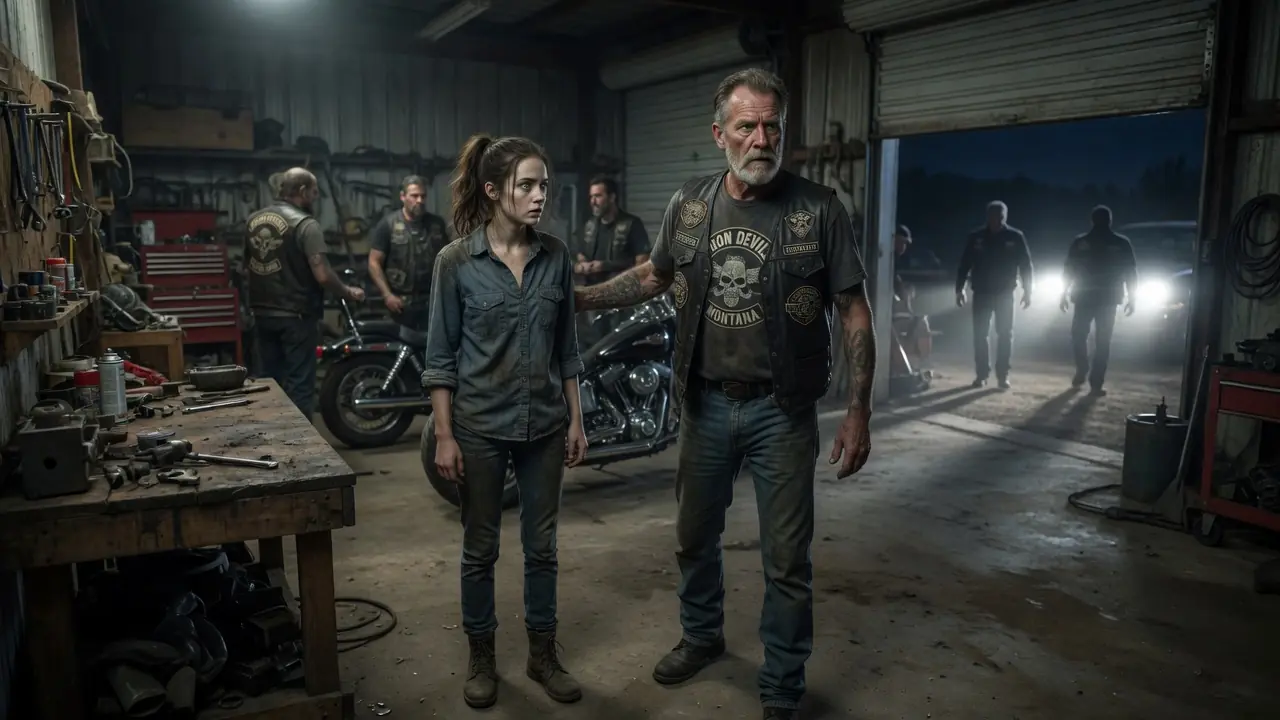
Two nights later, just past eleven, headlights swept across the front of the shop. Lena had taken to sleeping on a cot in the back office because she was too afraid to leave the building unwatched. She jolted awake to the sound of a car door slamming, then another, then a third.
She crept to the window and saw three men climb out of a black SUV in the gravel lot. One carried something long wrapped in cloth. The men moved with the same deliberate menace that had hung over the broken shop after the first attack.
Lena’s hand went to her phone. She dialed Jack with shaking fingers.
It rang once.
“Talk to me,” Jack said, alert, no sleep in his voice at all.
“Three men outside my shop,” Lena whispered. “One has something wrapped up. I don’t know what it is.”
“Do not go outside. Do you hear me? Do not open that door.”
“I wasn’t planning to.”
“I’m fifteen minutes out,” he said, and she heard an engine roar to life on his end. “Stay put. Stay quiet. Don’t open that door for anybody but me.”
“Maybe you should call the sheriff instead of coming alone.”
“There’ll be more coming behind those three,” Jack said, grim and certain. “This is just the first knock. Fifteen minutes, Lena. Stay down.”
The line went dead.
Through a gap in the blinds, Lena saw the man unwrap the object. Moonlight caught the dull gleam of a crowbar. Some useless part of her brain felt relief that it was not a gun, then the rest of her caught up to the fact that a crowbar against a locked door was still a crowbar against everything she had left in the world.
She called 911 and whispered the address.
The crowbar hit the door with a crack that sounded like a gunshot. The frame splintered. Lena flinched so hard she knocked her elbow against the filing cabinet behind her.
Then, cutting through the dark, came the low rolling growl of a motorcycle engine closing fast.
The three men froze.
One engine became several. The sound grew. A single headlight swung into the gravel lot, and Jack Donovan’s Harley skidded to a stop not thirty feet from the men at the door.
Jack swung off the bike, standing in his leather vest with the red-lettered patch catching the security light, utterly unafraid.
“Y’all lost,” he said.
His voice carried none of the warmth Lena had heard in the shop. It was flat and cold, built for exactly this moment.
The man with the crowbar took one step forward.
“This ain’t your business, old man. Get back on your toy and ride home.”
“Funny,” Jack said. “I was about to say the same thing to you.”
The man laughed and lifted the crowbar slightly.
That was when the sound behind Jack arrived.
Headlights poured around the bend. Six, then ten, then more, engines so loud the shop windows rattled in their frames. Bike after bike rolled into the lot and fanned out in a silent semicircle behind Jack Donovan.
Lena counted without meaning to.
Twelve.
Fifteen.
Twenty riders killed their engines one by one until the only sound left was hot metal ticking and a sheriff’s siren finally approaching from town.
“We’re going to go,” the man with the crowbar said, his voice smaller now.
“Yeah,” Jack agreed. “I imagine you are.”
They did not run, exactly, but they moved with the stiff hurry of men trying not to look afraid. They climbed into the SUV and reversed out so fast gravel sprayed against the repaired door.
Jack watched them go, arms crossed, until their taillights vanished.
Only then did he turn toward the shop.
“Lena,” he called gently. “It’s all right. You can come out.”
She unlocked what remained of the splintered door with hands that would not stop shaking. The moment she stepped into the gravel lot, surrounded by twenty riders standing quiet and watchful around their bikes, something inside her cracked open. She cried like the child she had not been allowed to be since her father died.
Jack crossed the lot and put one steady hand on her shoulder. He did not tell her to calm down. He did not say she was brave. He simply stood there, solid as a support beam, until the deputy arrived.
The deputy from the break-in looked at the splintered door, the gathered riders, and Lena’s tear-streaked face, and seemed to have no idea where to begin.
“Evening, Deputy,” Jack said. “Miss Carter here had visitors. Three men, black SUV, tried to force the door with a crowbar. We got here before they finished.”
“You got here?” the deputy repeated, looking around. “All of you?”
“Word travels,” Jack said, and offered nothing more.
After statements were taken and most of the riders had rumbled away into the dark, Lena turned to Jack in the wreckage of her second broken door in two weeks.
“Who are you?” she asked. “Who are you really?”
Jack looked at her for a long moment.
“Come sit down,” he said. “You look like you’re about to fall over, and I think it’s time I told you the truth.”
They sat on overturned crates just inside the doorway. The shop was lit only by one working overhead bulb.
“I rode with the Hells Angels for thirty-one years,” Jack said. “Not the movie version. Real chapter, real brothers, real years of my life. I was national road captain for a stretch back in the nineties. A man like me doesn’t just walk away clean when he gets old. He doesn’t get a pension and a gold watch.”
He folded his scarred hands.
“I stepped back about eight years ago when my knees got bad and my wife got sick. Moved out here for quiet. But quiet doesn’t mean I stop watching. Old habits, like I told you.”
“The riders tonight were your old brothers?”
“Some of them. Some younger chapters from three counties over. Word travels fast in that world.”
He looked at her steadily.
“And it doesn’t take much once people understand a decent man’s kid is getting squeezed by somebody with money and no conscience.”
Lena sat with that for a moment.
“So tonight was just a favor for an old debt.”
“Tonight was a first step,” Jack said. “Victor Hale is going to hear about this by morning, if he hasn’t already. He’ll either back off or escalate. Men like Hale rarely back off after the first surprise.”
“What do we do?”
“We build a case. Everything that’s happened, suppliers, bank, break-in, tonight, every date, every call, every name. Men like Hale are careful, but careful men still leave trails when they’re moving fast and feeling untouchable.”
He paused.
“And I know somebody who might be interested in that trail.”
“Who?”
“A federal agent I crossed paths with a few years back. Financial Crimes Division. Mason Reed. We didn’t meet on friendly terms, but he was thorough and fair when it would have been easier to assume the worst because of the patch on my back. I respected that. Kept his card.”
A flicker of hope, weak but real, touched Lena’s chest.
“You think he’ll help?”
“I think a man who builds fraud cases for a living doesn’t turn down a lead handed to him on a silver platter, especially not one involving a developer squeezing a dead mechanic’s seventeen-year-old daughter out of her daddy’s shop.”
Victor Hale received the news the next morning while eating breakfast on the patio of his rented lake house. A nervous associate named Grady delivered it with the expression of a man approaching a bomb.
“There were a lot of them, sir. Bikes. More than twenty.”
Victor set down his coffee cup with terrifying precision.
“Explain to me how three men with a crowbar and a simple task became a story about twenty bikers.”
“One of the regulars at the shop is an old biker. Jack Donovan. He showed first, then others came fast.”
Victor was silent for a long moment.
“Find out everything about him.”
By afternoon, Grady had a folder.
“Former Hells Angels, national road captain, retired but still connected. He seems to be helping the girl because he owed her father a debt.”
“Sentiment,” Victor said with disdain. “People are so predictable when it comes to sentiment.”
He closed the folder.
“No more crowbars. No more theatrics. We go legal. We go financial. We go clean. Let’s see how many bikers show up to fight a zoning board.”
Four days later, a zoning letter arrived. It said Carter’s Auto Repair was under review due to recently filed complaints about environmental compliance and structural safety. Operations might be suspended pending inspection.
Lena read the letter twice in the shop office, coffee going cold in her hand.
She called Jack.
“They’re coming after permits now,” she said. “Environmental complaints. Structural safety. We’ve never had one complaint in thirty-one years.”
“Complaints don’t need to be true,” Jack said grimly. “They just need to exist long enough to trigger a review.”
“How is that good news?”
“Because paper leaves a trail easier than men in ski masks. I called Reed. He’s flying out Thursday.”
Mason Reed arrived in a plain gray sedan, wearing a suit that looked deliberately unremarkable. He shook Lena’s hand with firm precision.
“Miss Carter,” he said. “Jack told me some of your situation. I’d like to hear the rest from you directly.”
They sat in the back office, and Lena told him everything, from Victor Hale’s first offer to the frozen credit line, the canceled customers, the break-in, the crowbar, and the zoning letter.
Reed listened without interrupting. He wrote in a small notebook, his face careful and unreadable.
When she finished, he leaned forward.
“I want to be direct because I think you’ve earned directness. What you’re describing has a pattern. I’ve seen it before in aggressive land acquisition cases. Developers who can’t buy a property sometimes try to starve it, financially, socially, and bureaucratically.”
“So there’s nothing you can do?”
“I didn’t say that.”
He tapped the folder on the desk.
“I need a pattern with a paper trail leading back to one source. Dates, names, letters, phone logs, emails, all of it. Keep documenting everything. If Victor Hale is doing what I think he’s doing, he won’t stop just because someone is watching. Men like him believe they’re smarter than the system. That belief usually becomes their undoing.”
The zoning inspection happened the following Monday. The inspector, a tired county employee named Harold, walked through with a clipboard and looked increasingly irritated on Lena’s behalf.
“I’ll be honest with you,” he said near the end, lowering his voice. “This place is cleaner and better maintained than half the shops I inspect. Whoever filed that complaint either never set foot in here or is lying through his teeth.”
“Can you tell me who filed it?”
“Anonymous.”
He clicked his pen closed.
“Between you and me, anonymous complaints against small businesses right when a developer’s circling, I’ve seen that pattern more than once. I’m passing this inspection clean, but keep records.”
The inspection passed.
It was a small victory, but Lena felt it land in her chest like a full breath after weeks of holding air.
It did not last.
A new letter challenged the property’s tax valuation, claiming structural depreciation and code violations even after the inspection cleared the shop. Reed explained that it was a different department, a different process, and another way to pressure her.
“They don’t break laws so much as weaponize the space between them,” Reed said over the phone. “But every filing is a data point, Lena. Every letter is a thread.”
She held onto that image through the next two weeks.
Threads.
A coat unraveling one stitch at a time.
She filed an appeal with Reed’s help. She kept a folder of every letter, every strange phone call, every canceled appointment, every odd warning from a customer. The folder grew thick with the careful discipline of a girl who understood it might be the only thing standing between her and losing everything.
Jack came by most days now. Sometimes he helped with repairs. Sometimes he only sat near the bay doors, watching the highway with the unhurried alertness of a man who had spent thirty-one years learning how danger approached.
Other riders came too, filling the bays with bikes that did not strictly need service, buying parts they did not strictly need, leaving tips they insisted were not charity.
“You don’t have to do this,” Lena told Jack one evening.
“You’re not accepting charity,” he said. “You’re accepting business. Every one of these men needed something done eventually. We’re just making sure eventually happens now, while you need the cash flow.”
“I don’t want people feeling sorry for me because I’m seventeen.”
“Pride’s a fine thing, kid,” Jack said gently. “Don’t let it starve you while help is standing right in front of you.”
Three weeks after the tax letter, Reed called with something in his voice Lena had not heard before.
“I think we found something. The shell company that filed the zoning complaint traces through two intermediary LLCs to a holding company registered at a Denver address. That address matches the LLC that made the original offer on your property. It also matches three other property acquisitions in this county over the last two years.”
Lena’s pulse quickened.
“Other properties?”
“A hardware store outside Bozeman. A family restaurant near Livingston. A small equipment rental company two counties over. All showed a similar pattern. Supplier pressure, frozen credit, mysterious complaints, then a lowball offer.”
“This isn’t just me.”
“No,” Reed said. “This is a system. A playbook.”
Victor Hale grew increasingly frustrated. The zoning complaint failed. The tax reassessment stalled. The girl refused to fold. Worse, a federal agent was now asking questions.
“She isn’t supposed to have this kind of protection,” Victor said in his office, staring out the window. “A grease-stained seventeen-year-old girl running a dying shop in the middle of nowhere is not supposed to have federal attention and a private army of bikers.”
“What do you want to do?” Grady asked.
Victor turned slowly.
“I want this finished before that agent connects a single dot back to me.”
The warning came from Mrs. Petrovsky at nine that night.
“Lena, honey, I don’t know if this means anything,” the old woman said, voice trembling, “but I was driving past the old grain elevator off Route 9, and there were trucks. Six, maybe eight. Men standing around. It gave me a bad feeling, and I thought of you.”
Lena’s stomach dropped.
She called Jack.
“They’re moving,” she said. “Trucks staging off Route 9. Mrs. Petrovsky saw them.”
Jack’s voice went flat and cold.
“Route 9 is fifteen minutes from you. That’s not a coincidence. Lock every door, kill the lights, and get to the back office. I’m calling everyone.”
“Everyone?”
“This isn’t going to be twenty bikes this time.”
He hung up.
Lena killed the lights, locked the doors, and crouched beneath her father’s desk with her phone clutched in both hands.
At 11:47, trucks rolled into the lot.
One, then another, then another. Men climbed out, more than a dozen, then fifteen. A tall man named Frank Delgado walked to the center of the lot with the confident authority of someone sent to end a problem.
“Miss Carter,” he called. “I know you’re inside. My employer would like this to be simple. Come out, sign the papers, and everybody goes home. Nobody has to get hurt.”
Lena stayed silent.
“She’s not answering,” another man said, followed by ugly laughter.
“She will,” Delgado replied. “One way or another.”
A text from Jack lit her phone.
Two minutes out. Stay down. Do not come out no matter what they say.
Outside, an angle grinder screamed to life against the metal of the front door. Sparks burst in the dark. Lena pressed herself harder against the wall, certain two minutes would not be fast enough.
Then she heard it.
Not one engine.
Not twenty.
A sound like thunder rolling across the prairie, continuous and growing, coming from every direction of the highway at once.
The grinder cut off mid-shriek.
“What the hell is that?” someone muttered.
The first headlight appeared at the bend.
Then another.
Then the horizon seemed to fill with them.
Dozens of motorcycles rolled toward the shop in disciplined formation, flanking wide, cutting off exits, hemming Delgado’s men inside the lot without throwing a single punch. Lena lost count somewhere past a hundred. Later she would learn the number was closer to two hundred forty riders from four counties, some riding over an hour the moment word reached them.
The bikes stopped in a vast ring around the lot. One by one, the engines cut out until the only sound left was wind and the ragged breathing of fifteen frightened men.
Jack Donovan walked his bike to the front and swung off slowly.
“Evening,” he said. “I believe you gentlemen were just leaving.”
Delgado tried to hold his composure.
“This is private business between Miss Carter and my employer. It doesn’t concern your club.”
“It concerns every one of us,” Jack said, stepping forward, “the moment your employer decided threatening a dead mechanic’s seventeen-year-old daughter over land was acceptable business.”
He stopped a few feet from Delgado.
“You have two choices. You get in those trucks and leave, and we pretend this chapter of stupidity never happened. Or you don’t, and we find out together exactly how patient two hundred forty men can be.”
The silence felt endless.
Delgado looked around, doing the math.
Fifteen against two hundred forty.
“This isn’t over,” he said, but the confidence had drained from his voice.
“Didn’t figure it was,” Jack replied. “But it’s over for tonight.”
Within ninety seconds, the trucks were pulling out, the abandoned angle grinder lying on the gravel.
When Lena stepped outside, she stood in stunned silence before an ocean of leather, chrome, and headlights. She did not cry this time. She was too overwhelmed for tears.
“Jack,” she whispered. “How many people did you even call?”
“Four,” he said. “The other two hundred thirty-six made their own decision when those four spread the word.”
Reed arrived twenty minutes later, too late for the confrontation but in time to see the aftermath. He studied the abandoned grinder, the tire marks, and the lingering riders.
“This is it,” he said, jotting notes quickly. “Attempted forced entry witnessed by dozens, tied to a contractor with financial links to Hale’s operation. This is not ambiguous anymore, Lena. Give me forty-eight hours. I think we can move.”
Victor Hale received news of the second failure the following morning.
“Closer to two hundred forty, sir,” Grady said.
Victor’s face went the color of ash.
“Two hundred forty bikers in the middle of nowhere, Montana.”
“They ran, sir. Delgado assessed the situation and made a tactical retreat.”
“He ran,” Victor said. “From a child with grease on her hands because she has bikers and a federal agent following her like bodyguards.”
He ordered shell companies liquidated and lawyers called. He ordered a countersuit accusing Lena of colluding with a criminal motorcycle organization to intimidate his representatives. He wanted to turn her protection into a crime, her fear into a weapon against her.
The lawsuit landed on her doorstep four days later.
Lena read the pages in her kitchen and felt something in her chest cave in.
“He’s suing me, Mason,” she told Reed, her voice shaking. “He’s making it sound like I attacked them.”
“It’s a desperation move,” Reed said. “A weak one, but it can cost money, and that’s the point. It’s a strategic lawsuit designed to intimidate and drain resources.”
“I don’t have money for a lawyer.”
“Then let me make a call.”
The attorney Reed found was Patricia Alvarez, a sharp, no-nonsense woman who had built a career defending small business owners against corporate intimidation.
“Lena,” Patricia said that evening, “I read the file. This lawsuit is garbage. Not sophisticated garbage. Obvious, desperate garbage. We are going to file a motion to dismiss, and we are going to win.”
Lena closed her eyes.
“Thank you.”
“You’re not alone now,” Patricia said. “Men like Victor Hale usually get away with this because their targets give up before help arrives. You didn’t. That matters more than you know.”
The days fell into a tense rhythm. Lena ran the shop with Jack or another rider nearby. Patricia fought the countersuit. Reed built the case.
The break came nine days after the trucks.
“We got a warrant,” Reed told Lena before the shop opened. “Financial records, property records, communications, everything tied to Hale’s company and the shell entities. My team is executing it now.”
Lena sat down hard on the edge of her father’s desk.
“It’s really happening.”
“There’s more. Delgado is cooperating. He has records tying Hale’s operation to the break-in, the sabotage, the attempted forced entry. It’s not just circumstantial anymore.”
“So it’s over?”
“Not yet. But it’s the beginning of the end.”
Jack arrived an hour later, and Lena met him at the door with the news.
“They got the warrant. Delgado’s talking.”
Jack’s weathered face softened into the closest thing to a full smile she had ever seen from him.
“Your daddy would be proud.”
“I almost folded,” Lena admitted. “That night after the break-in. I almost called Hale and told him to name his price.”
“But you didn’t.”
“No. I thought about my dad’s hands. About this place keeping us alive.”
“That’s the thing about inheriting something worth fighting for,” Jack said. “Easy was never really on the table.”
Victor Hale learned about the warrant too late. His attorney called at six in the morning and told him federal agents had hit three properties overnight, including the Denver holding company address.
“They have financials, emails, correspondence with Delgado,” the attorney said. “If half of what they have holds up, you are looking at years, Victor.”
Victor felt fear for the first time in years.
But instead of damage control, he picked up a phone that was not registered to him.
“I need this finished,” he said when the call connected. “Tonight. Whatever it costs.”
The voice on the other end was careful.
“Finished how?”
Victor stared out at gray water.
“However it needs to be.”
Lena did not know that yet.
She spent the morning doing ordinary work, an oil change and brake inspection on Mrs. Petrovsky’s Buick. For two hours, while the old woman chatted about her grandson’s baseball season, Lena felt something close to normal.
Then Jack arrived after noon with worry carved into his face.
“Reed called me. Delgado’s formal statement is enough to move on Hale within days, maybe sooner.”
“That’s good, isn’t it?”
“It means Hale knows he’s cornered,” Jack said. “Cornered men surrender or get reckless. I don’t like betting on which one a man like him chooses.”
“What do you want me to do?”
“Stay somewhere else tonight. My place, or with one of the others. Not here.”
Lena wanted to argue, but the way Jack said please made her stop.
“Okay,” she said. “I’ll stay with you tonight after I close.”
She finished Mrs. Petrovsky’s Buick and locked the shop at half past six as the sun went orange behind the mountains.
At 8:40, her phone buzzed with a text from a number she did not recognize.
Your friend Jack ran into some trouble on his way to town. You should come see about that before you go anywhere else tonight.
Lena’s blood went cold.
She called Jack.
Voicemail.
She called again.
Voicemail.
Then she called Reed.
“Mason, someone texted me that Jack’s in trouble. He’s not answering. He always answers.”
“Read me the text exactly.”
She did.
“That’s bait,” Reed said. “Somebody wants you to leave. Stay where you are. Lock everything. I’m calling local PD for a welfare check on Jack and heading to you now.”
The line ended.
Lena tried Jack once more, but this time the call went straight to voicemail.
That was when she heard footsteps outside.
Not engines.
Footsteps, careful and deliberate, crunching across gravel.
She retreated toward the back office as two silhouettes moved past the front window. Reed texted a moment later.
PD checked Jack’s place. He’s not there. No signs of struggle. Stay locked up.
Lena typed back with trembling thumbs.
Men outside the shop right now. At least two.
The reply came instantly.
Do not make a sound. I’m 8 minutes out. Backup coming.
Eight minutes.
Lena had learned exactly how long eight minutes could feel when danger was already at the door.
The front lock clicked.
The door opened.
Two men stepped inside quietly, not loud like Delgado’s crew, not theatrical like the crowbar men. These men wanted silence. They wanted to get in and out before two hundred motorcycles could arrive.
“She’s got to be in here somewhere,” one muttered. “Truck’s still out back. Check the office.”
There was nowhere left to run.
Lena thought of every version of herself that had brought her to that moment: the girl who grew up on the shop floor, the daughter who promised her dying father she would not let it go, the seventeen-year-old who had stood in a doorway with a tire iron and told Victor Hale to leave.
She grabbed the heaviest thing within reach, her father’s old torque wrench, and held it low at her side.
The office door swung open.
A flashlight beam found her.
“Found her,” the man said.
That was when the front of the shop exploded with sound and light.
Headlights flooded every window at once. Engines roared so suddenly that both men spun toward the noise in startled reflex. Underneath the thunder came a voice Lena knew anywhere, roaring across the lot with a fury she had never heard from him before.
“Get away from her.”
Jack.
Alive.
Furious.
The two men bolted, not toward Lena, but away from her, shoving past each other toward the back exit. Outside came shouting, a brief scuffle, then sirens, multiple units closing fast.
Lena staggered out of the office as Jack burst through the front door. The look on his face when he saw her alive and unharmed cracked something open in his granite composure.
“Lena,” he said, voice breaking. “Thank God.”
“You didn’t answer,” she sobbed. “I thought something happened to you.”
“They ambushed my bike a mile out,” Jack said, one steady hand landing on her shoulder. “Cut me off with a truck. Meant to keep me away while someone came here for you.”
“I thought you were dead.”
“I got clear,” he said. “Called every man I know and rode faster than I’ve ridden in twenty years. I’m sorry it took so long.”
Reed arrived less than a minute behind the deputies, badge already out. Two men were caught fleeing through the back lot, cornered by riders who had formed a perimeter without being asked.
“Miss Carter,” Reed said gently. “Are you hurt?”
“No,” she said, though her voice shook. “I’m okay.”
By two in the morning, the captured men had broken under the weight of the charges. They had been hired through intermediaries, but one instruction traced back to a burner phone purchased on a corporate card belonging to one of Hale’s shell companies.
Handle the Carter situation permanently tonight before this window closes.
“He panicked,” Reed said in the shop office at nearly three. “The warrant scared him badly enough that he stopped thinking like a careful man. This mistake ends him.”
“What happens now?” Lena asked, hoarse from fear and tears.
“Now I request an arrest warrant. Attempted kidnapping tied to a financial crimes conspiracy is not something any prosecutor lets sit.”
Jack sat beside her. At some point, his hand had found hers and had not let go.
“I should have been here sooner,” he said quietly.
“You got here,” Lena said. “You brought half the county with you. I’m standing here because of that. Don’t carry guilt for the two minutes when you gave me everything else.”
Jack looked at her, raw and unguarded.
“Your daddy would have ridden through hell for the people he loved. I just did what I figure he would have wanted somebody to do for you since he couldn’t.”
Victor Hale was arrested four days later outside his attorney’s office.
There was no dramatic dawn raid. Two agents stepped beside him with procedural calm and guided him toward a car. A small crowd had gathered on the sidewalk because word traveled fast in Montana.
Lena stood near the back with her arms crossed.
Victor saw her for one moment.
There was no remorse in his eyes. Only disbelief. The wounded disbelief of a man who had never imagined a seventeen-year-old girl with grease under her fingernails could be the thing that finally brought him down.
The car door closed, and the empire he had built on quiet coercion began to collapse.
Reed found Lena afterward.
“Fraud, conspiracy, attempted kidnapping, and we’re still building the racketeering case around the other properties,” he said. “Every single piece you documented helped put him in that car.”
“It doesn’t feel over,” Lena admitted.
“Peace doesn’t always announce itself the moment it arrives,” Reed said. “Sometimes it starts quietly, and you don’t believe it until you’ve lived in it for a while.”
The ripple began eleven days later with a phone call.
“Miss Carter, my name is Diane Whitfield,” a woman said. “I ran Whitfield’s Hardware outside Bozeman until eighteen months ago when I lost it. I saw your name in the paper. What happened to me was exactly the same. Suppliers, bank, break-in, rumors. I thought it was bad luck.”
Lena sat down slowly at her father’s desk.
“It wasn’t bad luck,” she said. “It was Victor Hale. And you need to call Agent Mason Reed today.”
By the end of the week, two more calls came in: the Livingston restaurant family and the equipment rental owner. All described the same pattern with the exhausted precision of people finally being believed after doubting their own sanity for too long.
Reed drove to the shop to deliver the news in person.
“Three additional victims, all willing to testify,” he said. “The U.S. Attorney’s Office is pursuing an organized racketeering case now. Lena, you didn’t just save your own shop. You handed us the thread that’s about to unravel everything that man built.”
Lena looked around the shop, at the humming diagnostic machine, the solid hydraulic lift, the clean wall where a threat had once dripped red.
“My dad used to say the shop kept us alive,” she said quietly. “But I think what he meant was that showing up for people keeps you alive. The shop was just where he practiced it.”
The weeks that followed slowly became ordinary again.
Mornings started with customers instead of threats. Afternoons were spent under hoods with honest problems. Evenings ended in bone-deep tiredness instead of fear-soaked exhaustion.
Jack still came by most Wednesdays, though the tension had drained from his visits. He sat near the bay doors and drank coffee. Sometimes he helped with repairs. Sometimes he simply watched the highway because old habits did not retire easily.
“You ever think about what you’ll do with the extra space?” he asked one afternoon, nodding toward the back corner of the shop. “Business is picking up. Word traveled.”
“I’ve been thinking about something bigger than hiring,” Lena said.
“Bigger how?”
“A fund. For small business owners who get targeted the way I did. Legal resources, emergency cash, people who recognize the pattern before it destroys them. So nobody else sits in the dark for three months thinking they’re just having bad luck.”
Jack looked at her with quiet pride.
“Your daddy’s shop keeping people alive,” he said. “Just under a bigger roof.”
“Would you help me? You and the others?”
Jack did not answer right away.
“Lena, I’ve ridden with men my whole life who talk about brotherhood and loyalty. Most of the time, it means standing beside a casket, helping somebody move, or riding in a fundraiser. This right here, protecting people before they get crushed, that’s worth showing up for. Count me in.”
The formal announcement came three months later on a bright, cold Saturday morning in the same gravel lot where trucks had once staged an assault and two hundred forty motorcycles had once formed a wall against it.
A modest banner hung across the front of the shop.
The Robert Carter Foundation
For Small Business Protection
Diane Whitfield drove in from Bozeman. The Livingston family came too. Patricia Alvarez stood near Reed, who had flown back for the occasion. Jack and a dozen riders stood near the back, arms crossed, watching with quiet pride.
Lena stood in front of the crowd, seventeen years old, grease still faintly under her nails, her father’s old shop behind her.
“My father built this shop with his own hands,” she said. “He used to say a good shop doesn’t just fix what’s broken. It figures out why it broke so it doesn’t happen again.”
She drew a breath.
“What happened to me, and what happened to others, was not bad luck. It was a system built by someone who counted on people being isolated, exhausted, and too alone to fight back. This foundation exists so the next person that system tries to break is not alone. Not for one single day.”
The applause was quiet and real, exactly the kind her father would have approved of.
Afterward, Jack found Lena by the front door, the same door that had been broken twice and now stood whole.
“Your daddy really would be proud,” he said.
“I couldn’t have done any of it without you.”
Jack looked toward the highway.
“You know what the patch on my back means to most people before they know better. Fear. Trouble. Something to cross the street to avoid. But I spent thirty-one years with men who understood loyalty better than most folks understand their own families.”
He looked at her steadily.
“What happened here told that story a little more honestly.”
Victor Hale’s sentencing took place seven months after his arrest in a federal courtroom two hundred miles from the shop he had tried to erase. Lena drove there with Jack beside her in his truck because the weather had turned too cold for even him to pretend a bike made sense.
Inside, Victor looked smaller than she remembered. Not physically, but in some essential way. The untouchable posture was gone, replaced by something gray and diminished.
The prosecutor read the plea agreement: fraud, conspiracy, coercion across four business acquisitions, attempted kidnapping tied to Carter’s Auto Repair. The judge sentenced Victor Hale to spend the better part of two decades behind bars and ordered restitution for the victims whose lives he had damaged.
Victor did not look at Lena when he was led away.
Lena had expected triumph.
Instead, it felt final. Quiet. Complete. The closing of a door rather than the winning of a war.
Outside the courthouse, Diane Whitfield squeezed Lena’s hand.
“I don’t think I ever properly thanked you,” Diane said. “For telling me to call Reed. It doesn’t undo eighteen months of believing I failed, but it means something to know I didn’t fail. Somebody did this, and now he answered for it.”
“You didn’t fail,” Lena said firmly. “None of us did.”
The foundation grew slowly over the following year, not into something flashy, but into something durable and real, the way Robert Carter had always built things. Patricia recruited attorneys. Reed stayed connected as an informal adviser. Jack became an early warning system, riding out whenever word reached him that a small business owner had begun noticing the same quiet strangulation Lena once mistook for bad luck.
On the one-year anniversary of the night two hundred forty motorcycles filled her father’s gravel lot, Lena stood in the doorway of Carter’s Auto Repair at closing time. The sun went down behind the mountains, and for the first time since before her father got sick, something settled inside her that felt larger than survival.
Purpose.
Jack pulled into the lot, killed his engine, and walked over to stand beside her.
“You ever think what would have happened if you hadn’t kept coming here every Wednesday?” Lena asked.
Jack considered it with his usual seriousness.
“I think you would have found a way through regardless. You’re your father’s daughter, stubborn as bedrock. But I’m awful glad I didn’t have to find out.”
Lena smiled, easy and unguarded, and looked back at the shop.
Whole.
Solid.
Humming with the ordinary machinery of a life rebuilt instead of merely survived.
Victor Hale sat in federal prison two hundred miles away. Diane Whitfield had reopened her hardware store. The Livingston family’s restaurant had reopened its doors with a framed photo of Carter’s Auto Repair near the register.
And Carter’s Auto Repair still stood exactly where it always had, at the edge of a two-lane highway in rural Montana, the hand-painted sign above the door, the C still peeling because Lena, like her father before her, had never let anyone touch it up.
Some things, she had learned, were never meant to be erased.
They were meant to be protected fiercely by the people who understood what they were worth.
And Lena Carter, seventeen years old, standing in the doorway of the shop that had raised her, buried her father, nearly destroyed her, and ultimately saved her, understood now without a single doubt that some legacies simply refused to disappear.
Because the people who loved them refused to let them go.