The joke had become a season of its own.
Every spring, somebody asked Hannah Cole when she planned to clear the row behind her father’s machine shed. Every summer, somebody suggested she could get decent scrap money for the old tractors before they sank any deeper into the earth. Every autumn, after the serious work was finished and farmers had enough breath left to look across fences and comment on one another’s choices, someone would slow a pickup at Hannah’s gate, point toward the faded red line of Farmalls, and call them a museum.
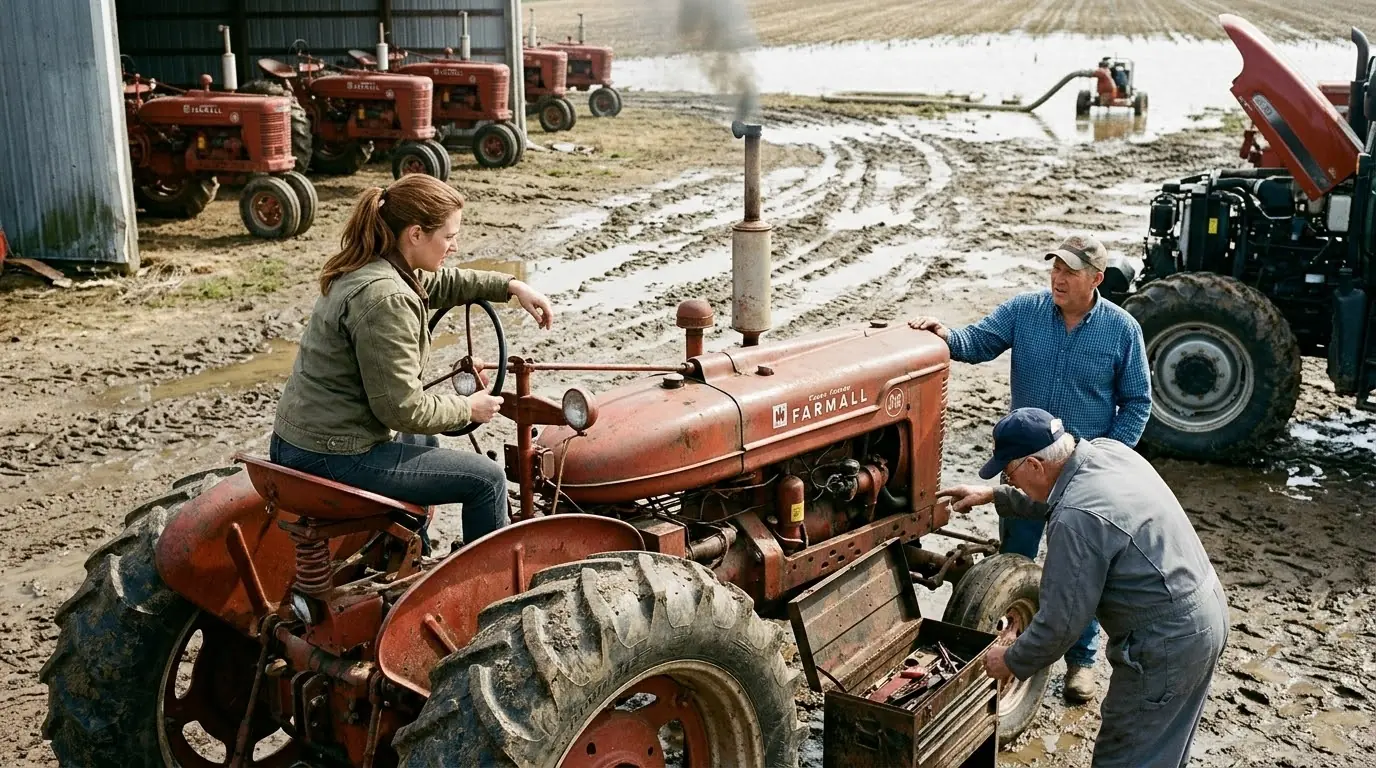
The nine tractors stood in a straight row beneath maples that had grown taller than the shed roof. Their paint had faded to chalky reds and browns. Several tires sagged. One seat had split down the middle. One tractor had no hood. Another wore a steering wheel wrapped in black tape that had long ago turned gray. Dust lived in every seam. Dead grass leaned around the axles. At first glance, the whole row looked less like equipment than evidence of a man who had not known when to let go.
“My father wanted them here,” Hannah always said.
That answer usually made people smile in the way adults smile at sentiment they consider harmless. Thomas Cole had been dead for two years, and the county remembered him with affection. He had farmed three hundred acres of wheat, corn, and hay in the northern valley, repaired more things than he replaced, labeled bolts by size, stacked worn gears in boxes, and kept old manuals beside the kitchen door as if a hydraulic diagram might be needed between breakfast and lunch. He had been practical almost to the point of stubbornness, which was precisely why people found the nine old tractors amusing.
Thomas had never called them antiques. He had never entered one in a show. He had never spent money polishing chrome or restoring paint for parades. He simply acquired them over nearly four decades and kept them from disappearing.
The first had belonged to a neighbor who left farming. The second came from an estate auction. The third had sat beside a collapsed barn until Thomas hauled it home on a flatbed. The rest arrived one at a time from places where families were downsizing, retiring, or clearing out what no longer seemed useful.
When Hannah was a teenager, she asked him why he needed nine tractors that barely ran.
Thomas had wiped grease from his thumb with a rag and looked past her toward the row. “Old machines remember how to work.”
She had rolled her eyes.
At twenty-eight, living in the city and visiting on holidays, she had asked again after noticing a new tractor with satellite guidance parked in the main shed while the Farmalls remained lined up like relics.
Her father gave the same answer.
“Old machines remember how to work.”
She thought he was being sentimental because age makes people sentimental about objects that belonged to harder years. Thomas had grown up around simple mechanical engines and manual transmissions. He trusted machines that could be opened with ordinary tools and understood by sound. Hannah understood why that mattered to him, but she also understood arithmetic. Newer tractors did more work in less time. Their cabs were safer, their hydraulics stronger, their fuel use more efficient. Their guidance systems reduced overlap. Their attachments made jobs possible that would once have required three machines and twice as many people.