Behind Walter Bennett's barn sat the ugliest tractor in Millstone County. The machine had not started properly in almost 30 years. Its paint was gone. Tires cracked. Half the town thought it belonged in a junkyard. Even Walter's grandson didn't understand why the old man kept it around. "Grandpa, that thing hasn't worked since Dad was in high school." Walter just kept cleaning the old machine like it still mattered.
Back in 1967, that tractor harvested the best corn crop the county had ever seen. Walter bought it after three years of saving cash from cattle auctions and wheat harvests. It was the first machine he had ever truly owned debt-free. And men who survive hard times remember certain machines like family.
People in town joked about the old tractor constantly, especially during the farming boom years of the late '70s. Other farmers upgraded machines every few years. Walter never did. The banks encouraged bigger loans, bigger equipment, bigger risks. Walter trusted old steel more than borrowed money. New machines break, too. But debt breaks men faster. Then came the farm crisis. And suddenly the jokes stopped. Men with million-dollar equipment lost entire farms almost overnight. But Walter Bennett survived because everything he owned was already paid for.
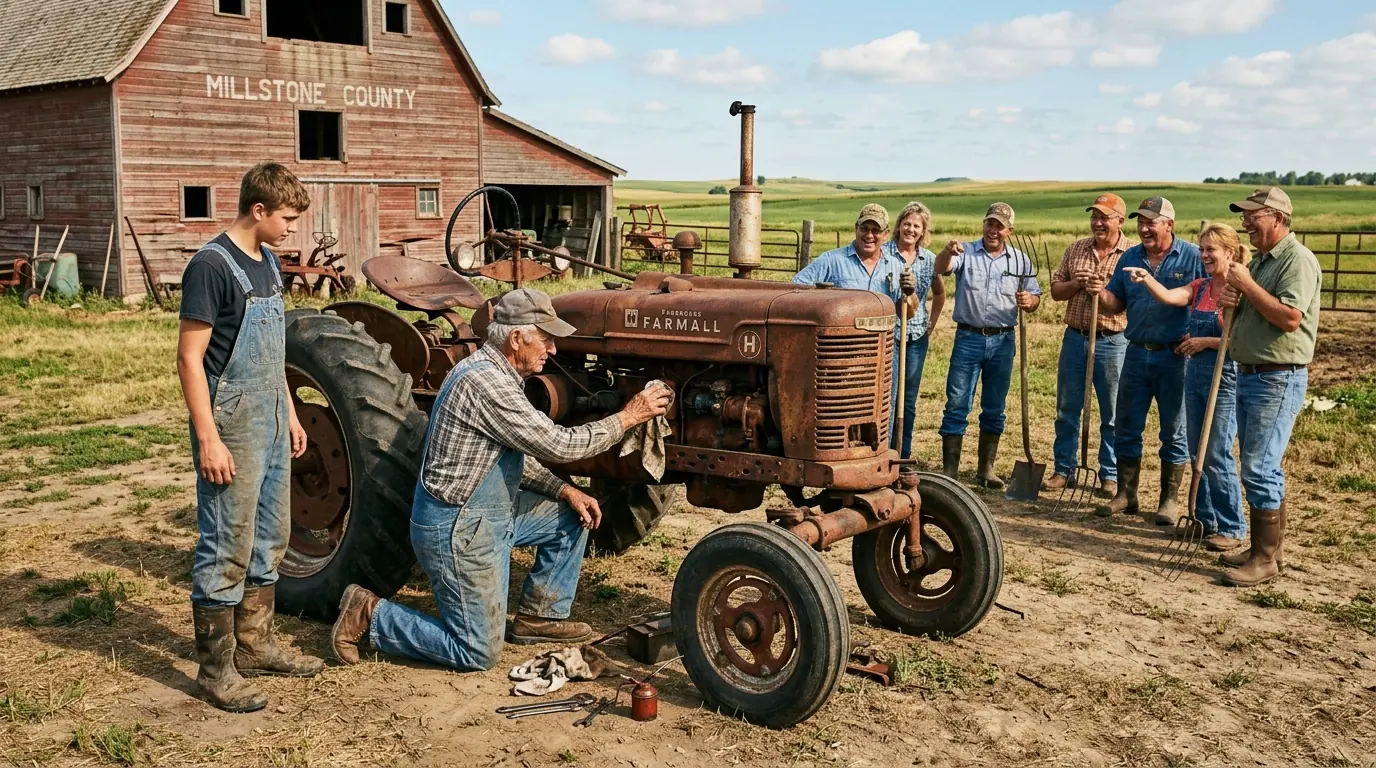 Then, in the autumn of 1988, a disaster hit Millstone County that threatened to destroy the entire harvest. And suddenly, the storm warning came early that October morning. Every farmer in Millstone County heard the same sentence: three days of heavy rain expected across central Nebraska. The problem was simple. Almost nobody had finished harvesting yet. Modern equipment was already failing under the wet conditions. Italy had never seen machinery pushed this hard before. But Walter Bennett didn't panic. Old farmers usually don't. "You should have upgraded years ago. Now we're going to lose the crop, too." Walter said nothing for a long moment. Then he walked toward the barn.
The grandson thought he was looking for spare fuel. Instead, Walter uncovered something nobody had seen in decades: perfectly maintained replacement parts, wrapped in oil cloth since 1979. The old man had been preparing this entire time. Every winter, Walter repaired one small piece of the tractor, even after it stopped running. Because he trusted old machinery the way sailors trust lifeboats. For the first time in years, the grandson stopped laughing at the tractor.
Walter worked slowly, like a man rebuilding memory itself. The first attempt failed immediately. Outside, rain clouds kept getting closer. But Walter Bennett belonged to a generation of men who never expected success on the first try. Near midnight, Walter tried again. And after 30 silent years, the old tractor finally woke up. The sound shook the entire barn—deep, violent, alive again after 30 years. Walter didn't smile. He just listened carefully, like an old doctor checking a patient's heartbeat. For the first time in his life, the boy understood why his grandfather never gave up on the machine.
Outside, the first drops of rain had already started falling. Across the county, new combines worth hundreds of thousands of dollars were breaking down everywhere. But the old tractor kept moving: heavy, slow, unstoppable. By sunrise, grandfather and grandson were harvesting together. Walter knew every sound that machine made. Every vibration. Every weakness. Because he had spent half his life keeping it alive. Slowly, the county started watching something impossible happen. The machine everyone mocked was outperforming equipment built 20 years later.
Walter harvested 16 straight hours without stopping. By afternoon, the grandson's hands were bleeding from loading grain. Walter noticed immediately. Of course he did. Old farmers notice everything. And somewhere out there in the storm, between the engine noise and the endless mud, the boy finally understood something important. His grandfather had never been fighting alone. Even the bank manager came out to watch. Nearly every other farm around Millstone County was failing. But Walter Bennett's harvest kept moving through the storm like something from another era.
Within 48 hours, thousands of acres across the county were destroyed. But Walter finished almost his entire harvest before the flooding arrived. Standing there beside the steaming engine, the old farmer finally revealed why he had protected that broken tractor for 30 years. By the time the storm finally passed, Walter Bennett had saved almost his entire crop. Across Millstone County, other farmers were counting losses that would follow them for years. But standing there in the mud, the grandson no longer saw a broken machine. He saw 30 years of discipline, 30 years of preparation, 30 years of refusing debt. Even the county mechanic admitted he didn't fully understand how the tractor survived.
The bank manager thought about Walter constantly after the storm, because for the first time, the banker realized the old farmer understood risk better than any loan officer ever could. "You were right about debt." Walter stayed quiet for a moment before answering. "Debt works fine until the weather changes." The grandson never forgot that sentence. Not for the rest of his life. That winter, Walter began teaching the boy everything about the old machine. Not because the tractor mattered more than newer equipment, but because maintenance mattered more than pride. Most machines fail slowly. Most farms fail slowly, too. People simply ignore the warning signs.
By spring, the old tractor had become part of the family again. "You don't get it. This isn't just some old piece of junk. It has a story. My grandfather taught me everything on this tractor. This tractor is the best. Grandpa taught me everything I know about it." Walter never interrupted, but deep down, it meant more to him than he would ever admit aloud. A few years later, the old tractor would save the Bennett family one final time. That moment would become local legend across Millstone County.
The years after the storm passed quietly for Walter Bennett. Just the way he preferred. Every winter, grandfather and grandson rebuilt small pieces of the tractor together. Slowly, the machine became something more than equipment. It became a lesson about patience, about survival, about never borrowing more than life can repay. By the mid-1990s, almost every tractor from Walter's generation had disappeared—except one. Age finally started catching Walter Bennett, too. The grandson noticed before anyone else. The old man was getting tired. "I've spent my whole life with these machines. But it's the quiet moments like this that I remember most. When I bought this machine, I stopped being afraid of losing the farm." Because debt no longer controlled him after that day.
The tractor wasn't freedom because it was powerful. It was freedom because it was his. Walter Bennett died quietly in the summer of 1998. For the first time in decades, the entire county came together for one farmer. After the funeral, the grandson walked back into the barn alone. The tractor still smelled like oil, dust, and his grandfather's work gloves. Years later, he still used the old machine every harvest season. Not because he had to, but because some lessons deserve to stay alive. By then, the tractor had become local legend across Millstone County. The machine people once laughed at had outlived almost everything built after it. And maybe that was Walter Bennett's real lesson all along: the things built slowly, maintained carefully, and owned completely.