The laughter followed Elias Crawford across the stained concrete floor of the Coryell County Livestock Auction Barn. Each step made the loose soles of his ruined boots slap against the ground—flap, scrape, flap—while men in clean hats leaned over the wooden bleachers and pointed. Eli did not lower his head, though he could feel every eye measuring the baling twine wrapped around his left boot. He simply crossed the barn, pushed through the wide wooden doors, and disappeared into the freezing Texas fog.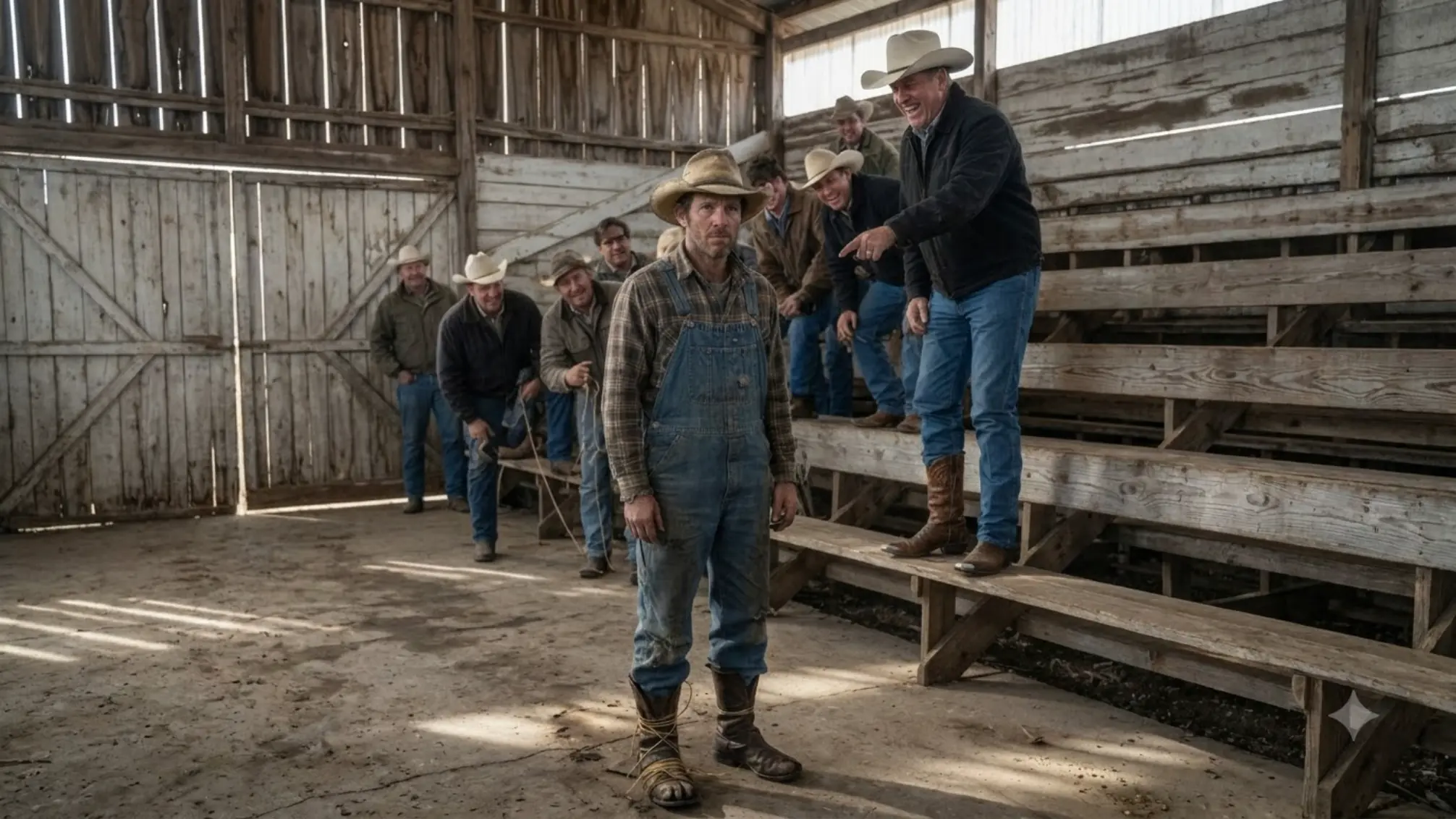
It was February 1982, and Eli had arrived that morning carrying exactly $385 in the inside pocket of his faded denim overalls. The money represented fourteen months of selling eggs, repairing fences, cutting firewood, and saving every dollar that remained after seed and feed. His grandfather’s old Allis-Chalmers tractor had suffered a seized transmission, and without another machine, Eli could not plant his ninety-five acres. He had come to bid on a rusted John Deere 2010 sitting outside in the mud.
There was nothing impressive about Eli’s appearance. He was thirty-six, lean from work rather than exercise, with weathered skin, gray eyes, and hands permanently marked by wire cuts and engine grease. His plaid shirt had been repaired at both elbows, and his straw hat had lost its original shape years earlier. The destroyed boots were the worst of it, but new ones would have cost money Eli needed for the tractor.
Beau Whitaker noticed those boots before Eli had taken ten steps into the building. Beau owned 2,800 acres, the largest operation in Coryell County, and occupied the front row at every auction as though the seat had been built for him. He wore polished ostrich-skin boots with silver toe caps, a black ranch jacket, and a gold ring large enough to catch light from across the barn. When he stood and pointed at Eli, everyone understood that a performance was beginning.
Some men laughed because Beau was powerful. Others laughed because they feared becoming his next target. A few looked uncomfortable but said nothing as he suggested Eli planned to pay for machinery with baling wire. By the time Beau told him to go home and find shoes, the humiliation had become entertainment for almost every person in the room.
Eli could have defended himself. He could have told them about the $385, the fourteen months of labor, or the farm he owned without owing a bank. He could have reminded Beau that boots protected feet while debt controlled entire lives. Instead, he gave the wealthy farmer one calm answer and walked away.
The John Deere sold twenty minutes later to a rancher from Gatesville for $410. Eli sat inside his old pickup in the auction-barn parking lot and watched the tractor leave on a trailer. He did not feel defeated because he had lost the bid. The number had already moved beyond what he could safely spend.
What burned was the laughter.
He drove twenty-two miles home along Farm Road 116 without turning on the radio. He passed the country church his grandfather had helped build, the cemetery where Hollis Crawford rested, and the crossroads where Eli had learned to drive at twelve. The fog thinned as the afternoon faded, revealing bare trees and fields hardened by winter.
The Crawford farm sat near the Lampasas River bottoms, where ninety-five acres of mixed ground had survived droughts, floods, and every agricultural fashion of the twentieth century. Hollis had homesteaded the property in 1912 and built the four-room farmhouse eleven years later. The porch leaned slightly toward the east, and the barn roof needed repair, but no lender held a claim on either building.
That mattered more to Eli than appearances.
Hollis had raised him after Eli’s mother died and his father left the county. The old farmer taught him to read rainfall, repair machinery, rotate cattle, and recognize the difference between wanting something and needing it. But one lesson returned more often than all the others.
“Don’t owe,” Hollis would say. “Stay small if you have to. Stay hungry if you have to. But never let another man own your tomorrow.”
Eli heard those words as he sat on the porch that evening and removed his boots. His socks were wet, and the cold boards stung beneath his feet. He placed the baling-twine boot beside its partner, leaned back in the old rocker, and watched the sun sink beyond the river bottoms.
He made himself three promises before darkness covered the fields.
He would never borrow money to prove he belonged beside wealthier men. He would continue farming slowly and carefully, exactly as Hollis had taught him. And if Beau Whitaker’s empire ever collapsed under the weight of its own debt, Eli Crawford would still be standing when the dust settled.
The promise was not revenge. Eli had no plan to destroy Beau or compete with him. He simply understood that a man could build something large enough to impress an entire county while leaving its foundation dangerously weak.
The next morning, Eli returned to the broken Allis-Chalmers in his barn. The transmission had locked so completely that the rear wheels refused to turn. A dealership mechanic had quoted more than Eli possessed just to open the housing, and a replacement tractor was no longer available within his budget.
So Eli drove eighty miles to a salvage yard outside Waco.
He spent most of Saturday climbing between wrecked machines until he found an Allis-Chalmers transmission core pulled from a tractor that had rolled into a ravine four years earlier. The casing was cracked, but several internal parts remained usable. The salvage-yard owner asked seventy-five dollars.
Eli offered fifty-five in cash.
The transmission returned to Coryell County in the bed of his pickup. For three months, Eli worked inside the unheated barn beneath the yellow glow of a kerosene lantern. He opened the damaged transmission, cleaned each gear, measured shafts, replaced worn bearings, and combined the best components from both machines.
His knuckles split in the cold. Grease hardened on the tools before he could wipe it away, and some nights he worked until nearly midnight after completing his regular chores. When frustration rose, he opened the old shop manual Hollis had kept inside a metal box and began again from the last measurement he trusted.
On the first warm morning in March 1983, Eli installed the battery and turned the key. The engine coughed twice, released a dark cloud from the exhaust, and settled into a rough idle. He pressed the clutch, selected first gear, and held his breath.
The tractor moved.
It crossed the barn floor slowly, but each wheel turned under its own power. Eli drove into the yard, shifted through every gear, and circled the house while his dog barked beside the fence. The repair had cost less than sixty dollars.
Nobody at the auction barn heard about it from Eli.
He planted sorghum in the river bottoms, wheat on the ridge, and vegetables behind the farmhouse. He maintained a small cattle herd, sold eggs at the weekend market, and supplied beef to two restaurants in Gatesville. His operation remained too modest to attract admiration, but it provided enough to keep the land productive and the bills paid.
That June, Eli entered a farm-supply store in Temple and walked directly to the boot aisle. A pair of Georgia work boots had been marked down to fifty-two dollars. He tried them on, checked the stitching, and paid cash.
The new soles made almost no sound when he walked.
For the next four years, Eli lived in deliberate silence. He never discussed Beau’s insults or the promise made on the porch. When neighbors called him backward, he repaired another fence. When men at the cooperative mocked his refusal to expand, he purchased feed and returned home.
Beau continued growing.
He bought neighboring farms, replaced equipment every few years, and financed an enormous grain-storage system. Each autumn brought another new black Chevrolet dually with leather seats and enough chrome to flash from half a mile away. When Beau passed the Crawford farm, he often held the horn down until the truck disappeared beyond the next hill.
Eli never waved.
Every spare dollar entered a red Maxwell House coffee can beneath a loose floorboard in the smokehouse. Twenty dollars after a strong market week, five after a difficult one, sometimes nothing for an entire month. He kept the can behind hanging hams because nobody entered that room except him.
While Eli saved slowly, the agricultural economy changed violently.
Through the 1970s, farmers had been encouraged to expand. Banks offered affordable credit, land values rose, and experts repeated one message: grow larger or disappear. Men borrowed against property inherited from their grandfathers to purchase more acreage, bigger tractors, and newer combines.
Beau followed that advice more aggressively than anyone in the county.
His 2,800 acres looked like proof that the strategy worked. Yet much of the land belonged to lenders in every meaningful sense. Beau’s profits depended on commodity prices staying high, export markets remaining strong, and interest rates remaining manageable.
None of those conditions lasted.
Export demand collapsed. Crop prices fell, and interest rates climbed beyond levels many farmers had considered possible. Loans taken at seven or eight percent were refinanced at eighteen, nineteen, and sometimes more than twenty percent.
The land itself began losing value.
Farmers who owed four hundred dollars per acre discovered the property might sell for half that amount. Machinery loans remained due even when equipment brought almost nothing at auction. By 1985, foreclosures moved through Central Texas like a sickness nobody could isolate.
Eli’s operation suffered too. Low grain prices reduced his income, and drought damaged part of his sorghum. But the bank could not take his tractor because he had rebuilt it himself. No lender could seize the farmhouse because Hollis had paid for it decades earlier.
Eli ate less, repaired more, and continued placing money inside the coffee can whenever possible.
Beau refinanced once, then again. He sold two trucks, a combine, and several cattle herds while insisting the next harvest would solve everything. He traveled to Dallas and begged a banker who had attended his hunting parties to restructure the debt.
The banker refused.
In February 1987, five years after the morning Beau mocked Eli’s boots, the Federal Land Bank foreclosed on the entire Whitaker operation. The notice included 2,800 acres, grain bins, equipment sheds, machinery, the main farmhouse, and the pecan orchard surrounding the family cemetery.
Eli heard the news at the county cooperative while paying for chicken feed.
Two men behind him discussed the foreclosure in voices normally reserved for funerals. One said Beau had lost everything. The other replied that the auction would attract corporate buyers from Dallas and Houston.
Eli paid the clerk, carried the feed to his truck, and returned home.
He entered the smokehouse, moved the hanging hams, and lifted the loose floorboard. The Maxwell House can felt heavier than he remembered. He carried it into the kitchen and counted every folded bill.
Fourteen thousand two hundred dollars.
It was not enough to purchase Beau’s operation. It was not even enough to buy a large portion outright. But Eli had spent five years earning something more valuable than money.
He had earned trust.
Over the next seven weeks, he called small farmers across Coryell County and two neighboring counties. Some had lost land to Beau during his years of expansion. Others were young families unable to compete with corporate buyers. Eli presented a simple plan: combine their savings, purchase part of the Whitaker property, divide it into family-sized parcels, and sell those parcels locally at fair prices.
Seventeen farmers agreed.
Each signed a letter stating exactly what they could contribute. Some offered thousands, others only a few hundred. Together, their savings supported a down payment and a direct contract with the Federal Land Bank, avoiding a new middleman loan.
On April 22, 1987, Eli returned to the Coryell County Livestock Auction Barn.
The building looked almost unchanged. The concrete carried a few more cracks, and the wooden bleachers had darkened with age. The same smells of hay, diesel, cattle, and cigarettes rested beneath the rafters.
But the crowd was different.
Corporate buyers occupied the front rows in pressed trousers and polished shoes. Investment representatives carried briefcases and spoke quietly into telephones. They had not come to preserve farms; they had come to purchase distressed property below its value.
Eli sat halfway up the left bleachers in a clean shirt, plain jeans, and the Georgia boots he had bought four years earlier. A manila folder rested across his knees. Nobody paid him much attention.
Beau occupied his traditional front-row seat.
The ostrich-skin boots were gone. So was the gold ring and the immaculate ranch jacket. He wore scuffed brown work boots and a faded canvas coat, his shoulders bent as he stared at the floor between his feet.
Eli watched him for a long moment.
He expected satisfaction. Instead, he saw a frightened man who had spent years disguising fear as arrogance. Beau had not been invincible when he laughed at Eli. He had merely been louder, richer in appearances, and deeper in debt.
The auction began with equipment.
A combine purchased for seventy thousand dollars sold for nine. A nearly new truck brought twelve thousand. Tractors, balers, and augers disappeared into corporate inventories for fractions of their original prices.
Beau watched every piece leave.
Shortly before noon, the auctioneer announced the largest property package: 720 acres of prime river-bottom land, including the Whitaker farmhouse, pecan orchard, hand-dug well, and family cemetery. The opening request was four hundred fifty dollars per acre.
Nobody moved.
The corporate buyers waited for the auctioneer to lower the price.
Eli raised his hand.
“Four hundred fifty,” the auctioneer called.
Every head turned toward the middle row.
One corporate representative offered five hundred. Eli raised the bid to five fifty. The numbers climbed steadily—six hundred, six fifty, seven hundred.
At seven hundred fifty dollars per acre, the corporate men began calculating. The land was valuable, but they had expected desperation pricing. One bidder shook his head and folded his paddle.
The auctioneer called the amount once.
Beau lifted his head.
The auctioneer called it twice.
Beau turned toward the bleachers and recognized Eli. For several seconds, the two men stared at each other across the same room where laughter had once followed flapping boots.
Eli did not smile.
The hammer fell.
“Sold to the gentleman in the middle row.”
Eli descended the wooden steps. His boots struck each board with a steady, solid sound. He crossed the concrete floor and placed the manila folder on the auctioneer’s table.
Behind him, Beau spoke.
“You’re the man with the tore-up boots.”
Eli stopped.
“Yes.”
“How?”
Eli opened the folder, revealing the seventeen signed commitments and the contract arranged with the land bank. He explained that the property would be divided into nine family-sized farms and sold through affordable owner-financed agreements.
Beau looked at the names.
Several belonged to families he had once pushed away from neighboring ground.
“You planned this?”
“I prepared for it.”
Beau’s hands trembled. “The farmhouse—could I buy back the house and a few acres?”
“How much do you have?”
“Six hundred dollars.”
Eli studied him in silence.
Beau lowered his head. “I know I don’t deserve anything.”
“You’re right.”
The words landed heavily, but Eli did not leave.
He borrowed a pen from the auctioneer and removed a yellow feed receipt from his shirt pocket. On the back, he wrote a simple agreement allowing Beau to remain in the farmhouse with twelve surrounding acres for the rest of his life.
No rent.
No loan.
No lien.
Beau stared at the paper. “What do you want?”
“Your story.”
“My story?”
“You’ll tell every farmer who listens what debt did to you. Every 4-H meeting, every FFA chapter, every young man ready to sign papers he doesn’t understand. You’ll become the warning.”
Tears moved down Beau’s face.
He signed.
Over the following eighteen months, Eli and the seventeen farmers divided the land exactly as promised. Twenty-six local families eventually received parcels from the larger Whitaker operation through fair contracts designed to keep ownership within the community.
Eli retained only 140 acres adjoining his original farm.
He bought no new truck.
He purchased no luxury equipment.
He continued using the rebuilt Allis-Chalmers and farming with the same patience Hollis had taught him.
Beau kept his promise for seven years. He traveled to schools, county fairs, extension meetings, and agricultural colleges in an old Ford pickup. He described the first easy loan, the second, the third, and how debt became less frightening each time until it controlled every decision.
He told audiences about losing the home his great-grandfather built.
Then he told them about Eli Crawford, the quiet farmer with broken boots who purchased the land and returned the house for the price of an honest warning.
Beau died from a heart attack in October 1994.
Eli served as one of his pallbearers.
After the funeral, a reporter asked why he carried the casket of a man who had once humiliated him before an entire county.
Eli looked across the churchyard toward the river bottoms.
“The people who laugh at you don’t matter,” he said. “What matters is what you do next.”
He explained that Beau had spent the final seven years of his life warning young farmers away from mistakes that destroyed families. The humiliation in 1982 lasted only minutes. What Beau did afterward prevented damage Eli would never live long enough to measure.
“That’s the only revenge worth having,” Eli said.
Decades later, Elias Crawford still returned to the auction barn every fourth Saturday in February. He no longer came to buy machinery or land. He sat alone on the old wooden bleachers and listened to the quiet building remember.
Before leaving, he performed one private ritual.
He untied his Georgia boots, removed them carefully, and placed his feet against the cold concrete floor. For one minute, he remembered the torn leather, the baling twine, the pointing fingers, and the sound of laughter rolling through the barn.
Then he smiled.
He put his boots back on, stood straight, and went home to the land no other man had ever owned for him.