What happens when two elite operators mock an old man’s faded tattoo, only for a four-star general to burst through the door behind three armored Suburbans? Why would the highest-ranking special operator in America roll up his sleeve and reveal the exact same mark?
It happened inside a diner on a quiet Tuesday morning. It was the moment two warriors learned that the greatest legends rarely announce themselves.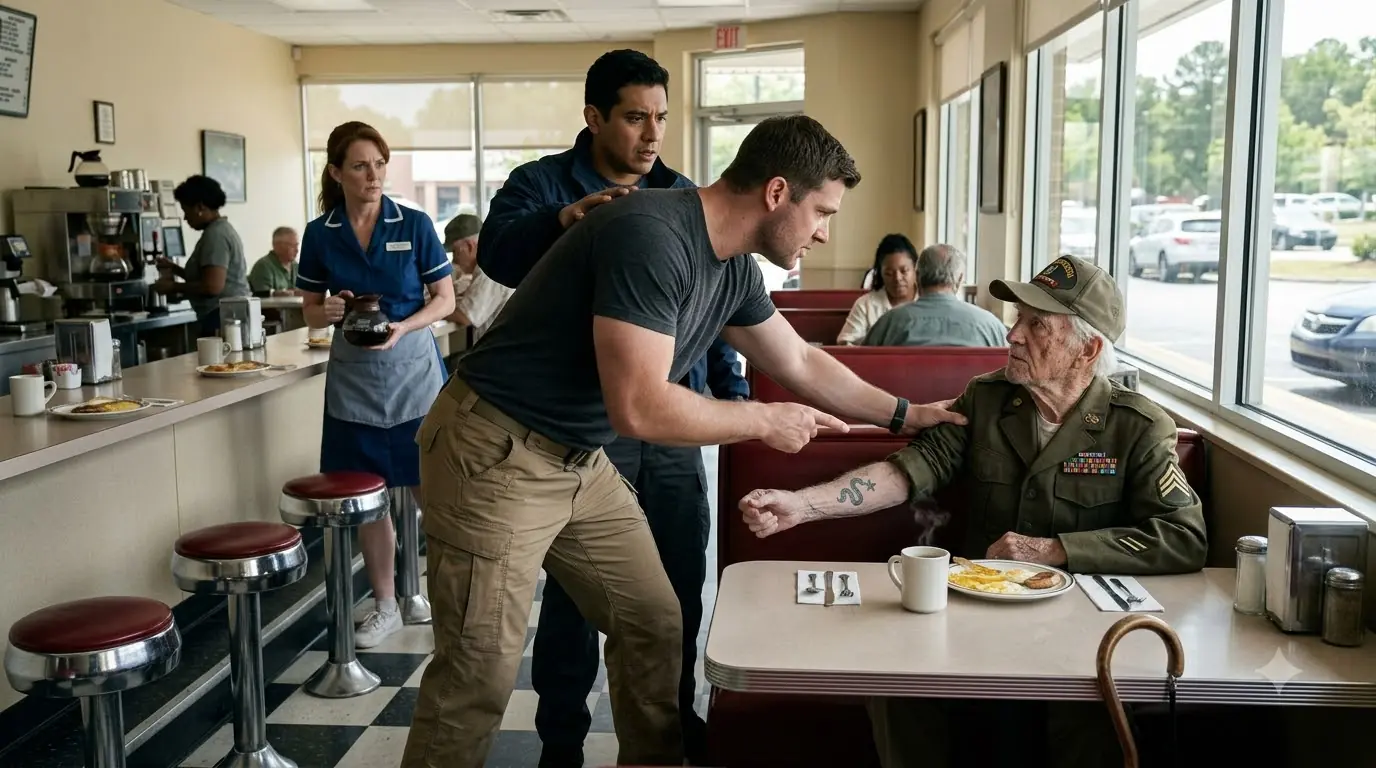
The Scrambled Egg Diner sat only a few miles from Fort Liberty. It was a comfortable place filled with vinyl booths, the smell of bacon and coffee, and the low hum of ordinary conversation.
Glenn Patterson, eighty-one, sat inside his usual booth, stirring two cubes of sugar into his coffee. He came every Tuesday and Thursday, always sitting in the same booth and ordering the same meal, toast and coffee.
The waitress, Sarah, knew him well. Glenn was a quiet, gentle man who always asked about her grandchildren and consistently left a tip far more generous than necessary.
Glenn sensed the two men before he saw them.
It was the physical density of their presence.
They looked like mountains carved from granite and confidence, dressed in civilian clothes that did a poor job of concealing what they were.
The man with the harder jaw stepped closer and planted both palms on Glenn’s table. His knuckles were scarred, and his eyes carried the constant awareness of someone trained to notice everything.
“Did you get that ink from a cereal box, old-timer?”
His voice was young and sharp, steeped in the kind of arrogance that came from being among the best and knowing it.
Glenn did not look up from his coffee.
He continued stirring.
“I am talking to you.”
The man gestured with his chin toward Glenn’s left forearm.
A faded tattoo rested on the wrinkled, sun-spotted skin. It depicted a dark serpent swallowing its own tail, forming a circle around one plain five-pointed star.
The lines had once been thick and black, but decades blurred the ink. It resembled less of a proud military emblem and more of a forgotten drawing.
“What about it?” Glenn asked.
His voice was rough, a low rumble that seemed to require effort.
He finally raised his gaze.
Glenn’s eyes were pale blue and slightly clouded with age, but they contained a placid stillness that appeared to unsettle the younger operator.
The second man, who had remained quieter, nudged his partner.
“Cutler, leave it alone.”
Cutler ignored him.
“I am only curious about what it is supposed to represent. Is it some kind of biker symbol?”
He smirked.
“Were you in a club? What was it called, the Geriatric Guzzlers?”
A pocket of silence spread outward from Glenn’s booth.
Sarah stopped with a coffee pot in her hand. The regular customers exchanged nervous glances while watching the two imposing men.
Glenn took a slow drink, then placed his mug down with a steady hand.
“It is something from a long time ago.”
“A long time ago,” Cutler repeated mockingly.
He drew out every word.
“You served?”
Glenn did not answer immediately.
“What were you, a cook? Quartermaster Corps? Maybe you pushed papers somewhere in Saigon?”
The condescension became almost physical.
Cutler was testing Glenn, prodding him, and enjoying what he believed was an obvious imbalance of power.
He and his partner served at the very tip of the spear, among the most elite fighting forces in the world. To Cutler, Glenn appeared to be only a relic, a piece of living history that had somehow forgotten to crumble into dust.
“Something like that,” Glenn said.
That indifference infuriated Cutler.
He had expected deference or at least a flicker of fear. Glenn gave him nothing but calm disinterest.
“You know, we do not appreciate people pretending to be something they are not,” Cutler continued. “It is called stolen valor.”
Glenn returned his attention to the coffee.
“People wear symbols and tell stories about places they never went. They claim things they never earned.”
Cutler pointed one thick finger toward the tattoo.
“That mark on your arm, I have never seen it in any book or unit history. Trust me, I know them all.”
The quieter operator, Reyes, spoke again.
His voice remained low.
“He is not claiming anything. We are on downtime. Let the man drink his coffee.”
“No,” Cutler snapped.
His focus remained locked on Glenn.
“I want to know. I want to hear the war story connected to that fifty-cent tattoo.”
He leaned closer.
“What does it mean, old man?”
Glenn looked at Cutler again.
It was not a challenging expression.
It showed profound, soul-deep exhaustion, as though Glenn was not merely seeing one arrogant young man but an entire line of them stretching backward through time.
“It means something,” Glenn whispered, “to the people it is supposed to.”
Cutler laughed.
The sound was harsh and barking.
“That is it? That is all you have?”
He moved closer until his voice dropped into a conspiratorial hiss.
“I think you are completely full of it. I think you spent your war peeling potatoes, then had that thing done inside some back-alley shop in Fayetteville to impress women.”
The disrespect hung inside the diner, thick and sour.
Sarah placed the coffee pot down with a sharp metallic sound. Inside the kitchen, the cook stopped turning pancakes.
Every conversation disappeared.
Everyone watched.
Cutler straightened with a satisfied expression.
In his own mind, he had won.
He had not received the frightened reaction he wanted, but he believed Glenn’s continuing silence confirmed everything.
Cutler turned toward Reyes.
“See? Nothing. He is just another phony.”
Then he made his final and most serious mistake.
Cutler reached forward and casually tapped one finger against Glenn’s tattoo.
The contact was light and almost dismissive.
For Glenn, it struck like lightning.
The diner vanished.
The smell of old coffee and bacon grease became the metallic scent of blood and wet earth. The sound of plates transformed into the distant rhythmic beating of helicopter rotors.
Glenn was no longer sitting inside a vinyl booth.
He was crouched beneath the humid canopy of a jungle while rain dripped from enormous leaves.
A young man’s hand, slick with mud, rested against his shoulder.
A whisper reached his ear.
“Stay with me, Pat. Just stay with me.”
Glenn remembered a makeshift needle.
A thin piece of bamboo dipped into a mixture of ink and gunpowder.
The tattoo had been created in silence inside a hidden camp deep in a country where their presence officially did not exist.
It was a pact shared by five survivors of a mission that had never happened according to every public record.
The serpent swallowing its own tail represented the endless cycle of their war.
The star represented them.
Five points inside a lonely constellation beneath a blacked-out sky.
It was not a decoration.
It was a scar.
It was a promise.
Glenn blinked.
The jungle disappeared.
He was back inside the diner, and Cutler’s finger still rested against his arm.
Glenn slowly pulled his arm away.
His expression remained unchanged, but something beneath the placid surface had moved. An ancient tide had turned.
Cutler continued grinning, enjoying his performance in front of the silent room.
Sarah was already moving.
She had witnessed enough.
Glenn Patterson was more than a customer. He was part of the diner, a quiet and gentle soul who remembered the names of her grandchildren.
Watching him be humiliated by two men intoxicated by their own strength awakened a cold fury inside her.
Sarah slipped into the small, cluttered office behind the kitchen.
She closed the door quietly and removed an old flip phone.
She did not call the police.
At most, local officers might ask the men to leave. Sarah understood that this was a different kind of problem requiring a different kind of response.
Her cousin, Stacy Miller, worked as an administrative assistant inside the Joint Special Operations Command headquarters on post.
It was a long shot.
It was also the only option Sarah had.
Stacy answered on the second ring.
“General Thorne’s office. Senior Airman Miller speaking.”
“Stacy, it is Sarah.”
Sarah whispered urgently.
“Listen, I do not have much time. Two of your men are inside the diner harassing one of my regular customers. He is an elderly man.”
“Sarah, I am in the middle of something,” Stacy replied with irritation. “If they are causing trouble, call the military police.”
“No, you do not understand.”
Sarah lowered her voice further.
“The old man’s name is Glenn Patterson.”
A pause followed.
“I do not recognize the name,” Stacy said. “Is he a retired general?”
“I do not know what he is, but they are mocking a tattoo on his arm.”
“What tattoo?”
“A snake inside a circle, swallowing its own tail. There is a star in the middle.”
The silence on the other end became absolute.
Three seconds passed.
Then four.
Then five.
When Stacy spoke again, her professional crispness had vanished. Her voice carried a strained, high-pitched tension.
“Say that again.”
Sarah frowned.
“Describe the tattoo again.”
Sarah repeated the description.
“And his name is Glenn Patterson?” Stacy asked.
“Yes. Are you going to do something?”
“Remain where you are. Do not allow them to leave.”
The call ended.
Inside the sprawling, sterile headquarters of Joint Special Operations Command, Senior Airman Stacy Miller felt cold sweat form across her forehead.
Neither the name nor the symbol appeared inside any official database accessible to her.
However, Stacy had worked in that office for three years.
She had heard the whispers.
Old sergeants major told stories about operators who existed before the official units, men who created the playbook through sacrifice and silence.
Project Omega.
The ghost unit.
General Marcus Thorne, the four-star commander overseeing America’s elite special operations forces, was in the middle of a highly classified briefing with his senior component commanders.
The room was soundproof.
Satellite images covered the screens, and the discussion was thick with acronyms and sensitive operational information.
Stacy understood the protocol.
Nobody interrupted the general during such a briefing unless the building was burning or World War Three had begun.
She decided the situation was close enough.
Stacy approached the heavy conference-room door, drew a breath, and knocked.
A colonel wearing an eagle on his collar opened it only a few inches. His face immediately displayed annoyance.
“What is it, Airman?”
“I need to speak with the general. It is urgent.”
“It can wait.”
“With respect, sir, it cannot.”
Stacy pushed past him.
Her heart hammered against her ribs as every person inside the room turned toward her.
Some of the most powerful and dangerous military leaders in the country now watched her.
General Thorne looked up from the head of the table.
His eyes resembled chips of flint.
“Airman, this had better be the end of the world.”
Stacy walked directly toward him.
Her training took over.
She leaned down and spoke clearly enough that only the general could hear.
“Sir, I apologize for interrupting. I received a call from a source outside the installation.”
Thorne’s expression remained unchanged.
“A man named Glenn Patterson is being harassed at the Scrambled Egg Diner by two active-duty operators from the unit.”
The general did not move.
“They are questioning his service, sir.”
Stacy’s voice began trembling.
“They are specifically mocking a tattoo.”
She hesitated.
“A serpent forming a circle around a five-pointed star.”
The change in General Thorne was immediate.
His famous mask of composure did not merely crack.
It vanished.
Color drained from his face and was replaced by a dark, thunderous rage that seemed to remove the oxygen from the entire room.
Several commanders instinctively moved back.
Thorne rose so quickly that his chair scraped against the floor and nearly overturned.
When he spoke, his voice was not loud.
It was a low, guttural command slicing through the silence.
“Get my security detail.”
Nobody moved quickly enough for him.
“Get my vehicles now.”
Thorne looked around the table.
“This meeting is over.”
Back inside the diner, Cutler had received no satisfying reaction from Glenn and decided to escalate.
His patience disappeared.
In its place emerged a mean-spirited need to force the elderly man to break.
“All right, Grandpa. I think we have had enough of your stolen-valor performance.”
His voice hardened.
Cutler seized Glenn’s upper arm.
“Let us take a walk outside. You and I can have a private conversation about respect.”
He was threatening to physically confront an eighty-one-year-old man inside a public diner.
A collective gasp moved through the room.
Reyes grabbed Cutler’s shoulder.
“Cutler, stop. What are you doing?”
Cutler no longer listened.
He began pulling Glenn from the booth.
That was when everyone heard the sound.
It was not the familiar wail of police sirens.
It was deeper and more ominous.
Powerful engines approached at high speed.
Heads turned toward the windows.
Three black Chevrolet Suburbans carrying government plates swept into the parking lot. They stopped in a precise tactical formation surrounding the diner’s entrance.
The doors opened before the vehicles completely stopped.
Men and women in crisp military service uniforms emerged.
They did not wear combat equipment.
They were members of the command security detail, serious-faced sergeants major and master sergeants moving with synchronized precision.
They established a perimeter and scanned every window, vehicle, and entrance.
Within seconds, the small roadside diner became a high-security zone.
Cutler and Reyes froze.
They recognized the vehicles.
They recognized the senior noncommissioned officer leading the security detail.
The blood drained from their faces.
Cutler’s arrogance disappeared, replaced by pale confusion and the first cold sensations of genuine dread.
The rear door of the lead Suburban opened.
General Marcus Thorne stepped out.
Four silver stars glittered on his uniform beneath the morning sunlight.
He did not acknowledge the people around him.
His eyes burned with a cold, controlled fury and remained fixed on the diner’s entrance.
Thorne strode forward as his security detail silently followed.
The bell above the diner door rang when he entered.
The room was so silent that the small sound resembled a gunshot.
The general filled the doorway.
His presence seemed to pull every remaining breath from the room.
He ignored the stunned operators.
He ignored the customers staring from their booths and counter stools.
His gaze swept across the diner and settled on the old man beside the window.
General Thorne walked directly toward Glenn Patterson.
He stopped with his polished black shoes only inches from the table.
Cutler still had one hand gripping Glenn’s arm.
Thorne looked down at it.
The expression inside the general’s eyes was so cold that Cutler immediately released Glenn as though burned.
Then General Thorne did something nobody in the diner expected.
He clicked his heels together.
His back became perfectly straight.
Inside a small diner filled with the smell of bacon and coffee, the highest-ranking special operator in the United States military came to attention.
He raised his hand and rendered a perfect, textbook salute to the frail old man beside the window.
Time appeared to stop.
After a long moment, Thorne lowered his hand.
When he spoke, his voice carried an emotion none of the people around him had ever heard.
“Glenn, it has been too long.”
Glenn looked up.
A faint and sad smile touched his face.
“Marcus, you got old.”
General Thorne allowed himself a brief smile.
Then he turned toward the two operators, who appeared close to becoming physically ill.
The general’s eyes became arctic.
“You.”
He addressed Cutler.
“You questioned this man.”
Cutler attempted to speak but produced only a strangled sound.
“You questioned his tattoo.”
Thorne did not wait for an answer.
With slow and deliberate movements, he unfastened the cuff of his right sleeve.
He rolled the fabric past his wrist and above an expensive watch.
There, on the forearm of the four-star general, was the exact same tattoo.
A serpent swallowing its tail.
A circle surrounding a five-pointed star.
Thorne’s tattoo was newer and its lines remained sharper, but it was an unmistakable match for the faded mark on Glenn Patterson’s arm.
A wave of shock spread throughout the diner.
“Allow me to explain who you were speaking to.”
The general’s voice remained low and dangerous but carried clearly through the room.
“This is Glenn Patterson.”
He looked toward the old man.
“Before SEAL Team Six, before Delta Force, there was a small group of men sent into darkness to accomplish what everyone else considered impossible.”
The general turned back toward the operators.
“They were called Project Omega.”
Cutler could not look away.
“They were ghosts. Their operations were never publicly recorded, and their names were never spoken.”
Thorne stepped closer to Cutler and Reyes.
“This man and four others established the tradition you believe you represent.”
He allowed silence to follow.
“Understand that.”
The room remained perfectly still.
“In 1968, during an operation that remains heavily classified, Glenn’s team was compromised deep inside Laos.”
Thorne’s voice became quieter and more intense.
“They were pursued for three weeks through terrain most men could not survive for three days.”
The general looked at Glenn.
“Three battalions searched for them.”
He turned toward Cutler again.
“Glenn Patterson carried a wounded teammate on his back during the final two days. That teammate was me.”
The revelation settled over the room.
“I was a young lieutenant.”
Thorne’s jaw tightened.
“He carried me through swamps, hostile patrols, and conditions that should have ended both of us. He reached the extraction point when every reasonable calculation said it was impossible.”
The general allowed the silence to deepen.
“Of the five men who originally wore this mark, only two remain alive.”
Thorne gestured between himself and Glenn.
“You are looking at both of them.”
The weight of the explanation crushed what remained of Cutler and Reyes’s confidence.
Customers stared at Glenn with an entirely different understanding.
The quiet man who drank coffee twice each week was not merely a veteran.
He was a living legend whose existence had been deliberately hidden.
Thorne returned his attention to the two operators.
The rebuke that followed was not loud.
It was quiet and surgically precise.
“You wear the uniform of the quiet professional.”
His eyes moved between them.
“That is our creed.”
Neither man answered.
“Today, you forgot the quiet part.”
Thorne took another step.
“You forgot the professional part.”
His voice became barely louder than a whisper.
“You forgot that every piece of equipment you carry and every tactic you employ was purchased through the sacrifices of men like him.”
Cutler lowered his head.
“You forgot to respect those who came before you.”
Thorne examined them with complete contempt.
“You forgot everything.”
He straightened.
“My office at 0500 tomorrow.”
The two operators remained frozen.
“Be prepared to surrender your credentials.”
The general had ended their careers inside the elite teams.
Cutler and Reyes stood broken and humiliated.
Glenn Patterson finally spoke.
He slowly pushed himself out of the booth and stood on uncertain legs.
He did not look at General Thorne.
His pale eyes settled on the shattered expressions of the two younger men.
There was no anger or triumph inside Glenn’s voice.
“The tattoo does not make the man.”
Cutler raised his eyes.
“The man makes the tattoo mean something.”
Glenn gestured vaguely toward Thorne, the uniforms, and the security detail.
“All of this comes and goes.”
He looked directly at Cutler.
“Uniforms, assignments, status, and reputation.”
Glenn paused.
“Your character is the only thing you truly own, son.”
The diner remained silent.
“Try not to lose it.”
Glenn turned toward his old friend.
“Buy me a coffee, Marcus. It has been a while.”
General Thorne placed one hand against Glenn’s shoulder to steady him.
For an instant, a final image returned to Glenn’s mind.
It was not of the jungle or the pursuit.
It was a quiet moment afterward inside a temporary medical station.
A much younger Marcus Thorne sat with one arm bandaged, wincing while Glenn carefully completed the tattoo on the lieutenant’s forearm using the same improvised bamboo needle.
Glenn remembered the words he spoke more than half a century earlier.
“It is a promise to remember those who are not here.”
The young lieutenant listened.
“It is a promise never to quit.”
Glenn finished the mark.
“Now you are one of us for life.”
The consequences of the Scrambled Egg Diner incident were swift and decisive.
General Thorne did not consider Cutler and Reyes to be the entire problem.
He viewed their behavior as a symptom of something larger, a generation of warriors so concentrated on the present that some had forgotten the people who created their profession.
Within one month, Thorne established a new mandatory training block for every special-operations candidate.
The program was called Legacy.
It provided a detailed examination of the history and lineage of their silent profession.
Active-duty instructors did not teach the most important classes.
Instead, the command invited carefully vetted veterans from Vietnam, Grenada, Panama, and other operations.
Men like Glenn Patterson were flown in to speak directly with young candidates.
They shared stories and lessons available only through experience, time, and sacrifice.
Cutler and Reyes were not dishonorably discharged.
General Thorne considered that outcome too easy.
They were reassigned as permanent administrative staff for the Legacy program.
Their responsibilities included arranging travel, preparing classrooms, coordinating schedules, and ensuring every veteran speaker received whatever he needed.
For the next three years, Cutler and Reyes served the exact men they had once failed to respect.
Day after day, they listened to accounts of quiet and unassuming courage.
It was a subtle but profound form of penance.
Approximately one year later, Glenn visited a local hardware store while searching for a particular bolt for his old lawn mower.
He was examining bins inside one aisle when a young man wearing a simple Army physical-training uniform cleared his throat respectfully.
It was Cutler.
He looked leaner.
The arrogance had disappeared from his eyes and had been replaced by quiet humility.
“Sir,” Cutler began hesitantly. “Mr. Patterson, I do not know whether you remember me.”
“I remember.”
Glenn’s gaze remained steady.
Cutler swallowed.
“I wanted to tell you that what I did that day was inexcusable.”
He did not offer a dramatic speech or plead for forgiveness.
“I was arrogant, disrespectful, and wrong. There is no excuse.”
Cutler looked Glenn in the eyes.
“I am sorry for everything.”
Glenn studied him for a long moment.
Then he extended one hand.
Cutler accepted it and appeared surprised by the strength remaining inside the elderly man’s grip.
“We all have things to learn, son,” Glenn said.
His voice remained the same quiet rumble it had always been.
“The important thing is that you continue learning.”
Glenn gave him one small nod.
Then he turned back toward the bins of bolts.
For Glenn, the conversation was complete.
Quiet heroes walk among ordinary people every day.
They do not announce themselves or demand recognition.
Sometimes they simply sit inside a diner, order coffee, and stir in two cubes of sugar.
If a person is not careful, humility can be mistaken for weakness and silence for insignificance.
Then a four-star general rolls up his sleeve and reveals that legends are not constructed from noise.
They are built from promises kept in the dark.