On April 17, 1984, Carl Brenner stood at the back of a farm auction in Shelby County, Illinois. He was forty years old, and the wind came hard across the gravel lot, carrying dust and the smell of diesel.
In front of him, a Case IH 2390 sat on a trailer, its red paint faded along the hood and one rear tire worn deeply enough to show cord. The auctioneer’s voice cut through the cold.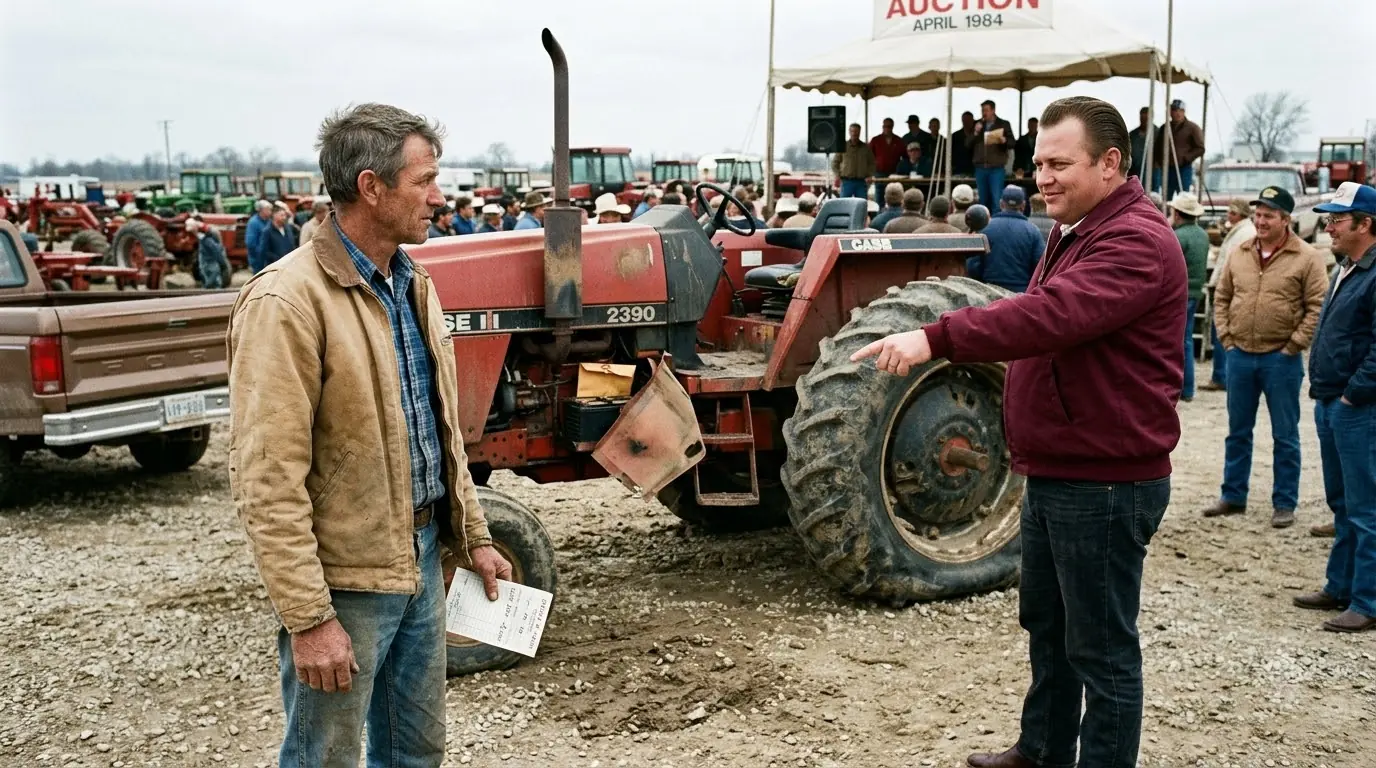
“Do I hear seventy-five hundred?”
Silence.
Carl had not come to buy a tractor. He had come only to watch. His own equipment was aging but functional, and his farm consisted of 480 acres of corn and soybeans inherited from his father, managed carefully and without excess. He had no intention of spending money he did not have on a machine he did not need.
The silence stretched.
“Seven thousand,” the auctioneer called. “Sixty-five hundred. Six thousand.”
Carl studied the 2390. It was a four-wheel-drive model built in 1981, only three years old, though neglect and hard work had made it appear much older. Its previous owner was Russell Hoffman, a farmer Carl knew only by reputation.
Hoffman had expanded aggressively during the late 1970s. He bought land on credit, upgraded machinery every two years, and operated as if grain prices would continue climbing forever. Then prices collapsed, interest rates rose, and the debt that had once seemed manageable became impossible.
Russell Hoffman filed for bankruptcy in February.
Everything he owned was being sold that morning.
“Five thousand,” the auctioneer called.
Carl raised his hand.
The auctioneer pointed toward the rear of the crowd.
“Five thousand. I have five. Do I hear fifty-five hundred?”
No one moved.
“Sold. Five thousand dollars to the gentleman in the back.”
Carl walked to the cashier’s table and wrote a check. As he turned to leave, he heard laughter from near the fence. Three men stood together, neighbors and farmers he had known for years.
One of them was Vernon Klaas.
Vernon grinned and shook his head.
“You bought Hoffman’s junk.”
Carl did not answer.
“That thing will be in pieces by fall,” another man added.
Carl climbed into his truck and drove home.
The Case IH 2390 was delivered two days later.
Carl Brenner had been raised on the same land he now farmed. His father, Raymond, purchased the original quarter section in 1946 and gradually added acreage over the years. Raymond was not a talkative man, and he taught Carl to work by working beside him.
He taught his son to maintain equipment by maintaining it until there was truly nothing left to maintain. He believed machinery should earn the right to be replaced through complete exhaustion, not merely through age or changing fashion. Every broken part was examined before a new one was ordered, and every new purchase was considered for weeks.
When Raymond died in 1978, Carl inherited the farm, the machinery, and a mortgage that was nearly paid off. He did not expand immediately or purchase new equipment every season. He did not believe growth was automatically a sign of success.
In 1984, survival meant keeping his head down, controlling costs, and ignoring the men who measured achievement by the size of their operations. Many of those men carried more debt than land, though they rarely mentioned that part at the cooperative.
The Case IH 2390 sat inside Carl’s machine shed for three weeks before he seriously examined it. He still had work to finish with the equipment he already owned, and planting season was approaching quickly. The tractor remained near the back wall, coated in auction dust, looking exactly like the mistake Vernon Klaas had claimed it was.
On a Sunday afternoon in early May, Carl finally walked into the shed and opened the engine cowling.
The tractor carried a six-cylinder turbocharged diesel engine. Carl checked the oil and found it surprisingly clean. He pulled the dipstick, wiped it, inserted it again, and inspected the level a second time.
Still clean.
He examined the hydraulic fluid, coolant, fuel filters, hoses, and fittings. Everything appeared newer than it should have been on a machine that looked so neglected from the outside. Even several bolts showed signs of having been removed and reinstalled recently.
Carl climbed into the cab and turned the key.
The engine started on the first attempt.
It settled into a smooth idle without knocking, hesitation, or uneven vibration. Carl let it run for ten minutes, watching the gauges and listening for changes in tone. The oil pressure remained steady, the temperature rose normally, and the exhaust stayed clean.
He shut the engine down.
In the sudden quiet of the shed, Carl stood looking at the tractor and felt the first edge of doubt about everything people had said at the auction.
Over the next two days, he examined the machine more closely. Carl was not a trained mechanic, but he understood machinery the way his father had, through necessity, repetition, and years of learning what different sounds meant before they became failures.
He removed the valve cover and inspected the rocker arms. He checked the accessible surfaces of the camshaft and looked for sludge, scoring, heat discoloration, or excessive wear. Everything appeared unusually clean.
Then he removed the oil pan.
The bearings showed almost no wear.
That was when he found the receipts.
They were folded inside a greasy envelope tucked behind the battery box, hidden in a narrow space where they had remained protected from rain and field dust. Carl opened the envelope and found invoices from a Case IH dealer in Mattoon.
The dates ranged from October 1982 through March 1983.
The documents listed a rebuilt cylinder head, new pistons, main bearings, a replacement turbocharger, injectors, and an overhauled fuel pump. There were additional charges for seals, gaskets, hoses, labor, and testing.
The total came to nearly fourteen thousand dollars.
Russell Hoffman had rebuilt almost the entire engine less than two years before going bankrupt.
Carl sat on the concrete floor holding the receipts.
He finally understood what he had purchased.
This was not simply a worn-out tractor sold in desperation. It was a machine Russell Hoffman had tried desperately to save. Hoffman had spent money he did not have because he believed that if he could keep the equipment running, he could keep the farm running with it.
The tractor had not saved him.
The grain market had not recovered in time, the debt had remained, and the bank had taken everything anyway.
But the work on the machine had been done.
Carl folded the receipts carefully and returned them to the envelope. He placed the envelope behind the battery box exactly where he had found it.
He told no one.
Planting season in 1984 was wet. Rain arrived every few days, and fields that had begun drying turned back into mud before many farmers could finish working them.
Carl connected the 2390 to a twelve-row planter. The four-wheel-drive system kept traction where his older two-wheel-drive tractors would have spun, forcing him to stop or wait for better conditions.
The machine handled the work without complaint.
It pulled steadily through soft ground, maintained hydraulic pressure, and never overheated. Carl finished planting three days earlier than expected.
At the cooperative, Vernon Klaas saw him fueling the tractor.
“Still running?” Vernon asked.
“Still running,” Carl answered.
Vernon laughed.
“Give it time.”
Carl finished fueling and drove home.
Summer came dry. The corn developed slowly, and by August, yield estimates were falling throughout Shelby County. Carl’s farm was no exception.
He began harvest in September, stored what grain he could, and sold the rest at prices that barely covered production costs. It was not a profitable year, but it was not a catastrophic one either.
Carl paid his bills.
He kept the farm.
The 2390 worked through the entire harvest without a mechanical failure.
In October, Carl was combining a field beside the road when he saw a truck pull onto the shoulder. A man climbed out and walked to the fence.
Carl recognized him after a moment.
It was Tom Hoffman, Russell’s younger brother.
Tom stood at the fence and watched the Case IH tractor pulling grain wagons from the field. Carl finished the pass, shut down the combine, and walked over.
“That’s Russell’s tractor,” Tom said.
“It is.”
Tom studied the machine for a long time.
“He put everything into that tractor. He thought that if he could keep the equipment running, he could make the farm work.”
Carl nodded.
“He couldn’t,” Tom said.
Carl did not know what answer the moment required.
Tom turned, returned to his truck, and drove away without saying goodbye.
The years that followed were not dramatic.
Carl farmed.
He planted in spring, harvested in fall, and repaired machinery during winter. The 2390 became his primary tractor, used for tillage, planting, hauling wagons, and nearly every heavy job the farm required.
He changed the oil every one hundred hours. He replaced filters according to a schedule more careful than the manufacturer required and greased every fitting before the old lubricant had time to dry.
The tractor required maintenance.
It did not require major repair.
In 1987, grain prices improved slightly, and Carl harvested a respectable crop. He applied much of the extra income to the remaining mortgage.
The following year, the drought of 1988 struck the Midwest.
Fields withered beneath weeks of heat. Carl’s yields fell approximately forty percent, and several areas of corn never developed full ears. He sold cattle he had intended to keep and borrowed against the following year’s crop.
He survived.
The 2390 worked through the dry, hardened soil without breaking down.
In 1989, Carl’s wife, Ellen, was diagnosed with breast cancer.
She underwent surgery in Springfield, followed by chemotherapy through the winter. Carl drove her to every appointment, a trip of nearly two hours each way.
Farm work fell behind.
He hired a neighbor’s son to help feed livestock and reduced the number of acres planted the following spring. Some days, he completed only the work that absolutely could not wait and left everything else for another time.
Ellen recovered slowly.
By summer, she could sit on the porch and watch Carl move through the nearby fields. She never returned completely to her old strength, but she lived, and for several years that was enough.
The medical bills took three years to pay.
Through all of it, the 2390 continued running.
Carl turned forty-seven in 1991. He had been managing the farm alone for thirteen years since his father’s death.
The land mortgage was nearly paid off. His machinery was old but functional, and the farm had survived the most difficult years of the agricultural crisis.
Carl had survived drought.
He had survived debt.
He had survived the illness that almost took his wife.
One morning at the cooperative, Vernon Klaas stood beside the seed display speaking with two other farmers. Carl entered to purchase parts and walked past them.
“Carl is still running that auction tractor,” Vernon said loudly.
One of the other men laughed.
“I’m surprised it hasn’t fallen apart.”
Carl paid for his parts and left without responding.
When he returned home, he parked the truck and walked directly to the machine shed.
The 2390 stood where he had left it, covered with field dust. A branch had cracked one headlight during spring tillage, and the red paint had faded further along the hood.
Carl looked at the tractor for a long time.
He thought about the receipts still folded behind the battery box. He thought about Russell Hoffman spending fourteen thousand dollars to save an engine and, perhaps in his own mind, save a farm.
He thought about Tom Hoffman standing at the fence and saying that his brother had put everything into the machine.
Carl returned to the house.
He never told anyone about the receipts.
The 1990s passed in the way years pass on a farm that survives without becoming wealthy.
Carl planted, harvested, and maintained.
Grain prices remained low for long stretches. Input costs continued rising, and profit margins stayed thin enough that every unexpected repair mattered.
Farms around him were sold, consolidated, or absorbed into larger operations. Families who had worked the same ground for generations held auctions, signed papers, and disappeared from the county within weeks.
Carl kept his 480 acres.
He kept his equipment.
He kept working.
The 2390 accumulated hours.
Five thousand.
Seven thousand.
Ten thousand.
Carl rebuilt the clutch in 1994. He replaced the radiator in 1997 and overhauled the hydraulic pump in 1999.
These were normal repairs, the kinds expected from a machine that worked hard every season. None of them surprised him.
The engine Russell Hoffman had rebuilt in 1982 never failed.
Ellen’s health began declining again.
It did not happen suddenly. She had been weakening for months, and the old illness eventually returned in a form doctors could no longer treat.
Carl buried her in the cemetery outside town beside his parents.
After the funeral, he returned to the farm and continued working because he did not know what else to do.
His son, Michael, had left for college in 1993 and never returned to farming. Michael found work in Chicago in finance and eventually married a woman Carl had met only a few times.
Michael called approximately once a month.
Their conversations were brief.
Carl farmed alone.
In 2003, Carl was fifty-nine years old, and the 2390 had been working on his farm for nineteen years.
He was pulling a chisel plow through a field in late March when the tractor began losing power. Carl reduced the throttle and checked the gauges.
Oil pressure remained normal.
Temperature remained normal.
But the engine labored under a load it normally handled easily.
Carl completed the pass and drove back to the machine shed. He inspected the fuel system and then removed the air filter.
The filter was badly clogged.
Carl replaced it.
The power returned.
That evening, he sat alone in the kitchen eating dinner and realized the tractor had outlasted his wife, outlasted his father’s living memory, and outlasted every prediction made about it at the auction in 1984.
Vernon Klaas had stopped farming in 1999. He sold his land to a large operation and moved to Florida.
Carl had not spoken to him in years.
Russell Hoffman died in 1996.
Carl learned about it from a short obituary in the local newspaper. The notice listed relatives and funeral information but said nothing about the farm, the bankruptcy, or the machine Russell had tried so hard to save.
Carl folded the newspaper and set it aside.
By 2008, Carl was sixty-four.
He had begun thinking about retirement, though he did not understand what retirement was supposed to mean for someone whose identity had always been tied to the next season.
The farm was paid off.
The machinery was old.
Michael had made it clear he would not be taking over.
In October of that year, Carl attended a farm auction south of town. It was a complete dispersal sale for a family preparing to retire.
He walked through the equipment yard and examined tractors newer, cleaner, and more advanced than anything he owned. A man in his thirties stood near a John Deere 8300 speaking on a cell phone, while another inspected a sprayer and took notes on a clipboard.
The auctioneer began with a hay baler.
Carl walked toward the rear of the property and found a 1985 Case IH 1896. The tractor looked rough, with chipped paint and worn tires.
The auctioneer reached it near the end of the sale.
“Do I hear four thousand?”
Silence.
“Three thousand. Twenty-five hundred. Two thousand.”
A young farmer near the front raised his hand at eighteen hundred dollars.
“Sold.”
Carl watched the young man walk toward the cashier.
He looked nervous and excited, perhaps aware that he had just spent money he could barely spare.
Carl wondered whether anyone would mock him for buying an old tractor at auction.
He wondered whether it mattered.
In 2012, Carl turned sixty-eight.
He had operated the farm for thirty-four years since his father’s death. The 2390 showed approximately fourteen thousand hours.
The red paint had nearly disappeared from several surfaces. The seat was torn, and the steering wheel had been worn smooth by decades of hands.
But Russell Hoffman’s engine still ran.
That spring, Michael called and announced that he was coming to visit.
It was the first visit in two years.
Michael arrived on a Saturday with his wife and two children, grandchildren Carl barely knew. They walked through the farmhouse, looked at old photographs, and ate lunch around the kitchen table.
Afterward, Michael asked to see the farm.
Carl drove him around in the truck and eventually stopped at the machine shed. Michael examined the tractors, tools, and equipment lining the walls.
“You’re still using that one?” he asked, pointing toward the 2390.
“Every day.”
“Dad, that machine must be thirty years old.”
“Thirty-one.”
Michael looked at him.
“When are you going to retire?”
Carl did not answer.
They drove back to the house.
Michael and his family left before dinner.
Carl stood in the driveway watching their taillights disappear and understood that his son knew almost nothing about the farm. Michael did not understand the equipment, the decisions, the sacrifices, or the narrow calculations that had kept everything operating.
Carl did not blame him.
Their lives had simply taught them different ways of measuring value.
In 2014, Carl listed the farm for sale.
He was seventy years old. His knees hurt, his hands were stiff every morning, and operating 480 acres alone had become more difficult than he could safely manage.
A real estate agent placed a sign beside the road.
Several people came to inspect the property, but no one made an offer.
Months passed.
In August, a man named Aaron Dietrich called.
Aaron was thirty-five and farmed with his father two counties away. Their operation needed additional land, and the Brenner farm appeared suited to their plans.
Aaron came to walk the fields and inspect the buildings.
He spent nearly an hour inside the machine shed.
“Is that 2390 included in the sale?” he asked.
“It can be.”
Aaron walked around the tractor. He examined the hour meter, tires, hitch, hydraulic connections, and the wear around the cab.
“Does it run?”
Carl climbed into the cab and started it.
The engine fired immediately and settled into the same steady rhythm it had carried for decades.
Aaron listened.
“That sounds good for the number of hours.”
Carl shut it down.
“I’ll buy the farm,” Aaron said. “But I want the 2390 included.”
They agreed on a price.
The sale closed in November.
On the day Carl left the farm, he loaded his truck with tools, a few pieces of furniture, clothing, photographs, and several boxes of papers. He was moving into a small house in town, a place without fields, machinery, or a shed.
Aaron arrived during the afternoon to take possession.
Carl handed him the keys to the house and the equipment.
The two men stood in the driveway for a moment.
“That 2390,” Carl said. “There is an envelope behind the battery box. It contains receipts from an engine rebuild. You may want to keep them.”
Aaron nodded.
“I will.”
Carl climbed into his truck and drove toward town.
He did not look back.
In 2018, Carl was sitting in his small kitchen when the telephone rang.
It was Aaron Dietrich.
“I wanted to let you know that the 2390 finally gave out,” Aaron said. “The transmission failed. It is not worth repairing at this point.”
Carl felt something tighten inside his chest.
“How many hours?”
“Eighteen thousand two hundred.”
Carl remained quiet.
“I found the receipts you mentioned,” Aaron continued. “I had no idea what I was buying. That tractor carried us through four seasons. I’m grateful.”
They spoke for several more minutes and then ended the call.
Carl sat at the kitchen table looking through the window at a yard without fields or machinery.
He thought about April 17, 1984.
The auction.
The laughter.
The five thousand dollars he spent on a tractor everyone considered worthless.
He thought about Russell Hoffman spending fourteen thousand dollars to rebuild an engine while his farm was already failing.
He thought about Tom Hoffman standing at the fence and saying his brother had put everything into that machine.
The 2390 had worked for thirty-four years after Carl bought it.
Carl had never told anyone the complete story of what he found behind the battery box.
In 2019, Carl attended another farm machinery auction north of town.
He went because it was Saturday, because he had nothing else planned, and because habits formed across a lifetime do not disappear simply because the land is gone.
The auction involved equipment from a farm that had operated since the 1950s.
Carl walked through the yard, looking at tractors, combines, planters, and implements whose purposes he still understood instinctively.
Near the back, he found a Case IH Magnum 7140 built during the late 1980s or early 1990s. It appeared well maintained.
A young woman, perhaps twenty-five, stood beside it holding a notebook. She was speaking on a phone and apparently relaying bids to someone unable to attend.
The auctioneer began at twelve thousand dollars.
The price climbed rapidly.
Fifteen thousand.
Eighteen thousand.
Twenty-two thousand.
The young woman continued bidding.
At twenty-five thousand dollars, she won.
Carl watched her walk to the cashier while still on the phone, smiling as she spoke.
He wondered whether anyone would mock her.
He wondered whether she might someday discover something hidden inside that tractor, evidence of what a previous owner had done to preserve it when everything else was failing.
He wondered whether the discovery would matter to anyone but her.
Carl Brenner died in January 2023.
He was seventy-nine years old.
The obituary in the local newspaper listed his son, Michael, two grandchildren, and a sister living in Ohio. It mentioned that Carl had farmed in Shelby County for more than three decades.
It did not mention the Case IH 2390.
Michael returned to settle the estate.
There was not much to distribute. Carl left furniture, a few bank accounts, clothing, tools, and boxes of old photographs and documents.
Inside one box, Michael found a folded envelope containing receipts dated from 1982 and 1983.
He did not recognize Russell Hoffman’s name.
He threw the envelope away.
The Case IH 2390 Carl purchased in 1984 had been sold to a salvage yard in 2019. Aaron Dietrich received payment for the remaining usable parts.
The transmission was beyond repair, and the body had suffered from decades of weather, vibration, and work.
But the engine was removed.
It was the same engine Russell Hoffman had rebuilt when he still believed a tractor could help save his farm. It was the engine Carl discovered after the auction, maintained for three decades, and trusted through drought, debt, illness, grief, and thousands of acres.
The salvage yard sold it to a man in Indiana who rebuilt old tractors.
It may still be running.
No one kept the receipts.