“This is a medical facility, not a jungle.”
That was how arrogant hospital corpsman Jake Mendes humiliated seventy-eight-year-old Doc Carver, mocking his old medical bag and forcing him to hide it in a locker.
Mendes trusted only tablets, checklists, and modern protocols.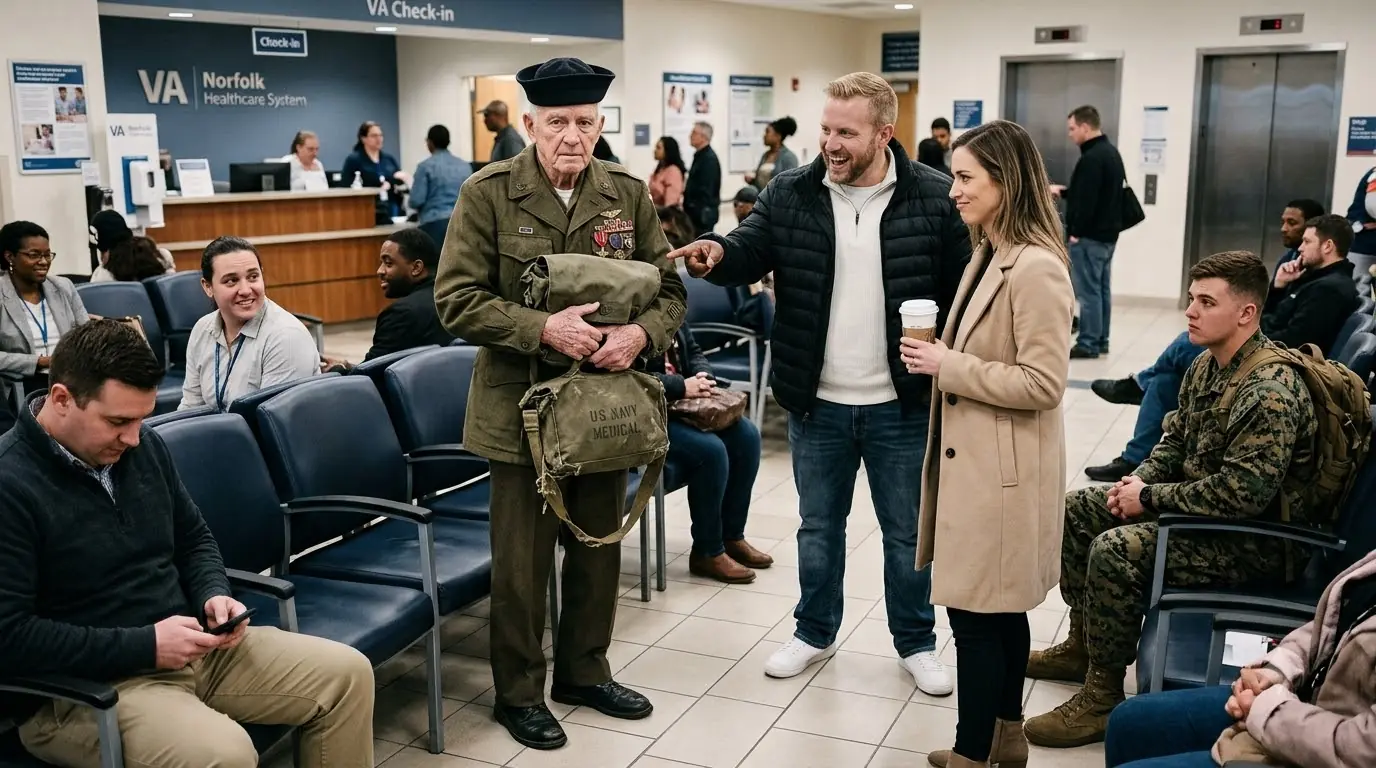
But his arrogance crumbled when a retired admiral collapsed in the waiting room.
While the young man froze in panic, the useless old man acted.
In just twelve seconds, with nothing but his hands, his memory, and the kind of field wisdom that had once saved men with improvised tools under fire, Doc saved the officer’s life.
The shock became total when a vice admiral walked in and revealed the truth.
That old man was a legend who had saved more lives with instinct and improvisation than Mendes might ever save with all the technology in the world.
“Sir. Sir, you can’t bring that in here.”
The voice belonged to hospital corpsman Jake Mendes, twenty-seven years old and convinced that his tablet held every answer the Navy Medical Corps had ever needed.
He stood blocking the entrance to the waiting room at the VA Medical Center in Norfolk, Virginia, one hand on his hip, the other pointing at the canvas bag in the old man’s weathered hands.
Thomas Carver, seventy-eight years old and bent like a question mark from decades of carrying weight no man should carry, looked up slowly.
His eyes were the pale blue of winter ice.
They held a depth that Mendes did not bother to notice.
“It’s just my kit,” Doc said quietly, his voice roughened by age and by cigarettes he had quit thirty years too late.
“Your kit?”
Mendes let out a short laugh that made two young Marines in the waiting room look up from their phones.
“Oh, sir, this is a medical facility. We have actual medical equipment. You can’t just walk around with a bag full of whatever that is.”
Doc’s fingers tightened slightly on the worn canvas, a motion so subtle it might have been a tremor from age.
The bag was older than Mendes.
Its olive drab fabric was stained with things that did not wash out. Inside were items that would look like junk to anyone who had never had to keep a man alive with nothing but improvisation and twelve seconds of clarity. A broken-down pen barrel saved as a reminder. A roll of heavy-duty tape gone sticky at the edges. Gauze. Rubber tubing. Old field tools from wars that did not care whether a medic had the perfect equipment.
“I’ll keep it with me,” Doc said. “I won’t bother anyone.”
“It bothers me.”
Mendes stepped closer, his voice dropping into that particular tone of condescension young men use when they think they are being patient.
“Look, Pops, I get it. You probably carried this around in whatever war you were in. Vietnam, right? But things have changed. We have protocols now. Standards. You’re in a modern facility, not a jungle.”
The waiting room went quiet.
A dozen people, most of them veterans decades younger than Doc, watched the exchange with varying degrees of interest and discomfort.
A young woman with sergeant stripes on her ACUs shifted in her seat. An older man with a Vietnam Veteran cap pulled low frowned, but said nothing.
Doc did not argue.
He had learned a long time ago that some battles were not worth the breath.
“Where should I put it?”
“There are lockers by the entrance. You can pick it up when you leave.”
Mendes’s tone had shifted to barely concealed impatience.
“Unless you want to just leave it in your car like a normal person.”
“Don’t have a car. Took the bus.”
Mendes sighed theatrically, glancing at his tablet as if it might offer an escape from the conversation.
There was no line.
The waiting room was half empty, and the front desk clerk, a heavyset woman named Doris who had worked there for twenty years, was reading a paperback novel.
But Doc did not point that out.
He just shuffled past Mendes, moving with the careful deliberation of a man whose knees had filed for retirement a decade ago.
As he walked toward the bank of scratched metal lockers near the men’s room, he heard Mendes mutter to one of the Marines.
“Every day with these old-timers. They think they’re special because they’re veterans. This is a VA hospital. Everyone here served. Doesn’t mean you get to break the rules.”
The Marine, a lance corporal with a fresh haircut and the lean build of someone who still ran three miles before breakfast, nodded uncertainly.
He watched Doc fumble with the locker combination, those trembling hands betraying him, and something uncomfortable twisted in his gut.
His grandfather had hands like that.
He had carried himself with that same quiet defeat, that same sense of being tolerated rather than respected.
Doc finally got the locker open and carefully placed his kit inside.
He stared at it for a long moment, as if saying goodbye to an old friend.
Then he closed the door with a soft metallic click.
When he turned back toward the waiting room, Mendes had already moved on, absorbed in his tablet, swiping through digital charts with the confidence of a man who had never had to make a life-or-death decision without the backing of an entire hospital’s resources.
The morning dragged on with the particular tedium unique to military medical facilities.
Doc sat in a chair near the back, his appointment not for another forty-five minutes, watching the flow of people.
Young veterans with invisible wounds.
Middle-aged men with missing limbs.
A handful of elderly warriors like himself.
The survivors of wars that were now just chapters in history books that high school students barely read.
Mendes worked the room like it was his personal kingdom.
Clipboard in one hand, tablet in the other, calling out names with the brisk efficiency of someone who would rather be anywhere else.
When he called Thomas Carver and Doc slowly rose to his feet, Mendes barely looked up.
“You’re early. Sit back down. I’ll call you when we’re ready.”
“Thought I heard my name.”
“You did. I’m checking you in. Your appointment’s at eleven hundred. It’s ten-fifteen.”
Mendes’s fingers danced across his tablet screen.
“You have your ID card?”
Doc produced it from a worn leather wallet. The card was creased and faded.
Mendes scanned it with a reader, frowned at whatever came up on his screen, and handed it back without comment.
“Sit down. Stay awake this time. Last month, I had to shake you three times before you heard your name.”
A flush of embarrassment colored Doc’s weathered cheeks.
“Yes, sir.”
“Don’t call me sir. I work for a living.”
It was an old military joke, but Mendes delivered it with an edge that stripped away any humor.
He was already moving on to the next patient, a young woman with a service dog, and Doc shuffled back to his seat.
The lance corporal, who had witnessed the earlier exchange, found himself watching the old man.
There was something about the way Doc moved, a precision buried under all that age and arthritis, like a finely made watch that had been dropped too many times but still kept perfect time if you knew how to read it.
The young Marine thought about his grandfather again, about the stories the old man had told before dementia took his words.
Stories about helicopters and rice paddies and friends who died with their boots on.
He wondered if this old guy had stories like that, locked up behind those pale blue eyes.
At 10:47, three minutes before Doc’s scheduled appointment, the main doors opened and a man in his late sixties walked in.
He wore a well-tailored civilian suit that could not quite hide the military bearing in his posture, and he moved with the careful deliberation of someone managing chronic pain.
His name was James Thornton, retired rear admiral.
Two tours in Vietnam, one in the first Gulf War, and enough ribbons to fill a shadow box.
He was at the VA for a routine cardiology follow-up, a consequence of too many years of stress and too many cigarettes in places where death came from the sky.
Thornton checked in at the desk, exchanged a few words with Doris that made her laugh, and took a seat near the center of the room.
He pulled out his phone and began scrolling through emails, his reading glasses perched on his nose, unaware that he had less than three minutes before his life would depend on a man everyone else had ignored.
At 10:49, Thornton’s phone slipped from his fingers and clattered on the linoleum floor.
His hand went to his chest, clutching at his tie. His face went from healthy pink to ash gray in the span of a single breath.
Then he pitched forward out of his chair, his body hitting the ground with a terrible weight.
For exactly two seconds, the waiting room froze in that uniquely human moment of disbelief, where the mind struggles to reconcile what the eyes are seeing with what reality should be.
Then chaos erupted.
Someone screamed.
The lance corporal jumped to his feet.
The woman with the service dog gasped.
And Mendes, standing fifteen feet away with his tablet in his hands, looked up with an expression of pure shock.
“Oh my God,” someone said. “He’s not breathing.”
Mendes’s training kicked in, but it kicked in through layers of procedure and protocol.
His fingers flew to his tablet, pulling up emergency response procedures, his other hand reaching for the phone on the desk to call a code.
His mouth opened to shout for help, to follow the chain of command, to do exactly what the manual said to do.
He had time.
He had resources.
He had every advantage.
What he did not have was twelve seconds of certainty.
Thomas Carver moved like water.
One moment he was in his chair at the back of the room, apparently half asleep, and the next he was dropping to his knees beside Thornton with a speed that defied every one of his seventy-eight years.
His hands, those trembling arthritic hands that had fumbled with a locker combination ten minutes earlier, suddenly moved with surgical precision.
He rolled Thornton onto his back, tilted his head, checked his airway with two fingers that knew exactly what they were looking for. His other hand moved to the man’s neck, searching for life in a pulse so faint most people would have missed it.
Twelve seconds.
That was all he had before the math turned brutal.
Before lack of oxygen started doing what lack of oxygen does.
Before Admiral James Thornton became a statistic instead of a man going home to his grandchildren.
The moment Doc’s fingers touched Thornton’s throat, searching for the pulse that was barely there, the sterile waiting room of the VA Medical Center dissolved like smoke.
The fluorescent lights became the harsh white sun of Southeast Asia.
The smell of industrial cleaner became the copper stink of blood and the bitter bite of smoke.
Doc was not seventy-eight anymore.
He was nineteen, belly down in the red mud of Khe Sanh, and the Marine Corps was teaching him the most important lesson he would ever learn.
When you have twelve seconds, you do not think.
You move.
January 21, 1968.
The siege of Khe Sanh was six days old, and North Vietnamese artillery was turning the combat base into hell on earth. Mortars came in waves, the shriek of incoming rounds so constant that men stopped flinching and started calculating danger by instinct.
Doc was attached to First Battalion, Twenty-Sixth Marines, a Navy corpsman in a sea of jarheads.
He had already learned that his job description was simple.
Keep them alive or die trying.
The round that changed everything landed thirty yards from the fighting hole where Lance Corporal Eddie Morrison and three other Marines were hunkered down.
The explosion was close enough to shower them with dirt and shrapnel, far enough away that it should not have killed anyone.
But shrapnel does not care about should.
A jagged piece of metal punched through Morrison’s gear and into his chest, leaving him fighting for air as the pressure inside his body began turning against him.
“Corpsman up! Corpsman up!”
The scream cut through the bombardment, and Doc was running before his mind had fully processed the words.
His feet found purchase in mud churned by constant shelling, his medical bag bouncing against his hip, his hands already reaching for the supplies he might need.
When he slid into the fighting hole, Morrison was on his back, his face changing color, his mouth opening and closing like a man drowning in air.
Doc knew what he was seeing.
A catastrophic chest injury.
A lung that could not do its job.
Pressure building where pressure was not supposed to be.
Textbooks had answers for this. Textbooks assumed time, backup, clean equipment, and a place where artillery was not chewing the ground apart around you.
Doc had none of that.
Doc had twelve seconds and a cheap ballpoint pen.
He tore open Morrison’s uniform enough to see the wound. Blood bubbled with every attempted breath.
Standard procedure had its place.
This was not that place.
Another mortar screamed overhead, close enough that everyone ducked except Doc.
His hands did not even twitch.
He grabbed the pen from his pocket, a cheap one he had been carrying since basic medical training, broke away what he did not need, and used what remained in the only way the moment allowed.
He worked quickly, guided by training, anatomy, and the terrible clarity of a man who understood there was no room left for hesitation.
A hiss of trapped pressure escaped.
Morrison’s face shifted from blue to gray to pink in the span of seconds.
His lungs fought, then found air.
His eyes focused.
He took a breath that no longer sounded like drowning.
Twelve seconds.
That was how long it had taken from the moment Doc saw Morrison’s face to the moment Morrison started breathing again.
Twelve seconds to decide that the textbook could wait.
Twelve seconds to understand that improvisation was not recklessness when the alternative was death.
Twelve seconds to learn that sometimes the only thing separating life from death was the willingness to move while everyone else was frozen.
Doc stabilized Morrison as best he could, kept him breathing, and got him ready for evacuation.
Morrison would need surgery. He would need months of recovery. But he would live.
He would go home to Mobile, Alabama.
He would marry his high school sweetheart.
He would tell his grandchildren about the crazy Navy corpsman who saved his life with a ballpoint pen and refusal.
As the medevac lifted Morrison out of Khe Sanh hours later, the young Marine grabbed Doc’s hand with a grip that was surprisingly strong for someone who had been dying that morning.
His voice was rough, but clear enough.
“Don’t matter what happens next, Doc. You saved my life. I owe you everything.”
Doc just shook his head.
“You don’t owe me nothing. Just don’t waste it.”
Three weeks later, Morrison’s personal effects from recovery included a small package sent back to Doc.
Inside was the canvas bag, carefully packed with the improvised tool that had saved his life, the razor, the tape, and a note written in shaky handwriting.
For the next twelve seconds.
Eddie Morrison, LCpl, USMC.
Doc carried that bag for the next fifty-six years.
Through the rest of Vietnam.
Through a brief retirement that felt wrong.
Through a contract position in Desert Storm.
Through a decade of work around military bases.
Through another deployment as a civilian contractor in Fallujah, where the twelve seconds came again and again, each time with different faces, but the same desperate math.
And when he finally retired for real, when his knees gave out and his hands started shaking and the VA became his social club, he still carried the bag.
Because you never knew when twelve seconds would matter.
The waiting room in Norfolk snapped back into focus.
Doc’s hands had moved through muscle memory without conscious thought.
Thornton’s airway was clear. Doc had adjusted him, swept away the obstruction, and delivered the kind of emergency intervention that belonged to another era but still existed in the hands of men who had learned it when hesitation killed.
Thornton gasped.
Then coughed.
Then drew in a ragged breath.
His eyes fluttered open, confused and terrified.
“Don’t move,” Doc said quietly, his hands already checking pulse, breathing, and response. “You’re okay. Stay still.”
Mendes finally snapped out of his paralysis, dropping his tablet and rushing over.
“What did you… how did you…”
His training reasserted itself.
“Sir, step back. I need to assess the patient.”
Doc did not move immediately. His fingers were on Thornton’s wrist, counting heartbeats.
“Pulse is weak but steady. Breathing elevated. Possible cardiac event complicated by airway obstruction. He needs transport now.”
“I know what he needs,” Mendes said.
But his voice lacked conviction.
He was staring at Doc’s hands, at the way they moved with absolute certainty, at the way this old man who had been fumbling with a locker combination was suddenly the calmest person in the room.
“I called for an ambulance,” Mendes added. “They’re three minutes out.”
“Good.”
Doc started to move back to give Mendes space, but Thornton’s hand shot out and grabbed his wrist with surprising strength.
“You,” Thornton rasped, his voice barely audible. “I know you.”
Doc met his eyes and saw the flicker of recognition there, the way memories work when they are buried deep but never really gone.
“No, sir. Just someone who was here.”
“You are. I know your face.”
Thornton’s grip tightened.
His eyes were clearing now, the fog of near death lifting.
“Where? When?”
“Doesn’t matter. You need to rest.”
“Fallujah.”
Thornton’s voice gained strength, memory clicking into place like tumblers in a lock.
“2004. Second Battle of Fallujah. You were with the contractors. The civilian medical team.”
His eyes widened.
“You’re the one who pulled me out of that building when the blast went off. You and that bag of yours.”
The room went silent.
Everyone was watching now.
The drama of the medical emergency had given way to something else, some story unfolding in real time.
Doc tried to pull his hand away, but Thornton held on.
“Sir, you need to focus on breathing.”
“You had a ballpoint pen,” Thornton said, wonder in his voice now, the kind of wonder that comes when you realize the universe has a sense of timing. “I was pinned under rubble, could barely breathe. You did something with a pen and saved my life. I tried to find you after. No one knew your name. They just called you Doc.”
Mendes stared at Doc now, his earlier condescension replaced by something like shock.
“You were a contractor in Fallujah?”
“A long time ago.”
“He was more than a contractor,” Thornton said. His breathing was easier now. Color was returning to his face. “He was a ghost. Showed up where the fighting was worst. Patched people up. Disappeared before anyone could thank him.”
He looked at Mendes.
“Son, do you have any idea who you’ve been talking to?”
Mendes opened his mouth, but nothing came out.
In the distance, sirens wailed, growing louder.
The ambulance was close, but the tension in the room had shifted. It had taken on a different quality.
The lance corporal, who had been watching Doc all morning, stood up, unconsciously coming to attention.
The woman with the service dog had tears running down her cheeks.
Doris at the front desk had put down her paperback, her hand over her mouth.
The main entrance doors burst open, and a team of EMTs rushed in with a stretcher and medical gear.
But right behind them, moving with the purposeful stride of someone who owned whatever space he entered, came a man in a Navy officer’s uniform.
Three stars gleamed on his shoulder boards.
Vice Admiral Richard Hale, Commander of Navy Medicine East, had been on the floor above conducting an inspection tour of the facility when the code had been called.
He had responded out of instinct and command responsibility, expecting to find his staff handling a routine medical emergency.
What he found was Thomas Carver kneeling on the floor, his weathered hands still on Admiral Thornton’s wrist, and the entire waiting room watching in stunned silence.
Hale stopped dead in his tracks.
His face went through a series of rapid transformations.
Confusion.
Recognition.
Disbelief.
And finally, something like joy mixed with profound respect.
“Holy God,” he said softly. “Doc Carver.”
Mendes looked up at the vice admiral, then back at Doc, his mind struggling to process what was happening.
“Admiral, I have the situation under control. This civilian, um…”
“This civilian,” Hale said, his voice cutting through Mendes’s words like a scalpel, “has more field medical experience than everyone in this building combined.”
He walked over to Doc, ignoring protocol, ignoring the EMTs who were starting to load Thornton onto the stretcher, ignoring everything except the old man on the floor.
“Tom. It’s been what, fifteen years?”
“About that, sir.”
Doc slowly got to his feet, his knees protesting, and Hale reached out to steady him.
“Don’t sir me. You outrank me where it matters.”
Hale turned to face the room, his command voice filling the space.
“For those of you who don’t know, which appears to be almost everyone, you have been in the presence of a legend. Chief Warrant Officer Thomas Carver, retired. Three tours in Vietnam as a Navy corpsman with the Marines. Two tours in the first Gulf War. Multiple deployments as a civilian contractor in Iraq and Afghanistan. The man the special operations community calls the Twelve-Second Saint.”
Mendes felt his stomach drop.
“The what?”
“The Twelve-Second Saint,” Hale repeated. “Because that’s how long it took him to assess a casualty and start treatment. Not a minute. Not thirty seconds. Twelve seconds from the moment he reached a wounded man to the moment he had that man stabilized enough to keep fighting for his life.”
Hale’s eyes swept the room, landing on each person, making sure they understood.
“In Vietnam, Chief Carver saved forty-seven lives that are documented. In Iraq and Afghanistan, probably double that. But no one kept a clean count because some of that work happened in places where records were incomplete, classified, or lost in the chaos.”
He looked at Mendes.
“The kit you made him lock up has saved more lives than this entire facility will save this month. Each piece in there represents someone who lived because Tom Carver refused to believe that lack of perfect equipment meant death.”
The EMTs had Thornton on the stretcher now, but they had paused to listen.
One of them, an older man with gray in his beard, stared at Doc with open reverence.
“I’ve heard the stories,” he said quietly. “Thought they were myths. The corpsman who could use anything as medical equipment. The guy who could turn scraps into a chance. That was you.”
Doc looked uncomfortable with the attention.
“Just did what needed doing.”
“No,” Hale said firmly. “You did what no one else could do. There’s a difference.”
He turned to Mendes, and his voice dropped to a register that made the young corpsman want to sink through the floor.
“Petty Officer Mendes, do you understand what you did this morning? Do you have any comprehension of the magnitude of your disrespect?”
Mendes’s face had gone pale.
“Admiral, I didn’t… I had no idea.”
“Of course you didn’t. Because you assumed. You saw an old man with a bag of junk and you assumed he was just another confused veteran wasting your precious time.”
Hale’s voice was ice.
“You know what happens when you assume in combat medicine? People die. Every person you dismissed, every veteran you treated like an inconvenience, they are here because they served. And some of them, like Chief Carver, did things that you, with all your tablets and protocols, may never fully understand.”
The vice admiral let that sink in, watching Mendes squirm.
Then he turned back to Doc, and his expression softened.
“Tom, I need to ask you something, and I need you to say yes.”
“I’m retired, Rich.”
“I know. But we need you.”
Hale gestured around the room.
“These kids are good. They’re well trained. But they’re trained for modern facilities with modern equipment. You know what happens when that equipment fails? When they’re in a field hospital somewhere, and the power goes out, and the supply line gets cut? They freeze, because no one’s teaching them how to improvise. No one’s teaching them the old ways.”
Doc shook his head.
“I’m too old to teach.”
“You just saved Admiral Thornton’s life with your bare hands and sixty-year-old muscle memory. You’re not too old for anything.”
Hale’s voice took on a tone of command.
“I want you to develop a training program, something we can implement across Navy medical facilities. Combat medicine with improvised thinking. Principles from Vietnam, Korea, World War II, all the hard-earned knowledge that got buried because we became too dependent on technology.”
“That’s a young man’s job.”
“It’s an experienced man’s job. I’ll get you whatever support you need. Assistants, resources, classrooms, simulation equipment. Just teach these kids what you know before it’s lost forever.”
Hale glanced at Mendes.
“And your first student is going to be Petty Officer Mendes here. Consider it part of his continuing education.”
Mendes looked like he had been punched.
“Admiral, I…”
“Yes, sir,” Mendes corrected himself quietly.
The EMTs were rolling Thornton toward the door now, but the retired admiral managed to raise a hand, gesturing for Doc to come closer.
When Doc did, Thornton’s voice was rough with emotion.
“I never got to thank you in Fallujah. You were gone before I woke up.”
“Didn’t need thanks. Just needed you to live.”
“Well, I did. Twenty more years. Got to see my grandkids grow up. Got to retire with my wife on a beach in Florida. Got to live a life I never would have had.”
Thornton’s eyes were bright with tears.
“Thank you for all those years. For today. For everything.”
Doc just nodded, his throat tight.
The EMTs wheeled Thornton out, and the waiting room slowly started to return to normal.
But normal had shifted into something new.
People were looking at Doc differently now.
Not as an old man taking up space.
Not as a relic.
As someone who mattered.
Someone who had earned his place.
Hale put a hand on Doc’s shoulder.
“I mean it about the training program. The Carver Protocol. We’ll call it that. Make it official.”
“You don’t need to name it after me.”
“Yes, I do. Because when these young corpsmen and medics are out there and the situation goes sideways, I want them to remember that someone before them faced worse with less and still saved lives. I want them to carry your example with them.”
Over the next six months, Thomas Carver became a fixture at the VA Medical Center in Norfolk.
Three times a week, he taught classes on field-expedient medicine to corpsmen, medics, and civilian contractors preparing for difficult assignments.
He did not teach recklessness.
He taught judgment.
He taught them how to stay calm when equipment failed, how to think clearly when the room was loud, how to recognize the difference between panic and urgency, and how to use every lawful, safe resource available when a life was slipping away.
He taught them that improvisation was not a last resort.
It was a survival skill.
Jake Mendes became Doc’s shadow.
The arrogance burned away in the first week, replaced by a humility that came from realizing how much he did not know.
He learned to see with his hands.
To assess with touch rather than only technology.
To listen to a patient before looking at a screen.
To understand that every second counted, and that twelve seconds of certainty beat a minute of hesitation every time.
The Carver Protocol was officially adopted by Navy Medicine in August.
By December, its core principles had spread into other military medical training programs, a bridge between the old ways and the new, a reminder that technology was a tool but experience was wisdom.
On a Tuesday afternoon in March, almost a year after the incident in the waiting room, Doc was sitting in his usual chair, waiting for a routine appointment.
His kit was on his lap now.
No one questioned it anymore.
Mendes walked past, saw him, and stopped.
Without a word, the young corpsman pulled up a chair and sat down beside the old man.
“Got a question for you, Doc,” Mendes said.
“Shoot.”
“Last week, we had a situation. Multi-vehicle accident on I-64. By the time we got there, we had three critical patients and not enough equipment. I had to improvise.”
Mendes’s voice was quiet, almost reverent.
“There was a man with a serious chest injury. I remembered what you taught us. I stayed calm. Used the principles. Kept him alive until transport.”
Doc nodded slowly.
“Good.”
“He asked me my name. Wanted to know who saved him.”
Mendes looked at Doc.
“I told him it wasn’t just me. Told him it was someone who taught me that twelve seconds can change everything. Told him about you.”
“Didn’t need to do that.”
“Yeah,” Mendes said. “I did.”
Mendes reached into his pocket and pulled out a small canvas pouch. New, but made in the same style as Doc’s ancient kit.
“I made this. Put together my own field kit. Figured if I’m going to carry your lessons, I should carry your example, too.”
Doc looked at the pouch, at the care that had gone into it, at what it represented.
“That’s good, son,” he said quietly. “Real good.”
They sat in silence for a moment.
Two corpsmen separated by more than fifty years and connected by the same truth.
That in the worst moments, when everything goes wrong, you do not rise to the occasion.
You fall back on your training.
And if your training includes the wisdom of those who came before, who faced worse with less and still saved lives, then maybe you have a chance.
When Doc’s name was finally called, Mendes stood up with him.
“Need any help, Doc?”
“I got it.”
“I know you do.”
Mendes smiled.
“But I’m here if you need me. Like you were there for all of us.”
Doc nodded, shouldered his kit, and walked toward the exam rooms with the careful deliberation of a man whose knees had filed for retirement years ago, but whose purpose never would.
Behind him, the waiting room continued its usual rhythm.
But everyone there knew something now that they had not known before.
Heroes do not always announce themselves.
Legends can look like ordinary old men.
And sometimes the most important twelve seconds of your life are the ones where someone else refuses to give up on you.