On the morning of Saturday, September 19th, 1981, a 17-year-old boy named Cal Whitmore stood at the edge of the Mercer County farm equipment auction in Celina, Ohio, and felt every pair of eyes in the yard decide, in the space of about 10 seconds, that he didn't belong there.
He was used to it.
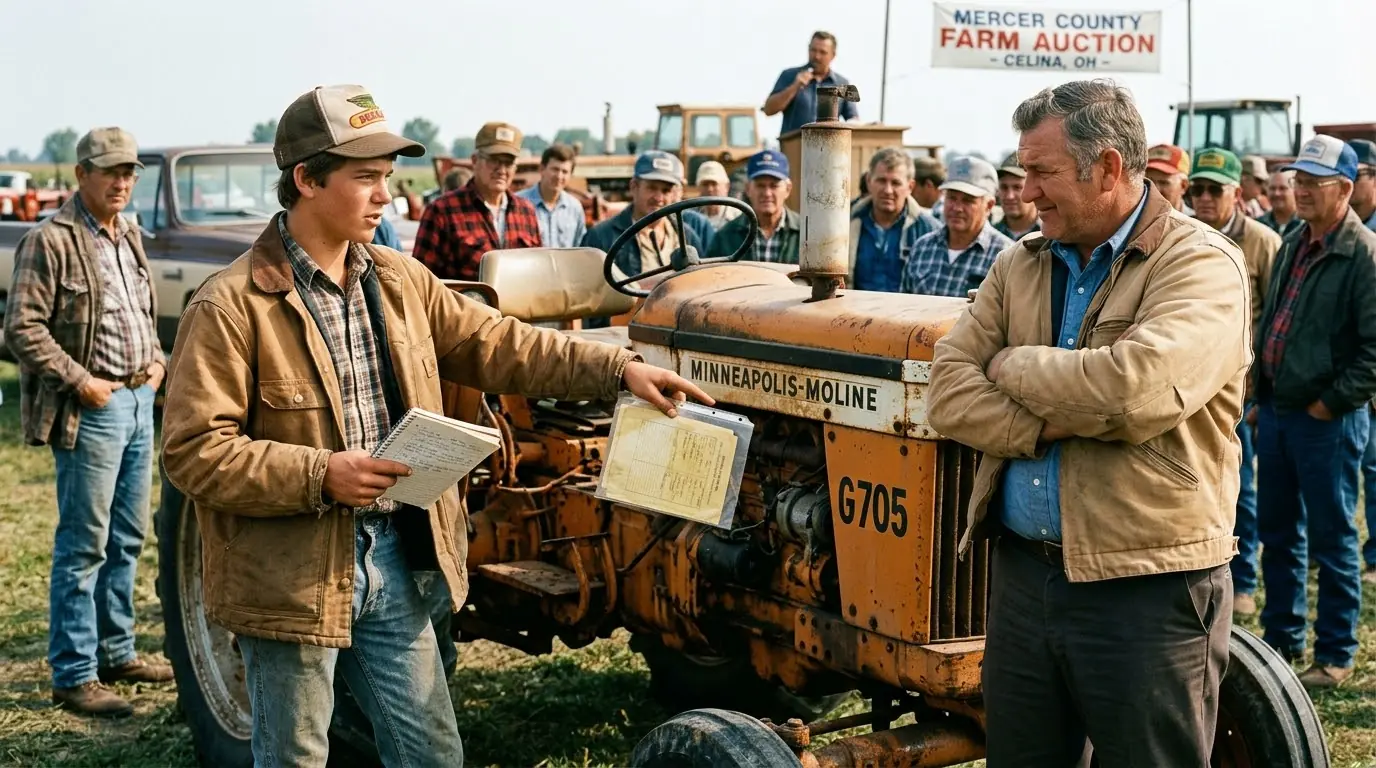
He had the kind of face that made adults assume he was younger than he was, slight build, not yet filled out, with the sunburned neck of someone who had spent the summer working outdoors, and the careful posture of someone who had been taught that how you carry yourself in a room tells people what you think of yourself before you say a word.
He was carrying a notebook. He was wearing his father's old work jacket, two sizes too large.
The auction had drawn 41 registered bidders that morning, retired farmers, active operators, three equipment dealers, a land speculator from Toledo who attended every county sale within 50 miles looking for undervalued iron. These were men who had been buying and selling farm equipment for longer than Cal had been alive.
They had financing arranged. They had trailers parked outside.
They had opinions about everything in the yard expressed freely in the way that men express opinions when they believe the room contains only people like them.
Cal was not like them. He was 17.
He had $215 in a savings account at the Celina branch of the Mercer County Bank, money saved from two summers of detasseling corn and doing odd repair work for neighbors.
He had a notebook filled with observations he had made during two hours of preview work that morning, starting at 7:00 a.m., which was an hour and a half before most of the other buyers arrived. He had been specifically, carefully, and completely ignored by every adult in that yard.
That was about to change, not because of what he did, but because of what he said.
The Mercer County auction ran four times a year and was one of the more respected equipment sales in western Ohio, drawing buyers from as far as Indiana and Michigan when the inventory was good. The September 1981 auction was drawing solid attendance because three local estates were being liquidated simultaneously, which meant the variety was broad and the quantities were enough to make the drive worthwhile for serious buyers.
Among the lots listed in the auction catalog was a 1963 Minneapolis-Moline G705 diesel tractor, a large two-wheel drive row crop machine that had been the pride of the Henderson estate before Walt Henderson's death the previous spring.
The G705 was not common equipment even in 1981. Minneapolis-Moline had been absorbed by White Farm Equipment in 1969, and parts for their older models were increasingly difficult to source.
Most buyers looked at older MM equipment with wariness because the combination of age, relative obscurity, and parts availability made repairs unpredictable.
The G705 was listed in the catalog at an estimated value of $800 to $1,400. It was a wide spread, reflecting genuine uncertainty.
The machine looked rough, paint faded to a chalky prairie gold, one headlight missing, the front loader attachment badly corroded. The hood was propped open to show the engine, and the engine looked like it had not been kind to itself in recent years.
The Toledo speculator had looked at it for 3 minutes and moved on. Ray Sutherland, who ran the largest equipment dealership in the county, had looked at it for 5 minutes, turned to his associate, said one word, "parts," and moved on.
Three other serious buyers had reached the same conclusion. The G705 was a parts machine.
Maybe worth $400 to $600 if you broke it down and sold the components individually, but not worth running, not worth transporting if you had to move it any distance, not worth the risk of a repair bill that might exceed the machine's value.
Cal Whitmore had spent 37 minutes on it. He had a flashlight, his notebook, and a compression gauge that had belonged to his grandfather.
He had checked every accessible system: engine compression, with all six cylinders recorded and compared; transmission fluid, pulled on the dipstick, smelled, and held to the light; hydraulics, tested at every accessible port; the front axle, measured and noted; and the fuel system, traced from tank to injectors, the last two of which he had checked individually with a small mirror borrowed from his mother's compact that he carried specifically for this purpose.
Two dealers had watched him work from a distance. One had pointed at him.
The other had said something that carried far enough for Cal to hear it, not the words, just the tone, which was the tone of a man who finds something amusing that he assumes the subject cannot hear.
Cal kept working.
He had been keeping a file on Minneapolis-Moline G705 tractors since the previous January, when his grandfather, a man named Harold Whitmore, who had farmed in Van Wert County for 40 years and was now retired but still paying close attention, had shown him a copy of the MM technical digest that he'd saved from 1960.
Harold had owned a G705 for 11 years and had seen it through two major services and one engine rebuild. He knew the machine's weaknesses and its strengths.
He had spent two evenings in December explaining both to Cal in the kind of detail that grandfathers provide when they recognize that a grandchild is actually listening.
Cal had listened. He had also gone to the Van Wert County library and requested every service bulletin he could find for the G705 through the interlibrary loan system, which took 3 weeks and produced seven documents.
He had read all seven. He had taken notes.
He had built, over eight months, a picture of exactly what made a G705 worth buying and what made one worthless.
And what he had found in 37 minutes of preview work that September morning was the thing that everyone else in the auction yard had missed. The G705 in lot 11 was not a parts machine.
It was a machine that looked like a parts machine.