“Your crops already died twice—now you’re feeding the dirt fireplace trash?”
Dale Whitmore’s laughter rolled across the cold Missouri field, followed by the voices of four older farmers gathered beside the county road. One man bent forward with both hands on his knees. Another pointed toward the rusted wheelbarrow as though he had just discovered the funniest sight in Clover Ridge.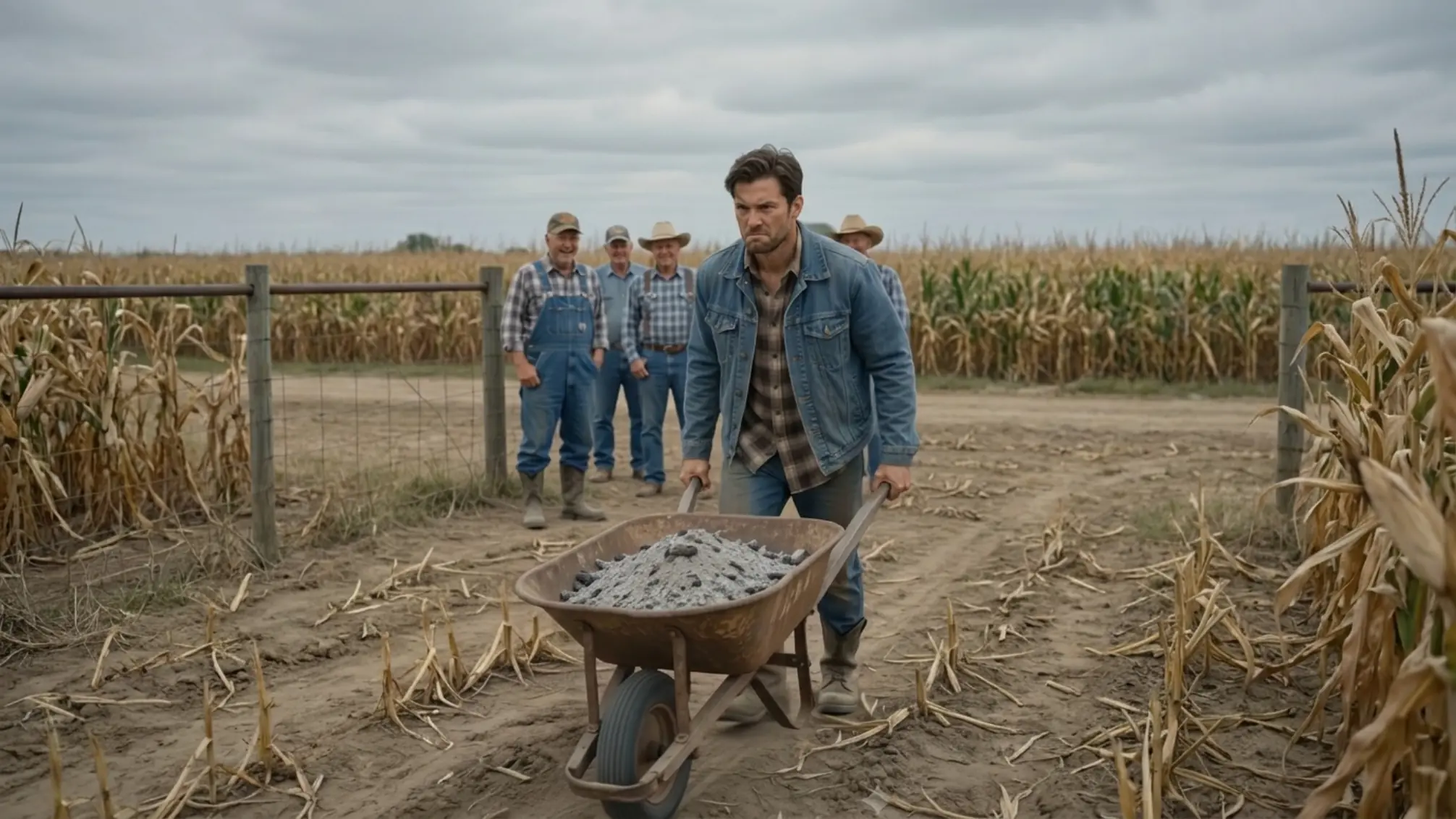
Caleb Harmon did not stop working.
The twenty-six-year-old white American farmer drove his steel shovel into the pale mound of wood ash and scattered another measured load across the dark soil. His faded denim jacket was dusty, his work boots were caked with mud, and smoke from a nearby brush pile drifted behind him.
“Laugh while your soil still hides its damage,” Caleb said.
Dale stepped through the open gate, still grinning. At fifty-five, he owned one of the largest farms in the county and carried himself like every successful harvest had made him an authority on everyone else’s land.
“When the bank takes this farm,” Dale said, “we’ll dump that wheelbarrow in your truck.”
Caleb rested both hands on the shovel and met the older farmer’s eyes.
“Come back at harvest—and bring every man laughing with you.”
For a moment, no one spoke.
Then Dale shook his head and led the others back toward their pickups. Their laughter returned as the engines started, but Caleb had already gone back to spreading the ash.
He had no time to defend himself.
Thirty acres of exhausted land, two missed payments, and one final growing season stood between him and losing everything his grandfather had spent forty years building.
The Harmon farm sat among the low hills outside Clover Ridge, Missouri. It was not the largest property in the county, nor the most impressive. The barn leaned slightly west. The farmhouse needed new siding, and one corner of the machine shed flooded whenever heavy rain came from the north.
But Caleb had loved the place since childhood.
His grandfather, Earl Harmon, had no children of his own. Caleb was the son of Earl’s younger sister, and every summer from the age of seven, he had been sent to the farm for several weeks. Earl taught him to repair fences, judge approaching rain by the smell of the wind, and walk a field slowly enough to notice changes beneath his boots.
“The land talks before it screams,” Earl often said. “Most men only listen after the screaming starts.”
When Earl died two years earlier, he left the farm to Caleb.
The inheritance looked generous on paper, but the property carried a bank note from improvements Earl had made late in life. The first harvest after Caleb took over was poor. The second was worse.
Corn germinated unevenly. Some rows stayed pale and stunted while others grew well enough to give him false hope. Fertilizer helped briefly, but the plants weakened again during summer heat.
The county extension agent advised him to increase nitrogen.
The cooperative salesman recommended a new commercial soil treatment.
Dale Whitmore suggested he sell before the land swallowed what little money he had left.
Caleb tried nearly everything he could afford.
Nothing changed enough.
By November, the letters from Farmers State Bank became increasingly direct. The final notice lay open on the kitchen table every night while Caleb ate alone beneath the weak yellow light.
Payment was due after the next harvest.
If he failed, the bank could begin foreclosure.
Caleb had spent weeks considering whether to sell voluntarily. He could probably leave with enough money to begin again somewhere else, but every time he looked through the kitchen window at Earl’s barn, he imagined strangers tearing it down.
One rainy evening, while searching the loft for an old drill bit, Caleb found a wooden box beneath a stack of feed sacks.
Inside were twelve small journals.
The earliest had been written almost forty years before. Each contained Earl’s careful observations about rainfall, insects, planting dates, livestock behavior, and soil conditions.
Caleb began reading after supper.
Hours passed.
Near midnight, he found an entry that made him stop.
Burned brush piles beside the creek fence. Hauled ash to the east field before snow. Spring growth stronger there than anywhere else. Used to think it was luck. Don’t think so anymore.
Caleb read the paragraph three times.
The following morning, he drove to the county library. He searched agricultural books, university reports, and soil-management guides. What Earl had discovered through observation had a scientific explanation.
Clean wood ash could contain potassium and calcium. Used carefully, it could help certain acidic soils move toward a healthier pH range. But applied recklessly, it could make problems worse.
That warning mattered.
Caleb did not need another desperate experiment.
He paid for detailed soil tests across the entire farm, dividing the acreage into mapped sections rather than treating the land as one uniform field.
The results explained years of confusion.
The eastern and southeastern sections were strongly acidic and low in potassium. Other sections were closer to balance and required little or no ash.
Caleb spent two nights calculating application rates.
He marked every section on a hand-drawn map and recorded the soil readings in a notebook. He planned small test rows first, using identical seed and spacing in treated and untreated soil.
Only then did he begin collecting wood ash.
He burned dead branches and rotting fence posts, careful not to include painted or chemically treated wood. He asked homeowners with clean wood stoves to save their ash. A small sawmill in the next county allowed him to collect material it would otherwise discard.
The work attracted attention.
A young farmer hauling wheelbarrows of gray powder across a failing field was impossible to ignore in a town where everyone knew everyone else’s business.
At Patsy’s Diner, someone called him Ash Boy.
The nickname spread faster than any explanation could have.
Dale Whitmore enjoyed it most.
“Planning to plant corn or cremate it?” he asked one morning near the grain elevator.
The men around him laughed.
Caleb loaded bags of seed into his truck without responding.
Dale followed him.
“I’m serious, Harmon. You’re already behind with the bank. Stop wasting time on things your grandfather scribbled in a notebook.”
Caleb turned.
“My grandfather kept this farm alive longer than you’ve owned yours.”
“And now he’s gone.”
The words were unnecessarily cruel.
Caleb’s jaw tightened.
Dale lowered his voice. “Sell the south ground to me. It gives you enough to pay the bank and keep the house.”
“You want my most productive acreage.”
“I’m offering you a way out.”
“You’re offering yourself a bargain.”
Dale shrugged. “Call it what you want. Dirt doesn’t care about pride.”
“No,” Caleb said. “But men do.”
He drove away before anger pushed him into saying more.
Spring arrived slowly.
Caleb worked the ash into selected sections several weeks before planting, following the application plan with the precision of a man handling medicine. He treated only the soil that needed it.
He planted test rows beside untreated controls.
Every morning, he recorded temperature, moisture, germination, and plant color. To anyone passing on the road, the notebook made him look more obsessive than intelligent.
By June, differences had begun to appear.
The treated rows were not miraculous. They did not suddenly tower above the rest. But they were greener, more even, and visibly stronger.
Their leaves widened faster.
Their stalks stood straighter.
Caleb dug beside several plants and found denser root systems beneath the amended soil.
For the first time in two years, the farm appeared to be answering him.
Then the setbacks came.
A late frost killed part of the earliest planting. Caleb spent money he did not have on replacement seed. Heavy rain exposed a drainage problem near the western corner, followed by three dry weeks that hardened the surface.
A fungal issue appeared in one low section.
Dale drove past while Caleb was digging a drainage trench by hand.
“Thought the magic ashes fixed everything,” he called through the truck window.
Caleb pushed the shovel deeper into the wet earth.
“They fixed what the soil test showed.”
Dale laughed. “Sounds like an excuse.”
“It sounds like farming.”
Dale drove away.
Caleb finished the trench after dark.
The following week, he visited Ruth Callaway, a sixty-four-year-old white American farmer in the next county whose name appeared in an old soil-conservation report.
Ruth had farmed river-bottom ground for more than thirty years. Her property was small, but her crops consistently outperformed larger operations nearby.
She listened while Caleb explained the tests, the ash sources, and the application map.
Then she read his notebook.
“You’re doing it right,” she said.
Caleb exhaled. “Everyone in town thinks I’ve lost my mind.”
“Everyone in town isn’t responsible for your soil.”
She pointed toward his map.
“Most people make one of two mistakes. They ignore old methods because they look primitive, or they use them like superstition. Your grandfather noticed something useful. You tested it before trusting it. That’s the difference.”
“Will it save the farm?”
Ruth closed the notebook.
“No honest farmer can promise a harvest.”
Caleb’s face fell slightly.
“But you’ve given the land a better chance,” she continued. “Now stop staring at it like fear will make it grow faster.”
Before he left, Ruth walked him through her fields. She showed him where she used wood ash, where she never used it, and how she combined soil amendments with organic matter, drainage, and crop rotation.
“Wood ash isn’t magic,” she said. “It’s one tool. Your advantage isn’t the ash.”
“What is it?”
“You’re paying attention.”
That summer, Missouri entered a brutal heat wave.
Temperatures rose above one hundred degrees for nine consecutive days. Afternoon wind carried no relief, and clouds gathered only to dissolve without rain.
Across Clover Ridge, corn leaves began curling.
The soil in lower fields cracked.
Dale Whitmore’s acreage showed stress within the first week. He had invested heavily in seed and commercial fertilizer, expecting another strong season, but large sections began fading before tasseling was complete.
Caleb’s crop suffered too.
He refused to lie to himself about that. The heat slowed growth, and several weaker rows failed.
But the amended sections held moisture differently.
Their root systems had developed more deeply in soil that was less acidic and better structured. The corn did not thrive, but it endured.
Pickup trucks began slowing along the county road.
Farmers looked through Caleb’s fence at the green bases of his plants, then across at their own pale rows.
One truck drove past twice in the same afternoon.
Dale stopped at the gate near sunset.
Caleb was checking soil moisture with a hand probe.
“What did you put down besides ash?” Dale asked.
“Nothing you didn’t see.”
“That field should look like mine.”
“It doesn’t.”
“You buying some treatment privately?”
Caleb straightened. “You laughed every morning while I applied what I used.”
“Wood ash doesn’t hold back a drought.”
“No. Healthier soil gives roots a better chance.”
Dale stepped closer. “You think one decent field makes you smarter than the rest of us?”
“No.”
“You act like it.”
“I’m working my land, Dale. You keep coming here to tell me what it means.”
Dale pointed toward the green rows.
“If you’re hiding something—”
Caleb’s expression hardened.
“Finish that sentence.”
The older farmer stopped.
Caleb moved closer to the gate.
“You called me stupid in town. You told men the bank would take this farm. You offered to buy my best acreage before I had finished planting. Now my crop is standing and yours is curling, so you want me to be a liar instead of admitting you were wrong.”
Dale’s face reddened.
“You haven’t harvested a bushel yet.”
“Then come back when I do.”
Caleb turned away.
For once, Dale left without laughing.
Rain finally arrived in late August.
It fell gently for four days, soaking into the ground rather than washing across it. Caleb walked the rows each morning, brushing water from the leaves and examining the ears.
The treated sections recovered faster.
By September, the difference could be measured without argument.
Caleb estimated a yield far above either of his previous two seasons. It was also likely to exceed several neighboring fields that had received much more expensive commercial inputs.
The bank manager came to inspect the property.
He stood beside Caleb near the east field and removed his hat.
“This is stronger than I expected.”
“So is the payment I owe.”
The manager ignored the challenge.
“If the harvest matches your estimate, we can discuss extending the remaining note.”
“I don’t want an extension.”
The man looked surprised.
“I want the balance.”
“You intend to pay it?”
“As much as the crop allows.”
“Most operators would reinvest in equipment.”
Caleb looked toward Earl’s old tractor.
“Most operators don’t have a foreclosure letter in their kitchen.”
The harvest began in October.
Caleb worked from before sunrise until long after dark. The old combine broke a belt on the second day, forcing him to lose six hours. A wagon tire failed near the road, and one section of corn yielded below expectations because of the earlier fungal damage.
Still, the overall result exceeded his most careful projection.
The east field produced nearly twice what it had the previous year.
The southeast section performed even better.
The untreated control rows provided the clearest evidence. They had grown, but their yield remained noticeably lower than the carefully amended ground beside them.
Caleb photographed, weighed, and recorded everything.
He was finishing the final section when Dale’s truck entered the yard.
Four other farmers arrived behind him.
The same men who had laughed beside the road months earlier climbed out of their pickups. None wore the expressions they had carried that morning.
Dale approached with his hat in one hand.
“You told us to come back at harvest.”
Caleb shut down the tractor.
“I did.”
“We came.”
Caleb climbed down.
For several seconds, the men stood in silence beside the loaded wagons.
Dale looked toward the fields.
“What did it yield?”
Caleb told him.
One of the farmers gave a low whistle.
“That’s higher than mine,” another admitted.
Dale’s mouth tightened. “Show me how.”
Caleb studied him.
The temptation to humiliate Dale was real. He could have repeated every insult, reminded the men of their laughter, or refused them the information they now wanted.
Instead, he walked toward the barn.
“Bring your notebooks.”
Inside, Caleb spread Earl’s journal, the soil-test results, field maps, and harvest records across a wooden table.
He explained each step.
He showed them the sections where ash had helped and those where he had intentionally used none. He explained that clean wood ash could damage soil if applied too heavily or where it was not needed.
He showed them the untreated control rows and the measured yield difference.
“This wasn’t guessing,” Caleb said. “I tested first.”
Dale stared at Earl’s handwriting.
“Your grandfather knew?”
“He observed the result. I found out why.”
“Why didn’t he tell anyone?”
“Maybe no one asked.”
The statement landed harder than an insult.
One of the farmers turned toward Dale.
“We were too busy laughing.”
Dale ignored him.
“My south field has tested acidic before,” he said quietly. “I never followed up.”
“Test it again,” Caleb said. “Break it into sections. Don’t spread anything until you know what each part needs.”
“You’d help me?”
Caleb looked directly at him.
“You tried to buy this farm while I was desperate.”
Dale’s face lowered.
“You called my grandfather’s journal nonsense.”
No one moved.
Then Caleb closed the notebook.
“I’ll show you what I learned. But you’ll pay for your own tests, keep proper records, and stop telling younger farmers they’re fools because they try something you haven’t studied.”
Dale nodded slowly.
“That’s fair.”
“No,” Caleb said. “It’s generous.”
The older farmer accepted the correction.
Caleb sold enough grain to make the required bank payment and reduce the remaining note substantially. He did not become wealthy overnight. The barn still leaned, the farmhouse still needed siding, and another poor season could create new problems.
But the foreclosure letter disappeared from the kitchen table.
More importantly, the farm had a future.
During the following winter, three neighboring farmers brought Caleb their soil-test results. Ruth Callaway visited Clover Ridge and spoke to a small gathering inside the feed store about wood ash, soil acidity, drainage, and careful application.
Dale sat in the front row.
No one called Caleb Ash Boy anymore.
The second spring, Caleb expanded the treatment only to sections confirmed by new tests. He added composted organic matter, improved drainage, and continued documenting every decision.
His harvest improved again.
Dale’s south field also recovered, though he applied less ash than he initially expected because the tests showed only part of the acreage needed it.
One evening, Dale stopped beside Caleb’s fence.
“I owe you an apology.”
Caleb continued repairing a gate hinge. “You already stopped laughing.”
“That’s not the same thing.”
“No.”
Dale removed his cap.
“I wanted your land. When you struggled, I saw an opportunity. When you found something I didn’t understand, I called it foolish because that was easier than admitting a younger man might know something I didn’t.”
Caleb set down the wrench.
“My grandfather used to say land talks before it screams.”
Dale looked across the fields.
“Mine was screaming. I was too proud to listen.”
Caleb held out his hand.
Dale shook it.
Years later, the Harmon farm became known throughout the county for disciplined soil management rather than miraculous ash. Caleb never allowed the story to become a fairy tale about throwing burned wood onto fields.
He explained the truth every time someone asked.
The soil had been tested.
The application had been measured.
The untreated rows had been compared.
Failures had been recorded alongside successes.
Wood ash had been useful because the land needed what it contained—not because an old journal transformed waste into magic.
Earl Harmon had given Caleb the first clue.
Science, patience, and careful observation had done the rest.
Caleb framed one page from his grandfather’s journal and hung it inside the barn. Beneath it, he placed the first soil map he had drawn and the final foreclosure notice stamped PAID.
Visitors often stopped to read them.
Some admired the restored farm.
Others asked about the harvest that had changed everything.
Caleb always corrected them.
“The harvest didn’t change the farm,” he said. “Listening did.”
And whenever someone mentioned the men who once laughed at him, Caleb looked toward the fields where those same farmers now tested their soil before applying anything.
“They came back at harvest,” he said.
“They brought their notebooks.”