The smell reached County Road 7 before the first truck had even finished unloading.
By noon, people were covering their noses with shirts, handkerchiefs, and sleeves.
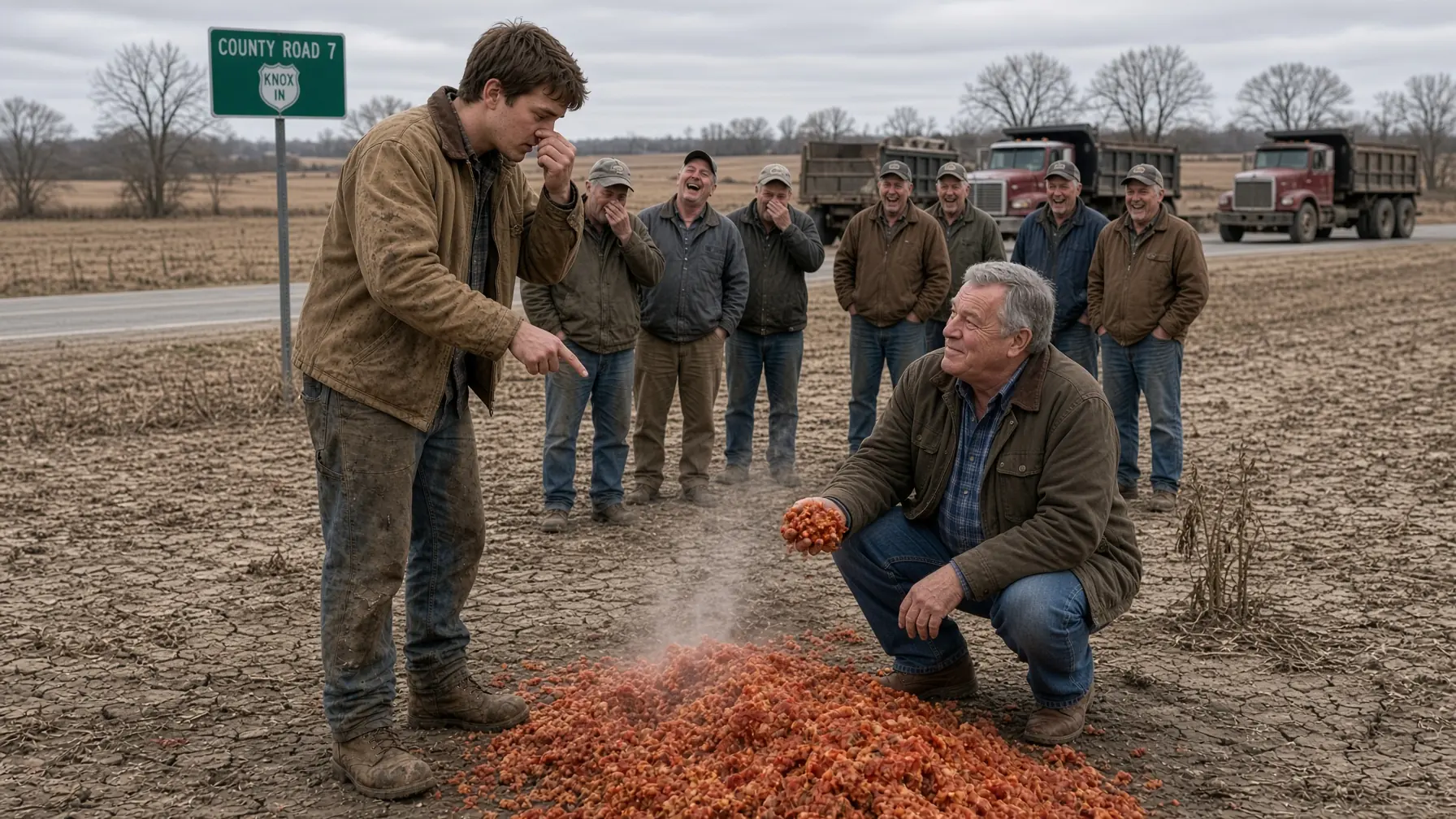
By one o’clock, somebody had called the sheriff.
By three, twenty-two complaints had been logged at the Knox County courthouse.
And standing in the middle of it all was twenty-two-year-old Cole Evans, watching fifty tons of rotting tomato waste spread across the only land he owned.
Forty-eight dump trucks had backed one after another onto the edge of his five-acre parcel in western Knox County, Indiana.
Their steel beds rose toward the gray April sky.
Then came the slurry.
Dark red.
Bubbling.
Fermented.
Tomato skins.
Crushed pulp.
Juice.
Seeds.
Plant material that had spent days sitting inside factory holding tanks.
It poured across earth so hard and gray it looked less like farmland than a dried lake bed.
Across the road, Arthur Vance climbed out of a new dual-cab pickup.
Arthur farmed six thousand acres of commercial tomatoes.
Modern equipment.
Computerized irrigation.
Hybrid seed contracts.
National supermarket buyers.
Everything Cole did not have.
Arthur took one look at the steaming field and burst out laughing.
“The boy has finally lost his mind.”
Several farmers nearby joined him.
Arthur pointed toward Cole.
“Hey!”
Cole looked over.
“You planning to farm tomatoes…”
Arthur paused for effect.
“…or maggots?”
Laughter rolled down the road.
Cole said nothing.
Arthur continued.
“Midwest Canning was going to pay thousands to get rid of that garbage.”
He looked toward the trucks.
“Instead they found somebody stupid enough to take it for free.”
More laughter.
Cole shoved both hands into the pockets of his faded work jacket.
His boots were worn.
His tractor was older than he was.
His entire five acres had been valued so low by agricultural appraisers that one report effectively listed its productive value at zero.
To everyone on County Road 7, the situation was obvious.
A broke young farmer had been tricked by a corporation trying to avoid disposal costs.
Cole watched another truck empty.
Then quietly said:
“Good.”
Arthur frowned.
“What?”
Cole looked at the red slurry spreading across the dead clay.
“Tell them to bring the rest.”
Three days later, the Knox County Herald printed a photograph of Cole’s field.
The headline read:
THE GREAT TOMATO LANDFILL OF KNOX COUNTY
Someone left three copies inside Cole’s mailbox.
Another copy appeared nailed to his fence.
Cole left it there.
The township trustee arrived Friday carrying a yellow citation.
“If this material isn't properly managed within thirty days, the county can send equipment onto the property.”
Cole read the notice.
“And bill me.”
“Yes.”
The trustee looked across the field.
“What are you doing, Cole?”
“Working.”
“This isn't farming.”
Cole folded the citation.
Put it into his pocket.
“We’ll see.”
The trustee shook his head.
“So you really think you know something everybody else doesn't?”
Cole looked toward the field.
“No.”
Then:
“My grandmother did.”
Three years earlier, Cole had inherited two things from Dr. Clara Evans.
The first was five acres of nearly useless soil.
The second was thirty years of handwritten notebooks.
Most people in Knox County remembered Clara simply as Cole’s eccentric grandmother.
She had worked as an independent soil microbiologist and consultant, taking special interest in damaged land.
Salt-heavy soil.
Dead orchards.
Compacted clay.
Fields where commercial fertilizer produced little improvement.
Cole grew up watching her scoop soil into her hands and examine it like a doctor checking a patient.
As a boy, he rarely understood what she was doing.
Once, when he was thirteen, Clara found him repairing an old cultivator.
“You like machines more than plants.”
“Machines make sense.”
She smiled.
“So does soil.”
“It’s dirt.”
“No.”
She crouched and picked up a handful.
“It’s chemistry, biology, water, air, minerals, and time.”
Cole rolled his eyes.
Clara laughed.
Then said something he remembered years later.
“Never call something useless just because you don't understand what job it can still do.”
At thirteen, Cole thought she was talking about dirt.
At twenty-two, he realized she had been talking about nearly everything.
Clara died when Cole was nineteen.
Cancer.
Fast enough that by the time Cole understood she was not going to recover, the questions he wanted to ask were too numerous to fit into the days she had left.
After the funeral, he opened her notebooks.
At first he read them because he missed her.
Then because he became curious.
Finally because he became desperate.
The five acres she left him were terrible.
Heavy alkaline clay.
pH around 8.4.
Compacted mineral layers.
Poor drainage in some areas.