“Half a sack of oats, please, Mr. Higgins. A tin of lard… and thread, if there’s enough left.”
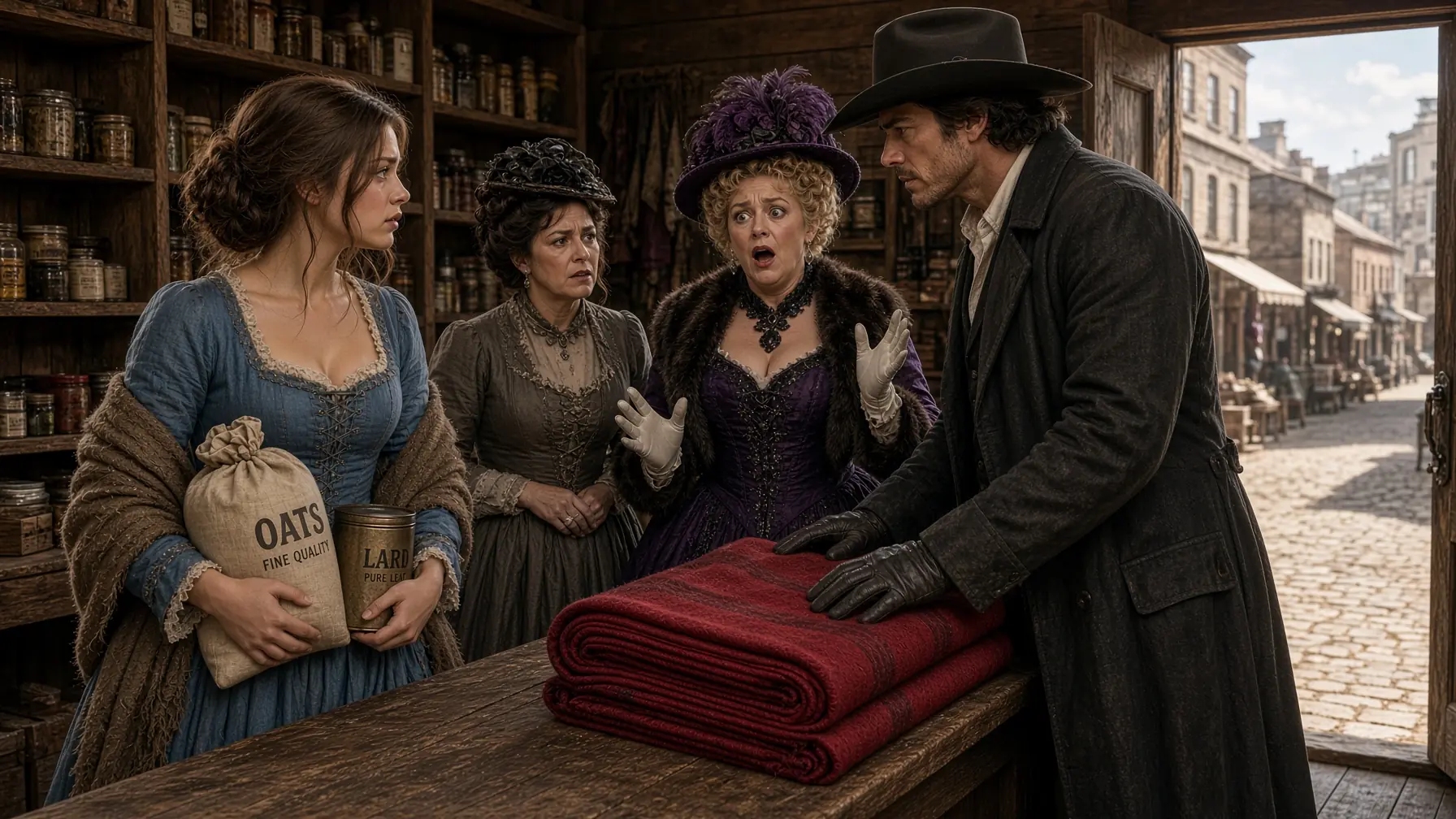
Nelly Thornton placed three coins on the mercantile counter and tried not to look at the bolt of deep red flannel sitting beneath the front window.
Mr. Higgins counted the money twice.
Then once more, slower.
“That’ll cover the oats and lard, Mrs. Thornton.”
He hesitated.
“The thread…”
Nelly already knew.
“How short?”
“Two cents.”
For a moment, neither of them spoke.
The mercantile smelled of coffee beans, lamp oil, leather, flour, and the wood smoke drifting from the iron stove in the center of the room. Outside, an early winter wind pushed dust down Clearwater’s main street and rattled the glass in the storefront.
Nelly nodded.
“The oats and lard, then.”
Mr. Higgins’s expression softened.
“I could put the thread on your account.”
“No.”
“You’ve always—”
“No, thank you.”
She smiled because pride was sometimes the only luxury left that cost nothing.
“I’ll manage.”
Behind her came a whisper.
Loud enough to be heard.
“My word, Eunice. Is that the Thornton girl?”
Nelly did not turn.
She recognized Harriet Gable’s voice immediately.
Everyone in Clearwater did.
Harriet was the wife of Arthur Gable, president of Clearwater Bank, which in Harriet’s mind apparently made her the closest thing the territory had to royalty.
Her friend Eunice Fletcher answered in the same stage whisper.
“Two years widowed and still working those fields herself.”
Harriet clicked her tongue.
“Some women simply have no sense of propriety.”
Nelly closed her fingers around the small parcel of lard Mr. Higgins placed on the counter.
She could leave.
That would be sensible.
But before she did, Harriet stepped toward the red flannel bolt beneath the window and ran two fingers over it.
“This fabric is four dollars a yard?”
“Yes, ma’am,” Mr. Higgins said.
“Imported?”
“From St. Louis.”
Harriet smiled.
“Beautiful.”
Nelly made the mistake of glancing toward it.
Harriet noticed.
Of course she did.
“Do you like it, Mrs. Thornton?”
Nelly met her eyes.
“It’s beautiful fabric.”
“I’m sure it would suit you well,” Nelly added politely.
Harriet’s eyebrows rose.
“Suit me?”
She laughed.
“Oh, my dear girl, fabric like this requires a certain standard.”
Eunice smiled.
Harriet continued.
“One must have both the means and the figure to carry quality.”
Nelly’s face remained still.
Harriet looked deliberately at Nelly’s worn work dress.
A repaired cuff.
A faint patch near one elbow.
Mud still dried along the hem from feeding livestock before sunrise.
“Perhaps,” Harriet said, “if you spent less time working fields like a hired hand, you might retain some feminine grace.”
Eunice laughed quietly.
Nelly picked up her oats receipt.
Harriet was not finished.
“Though I suppose when one is reduced to such circumstances, even a potato sack must seem fashionable.”
This time both women laughed.
Mr. Higgins looked down at the counter.
Nelly’s fingers tightened around the paper.
She could endure being called poor.
The facts were not insults merely because cruel people spoke them aloud.
The farm was struggling.
She had missed payments.
She patched clothes.
She bought half sacks of feed when she could not afford whole ones.
Those things were true.
But Harriet wanted more.
She wanted humiliation.
“Though you'd think,” Harriet continued, “the granddaughter of a war hero would have at least a shred of dignity left.”
That did it.
Nelly turned.
Her face was pale.
“My grandfather taught me dignity had more to do with how you treat people who can’t help you than what fabric you wear while doing it.”
The laughter died.
Harriet’s smile vanished.
Nelly nodded politely to Mr. Higgins.
Then a deep male voice came from near the door.
“How many yards are on that bolt of red flannel?”
Everyone turned.
Josiah Langden stood just inside the mercantile.
The wind had followed him in, lifting the hem of his dark wool coat before Mr. Higgins shut the door.
Josiah was forty-four years old, tall, broad through the shoulders, and known in every town for nearly a hundred miles.
Broken Ridge Ranch belonged to him.
So did thousands of head of cattle.
Freight wagons.
Timber contracts.
Grazing leases.
And, according to rumor, enough money to buy half of Clearwater without borrowing a cent.
His dark hair had begun to silver at the temples. A neatly trimmed beard framed a face weathered more by distance than age.
He removed his hat.
Mr. Higgins blinked.
“About forty yards, sir.”
Josiah looked at the fabric.
“I’ll take it.”
Harriet smiled immediately.
“I was actually just about to purchase five yards for a winter coat.”
Josiah looked at her.