The first thing Dale Whittaker noticed was that the woman was measuring the hay instead of looking at her check.
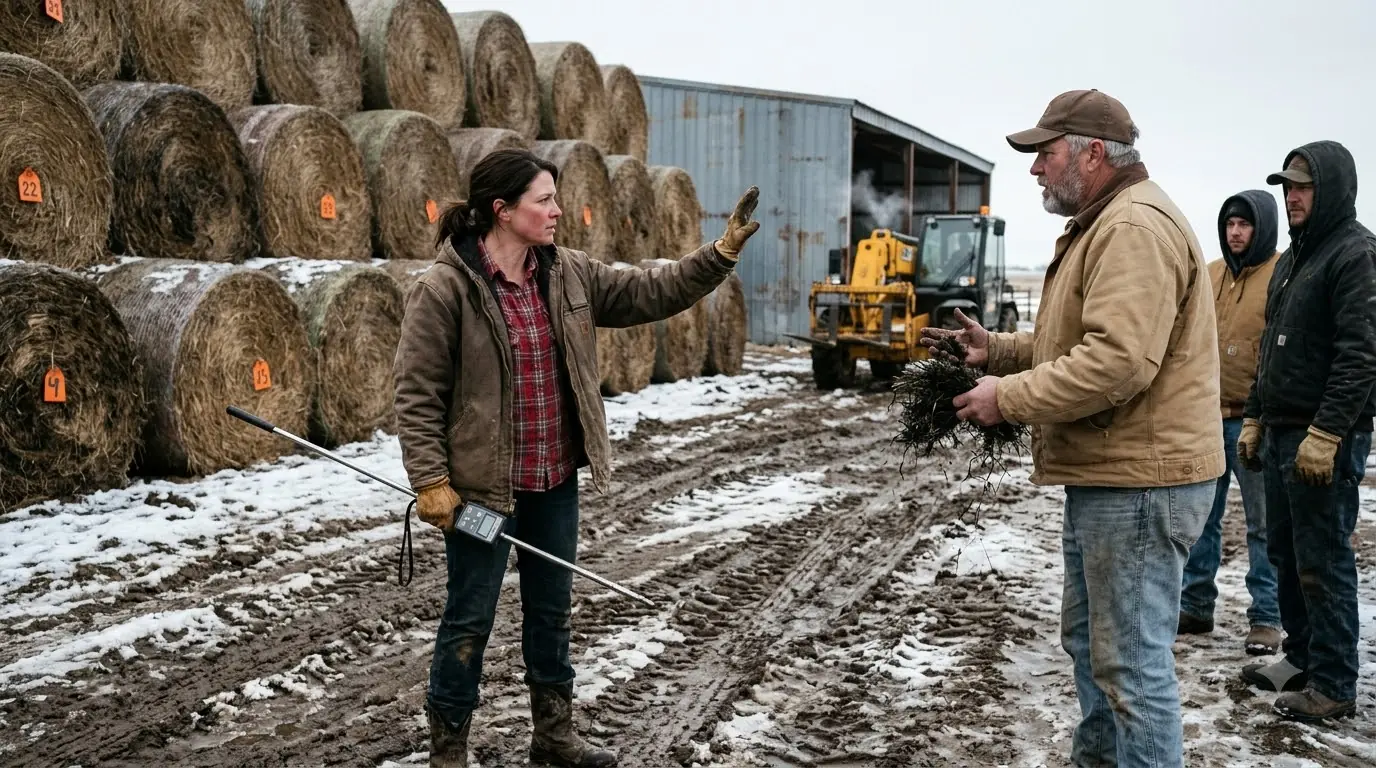
Behind his machine shed, three-high stacks of round bales sagged under a January sky the color of dirty dishwater. Two hundred tons of hay had occupied that patch of Morris County, Kansas, longer than he cared to admit. Rain had darkened the outer layers. Snow had collapsed the tops. Black earth showed through the gaps where settling bales had rubbed each other raw. Dale had spent the previous week imagining how good the yard would look when the whole disgrace was gone.
He had also imagined that the woman he was paying would be in a hurry to finish.
Instead, Marla Jennings walked along the bottom row with a steel probe, pushed it deep into a bale, and waited for a small digital meter to settle. She bent close to the display, entered a figure in a yellow notebook, and fastened an orange numbered tag into a section of twine. Then she moved one bale over and did the same thing again.
The telehandler idled twenty yards away. Dale's hired man had already warmed it up. Trucks would come later, and there was no shortage of work. Four hundred bales, give or take, did not move by themselves.
Dale watched her note another reading. “You don't need to be that careful,” he said. “It's all going the same place.”
Marla pulled the probe free and wiped it on a rag. “No,” she said. “It isn't.”
He waited for an explanation. She did not offer one.
It wasn't that Dale distrusted her. He knew her slightly from a previous purchase of erosion-control material and through a man they both did business with. She had a direct way of speaking, a work coat with a broken zipper pull, and the unmistakable impatience of someone who preferred finishing a job to discussing it. He liked that. He also liked the arithmetic. Other disposal options had approached nine thousand dollars. She would take all the old hay, hire the trucks, handle the loading, clean the pad, and receive four thousand dollars from him. A five-thousand-dollar difference was enough to make a farmer remember her name.
“You'll spend more time numbering it than moving it,” he said.
“Possibly.”
“You ever haul this kind of mess before?”
“I've handled the material before.”
“That wasn't exactly my question.”
Marla pushed the probe into the next bale. “It was close enough.”
Dale gave a short laugh. He was fifty-something, broad in the shoulders, and accustomed to making decisions that did not need consensus. Three hundred cow-calf pairs, roughly fourteen hundred acres, feed costs, fences, equipment repairs, weather: none of it left him much patience for mysteries. Yet he had signed the agreement Marla placed before him because its most important terms were simple. The hay became hers once loaded. He had no further claim. He carried no liability for what she might do with it afterward.
He had read the ownership paragraph twice. He remembered that because she had waited without a word while he did.