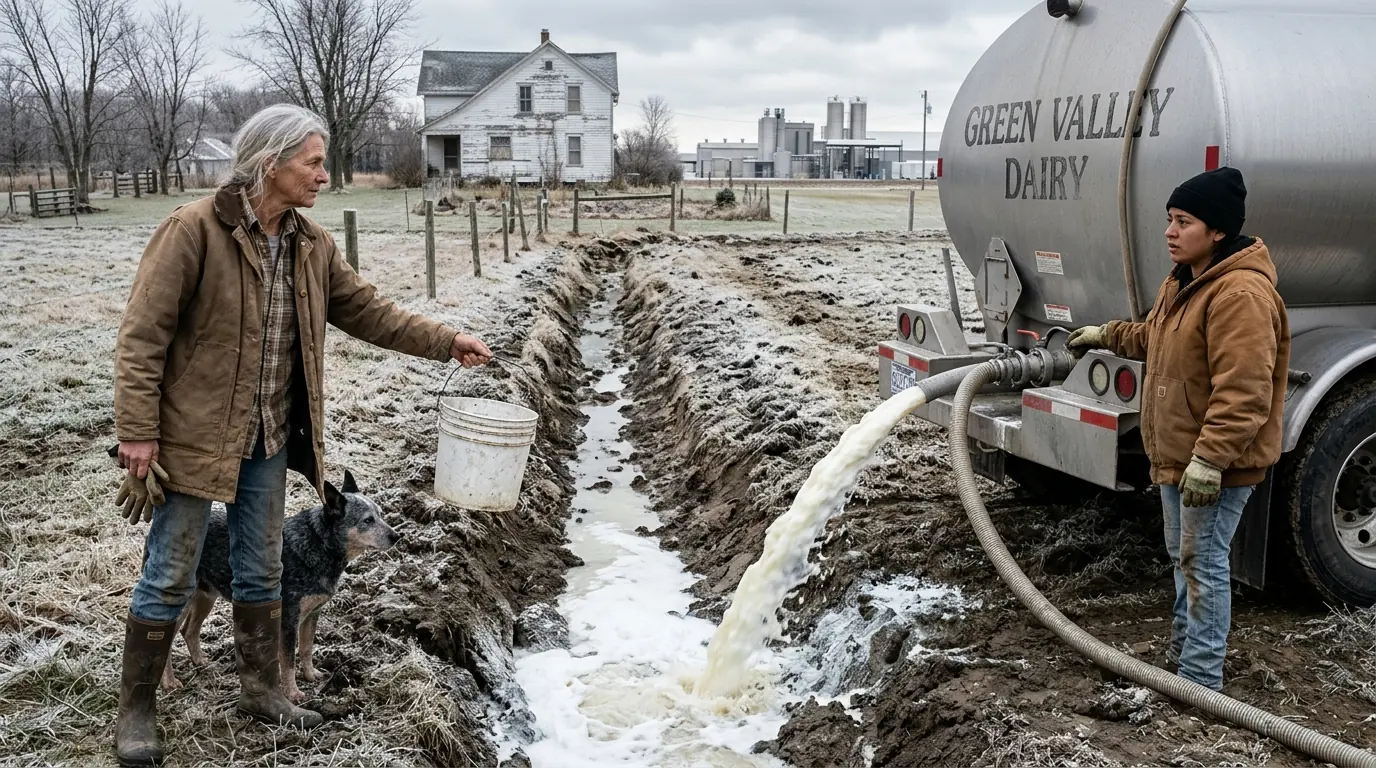
For nine years, the tanker came before sunrise. It arrived so regularly that Lorna Keller no longer needed a clock to know the hour. Long before the first wash of winter light touched the roofs of Bell Hollow, she could hear the low diesel growl climbing the service lane above her property. The truck would slow near the northern fence, reverse with a pair of dull warning beeps, and stop where the ground dipped toward the drainage ditch. Then came the hiss of a valve, the rush of liquid, and the smell.
Sometimes the discharge was thin and gray. Sometimes it was thick with cream. Sometimes it had already turned sour enough to sting the back of the throat. Whatever Brightland Dairy did not want that morning went into the shallow ditch beside Lorna’s land, and by sunrise another pale stream would be soaking into the soil beneath her fence. Brightland called it rejected milk. Lorna called it what it had become.
Garbage. She was sixty-eight years old, widowed, and still living in the farmhouse her family had occupied long before Brightland’s metal barns and feed silos rose on the northern hill. The house had been painted white so many times that the oldest boards beneath the siding were probably more paint than wood. The porch leaned slightly on the east corner. The kitchen floor creaked beside the stove. The back bedroom still held a cedar chest that had belonged to Lorna’s mother, and the springhouse built into the slope behind the kitchen garden had been there since Lorna’s grandmother was a girl.
Brightland had arrived later. First came one modern barn. Then another. Then concrete lots, a feed pad, milking parlors, tanker traffic, maintenance sheds, employee parking, floodlights, and finally the great industrial rhythm of two thousand cows producing around the clock. The company became the biggest employer in the township before most people understood how large it intended to become. By then the ditch had already changed.
It ran nearly two hundred feet along Lorna’s northern boundary. Decades earlier, it had been nothing more than a shallow runoff channel dug by some practical farmer to carry spring rain away from the county road. When Lorna was a child, frogs lived in it after storms. Wild mint grew in the low spots. Hank, her late husband, once caught two boys floating a toy boat along the water and told them to go home only after he had helped repair the mast.
Now nothing lived there. Grass vanished first. Then clover. The soil paled and hardened into a crust that cracked in dry months. By summer, flies rose from the ditch in dark clouds whenever the heat reached the sour residue. Lorna stopped opening the windows on the north side of the farmhouse. She stopped hanging laundry there. She moved the tomatoes to the south garden because the vines nearest the ditch always seemed weaker.
The smell had changed everything, but the real surprise came during an unusually hard January freeze. For years Lorna had believed there was nothing left in the ditch but evidence of a company that did not care. That morning, Bram refused to leave the fence. They became proof that your life had happened somewhere. Lorna refused to sell that proof cheaply. The first real change came during a January cold snap that froze the valley hard enough to make fence wire sing.