By the time the first blue lights appeared in her rearview mirror, Alexis Ward had already spent six hours on Georgia roads and three weeks inside a county where too many people had learned to lower their voices whenever they said the sheriff’s name.
The late afternoon sun hung low and hot above the highway, throwing long slashes of light across the asphalt and bleaching the dry grass beyond the shoulder into a brittle gold. Traffic ran hard in both directions. Tractor-trailers threw gusts of wind against passing sedans. The smell outside was a mixture of sun-baked gravel, hot rubber, and the faint chemical tang that lingered near interchanges where engines idled too often.
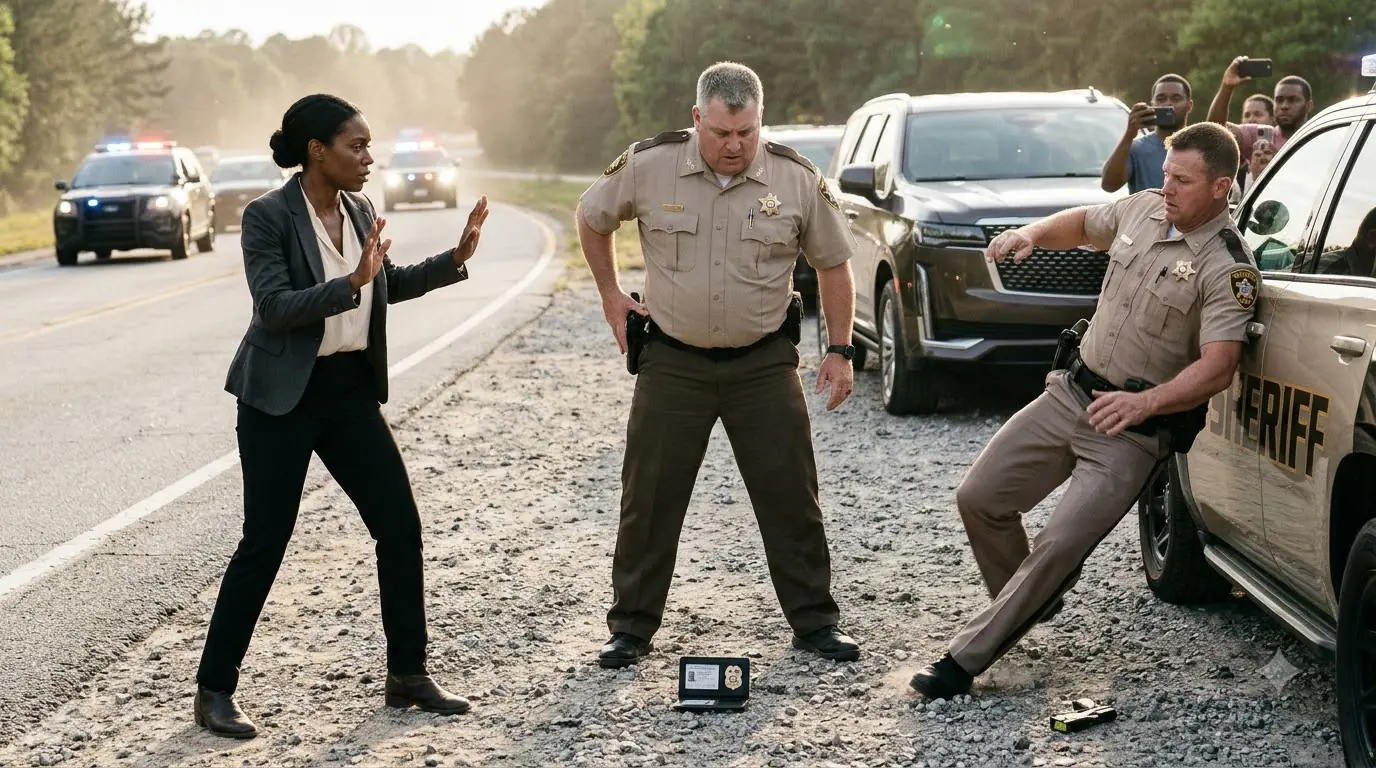
Alexis drove a dark luxury SUV that looked expensive enough to attract attention and plain enough not to advertise government use. She had chosen it for exactly that balance. There were no hidden lights. No plate frames. No windshield stickers. The vehicle was a bureau lease, but its registration did not scream federal ownership to anyone glancing casually from a patrol car.
That had been the point.
For the last month she had been moving quietly through Brant County, Georgia, meeting people who would not have spoken freely inside official buildings or on recorded government lines. The public reason for her presence, if anyone asked, was simple enough: an administrative review tied to a grant-funded public safety program. The private reason was heavier.
The U.S. Department of Justice had opened a joint investigation into civil-rights abuses, false arrest patterns, and public-corruption allegations tied to the Brant County Sheriff’s Office. The allegations reached back years. Some were ugly but difficult to prove. Some were easier to prove and uglier still.
Traffic-stop seizures that never fully appeared in evidence logs.
Body-camera gaps that happened too regularly to be accidental.
Drug charges filed after roadside searches with no usable consent recordings.
A death in county custody classified as medical distress despite witness accounts describing repeated blows.
A pattern of force complaints, almost all dismissed, many involving Black drivers pulled over on the same stretch of highway.
And beneath all of it, a stubborn, repeating accusation that the sheriff’s department treated certain roads not as public infrastructure but as privately profitable hunting grounds.
Alexis had seen departments go bad before. She had seen some rot from the bottom up, through cliques, shortcuts, and quiet intimidation. Others spoiled from the top down, when command staff decided image mattered more than law and loyalty mattered more than truth. Brant County had elements of both.
But even by the standards of the work she did, Brant County carried a distinctive scent of practiced impunity. The county was not large enough to disappear into pure bureaucracy, nor small enough for everyone to know everyone in a harmless way. It sat in the uncomfortable middle distance where roads mattered, public offices became personal fiefdoms, and local power traveled through church dinners, booster-club banquets, campaign favors, and cousins on payroll. Interstate traffic cut through its edges. Agricultural money moved through its center. The sheriff’s office had learned to present itself as the county’s hard shell against outside trouble while quietly generating a good deal of trouble of its own.