The bell above the door at Millie’s Grill had been broken for so long that Nora Bennett no longer expected it to ring.
It did not jingle like a cheerful diner bell should. It gave a dull, tired clank, as if even the metal had grown weary of greeting strangers.
Nora had worked beneath that sound for sixteen years, long enough to stop hearing the hiss of the grill, the hum of the old refrigerator, and the rattle of plates sliding into the bus tub.
But silence was different.
Silence always found her.
It came every Tuesday just after the lunch rush, when the booths had emptied, the coffee had gone bitter on the burner, and the afternoon light fell flat across the cracked red vinyl seats. That was when they came in: a man, a woman, and a little boy who looked as though someone had taught him not to take up space. The man always walked first, broad-shouldered, stiff-jawed, eyes searching the diner like he expected every person to challenge him.
His name was Dale Rowe.
The woman beside him was Emily, though Nora had only heard Dale say her name once, and even then it sounded more like a warning than affection. She was thin, careful, and beautiful in the faded way of someone who had spent too long apologizing for existing. Her little boy, Jonah, was seven or eight, with dark hair, pale skin, and eyes too serious for a child.
They always sat in the corner booth.
Dale slid in first, forcing Emily against the wall. Jonah tucked himself beside his mother, folding inward like a napkin no one planned to use. Nora knew their order by memory: black coffee for Dale, water with no ice for Emily, and milk for Jonah, though the boy rarely touched it.
Sometimes Dale ordered food for all of them.
He cut the burgers into stiff, even squares and pushed the plates across the table, not gently, not kindly, but with the sharp control of a man who turned even lunch into an inspection. Emily would lift a fry with trembling fingers and chew slowly, her eyes lowered. Jonah would stare at his plate until Dale’s voice tightened, and then he would take one careful bite.
That Tuesday, the silence around them was heavier than usual.
Dale’s hand rested on Emily’s wrist, his fingers spread wide in a casual gesture that made Nora’s stomach twist. Emily smiled at nothing, a brittle little smile that looked painted on and forgotten. Jonah did not look at his food, his milk, or the table.
He looked directly at Nora.
It was not the curious stare of a child watching a waitress move through a diner. It was steady, desperate, and too full of meaning for someone so young. His hands lay flat on the table, palms down, as if he had been told not to move them. His eyes followed Nora from the coffee station to the grill window and back again.
Nora had seen plenty in sixteen years.
She had watched couples break up over pie, men lie over coffee, and families pretend they were fine with a cruelty that filled the air thicker than smoke. She knew the smell of trouble before it showed its face. It smelled like burnt toast, stale fear, and words swallowed too many times.
She grabbed the coffee pot and walked to the corner booth.
“Refill?” she asked, keeping her voice light.
Dale did not look up from his phone. He only grunted and nudged his cup forward. Nora poured carefully, but her eyes flicked toward Jonah, who still had not looked away.
Emily flinched when a drop of coffee splashed near Dale’s hand.
It was tiny, almost nothing. A movement so fast that most people would have missed it. Nora did not miss it.
She saw too much.
It was her curse, and sometimes it was the only gift she had.
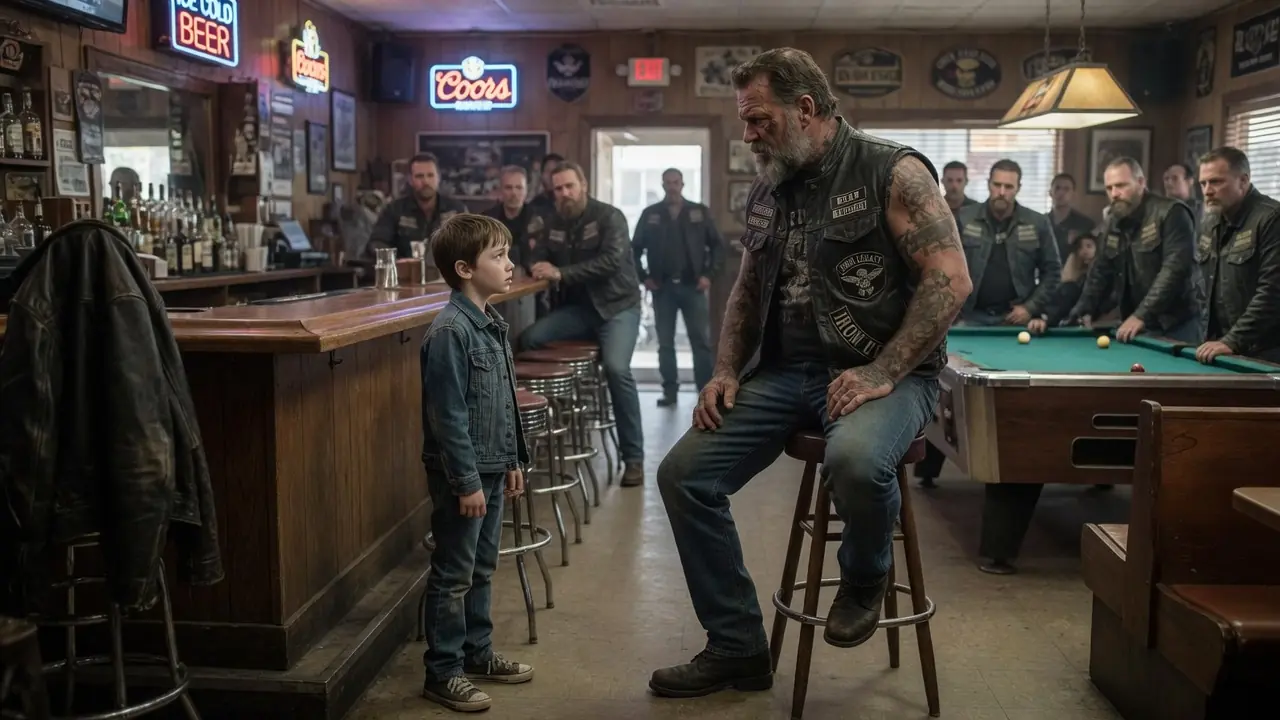
Their president was Mason Briggs, though everyone called him Bear.
He was a huge man with a gray beard, heavy arms, and a voice so low it seemed to vibrate the table when he spoke. He looked frightening at first glance, the kind of man people stepped around in grocery store aisles. But he said please, thanked Nora every time she refilled his coffee, and left a tip large enough to embarrass her.
His men were loud.
They argued, laughed, and told road stories that shook the glass sugar dispensers. Tiny, who was not tiny at all, always asked for extra onions. Hawk always complained about the pie and ordered two slices anyway.
Their noise made the diner feel alive.
That was why the corner booth felt even worse by comparison.
Nora served the bikers their plates and tried to focus on her work, but her thoughts kept circling back to Jonah. Every time she looked over, he was watching her. Not begging, not crying, not waving his hands, just staring with the fragile intensity of someone who had one chance to be understood and knew it.
An hour passed slowly.
The bikers finished eating and relaxed into the heavy, satisfied quiet of men who trusted the place around them. Dale’s table remained nearly untouched. His coffee was gone, but Emily’s water sat full, Jonah’s milk sweating on the table beside a plate of fries no one had eaten.
Then Dale stood.
“Let’s go,” he said.
It was not a request.
Emily moved quickly, almost too quickly, sliding out of the booth while keeping one hand on Jonah’s shoulder. Dale tossed a few bills on the table, not enough, and headed toward the counter to buy a pack of cigarettes. For a moment, his back was turned.
Nora moved toward the booth with a bus tray, her heart suddenly beating too hard.
She stacked the plates slowly. She wiped a circle on the table that did not need wiping. Emily stood near the door, fumbling with her purse, her attention fractured between Dale and the exit.
Jonah was only a few feet away.
Nora gave him a small, careful smile.
His eyes locked onto hers.
Then he stepped forward just half a step, his lips barely moving.
“They’re in the trash,” he whispered.
The words were so soft Nora almost wondered if she had imagined them.
Then Dale turned from the counter.
Emily seized Jonah’s hand at once. The boy’s face went blank, every emotion disappearing as if a curtain had dropped. Dale shoved the cigarette pack into his jacket and pushed open the door, dragging the whole small storm of them with him.
The broken bell clanked.
They were gone.
Nora stood frozen beside the table.
They’re in the trash.
The words spun through her mind, small and strange and terrible. What was in the trash? Toys? Clothes? Something he wanted back? Something Dale wanted hidden?
It could have been nothing.
Children said odd things when they were afraid. People in diners left behind all kinds of garbage, and maybe Jonah had simply dropped something. But Nora’s gut did not believe that.
Her body knew before her mind had the evidence.
She set the plates into the tub with a sharp clatter.
Bear was at the register, folding bills into the tip jar. His men were standing, shrugging into their vests, getting ready to leave. Nora wiped her palms on her apron and walked toward him.
Each step felt heavier than the last.
Bear turned before she spoke. “Everything all right, Nora?”
His voice was gentle enough to make the question hurt.
Nora swallowed. “That family that just left. Dale, Emily, and the little boy.”
Bear’s eyes shifted toward the parking lot. “The quiet ones.”
“The boy said something to me.”
Behind Bear, Tiny stopped adjusting his gloves. Hawk turned his head. The others grew still.
Bear waited.
Nora lowered her voice. “He said, ‘They’re in the trash.’”
For one terrible second, the words sounded foolish in the open air. Nora felt heat rise in her face. She expected Bear to soften the moment, to tell her she was tired, to say kids talked nonsense.
He did not.
His eyes narrowed.
“Show me,” he said.
Nora led them through the kitchen and out the back door into the narrow service alley. The dumpster sat against the brick wall, its lid slick with grease and rainwater. Bear approached it without hesitation and threw the lid open.
It slammed against the wall with a sound that made Nora flinch.
For several seconds, no one spoke.
Then Bear made a sound low in his chest, not quite a word, not quite a growl.
Tiny leaned closer. “Bear?”
Bear reached into the dumpster carefully.
When he pulled his hand back out, he was holding a small blue backpack with faded rockets printed across the front. The zipper was broken. One strap hung by a thread. It was stained, soaked, and smeared with diner refuse.
Nora covered her mouth.
Bear handed it to Tiny, then reached in again.
This time, he moved more slowly.
He lifted out a stuffed bear with one missing button eye and fur flattened from years of love. It was dirty, ruined in places, and wrapped in the same careless filth as the backpack. But Nora could tell at once it had belonged to Jonah.
Some toys looked new.
Some looked chosen.
This one had been held through nightmares.
Bear stared at it in his massive hand.
No one had to explain what it meant. Dale had not thrown away trash. He had thrown away a child’s world.
Nora felt sick.
Bear turned toward the parking lot.
Through the gap beside the diner, they could see Dale’s old sedan waiting at the driveway, trapped behind a stream of traffic. Dale was tapping the steering wheel, impatient. Emily sat rigid in the passenger seat, and Jonah was hidden in the back.
Bear’s voice came out cold and even.
“Block the car.”
The Iron Saints moved as one.
Two men went through the front door and climbed onto their motorcycles. Engines roared to life, deep and sharp, rolling across the pavement like thunder. One bike pulled in front of the sedan, the other behind it.
The car was trapped.
Dale saw them and hit the horn.
It made a weak, panicked sound.
Bear crossed the parking lot with the ruined teddy bear in his hand. Tiny and Hawk walked behind him, not rushing, not shouting, simply moving with the grim purpose of men who had seen enough. Nora stood in the diner doorway, hands shaking against her apron.
She had set something in motion.
There was no taking it back now.
Bear stopped beside Dale’s window.
For a moment, he said nothing. He let his shadow fall over the driver’s side, let Dale look up and understand that the world had shifted. Then Bear slowly raised the teddy bear and pressed it against the glass.
Dale’s face changed.
First confusion.
Then recognition.
Then fear.
“Roll down the window,” Bear said.
Dale shook his head. “We didn’t do anything. Leave us alone.”
Bear tapped the teddy bear against the glass.
Tap.
Tap.
Tap.
“I think you lost something,” Bear said.
Dale’s mouth twisted. “That’s garbage.”
Bear’s eyes hardened.
“Is that what you call it?”
Inside the car, Emily turned her head.
When she saw the stuffed bear, her face broke.
The sound she made was small, wounded, and full of years. Jonah rose just enough in the back seat to see it too, and his little hands pressed against the window. His mouth opened, but no sound came out.
Bear looked past Dale and met Emily’s eyes.
He gave her one small nod.
It was not dramatic. It was not a speech. It was only a silent message from a stranger built like a wall.
You can move now.
Emily did.
She slammed her hand down on the unlock button.
Dale shouted her name, but she had already thrown open the passenger door. She stumbled out, yanked open the back door, and pulled Jonah into her arms. He clung to her so tightly it looked as if he might disappear into her coat.
Then Emily ran.
Not to the bikers.
To the diner.
To Nora.
Nora caught them just inside the door, wrapping both arms around mother and child as they nearly collapsed against the counter. Emily shook so violently that Nora had to hold her upright. Jonah buried his face against his mother’s shoulder, his body trembling beneath his jacket.
“You’re safe,” Nora whispered.
She said it again and again, though she did not know yet if it was true.
Outside, Dale tried to reverse.
The motorcycle behind him did not move.
He slammed the steering wheel, cursed, and shouted through the closed window. Bear did not flinch. He placed one broad hand on the roof of the car and leaned down toward the glass.
“You’re done scaring them,” he said.
Someone had already called for help.
The sirens arrived minutes later, filling the parking lot with red and blue light. Officers stepped out, spoke firmly, took statements, and ordered Dale from the vehicle. He shouted at first, then argued, then tried to explain.
But his explanations thinned under the weight of what everyone had seen.
The backpack.
The toy.
The fear in Emily’s body.
The way Jonah would not look at him.
Dale was taken away while Bear stood beside the car, silent and immovable, until the door closed behind him. Only then did he turn back toward the diner.
He carried the stuffed bear inside.
Nora was still holding Emily and Jonah near the counter. Emily’s face was wet, her arms locked around her son as if she would never let go again. Jonah lifted his head only when Bear approached.
Bear set the stuffed animal gently on the counter.
Jonah stared at it.
Then, with shaking hands, he reached for it.
He pulled it to his chest and held it like a lifeline.
Bear’s voice softened. “That yours, little man?”
Jonah nodded.
Bear lowered himself slightly so he did not tower over him. “You were brave.”
Jonah’s lips trembled. “I whispered.”
Bear nodded. “And she listened.”
He looked at Nora then.
There was something in his face that had not been there before, something deep and solemn.
“You did good, Nora.”
Nora shook her head. “I almost didn’t.”
“But you did.”
Bear reached into his vest and pulled out a worn business card. It had his name, a phone number, and the Iron Saints insignia stamped in one corner. He slid it across the counter toward Emily.
“Anything ever happens again,” he said, “you call.”
Emily stared at the card as if it were more than paper.
Maybe it was.
Maybe it was a door.
The next hours were a blur.
Statements were taken. Emily spoke slowly at first, then with more strength as the truth finally found air. She told them about the control, the isolation, the way Dale decided what they ate, where they went, who they spoke to, what they were allowed to keep.
Jonah did not say much.
He held the bear and leaned against Nora’s side while a woman from family services spoke softly to Emily. When asked why he told Nora to look in the trash, he whispered that Dale had thrown away his backpack and Mr. Button because he said Jonah needed to learn not to need things.
Mr. Button was the bear.
The missing eye was the button.
Nora had to turn away for a moment.
That night, Emily and Jonah did not leave with Dale.
They left with a caseworker, a safety plan, and Bear’s card folded in Emily’s hand. Before they walked out, Jonah turned back toward Nora. He did not smile, not yet, but he lifted one small hand.
It was enough.
In the weeks that followed, Millie’s Grill changed in ways no one could have planned.
The cracked vinyl booth in the corner was repaired first. Nora told herself it was overdue, but everyone knew why she had finally asked the owner to fix it. The back door got a better lock, the phone numbers for local shelters and family resources were taped under the counter, and Bear’s card stayed beside the register where Nora could reach it fast.
The Iron Saints kept coming every Tuesday.
They still laughed too loudly and argued over pie. Tiny still ordered extra onions, and Hawk still complained about desserts he finished anyway. But their presence carried a new meaning now.
People noticed.
Trouble noticed too, and usually chose somewhere else to go.
Emily came back three months later.
She looked different.
Not completely healed, not untouched by what had happened, but lighter in the shoulders. Jonah walked beside her, holding Mr. Button under one arm. He was still quiet, but his eyes no longer looked empty.
They sat at the counter instead of the corner booth.
Nora poured Emily coffee and gave Jonah a milkshake with whipped cream because some things in life should be unnecessary and sweet.
“I wanted to say thank you,” Emily said.
Nora shook her head. “You already did.”
“No,” Emily said. “Not properly.”
Her eyes filled, but she did not look away.
“You listened to my son when I had forgotten how to believe anyone would.”
Nora had no answer for that.
So she reached across the counter and covered Emily’s hand.
Jonah looked toward the back section where the bikers sat.
Bear raised two fingers in a small salute.
Jonah lifted Mr. Button in return.
Years passed.
Millie’s Grill stayed mostly the same. The coffee was still too strong, the floor still stuck in humid weather, and the bell above the door still gave its dull, tired clank. Nora’s hair silvered at the temples, but she kept working the lunch shift because she said retirement sounded like a punishment.
Jonah grew taller.
He became a lanky teenager with a shy smile and a dry sense of humor that surfaced when people least expected it. He and Emily still came by sometimes, usually on Tuesdays. Emily had found work, then an apartment, then a life that belonged to her.
She eventually remarried.
The man she chose was quiet, patient, and careful with Jonah’s heart. He never tried to replace anyone or demand trust before it was earned. Bear approved of him, which became a joke in the diner, though everyone knew it mattered.
One winter afternoon, a package arrived for Nora.
Inside was a framed drawing.
It showed a waitress in a brown apron holding hands with a small boy carrying a teddy bear. Beside them stood a huge bearded man on a motorcycle, drawn twice the size of everyone else. In careful handwriting at the bottom, Jonah had written one word.
Thank you.
Nora hung it behind the counter.
The Iron Saints saw it the next Tuesday.
Tiny pretended to wipe his eyes with a napkin. Hawk said the biker looked too handsome to be Bear. Bear said nothing for a long while.
Then he nodded once.
That was how Bear spoke when words were too small.
The club started a new tradition after that day.
Once a month, they rode to the local women’s and children’s shelter with supplies strapped to their bikes: diapers, blankets, canned food, school backpacks, winter coats, and sometimes toys with tags still attached. They never made speeches. They simply delivered what was needed and stood around long enough for everyone to understand that the shelter was watched over.
Not controlled.
Protected.
Nora went with them once.
She stood beside Bear as the riders unloaded boxes, and she watched a little girl choose a stuffed rabbit from a pile of donated toys. The child held it with the same fierce tenderness Jonah had once used with Mr. Button.
Nora felt tears rise and did not bother hiding them.
Bear glanced at her.
“You all right?”
She nodded. “Just thinking how one whisper can become a lot of noise.”
Bear smiled faintly. “Only if someone hears it.”
One Tuesday many years after Jonah first whispered to her, Nora brought the Iron Saints their usual order. Bear sat at the head of the joined booths, older now, his beard almost completely silver. His men had changed too, some new faces mixed with the old, but the table still carried that same rumbling warmth.
As Nora set down Bear’s coffee, he raised his cup.
The whole table went quiet.
Nora paused, one hand still on the tray.
Bear looked at her across the steam rising from his mug.
“To the ones who see,” he said.
The bikers lifted their cups and glasses.
“To the ones who see,” they echoed.
Nora stood there for a moment, caught between embarrassment and something deeper.
Then she smiled.
Not the customer-service smile she had worn for sixteen years. Not the tired smile of a woman who had learned to survive long days on sore feet. A real one.
Because she understood now.
Heroes were not always the ones who burst through doors.
Sometimes they were the ones who noticed the child who did not speak. Sometimes they were the ones who believed a whisper before the world offered proof. Sometimes they were waitresses with coffee pots, bikers with frightening faces and gentle hearts, mothers who found the courage to run, and little boys brave enough to say three small words.
They’re in the trash.
That was all Jonah had been able to give her.
And because Nora listened, his whole life changed.