Cold rain slicked the streets of Oakland that night, turning the pavement black and glassy beneath the flicker of old neon signs.
But the real chill did not come from the weather.
It came from the whisper of a homeless boy hiding behind a diner.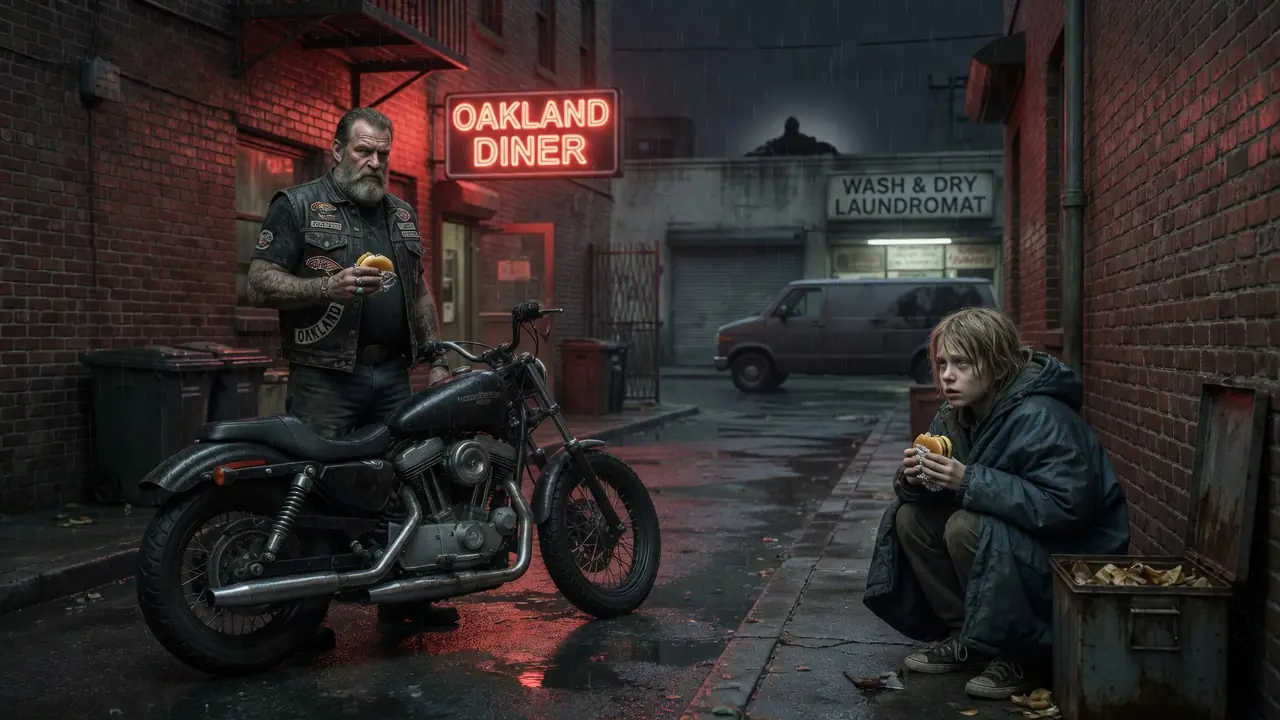
“They’re watching you.”
Roland Calloway heard the words before he fully understood them.
Most men in Oakland knew him by another name.
Grit.
That was the name stitched into the front of his leather cut, beneath years of road dust, old scars, and the kind of reputation people did not test twice. He was forty-five years old, broad across the shoulders, thick through the arms, with a weathered face, a graying beard, and eyes that had learned to measure danger before it introduced itself.
He had been riding with the Oakland charter for more than two decades.
He had seen frightened men pretend to be brave.
He had seen brave men become careless.
He had seen enough trouble to know that the worst nights usually began quietly.
That night, he had only stopped for coffee and a burger at a late-night diner off San Leandro Street. The place was half-lit, half-forgotten, wedged between a tire shop and a vacant storefront with plywood over the windows. The neon sign buzzed above the entrance, one letter blinking out every few seconds, bathing the wet sidewalk in tired red light.
Inside, the waitress had called him “hon” because she called everyone “hon.” Grit had eaten at the counter, drank coffee that tasted burnt enough to qualify as punishment, and bought an extra cheeseburger for Tommy, the young prospect waiting back at the clubhouse.
By the time he stepped into the alley behind the diner, rain had turned heavier.
It dripped from rusted fire escapes.
Ran along the brick walls.
Collected in oily puddles around the back tires of his heavily modified Harley.
Grit killed the engine.
The sudden silence felt wrong.
It was not real silence. Oakland was never silent. Somewhere beyond the alley, tires hissed over wet streets. Music thumped faintly from a passing car. A bus sighed at the corner. The diner’s kitchen fan rattled above the back door.
But inside the alley, something held still.
Grit swung one boot off the peg and reached into his saddlebag for a fresh pack of cigarettes.
That was when he saw movement.
At first, he thought it was a stray dog.
Then the shape tucked behind the overflowing grease trap shifted, and he saw a face.
A boy.
Thin.
Filthy.
Wrapped in a rain-soaked sleeping bag that had once been blue but was now the color of old pavement.
He could not have been older than twelve.
His face was smeared with engine grease and street dirt, framing pale, sunken cheeks and eyes so blue they almost looked unnatural in the darkness. But what made Grit stop was not the hunger, the dirt, or the cold.
It was the way the kid looked at him.
Not begging.
Not pleading.
Watching.
Measuring.
Tracking every movement in the alley as if his survival depended on noticing what grown men missed.
Grit had known men like that.
Not many.
And never at twelve.
He struck a match, cupped the flame against the wind, and lit his cigarette.
The kid did not move.
Grit took a long drag, exhaled into the damp air, then reached into his jacket and pulled out the foil-wrapped cheeseburger.
He tossed it underhand.
The silver package landed in the boy’s lap.
The kid flinched so hard his shoulders hit the brick behind him.
Then he stared at the foil like it might be a trap.
“Eat it,” Grit grunted. “Before the rats beat you to it.”
The boy looked at the burger.
Then at Grit’s leather cut.
Then at the rings on his fingers, the patches on his chest, and the boots planted wide on the wet ground.
His small hands moved slowly as he unwrapped the foil.
But he did not take a bite.
Instead, he looked past Grit.
Past the Harley.
Past the alley entrance.
And whispered, “They’re watching you.”
Grit went still.
Not visibly.
No sharp turn.
No startled reaction.
Men who survived long enough in his world learned not to show danger where their body found it.
His cigarette remained between his fingers.
His face did not change.
But inside, every instinct he had sharpened over twenty years woke at once.
“Who’s watching?” he asked.
The boy swallowed.
His voice was hoarse, scraped thin by cold and hunger.
“The men in the gray van.”
Grit let smoke curl out of his mouth.
“Where?”
“Across the street. Parked by the closed laundromat.”
Grit kept his gaze lazy, but he used the diner window beside him, the reflection warped by rain, to scan the street behind him.
A gray van sat across the road.
Dark windows.
Commercial plates.
Too clean for the neighborhood.
Too still for the hour.
“And?” Grit asked.
The boy’s fingers tightened around the burger.
“There’s a man on the roof.”
That got Grit’s full attention.
“Which roof?”
“Building with the green awning.”
The old furniture repair place.
Closed for years.
“Doing what?”
The boy finally took a bite of the burger, but even while chewing, his eyes never stopped moving.
“He has something long. Black. He’s been lying flat since before you came out.”
Grit’s blood turned cold.
A man lying flat on a roof in the rain was not there to fix shingles.
“How long have they been watching me?”
“Since you parked.”
“You saw them arrive?”
The boy nodded.
“They followed you from the interstate.”
Grit studied him.
“You know what following looks like?”
The boy gave him a look too old for his face.
“When you live outside, mister, you know every car that slows down twice.”
The rain beat harder against the fire escapes.
Grit dropped the cigarette into a puddle.
It hissed.
At the same second, he moved.
He dropped low behind the engine block of his Harley and grabbed the boy by the shoulder, pulling him flat into the shadow of the grease trap alcove.
A sharp crack snapped through the alley.
A brick near where Grit’s head had been a moment earlier burst apart, spraying grit across his leather.
The boy did not scream.
That told Grit more than anything else.
A normal child would have panicked.
Leo froze.
Silent.
Small.
Alive because he knew how to become part of the wall.
“You got a name?” Grit whispered.
“Leo.”
“Listen close, Leo. When I say move, you crawl toward that chain-link gate by the dumpster. Stay low. Don’t look up. Don’t run into the street.”
Leo nodded once.
“Can you do that?”
“I’ve done harder.”
Grit glanced at him.
“I believe you.”
Another round struck the side of the dumpster, sending a hollow metal bang through the alley. The shooter was not firing wildly. He was controlling the exits, cutting off easy movement, forcing Grit into predictable cover.
Professionals.
Not locals.
Not rivals trying to make noise.
This was planned.
Grit needed darkness.
He grabbed the heavy flashlight from his saddlebag and hurled it toward a stack of empty glass bottles near the opposite wall.
The crash tore through the alley.
The shooter shifted.
Grit used that half-second to kick the diner’s rear breaker box hard enough to kill the floodlights and the buzzing neon sign overhead.
Darkness swallowed the alley.
“Now,” Grit hissed.
Leo moved like smoke.
Grit stayed between the boy and the open alley, guiding him by the back of his soaked jacket toward the chain-link gate. The latch stuck. Grit forced it open with his shoulder, and they slipped into the yard beyond.
It was an old salvage lot, fenced on three sides and packed with rusted cars, loose tires, busted appliances, and machinery that had outlived anyone’s use for it. Grit knew the place. Years earlier, a friend of the club had worked here before the owner died and the lot began collapsing into itself.
To most people, it was junk.
To a man being hunted, it was cover.
They ducked behind the hollow body of an old Chevelle, rain dripping through the missing windshield.
Grit listened.
Boots in the alley.
A van door sliding open.
Low voices.
No shouting.
No sirens.
No police.
He pulled out his phone.
No service.
“Jammer,” he muttered.
Leo crouched beside him, clutching the half-eaten cheeseburger against his chest.
“They had a drone too.”
Grit turned.
“What?”
“A little black one. No lights. It hovered over your bike when you went inside the diner.”
Grit stared at him.
This was not just an alley setup.
This was a coordinated operation.
“You sure?”
Leo’s face hardened.
“I’m sure.”
Grit had known plenty of grown men who pretended certainty. Leo did not pretend. He reported facts the way a person reported weather.
“What else did you see?”
The boy hesitated.
Then said, “They were at your clubhouse too.”
The rain seemed to stop for one breath.
Grit leaned closer.
“What did you say?”
“I sleep behind the auto shop near Foothill sometimes,” Leo said. “Not close to the front. Behind the broken van by the fence. I saw the gray van three nights in a row. Same men. Same boots. They crawled under some bikes and cars.”
Grit’s jaw tightened.
“What were they doing?”
“Putting things there. Little black boxes. Magnets, maybe.”
Trackers.
His mind raced through every bike outside the clubhouse. Every brother who came and went. Every conversation. Every route. Every stop. If those boxes had audio too, the whole charter might have been compromised.
“How do you know my clubhouse?” Grit asked.
Leo looked embarrassed for the first time.
“I know everybody’s places.”
“Everybody?”
“The places that throw food away. The places with cameras. The places where men don’t like kids sleeping near the trash. The places where nobody checks after midnight.”
He looked down.
“You notice things when nobody notices you.”
Grit felt the words land somewhere beneath his ribs.
Nobody notices you.
That was how a twelve-year-old became better surveillance than cameras, better warning than alarms, better protection than men paid to stand watch.
“What did they look like?” Grit asked.
“Not street guys. Not cops. They moved like soldiers.”
“Soldiers?”
“They didn’t talk much. Used hand signs. Wore gray clothes, no names.”
Leo reached into the pocket of his oversized jacket.
“One dropped this.”
He held out a heavy brass coin.
Grit took it and angled it toward the faint red glow of his penlight. On one side was a military-style insignia. On the other was a corporate mark: a falcon wrapped around a globe.
Vanguard Security Solutions.
Grit had heard the name.
Everyone with ties to port work, shipping security, or private protection had heard the name. Vanguard was not a street crew. Not a rival club. Not a neighborhood gang trying to prove something.
They were corporate muscle with overseas contracts, private aircraft, and clients who could afford to erase problems without leaving fingerprints.
If they were in Oakland tracking the club, then this was about more than one biker in an alley.
The port.
Shipping lanes.
Control.
Someone wanted the Oakland charter out of the way.
Not scared.
Gone.
“They’re going after Foothill tonight,” Grit said.
Leo’s eyes widened.
“Your clubhouse?”
“They pinned me here to keep me away from my brothers.”
“Can you warn them?”
Grit held up the dead phone.
“Not from here.”
The sound of boots crunched in the salvage yard.
Leo grabbed Grit’s sleeve.
“They’re coming.”
Grit peered through a crack in the old car frame.
Three dark shapes moved through the yard.
Not rushed.
Not careless.
Professionals sweeping the space.
“They’ll find us,” Leo whispered.
“Not if you know another way.”
Leo nodded immediately.
“There’s a storm drain under that scrap pile. It goes under the district and comes out near the railyard.”
“You’ve used it?”
“Lots of times.”
Grit looked toward the scrap pile.
A narrow gap beneath a mound of corrugated metal and old tires. The kind of route only a desperate kid would know.
He drew a slow breath.
“Lead the way.”
Leo moved first, fast and low.
Grit followed, keeping himself between the boy and the searchlights sweeping through the salvage yard. The storm drain cover was half-buried beneath wet leaves and rusted metal. Grit jammed his fingers into the iron slots and lifted with a low grunt, muscles straining under the soaked leather.
The smell that rolled up from below was foul enough to make his eyes water.
Leo slid inside without hesitation.
Grit squeezed in after him and eased the cover back into place just as a white beam swept across the scrap pile above.
Boots stopped nearby.
One voice said, “No movement.”
Another answered, “Deploy secondary sweep.”
Grit held his breath.
Leo did not even blink.
Only when the boots moved away did Grit switch on the dim red light.
The tunnel stretched ahead, wet concrete fading into darkness. Water moved around their ankles. Rats scattered from the beam. Somewhere above them, Oakland carried on, unaware that a homeless boy and a biker were crawling beneath its streets with an entire clubhouse hanging in the balance.
“You okay?” Grit asked.
Leo shrugged.
“I’ve slept worse places.”
“You shouldn’t have had to.”
Leo did not answer.
They moved through the tunnel for what felt like forever.
Grit’s shoulders brushed the walls in places. His boots slipped on algae-slick concrete. Leo moved with eerie familiarity, ducking at low points, stepping over broken sections, warning him before the water deepened.
“You really know this whole place,” Grit said.
Leo glanced back.
“You learn what keeps you alive.”
“How long you been out here?”
Leo did not answer at first.
Grit did not push.
After a while, the boy said, “Since last winter.”
“You got people?”
“Had.”
Grit heard the finality in the word.
He thought of boys he had known growing up. Kids who vanished from school. Kids whose parents lost apartments. Kids who became rumors before anyone thought to look for them properly.
“What happened?”
Leo stared ahead.
“My mom got sick. Then she got gone. I got placed with my uncle. He liked checks more than kids.”
Grit’s jaw tightened.
“So you ran.”
“I left before he sold my stuff.”
“You’re twelve.”
“I was eleven then.”
The tunnel seemed colder after that.
Grit had nothing useful to say.
So he said the only thing that felt honest.
“You saved my life tonight.”
Leo kept walking.
“Maybe.”
“No maybe.”
The boy’s shoulders lifted slightly, as if he did not know what to do with being told he mattered.
After nearly an hour, the tunnel sloped upward. Faint industrial light appeared through a rusted grate ahead. Beyond it lay the Union Pacific railyard, wide and empty under rain, rows of freight cars stretching into the night like sleeping animals.
Grit forced the grate loose with his shoulder and helped Leo out.
Cold air slapped them both.
The railyard smelled of diesel, steel, and rain.
Grit checked his phone again.
Still no service.
“They’re still blocking the signal,” he muttered.
Leo pointed toward a three-story yardmaster tower at the far side of the tracks.
“They have landlines up there.”
“Can we reach it?”
“If they don’t have another drone.”
A faint mechanical whine answered before Grit could speak.
Leo’s face changed.
“Down.”
Grit grabbed him and pulled him under the shadow of a flatbed railcar as a small black drone passed overhead. A red light blinked once in the rain.
Then the yard lit up.
Flashlights.
Men moving from between container stacks.
Vanguard had found them.
Grit cursed under his breath.
The tower was too far.
The open ground between the railcars was too exposed.
Leo pressed himself against the steel wheel of the flatbed, trembling now. He had been brave for so long that it had almost become easy to forget he was a child.
Almost.
“What do we do?” Leo whispered.
Grit looked at the advancing men.
Then at the boy.
He reached into his leather cut and removed a heavy silver pin from the inside flap. A winged skull, old and worn smooth at the edges.
He pressed it into Leo’s dirty palm.
“You listen to me. If this goes bad, you stay hidden. You don’t try to help me. You don’t come out for anyone unless you hear my voice. If someone else finds you, you give them that pin and you tell them what you saw. Vanguard. Gray van. Trackers. Everything.”
Leo’s fingers closed around the pin.
“No.”
Grit blinked.
“No?”
Leo’s voice shook, but he held his ground.
“You don’t get to give me a burger and then die.”
Despite everything, Grit almost smiled.
“You got rules, kid?”
“I got one. People who help me don’t get left.”
The words punched through Grit’s chest harder than any bullet could have.
Before he could answer, a cold amplified voice carried across the railyard.
“Roland Calloway. Step out. You are surrounded.”
Leo flinched at the use of Grit’s real name.
Grit’s face hardened.
The voice continued.
“Your clubhouse is contained. Your chapter is already compromised. Do not make the boy pay for your pride.”
Grit’s hand curled into a fist.
Leo looked up at him.
“They’re lying?”
Grit did not answer fast enough.
Then the ground began to vibrate.
At first, it was low and distant.
A tremor through the rail lines.
A rolling thunder that grew beneath the rain.
Leo looked around.
“Train?”
Grit listened.
No.
Not a train.
Engines.
Many engines.
Big ones.
The kind of deep mechanical roar that settled in the bones before the mind identified it.
A sound every man in Oakland’s underworld knew.
Harleys.
The main gate of the railyard burst inward with a shriek of metal as a black pickup slammed through the chain and kept moving. Behind it poured a wall of motorcycles, headlights cutting through rain, engines roaring like an angry storm.
Forty patched riders flooded the yard.
At the front rode Big Dutch, president of the Oakland charter.
Dutch was a huge man, older than Grit, with a white beard, broad hands, and the kind of calm that made dangerous men nervous. He rode straight toward the line of Vanguard men as if they were not armed professionals, but debris in the road.
The Vanguard crew hesitated.
That was their first mistake.
They had planned for stealth.
Isolation.
Technology.
Clean angles.
They had not planned for forty furious bikers arriving like thunder with no intention of giving ground.
The next minute became noise, lights, movement, and chaos.
Grit kept Leo down, shielding him with his body. The club surged through the railyard, forcing the Vanguard men away from the railcars, cutting off their exits, overwhelming their careful formation with raw numbers and home-ground knowledge.
It was not pretty.
It was not clean.
But it was fast.
Within moments, the Vanguard team was disarmed and forced down onto the wet gravel. Their van was blocked. Their drone was smashed under a motorcycle tire. Their equipment lay scattered across the ground, useless beneath the rain and the boots of men they had badly underestimated.
Grit rose slowly from behind the railcar.
Dutch spotted him and let out a rough laugh.
“There you are.”
Grit exhaled for what felt like the first time in an hour.
“You took your time.”
Dutch’s eyes moved to Leo.
“Had to clear our own mess first. Found trackers on six bikes and two cars. Prospect Tommy caught the signal flicker right before the jammer hit. Then your tracker dropped off across town.”
Grit looked past him at Tommy, the young prospect, who stood near the truck soaked to the skin and shaking with adrenaline.
“Tommy figured it out?”
Dutch nodded.
“Tommy figured enough to come ask me why your bike was talking to an address where you weren’t supposed to be.”
Grit made a mental note to stop calling Tommy useless.
Then he turned toward Leo.
“No,” Grit said. “This kid figured it out first.”
The railyard seemed to quiet around them.
Leo stood under the railcar, wrapped in his filthy jacket, clutching Grit’s silver pin in one fist. Rain ran down his face. His lips were blue from cold. His eyes, those terrifyingly sharp blue eyes, darted from rider to rider, ready to bolt if the circle tightened the wrong way.
Grit walked over to him and placed a hand gently on his shoulder.
“This is Leo,” he said, loud enough for every rider nearby to hear. “He spotted the van. He spotted the roof man. He knew about the trackers before we did. He got me out through the storm drains. If not for him, I’d be on the pavement behind that diner, and the clubhouse would have been hit blind.”
No one spoke.
The Oakland Hells Angels were not sentimental men.
Most of them had lived hard lives, made hard choices, and worn their loyalty like iron.
But even the hardest men understood what it meant when a hungry child warned you instead of saving only himself.
Dutch stepped forward.
Leo immediately stiffened.
Dutch saw it and stopped several feet away.
Then, slowly, the club president crouched until he was eye-level with the boy.
“You hungry?” Dutch asked.
Leo blinked.
The question confused him more than the chaos had.
“I had a burger.”
“One burger ain’t dinner.”
Leo said nothing.
Dutch looked at Grit.
“He got people?”
Grit shook his head once.
Dutch’s expression changed.
Not softer exactly.
Deeper.
He took off the heavy flannel from beneath his cut and held it out.
Leo did not take it at first.
Grit said quietly, “It’s all right.”
Leo accepted it.
The flannel swallowed his small frame when Dutch helped wrap it around his shoulders.
“You saved one of mine,” Dutch said. “That means something.”
Leo looked at him.
“What does it mean?”
Dutch stood.
“It means you don’t sleep behind auto shops anymore.”
Leo’s grip tightened on the flannel.
“I’m not joining anything.”
A few riders chuckled, but Dutch did not.
“Good,” Dutch said. “You’re twelve. You’re joining a bed, a meal, a doctor, and school if I have to drag the school board out by the ears.”
Leo stared at him.
Grit looked away for a second because the boy’s face was too much.
Not hope.
Not yet.
Hope was too dangerous for kids who had been disappointed often.
But something had shifted.
For the first time since Grit saw him behind the diner, Leo looked less like he was preparing to disappear.
They took him to the clubhouse.
Not through the front, where the noise and questions would overwhelm him, but through the side door into the old lounge Dutch used for private conversations. Someone brought towels. Someone brought dry clothes meant for a prospect, too big but better than wet rags. Someone ordered food from three different places because no one could agree what a starving twelve-year-old should eat, so they solved the problem by ordering everything.
Leo sat on the edge of a couch with Dutch’s flannel still around him, watching the room with suspicious precision.
Tommy placed a plate near him.
“Chicken strips,” Tommy said. “Fries. Burger. Pancakes too, but that was Dutch’s idea.”
Leo stared.
“Pancakes?”
Dutch shrugged from across the room.
“Breakfast is a state of mind.”
Leo ate slowly at first.
Then faster.
Then forced himself to slow down, as if afraid someone would take the plate away if he looked too hungry.
Grit noticed.
So did Dutch.
Neither commented.
A club doctor named Doc Melvin checked Leo over in the back room. Hypothermia risk. Bruises. Old cuts. Malnutrition. Exhaustion. Nothing that needed emergency care that night, but plenty that said the city had failed him long before he hid behind a diner grease trap.
“What happens to me?” Leo asked finally.
The room quieted.
Grit sat across from him.
“That depends.”
“On what?”
“On what keeps you safe.”
Leo’s mouth tightened.
“People always say that before they send you somewhere worse.”
Grit had no answer for that.
Dutch did.
“Then we don’t say it. We do it.”
Leo looked at him.
“You can’t just keep me.”
Dutch snorted.
“Kid, I’ve spent my whole life being told what I can’t do.”
A woman stepped into the doorway then.
Her name was Marlene Alvarez. She was a retired social worker, an old friend of the club from years back, and one of the few civilians Dutch trusted with anything delicate. She had gray hair pulled into a braid, a raincoat over pajamas, and the expression of a woman who had been woken after midnight and intended to be useful anyway.
She sat beside Leo, not too close.
“Hello, Leo,” she said. “I’m Marlene.”
Leo looked at Grit.
“She’s safe,” Grit said.
Leo studied her for a long moment.
Then said, “Nobody is safe.”
Marlene nodded.
“That’s a fair place to start.”
That was the first thing she said that made Leo actually look at her.
Over the next several days, the story spread.
Not the full truth.
The full truth stayed inside rooms where men spoke quietly and doors stayed locked.
But enough spread.
A homeless kid had warned Grit.
A homeless kid had spotted danger before anyone else.
A homeless kid had saved the Oakland charter from walking blind into something much worse.
At first, Leo hated the attention.
He refused to leave the back rooms.
Refused new clothes unless Grit put them on a chair and walked away.
Refused to sleep in a real bed for two nights, choosing the floor beside the couch instead, because beds felt like places where people could be trapped.
Grit did not force him.
He simply slept in the chair near the door both nights without saying why.
On the third night, Leo climbed into the bed.
On the fourth, he slept six hours.
On the fifth, he asked whether the clubhouse kitchen always had cereal.
Tommy cried when he heard that question and claimed it was because someone had punched him during training.
Nobody believed him.
Marlene began making calls.
There were agencies.
Paperwork.
Court hearings.
Temporary guardianship discussions.
Background checks that made half the clubhouse groan and Dutch threaten to adopt a courthouse just to speed things up.
Leo had no stable relatives who could safely take him. His uncle had been collecting benefits and reporting him “difficult” while doing nothing to find him. That situation ended quickly once Marlene got involved, especially with Dutch sitting silently beside her during meetings like a leather-clad thundercloud.
Three weeks after the diner alley, Leo moved into a small apartment above Marlene’s garage.
It was not the clubhouse.
That had been Marlene’s rule.
“You are not raising a child in a clubhouse,” she told Dutch.
Dutch had objected for exactly nine seconds.
Then Marlene looked at him over her glasses.
He stopped.
The apartment was small but clean. One bedroom. A kitchenette. A desk. A window facing a narrow yard with two lemon trees.
Leo stood in the doorway holding a duffel bag of new clothes.
“This is mine?”
“For now,” Marlene said.
He looked at the bed.
“The door locks?”
“Yes.”
“From the inside?”
“Yes.”
“And nobody comes in?”
“Not without knocking.”
Leo swallowed.
Grit stood behind him, arms crossed.
The boy turned to him.
“You leaving?”
Grit wanted to say something casual.
Something tough.
Something that made the moment less dangerous.
Instead, he told the truth.
“No.”
Leo nodded once, then stepped inside.
School was harder than firefights.
That was Leo’s assessment after one week.
He was behind in almost everything except reading maps, reading people, and noticing when someone lied. Math made him angry. Writing made him restless. Other kids made him suspicious. Teachers made him suspicious too, but in different ways.
The school counselor called Marlene after Leo refused to answer a question and instead told her the janitor had a bad knee, the third window in the library did not latch, and the cafeteria manager was hiding her crying behind the freezer.
“He notices everything,” the counselor said.
“Yes,” Marlene replied. “That is how he survived.”
Grit started picking Leo up on Thursdays.
At first, Leo pretended not to care.
Then he began waiting by the front steps five minutes early.
Then ten.
Grit would rumble up on his bike, and every kid within eyesight would stop talking.
“Helmet,” Grit said every time.
Leo put it on every time.
They did not go to the clubhouse after school. Marlene had rules.
Instead, Grit took him to quiet places.
The old marina.
A taco stand near Fruitvale.
A park where Leo could sit with his back against a tree and see every direction at once.
Sometimes they talked.
Mostly, they did not.
One afternoon, Leo asked, “Why did you help me?”
Grit looked at him.
“You warned me.”
“That was once.”
“Once matters.”
“No. I mean after.”
Grit leaned back against the picnic table.
Rain clouds moved over Oakland, not yet breaking.
“When I was your age, I slept in a bus station for three nights,” he said.
Leo stared at him.
“You?”
“Me.”
“Why?”
“Old man threw me out. Mom was gone. I had nowhere else. A man named Frankie found me there. Big guy. Biker. Mean face. He bought me breakfast and told me I could sleep in the storage room behind his shop until I figured things out.”
“What happened?”
“I didn’t figure things out. Frankie did.”
Leo looked down.
“He kept you?”
“He gave me a place long enough for me to become someone.”
The boy was quiet for a long time.
Then he said, “So this is payback?”
Grit shook his head.
“No. This is what men are supposed to do when they remember who helped them.”
Months passed.
Leo gained weight.
Not much at first.
Enough that his cheeks stopped looking hollow. Enough that his clothes fit instead of hanging from him. Enough that Marlene stopped pretending she was not adding extra butter to everything.
He learned to sleep without hiding his shoes under the bed.
He learned to keep a toothbrush in the bathroom and trust it would still be there in the morning.
He learned that Marlene knocked.
Every time.
He learned that Dutch shouted at grown men but lowered his voice with kids.
He learned that Tommy was terrible at chess but insisted on playing anyway.
He learned that Grit made awful coffee and drank it like a moral obligation.
He learned that safety was not one big feeling.
It was a thousand small repeated proofs.
A door that stayed locked.
A meal that came again tomorrow.
A ride that showed up when promised.
A man who said no and meant protection, not rejection.
The Vanguard case did not disappear.
Investigators eventually pulled apart enough of the network to prove what Grit and Leo already knew: private contractors had been hired through shell companies tied to shipping interests at the port. Several people were arrested. Others vanished behind lawyers. The newspapers called it a “security scandal.” The television anchors spoke of “organized crime conflicts” and “private military overreach.”
None of them mentioned Leo by name.
Dutch made sure of that.
“He did enough,” Dutch said. “He doesn’t need the world putting a target on his back.”
But inside the club, everyone knew.
When Leo walked into the clubhouse now, men nodded.
Not the indulgent nod adults gave children.
The real one.
Respect.
It unsettled him at first.
Then he grew into it.
On the one-year anniversary of the rainy diner night, Grit took Leo back to San Leandro Street.
The diner was still there.
The neon sign had been repaired.
The alley smelled the same.
Grease.
Rain.
Old brick.
Leo stood near the grease trap, hands in the pockets of his clean jacket.
“I slept right there,” he said.
“I remember.”
“I thought you were going to yell at me.”
“I thought about it.”
Leo looked at him.
Grit shrugged.
“You were behind the grease trap. Scared me.”
Leo almost smiled.
The boy had grown taller. Not much, but enough. His hair was clean now, dark blond when washed, lighter at the edges. His blue eyes were still sharp, but they no longer looked as if every light in the world was an alarm.
Grit reached into his pocket and pulled out the silver pin.
The winged skull.
The same one Leo had clutched under the railcar.
He had taken it back that night only because Leo was afraid to lose it. Now he held it out again.
Leo stared.
“What’s that for?”
“You earned it.”
“I’m not in the club.”
“No. You’re a kid. You’re going to school, doing homework, making Marlene crazy, and beating Tommy at chess.”
“Tommy is easy to beat.”
“Most people are.”
Leo looked at the pin.
“What does it mean then?”
Grit closed Leo’s fingers around it.
“It means you reminded a lot of men what loyalty looks like before it grows a beard.”
Leo looked down.
For a moment, the alley disappeared.
There was no gray van.
No roof.
No rain.
Only a man who had once been saved by a biker and a boy who had saved him back.
Leo’s voice was quiet.
“I was really scared that night.”
“I know.”
“I thought if I warned you, maybe you’d leave, and then they’d see me.”
“But you warned me anyway.”
Leo nodded.
“Why?”
The boy looked toward the diner window.
“Because you gave me the burger like I was a person.”
Grit could not speak for a moment.
Then he cleared his throat.
“You were always a person, kid.”
Leo’s mouth tightened.
“Not to everybody.”
“No,” Grit said. “Not to everybody.”
They stood there until rain began again, softer this time.
Then Grit put a hand on Leo’s shoulder and steered him toward the bike.
“Come on. Marlene made dinner.”
“What kind?”
“Something with vegetables.”
Leo groaned.
“Can we get burgers first?”
“Marlene will know.”
“How?”
“She always knows.”
Leo climbed onto the back of the Harley and put on his helmet.
Grit started the engine.
The bike roared to life, filling the alley with thunder.
A year earlier, that sound had meant danger closing in.
Now, to Leo, it meant something else.
It meant a ride home.
The streets of Oakland were still cold sometimes.
Still hard.
Still capable of swallowing anyone nobody bothered to see.
But Leo was no longer invisible.
Not to Grit.
Not to Marlene.
Not to Dutch.
Not to the men who had learned that the sharpest eyes on the street belonged to the kid everyone else had stepped around.
That rainy night behind the diner, Leo had saved a Hells Angel from an ambush.
But in the year that followed, something even harder happened.
A boy who had learned to survive alone allowed himself to be found.
And for the rest of his life, Grit would never pass a sleeping bag in an alley, a child near a dumpster, or a pair of watchful eyes beneath a dirty hood without remembering the whisper that changed everything.
“They’re watching you.”
It had been a warning.
It had been a rescue.
It had been the first time Leo’s voice had made powerful men listen.
And sometimes, that is how a life begins again.
Not with a miracle.
Not with a clean road.
But with rain, a cheeseburger, a dangerous truth, and one forgotten boy brave enough to speak.