The early morning sun had just begun to rise over a private aviation hangar in Texas, casting long shadows across the polished concrete floor.
Inside, a sleek helicopter sat at the center. Its exterior had been freshly restored, gleaming under the overhead lights.
For weeks, Daniel Hayes, a quiet, hardworking single father, had poured every ounce of his time and skill into rebuilding it. 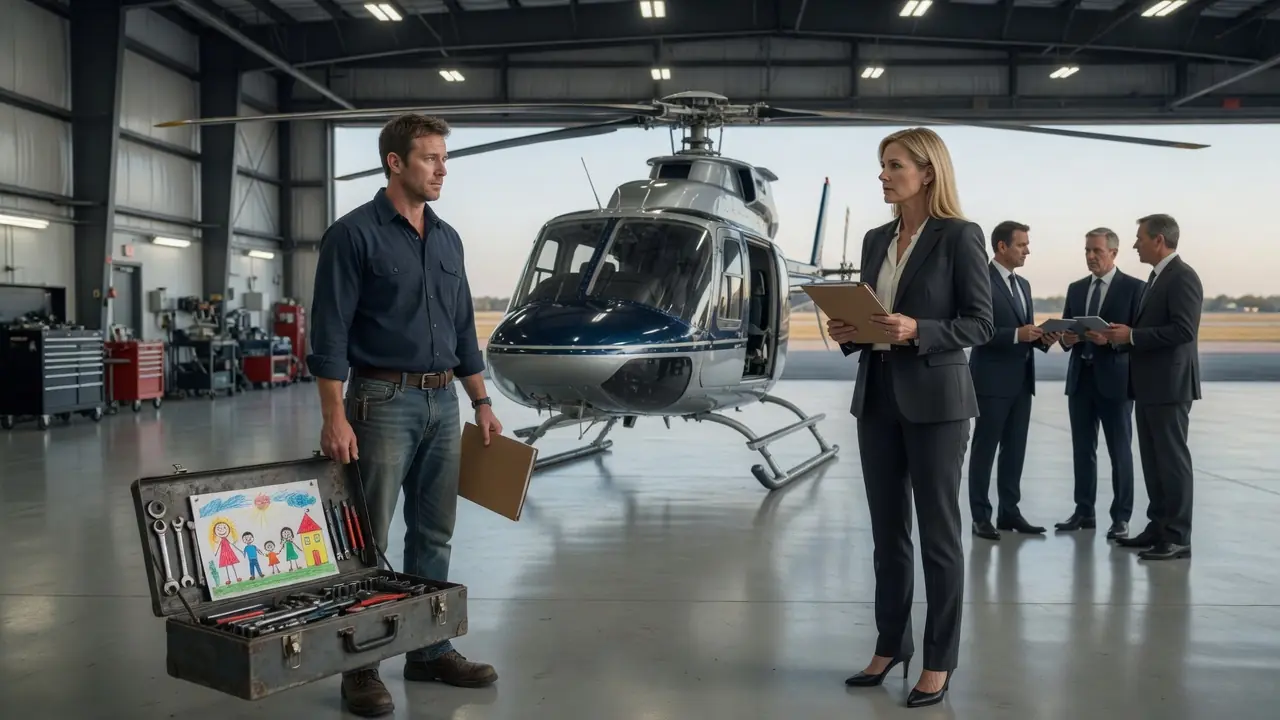
He worked late nights after taking care of his young daughter, often surviving on little sleep, driven by the promise of fair pay that would finally ease his financial struggles.
Daniel wasn’t just any contractor.
Before life had forced him onto a different path, he had years of deep experience working with aircraft systems. He understood machines in a way that went beyond manuals. He could feel when something wasn’t right.
And that intuition had guided every bolt he tightened and every system he recalibrated on this helicopter.
When the project was finally complete, Daniel stood before a group of executives inside the hangar, waiting quietly as they inspected his work.
They circled the aircraft, nodding in approval, clearly impressed by the transformation. The helicopter looked brand new. Better than brand new, even.
This job mattered.
He needed the payment.
But then the tone shifted.
One of the executives stepped forward, his expression distant and businesslike.
“We’ve reviewed everything,” he said flatly. “Unfortunately, we won’t be moving forward with your payment.”
Daniel blinked, unsure if he had heard correctly.
“I’m sorry?” he asked, his voice calm but firm.
“You were brought in as a temporary contractor,” the man continued. “There were no finalized agreements. We appreciate the work, but legally, we’re not obligated.”
The words hit harder than Daniel expected.
Weeks of sacrifice, long nights, and careful precision were dismissed in seconds.
Still, he didn’t argue.
He looked at the helicopter one last time, then back at the men standing in suits who clearly saw him as replaceable.
“I understand,” he said quietly.
There was no anger in his voice. No raised tone. Just controlled disappointment.
He gathered his tools slowly, each movement measured as if he had already accepted the outcome.
Without another word, he walked out of the hangar, leaving behind not just the aircraft, but the unseen expertise that had gone into it.
The executives exchanged brief glances, unconcerned.
To them, the job was done.
The helicopter looked perfect.
That was all that mattered.
But as the hangar doors closed behind Daniel, something subtle lingered in the air, something no checklist or surface inspection could reveal.
Because what they had taken for granted wasn’t just labor.
It was understanding.
And without it, perfection could be dangerously incomplete.
By midmorning, the hangar that had felt so confident the day before was now thick with unease.
The helicopter stood ready on the tarmac. Engines prepped. Systems checked. Executives gathered nearby, expecting a smooth test flight.
But something wasn’t right.
One by one, the pilots brought in to fly the aircraft stepped back.
“I don’t like it,” the first pilot said after a brief inspection.
“Everything checks out on paper,” another added, “but something feels off.”
The executives exchanged frustrated looks.
They had invested heavily in this aircraft, and delays were costing them time and credibility.
“What do you mean it feels off?” one of them snapped. “The system diagnostics are clean.”
The pilots didn’t argue.
They simply refused.
Experienced professionals trusted instinct as much as instruments, and none of them were willing to take the risk.
Within an hour, word had spread across the small aviation circle.
The rebuilt helicopter had no pilot willing to fly it.
And more importantly, the man who had rebuilt it hadn’t been paid.
That detail changed everything.
Doubt crept in quickly.
If the person responsible for restoring the aircraft had walked away without recognition, what else had been overlooked?
Inside the control room, tension grew.
Phone calls were made.
Voices were raised.
But solutions didn’t come.
Finally, with no other option left, the CEO made a reluctant decision.
“Call him back.”
It didn’t take long for Daniel Hayes to return.
He walked into the hangar the same way he had left, calm, steady, and unreadable.
The executives who had dismissed him now stood waiting, their confidence replaced with quiet urgency.
“We need you to take another look,” the CEO said, trying to keep his tone controlled.
Daniel didn’t respond immediately.
He simply nodded and walked toward the helicopter.
His eyes moved carefully over every detail. The rotor assembly. The control systems. The subtle alignment of components others wouldn’t notice.
The hangar fell silent as everyone watched him work.
After several minutes, Daniel stepped back.
“It will fly,” he said.
Relief began to flicker across a few faces.
But it didn’t last.
“But not safely.”
The words landed heavily.
Daniel walked closer to the aircraft and pointed toward a specific internal section.
“There’s a structural imbalance here,” he explained. “It won’t show in basic diagnostics, but under pressure in the air, it could cause instability.”
The room went completely still.
None of the engineers or inspectors had caught it.
It wasn’t obvious.
It required more than technical knowledge. It required understanding, experience, and attention to detail that couldn’t be rushed.
The CEO took a slow breath, the reality of the situation finally settling in.
Their decision the day before had nearly cost far more than money.
“We’ll correct it,” she said. “Quickly. And you’ll be paid in full.”
Daniel looked at her for a moment, then gave a small nod.
No anger.
No satisfaction.
Just quiet acknowledgement.
He stepped forward again, ready to fix what only he truly understood.
And in that moment, the lesson was clear.
Skill could build something impressive.
But respect was what made it reliable.