“Take the cash and sign,” Miles Voss said, shoving a thick envelope toward Evan Roark’s chest. “The company isn’t paying your ridiculous invoice.”
Evan knocked the envelope aside, sending several bound stacks of money sliding across the maintenance table. Behind them, the restored white Gulfstream G550 gleamed beneath the hangar lights, every panel closed and every exterior surface polished. “Push that filthy bribe at me again,” Evan said, “and you’ll regret the hand holding it.”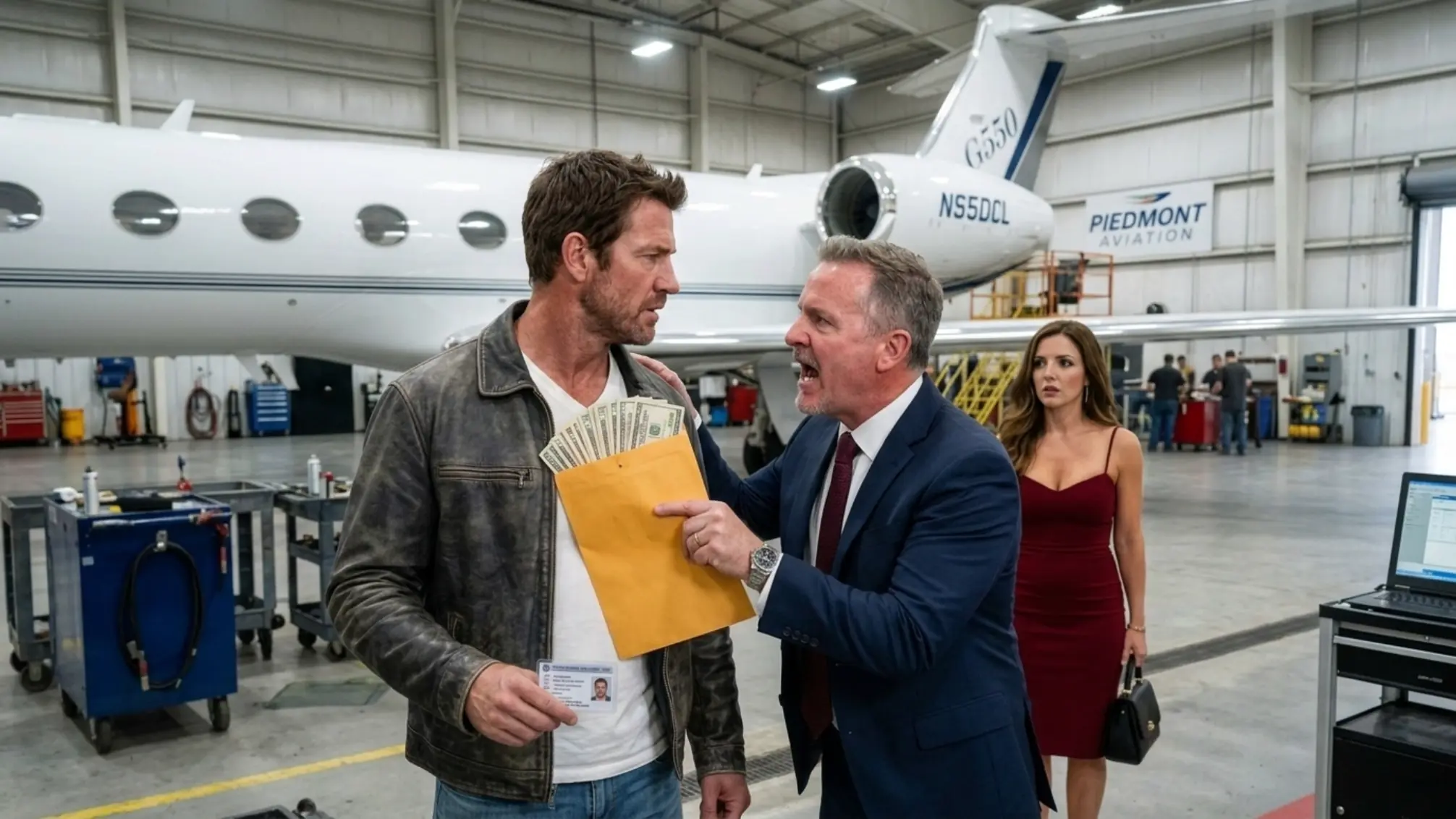
Miles stepped into his face. “I’ll destroy your shop, take the jet, and hire a mechanic who knows his place.”
A woman’s heels struck the concrete behind him. Vivian Ashcroft entered wearing a fitted deep-red spaghetti-strap dress beneath a light evening coat, her long chestnut hair falling in elegant waves over one shoulder. “Touch him,” she said, “and security removes you while every pilot waits for his signature.”
Miles slowly turned.
For the first time since entering the hangar, his expression showed uncertainty.
Vivian’s private Gulfstream stood less than twenty feet away, its cabin prepared for a flight to New York scheduled the following morning. Six weeks earlier, the aircraft had been a grounded shell filled with undocumented repairs, counterfeit components, missing maintenance records, and systems that could have failed without warning at cruising altitude.
Now it looked ready to fly.
It was not.
Miles stared at Vivian as though she had betrayed a private agreement. “This man is holding your aircraft hostage.”
Evan picked up his certification card from the table. “The aircraft belongs to her. My signature belongs to me.”
“You completed the work.”
“I completed the repairs I could verify.”
“You submitted an invoice.”
“For $240,000.”
“And the company rejected it.”
“The company used the labor, installed the parts, and accepted every progress report.”
Miles pointed toward the Gulfstream. “Then sign the release.”
Evan slipped the certification card into his jacket pocket. “No.”
The word echoed through the hangar.
Vivian looked at the envelope resting on the table. “How much is in there?”
Miles adjusted his tie. “A reasonable settlement.”
“How much?”
“Forty thousand.”
Evan said nothing.
Vivian’s eyes hardened. The invoice covered six weeks of labor from four certified technicians, emergency replacement components, outside testing, diagnostic services, and more than seventy thousand dollars Evan had personally advanced when Miles delayed approvals.
Miles had offered less than one-sixth of the amount due.
In exchange, he wanted Evan to certify the entire aircraft as airworthy.
Vivian moved toward the table and lifted one bundle of cash. “Where did this come from?”
“Operations contingency funds.”
“Recorded where?”
Miles did not answer.
“Was legal informed?”
“This was meant to prevent a contract dispute.”
“No,” Evan said. “It was meant to buy a signature without creating a payment record.”
Miles turned on him. “You are a mechanic with a failing business and a foreclosure notice taped to your door. Do not pretend you are above taking money.”
Vivian’s gaze moved toward Evan.
He did not look embarrassed.
“My finances have nothing to do with whether that aircraft is safe.”
“They have everything to do with why you manufactured this crisis,” Miles said. “You knew the company needed the jet for the merger. You ran over budget, missed the deadline, and now you want to use certification as leverage.”
Evan walked toward the Gulfstream and placed one hand against its fuselage.
“When I opened the flight-control bay, I found an untraceable component installed under a forged engineering approval. When I requested replacement, you denied it. When I documented the problem, someone altered my contract and planted old components in my storage room.”
Vivian looked sharply at Miles.
“That accusation is absurd.”
Evan faced her. “I have the original contract, the altered version, the access logs, photographs, serial numbers, server timestamps, and copies of every file deleted from your maintenance system.”
Miles laughed, but the sound lacked confidence. “Convenient.”
“My avionics specialist copied the server before the deletion.”
Vivian removed her phone from her handbag. “Who is the specialist?”
“Lena Brooks.”
“Call her.”
Miles stepped forward. “Vivian, you are allowing a contractor to manipulate you.”
She looked at him. “I told you to stop using my first name when you are lying to me.”
He went still.
Evan had first seen the Gulfstream during a cold rainstorm six weeks earlier. Blackridge Executive Airfield sat outside Charlotte, North Carolina, surrounded by warehouses, corporate hangars, and private terminals serving clients wealthy enough to treat distance as an inconvenience.
Miles called him three hours before sunset.
The aircraft had belonged to Vivian’s late father, Conrad Ashcroft. It had remained grounded for nearly two years after electrical and hydraulic failures no previous company wanted to investigate fully. Ashcroft Meridian Holdings needed it returned to service before a major corporate merger.
Miles described the assignment as a difficult but straightforward restoration.
Evan discovered the truth within an hour.
Wiring bundles had been disconnected and incorrectly reattached. Hydraulic components carried no traceable part histories. Logbook pages were missing, and several repairs appeared to have been performed by someone skilled enough to hide mistakes but careless enough to endanger everyone aboard.
Evan stood beneath the open avionics bay with rainwater dripping from his jacket and wondered how many people had already flown in the aircraft without knowing what sat behind the panels.
He almost refused the job.
Then he thought about Roark Air Works.
The independent shop had once employed nine people. After two clients collapsed during an economic downturn, the staff fell to four. Evan borrowed against the building, then against his home, to keep the doors open.
His fifteen-year-old daughter, Nora, knew the business was struggling.
She did not know the bank had delivered a final foreclosure notice.
Evan had raised her alone since his wife died eight years earlier. Nora never complained when he worked late, canceled plans, or repaired the same truck instead of replacing it. She only asked whether they would have to move.
Evan promised her they would not.
The Gulfstream contract could save everything.
It could also destroy him if he signed for an aircraft that later failed.
He accepted under one condition.
“The jet leaves when it is safe,” he told Miles. “Not when your calendar says it should.”
Miles smiled and agreed.
That smile became the first warning.
Evan brought in Lena Brooks the following morning. She was forty-one, sharp-eyed, patient, and one of the finest avionics specialists in the region. They had worked together for eleven years, long enough to communicate through small gestures and unfinished sentences.
Lena found the first unregistered component on the second day.
It sat inside the directional flight-control system, where failure could make the aircraft impossible to steer. Its markings resembled those of an approved manufacturer, but the serial number matched no legitimate database.
“Counterfeit?” Evan asked.
“Or deliberately untraceable.”
“Either answer grounds it.”
Lena nodded.
They submitted a formal discrepancy report.
Miles called before noon.
He wanted to know why Evan was delaying the schedule over what he called a labeling issue. Evan explained that the component required replacement and full provenance review.
Miles refused the expense.
“It worked before,” he said.
“No,” Evan replied. “The aircraft remained in the air before. That is not the same thing.”
The replacement assembly cost more than thirty thousand dollars. Miles said he needed forty-eight hours for approval.
Four days passed.
Evan ordered it using his own credit.
The problems multiplied. A pressurization controller had been repaired using internal parts from another model. Electrical connectors carried hidden heat damage. The emergency hydraulic accumulator had been replaced with a unit lacking certification.
Each discovery went into Evan’s inspection log.
Each report reached Vivian as a shortened summary describing cost overruns and delays.
Miles controlled the information between them.
Vivian visited the hangar on the ninth day. She arrived in a dark business suit, stepped around open panels, and asked why the aircraft remained dismantled.
Evan showed her a bent connector capable of causing intermittent autopilot failure.
She studied it carefully.
“Miles said you were replacing components unnecessarily.”
“Miles is not signing the aircraft.”
“You seem comfortable criticizing the person who hired you.”
“He hired me to find problems. He does not get to complain when I do.”
Vivian did not like his tone.
She respected the answer.
Her father had trusted Evan years earlier after a similar confrontation. Conrad once tried to pressure him into releasing an aircraft with a fuel-system irregularity. Evan refused, even after Conrad threatened to replace him.
The manufacturer later confirmed that the defect could have caused an engine failure.
From that day forward, Conrad considered Evan’s signature more valuable than any executive assurance.
Vivian had forgotten that lesson.
Miles encouraged her to forget it.
By the third week, Lena traced the counterfeit component to Vanguard Aero Supply, a company that had billed Ashcroft Meridian more than four million dollars for aircraft parts. The business had no real warehouse, no manufacturer authorization, and no technical employees.
Every purchase had been approved by Miles.
Evan submitted the records.
The files disappeared from the corporate server the next morning.
Lena had already copied them.
Then Evan discovered the contract alteration. The original document described the six-week completion date as a target. The version in Ashcroft Meridian’s system described it as a binding deadline allowing the company to withhold all payment.
Someone had added the language after Evan signed.
His initials had been digitally copied from another page.
Evan preserved both versions.
Miles responded by exploiting the one weakness he knew Evan could not hide.
He learned about the foreclosure.
“You need this contract more than we need your shop,” Miles told him one night. “Think carefully before creating trouble.”
Evan continued working.
He repaired the aircraft because abandoning it would leave dangerous components hidden inside a machine someone else might certify. Every day increased his debt, but it also strengthened the record.
Lena asked whether he regretted accepting the job.
“Every hour.”
“Planning to quit?”
“No.”
“That’s unfortunate. I already ordered dinner.”
During the fifth week, the Gulfstream’s engines started for the first time in nearly two years. Their sound vibrated through the hangar floor while the technicians watched system readings settle into stable ranges.
Vivian stood near the entrance.
The aircraft had been her father’s favorite possession. He took her on her first international trip aboard it, taught her to read maps at the conference table, and once let her sit in the cockpit while the pilots prepared for departure.
Seeing it alive again weakened something inside her.
She thanked Evan.
He told her the work was not finished.
Miles told her it was close enough.
The merger schedule required Vivian in New York on Monday morning. He promised another technician could issue the final certification if Evan continued being difficult.
Then the invoice arrived.
Miles called an internal meeting without Evan. Legal staff were shown the altered contract, photographs of counterfeit components planted inside his storage room, and summaries accusing him of unauthorized purchasing.
The company froze payment.
Miles delivered the decision personally.
Evan listened in silence.
Then Miles offered the envelope.
Evan placed the hangar key on the workbench and walked away.
He did not take his certification card from his pocket.
That card represented his legal authority to sign the maintenance release. Without his name in the logbook, the restoration remained incomplete.
Miles believed another mechanic would sign.
The following morning, Vivian arrived for her flight wearing the red dress chosen for a merger dinner in New York. Her car waited outside the terminal, luggage was already aboard, and the flight schedule called for departure at nine.
Captain Grant Hale entered the cockpit at seven thirty.
He opened the maintenance logbook.
Evan’s unresolved discrepancy remained inside:
Directional flight-control assembly requires final independent provenance confirmation. Aircraft not approved for return to service.
Grant closed the book.
Miles told him a replacement sign-off was coming.
Grant removed his headset. “Then I will wait for it.”
“We cannot wait.”
“The aircraft can.”
Miles called the backup first officer.
He declined before arriving.
Two contract pilots were offered double pay. One asked whether Evan Roark had cleared the aircraft and ended the call when Miles said no. The other came to the hangar, read the logbook, and walked back to his car.
Vivian entered the hangar at eight forty.
“Why is no one in the cockpit?”
Grant handed her the logbook.
“Because the mechanic who rebuilt your aircraft did not sign it.”
“Miles said another inspector was coming.”
“Three refused.”
“Why?”
“Because no responsible technician signs over an unresolved safety discrepancy written by Evan Roark.”
Miles approached carrying another folder. “This is professional solidarity. They’re protecting one another.”
Grant looked at him. “No. We are protecting the people who would be aboard.”
Vivian read Evan’s final entry.
Then she remembered the bolt he had shown her, the unmatched serial numbers, and her father’s old habit of keeping documents inside a private cabinet behind the copilot’s seat.
She opened it.
Inside was a sealed envelope addressed to Evan and a small voice recorder.
The letter came from Conrad.
He wrote that aviation companies failed when schedules became more important than signatures. He described mechanics willing to withhold approval as inconvenient, expensive, and indispensable.
The recording was more damaging.
Vivian heard her father questioning Miles about unexplained maintenance spending. Conrad said he intended to audit every aviation vendor after returning from his next international trip.
He died before conducting the review.
Vivian canceled the flight.
Then she drove to Roark Air Works.
She found Evan packing tools into wooden crates beneath a bank closure notice.
“You were right,” she said.
He continued wrapping a diagnostic unit. “About which part?”
“Vanguard. Miles. The records.”
“Being right does not make the aircraft safe.”
“I will pay the invoice immediately.”
“That does not make it safe either.”
“What do you need?”
“Independent component tracing across every flight-critical system. Full access for outside auditors. Payment for my team, whether the aircraft passes or fails.”
“You will return?”
“I will inspect it.”
“And sign?”
“If it deserves my signature.”
Vivian called the board from his workshop.
The payment hold was lifted within twenty minutes. The complete invoice, late interest, and every personal advance reached Roark Air Works that afternoon.
Evan still did not sign.
Independent auditors intercepted a shipment Miles attempted to remove from the airport. Inside a warehouse connected to his brother-in-law, they found hundreds of counterfeit aviation components carrying false manufacturer markings.
The same component class had been installed in two other Ashcroft aircraft.
Vivian grounded the entire fleet.
Three board members accused her of overreacting.
“If a single one of you wants those aircraft flying,” she said, “put your family aboard first.”
Nobody volunteered.
Miles tried to blame Evan. Access logs showed his employee planting the old components after Evan submitted the invoice. Server records proved files were deleted using Miles’s credentials. Financial statements traced millions in inflated purchases to Vanguard.
Miles was suspended, then arrested after investigators found forged certifications and illegal payments.
The merger collapsed.
Vivian accepted the loss.
“A transaction built on hidden aircraft defects is already broken,” she told the board.
Evan, Lena, and the independent auditors inspected all three jets. They found untraceable parts in each one. Inside the Gulfstream’s directional-control linkage, Evan discovered a deep wear groove caused by an incorrectly rated component.
At altitude, the part might have failed during Vivian’s planned flight to New York.
No warning would have given the pilots enough time.
Vivian stood beside the removed linkage while Evan explained the failure pattern.
“How close was I?”
He looked at the damaged metal. “Close enough that the calendar should stop mattering.”
She apologized to every technician personally.
Then she apologized to Evan.
“I believed the version that was easiest for me.”
“You believed the person with the office instead of the people inside the aircraft.”
“I was wrong.”
“Yes.”
She almost smiled. “You never make apologies comfortable.”
“They are not supposed to be.”
The legitimate replacement parts arrived with complete records. Evan checked every serial number, manufacturer certificate, installation entry, and inspection result.
When the final systems test ended, he entered the cockpit alone.
The small mechanical clock above the instrument panel still had a cracked crystal. He cleaned it during the restoration because Conrad had always kept it there.
Evan opened the logbook.
He signed his name.
Grant Hale entered the cockpit ten minutes later and began the preflight sequence. The backup pilot who had refused the earlier departure returned without being called.
Vivian watched from the hangar floor.
The Gulfstream rolled toward the runway and stopped at the threshold. Its engines rose smoothly to takeoff power, and the aircraft accelerated beneath a clear Carolina sky.
Evan stood beside Nora at the edge of the tarmac.
She had never seen one of his major projects fly.
“Were you scared it wouldn’t take off?” she asked.
“No.”
“Were you scared it wouldn’t come back?”
“Not after I signed it.”
The Gulfstream lifted cleanly from the runway.
Grant completed a two-hour test flight, checking every control surface, backup system, hydraulic circuit, and automated response. The aircraft returned without a single abnormal reading.
After landing, he walked directly to Evan.
“She’s ready to go anywhere.”
Vivian presented Evan with a ceremonial paper check for $240,000 in front of the board, audit team, and maintenance crew. The actual payment had already cleared, but she intended to frame the check inside the boardroom.
A brass plate beneath it would read:
No schedule, contract, or executive authority stands above the safety of this aircraft.
Evan agreed to serve as an independent aviation inspector with direct access to the board. He refused an executive position.
“You need someone outside the hierarchy,” he told Vivian. “The moment I depend on the people I inspect, you recreate the same problem.”
Roark Air Works survived.
The bank released its claim. Evan rehired two technicians and expanded the diagnostic bay. Nora remained in the only home she remembered.
Miles eventually pleaded guilty to fraud, procurement corruption, falsification of aviation records, and obstruction. His scheme had generated millions while placing executives, crews, and passengers inside aircraft containing parts that had never been tested to remain in the air.
He once believed Evan’s debt made him weak.
Instead, the mechanic was the only person he could not purchase.
Months later, Vivian visited Roark Air Works carrying two cups of coffee. She wore a simple coat rather than a formal dress and arrived without assistants.
Evan accepted one cup.
“You need something inspected?” he asked.
“Not today.”
“Then why are you here?”
“I wanted to see whether you speak to everyone this rudely or only CEOs.”
“Mostly CEOs.”
She smiled and looked through the office window at the Gulfstream waiting inside the main bay for a routine inspection.
Nora called during their conversation. Evan answered, listened, and glanced toward Vivian.
“What did she say?” Vivian asked after he ended the call.
“She asked whether the billionaire who keeps bringing coffee is interested in more than aircraft safety.”
Vivian lifted her cup. “What did you tell her?”
“Nothing.”
“That was probably wise.”
They sat quietly for a while.
Outside, a customer entered carrying a thick maintenance logbook. He asked Evan how quickly he could make an aircraft fly again.
Evan opened the records and turned several pages.
“I’m not paid to get it flying,” he said. “I’m paid to make sure it comes back.”
Six weeks earlier, Miles Voss had laughed at a mechanic who needed the money badly enough to risk everything.
He believed a cash envelope could purchase the final signature.
He believed the company owned Evan because it owned the jet.
Then the departure morning arrived.
The engines were ready.
The passengers were waiting.
The schedule was collapsing.
But one pilot after another opened the logbook and stepped away.
Without Evan Roark’s name, the Gulfstream remained exactly where integrity had placed it—on the ground.