The wind came off the fields before sunrise.
Cold enough to sting Casey Bennett’s cheeks.
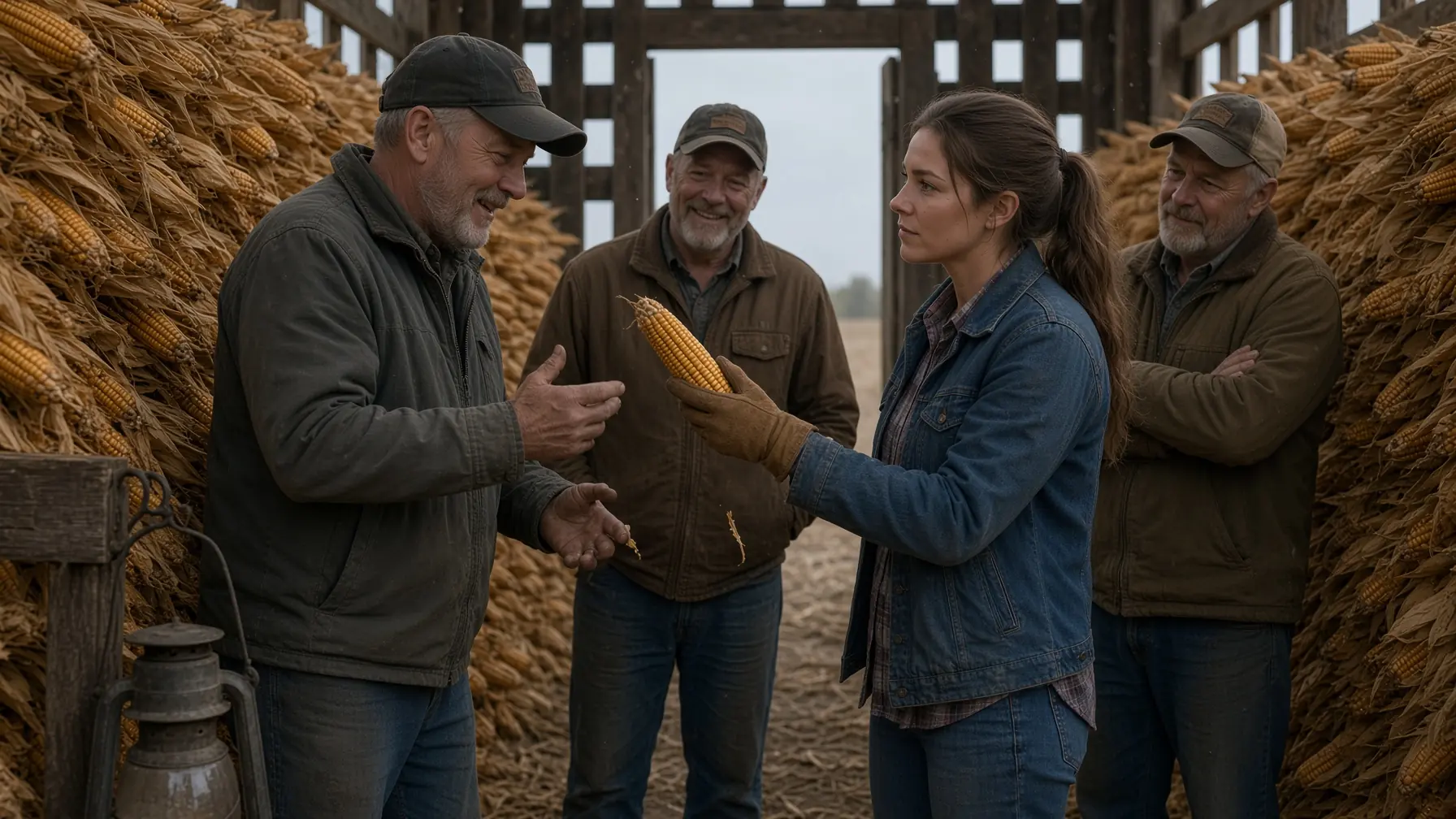
Strong enough to push through every narrow gap in the wooden slats of the old corn crib.
Inside, the air smelled of dust, dry husks, old lumber, and corn.
Casey stood beneath rafters her grandfather had raised more than forty years earlier and ran one bare hand along a row of ears stacked nearly to her shoulder.
Dry.
Firm.
Cool.
Exactly what she wanted.
Behind her, three neighboring farmers stood in the open doorway.
Arms crossed.
Caps pulled low.
Watching.
One of them, Warren Pike, finally broke the silence.
“You're going to lose every bushel in here.”
He did not say it cruelly.
That made it harder to dismiss.
Warren spoke the way an experienced farmer might warn somebody about ice on a bridge.
Not mocking.
Certain.
Another man, Leonard Baines, shook his head.
“You should've sold in November.”
Casey kept examining the corn.
“Price was decent.”
“Yes.”
“Elevator would've taken all of it.”
“Yes.”
“No storage risk.”
“Exactly.”
Leonard gestured toward the crib.
“This isn't how people store grain anymore.”
Casey broke an ear in her hands.
Pressed one kernel with her thumbnail.
Then another.
Listened when several dry kernels knocked against each other.
She had heard some version of this conversation every week since harvest.
At the co-op.
At church.
At the fuel pump.
At the feed store.
Everybody knew what she was doing.
Everybody had an opinion.
Casey had learned that arguing only made people more certain.
So she placed the ear back where she had found it.
Warren looked at her.
“You hear us?”
“Yes.”
“And?”
Casey finally turned.
“If it starts heating, I'll know.”
Leonard laughed softly.
“That's your plan?”
“No.”
She looked around the crib.
“This is part of it.”
None of the men knew that within a year, two of them would call Casey asking whether she had corn left.
Not to prove a point.
Not because they felt sorry for her.
Because they would need it.
Casey did not know that either.
She only knew that she had stored roughly a thousand bushels of ear corn in a structure everyone else considered obsolete.
And if she was wrong, her family could not afford the lesson.
Casey Bennett was twenty-nine years old.
She had been running most of Bennett Farm for three years, ever since her father’s health stopped allowing him to do it himself.
Her father, Daniel, had not retired by choice.
Farmers rarely did.
He developed heart problems at fifty-eight.
Then came surgery.
Medication.
Restrictions.
No twelve-hour days in the combine.
No climbing grain equipment alone.
No pretending fatigue was just weather.
Casey stepped in gradually.
Then all at once.
Bennett Farm covered a little more than three hundred acres in a part of the Midwest where the soil was good enough that outsiders assumed farming should be easy.
It wasn't.
Margins had tightened.
Machinery had grown expensive.
Seed had grown expensive.
Fertilizer had grown expensive.
Repairs came whenever they pleased.
The farm carried an equipment loan that had outlived the optimism with which it had been signed.
Their combine needed a replacement corn head.
The machine shed roof leaked in three places.
Property taxes arrived whether the crop did or not.