It began on a Tuesday evening in Windermere, Florida, in the living room of the house my late wife, Sarah, and I bought after twenty-eight years of careful saving.
The house sat on Maple Street, not the fanciest road in town, but quiet, shaded by old oaks, with a wide front porch Sarah had loved and a backyard big enough for grandchildren to run until they collapsed laughing in the grass.
Brochures about Hawaii lay across my coffee table like colorful promises.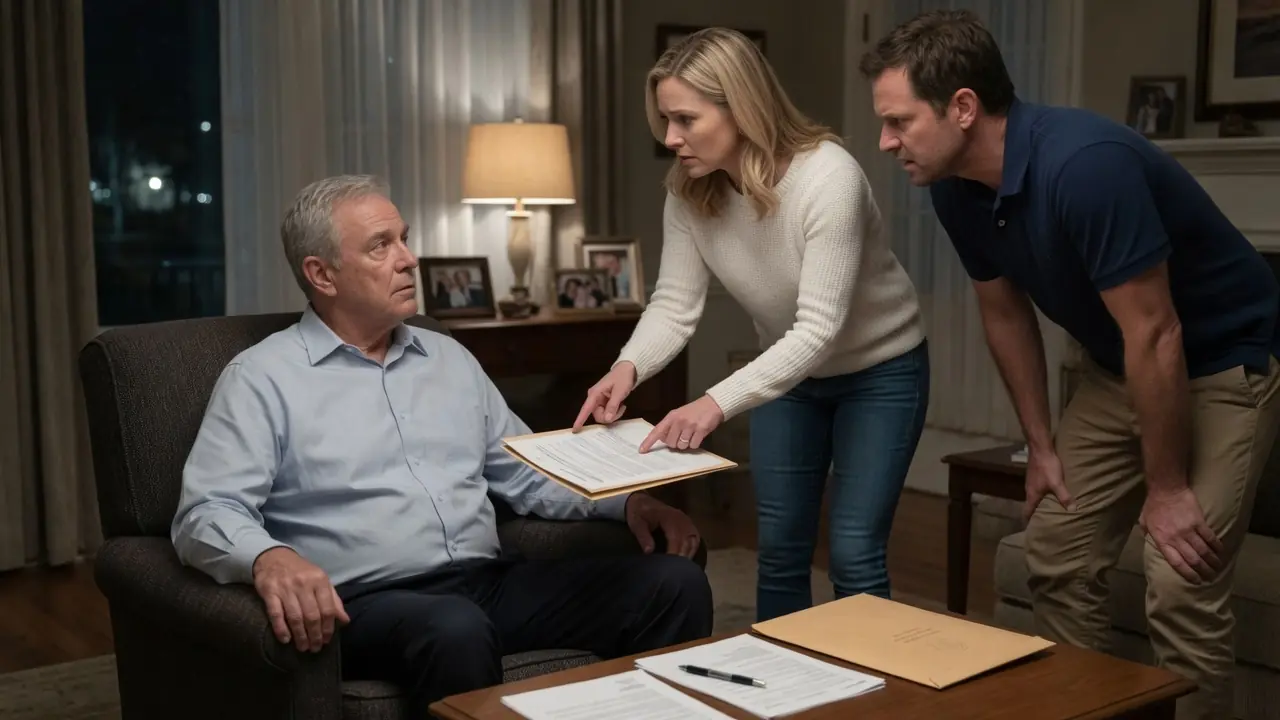
Golden beaches. Blue water. Palm trees. Resort pools sparkling under sunlight. Smiling families with sunglasses and flowers around their necks. The kind of pictures that made retirement look like one long reward if you had survived enough ordinary years.
My daughter Lauren opened one of the brochures wide, her manicured fingers tracing the coastline of Maui.
“The resort is perfect,” she said, her voice bright with excitement. “Four bedrooms, ocean view, private beach access, breakfast buffet included, and they have a kids’ snorkeling program.”
Her husband, Bradley, leaned over her shoulder and nodded in approval.
“Plus the helicopter tour package is discounted if we book early.”
Bradley’s parents, Walter and Margaret Mitchell, sat comfortably on my couch as if they had lived there for years instead of visiting from Tampa for the planning dinner. Walter had kicked off his shoes and placed one ankle over his knee. Margaret had already claimed the throw blanket Sarah knitted, folding it over her lap while discussing hotel amenities like a woman reviewing property she owned.
“The Maui resort looks wonderful,” Margaret said. “I’ve always wanted to see the sunsets there.”
“You will,” Lauren said. “I already checked the best beachside restaurants.”
I reached toward one of the brochures.
“That sounds wonderful,” I said. “When do we—”
“Dad,” Lauren interrupted.
She pushed the glossy paper away from my hand with a smile so small and practiced that it took me a second to understand the gesture.
“You’re too old for such adventures.”
The words landed strangely.
Not loudly.
Not even sharply.
But coldly, like a glass of water poured down the back of my neck.
I blinked, certain I had misheard her.
“I’m sixty-two,” I said.
“I know,” she replied, as if that proved her point. “That’s why it’s better for you to stay home and watch the house.”
Watch the house.
My house.
The house I had paid for, repaired, refinished, insured, and protected through hurricanes, recessions, medical bills, grief, and five years of my daughter’s family living in it for free.
Lauren kept going.
“We’re flying with Bradley’s mom and dad. It’s their dream trip, you know.”
Walter chuckled from the couch.
“Been saving for this for years. Can’t wait to see those sunsets.”
I looked at him.
Walter Mitchell was sixty-four, two years older than me. His wife Margaret was sixty-one, only one year younger. Yet somehow, I was too old for Hawaii while they were perfect traveling companions.
“The kids will love the snorkeling,” Margaret added, already claiming memories that had not happened yet.
My grandchildren, Noah and Lily, were upstairs packing the new swimsuits I had bought them the week before. Noah was eleven, curious and loud, always asking how engines worked. Lily was eight, sweet and sharp-eyed, with Sarah’s habit of tilting her head when she was thinking.
I had assumed I would be going with them.
That was my mistake.
“I’ve never been to Hawaii,” I said quietly.
Bradley shrugged.
“Maybe next time, Pops. This trip’s kind of a family thing.”
Family.
The word twisted in my chest.
I looked from Bradley to Lauren, then to Walter and Margaret. They continued planning around me, over me, and through me, as if I were a lamp they had to lean around to reach a better view of the table.
Lauren pulled out her phone to show Margaret a restaurant menu she had researched. Bradley grabbed another brochure and pointed at excursions. Walter asked if there would be rental cars. Margaret wondered aloud whether the resort spa required advance reservations.
They moved with the easy confidence of people who had already decided everything without consulting the man whose house they lived in.
My generosity had sheltered them for five years.
Yet in that living room, I felt less like a father and more like furniture they had stopped noticing.
Lauren said the flight left Thursday morning and that they would be gone ten days.
“You’ll have the whole place to yourself,” she said. “Think of it as a little vacation too.”
A vacation from what?
From providing free housing?
From cooking dinners they barely acknowledged?
From listening to Bradley complain about his credit score while using my electricity to charge his gaming devices?
From pretending I did not notice when Lauren ordered groceries through my account because, as she once said, “Dad doesn’t mind helping with the basics”?
I stood slowly.
My knees protested, reminding me of the age Lauren had suddenly become so concerned about.
“I should probably get some things in order then,” I said. “For housesitting.”
“You’re the best, Dad,” Lauren said.
For the first time that evening, she looked up at me fully. She gave me the smile that once melted my heart when she was seven years old and asking for one more bedtime story. But now it looked calculated. Practiced. A daughterly expression used when access to my cooperation was required.
“Don’t worry about anything,” she said. “Just relax and enjoy the quiet.”
Walter raised his coffee mug in a mock toast.
“To family vacations.”
They all laughed.
Even Margaret, who had met me exactly four times, felt comfortable enough to laugh at my exclusion in my own living room.
I walked toward the hallway, their voices following me, full of animated discussions about sunset dinners and helicopter tours. Adventures I had apparently aged out of overnight.
The hardwood floor creaked under my feet, the same sound it had made when Sarah and I danced in the living room on our thirtieth anniversary.
Sarah would have fought for me.
She would have placed both hands on her hips and said, “If David is too old, Walter must be ancient, and nobody is going anywhere until we learn basic respect.”
Then she would have kissed my cheek and told me to start packing.
But Sarah had been gone five years.
And I was learning that the daughter we had raised together saw me differently than I had imagined.
Behind me, Lauren’s voice carried clearly.
“Mom would have understood. She always said Dad needed looking after as he got older.”
I stopped at the bedroom doorway.
Sarah had never said anything like that.
Not once.
Sarah used to say I was stubborn, overly cautious with money, too loyal to broken appliances, and terrible at remembering where I placed my reading glasses. But she never spoke of me as if I were helpless. She never treated aging like a crime.
Apparently, my late wife’s imaginary concerns were now being used as justification for my exclusion from family joy.
Three hours later, I sat on the edge of my bed, still wearing the same clothes from dinner.
My reflection stared back from Sarah’s old vanity mirror, showing a man who had apparently become invisible in his own home. The house had settled into its evening rhythm, but voices drifted up from the living room below.
At first, their laughter seemed distant, muffled by the walls and vents.
I planned to ignore them. Maybe I would read one of the mystery novels Sarah had loved. Maybe I would tell myself Lauren had simply been thoughtless, not cruel. Maybe I would swallow one more insult because parents are trained to forgive before children even finish hurting them.
Then Bradley’s voice cut through the ambient noise, clearer than it should have been.
“Honestly, I think he bought that whole too-old nonsense.”
My book fell closed.
I froze.
Every muscle in my body tightened.
Lauren’s response floated up through the heating vent near my feet.
“Dad’s always been gullible. Remember when we told him we’d pay him back for the roof repairs?”
Their laughter followed.
Casual.
Dismissive.
Cruel.
I moved carefully toward the vent, my old teacher’s instincts waking up. I had taught high school mathematics for thirty-six years. I knew when students were whispering. I knew when a room was hiding something. I knew when to interrupt and when to listen.
This was a listening moment.
Walter’s voice joined in.
“Right after we return from Hawaii, we need to get serious about putting him in that home we researched.”
My breath caught.
“Sunset Manor has an opening next month,” Margaret said, her tone businesslike. “They told us they could expedite the paperwork if the deposit is paid upfront.”
“How much?” Bradley asked.
“Three thousand,” Walter replied. “But it’s worth it to get him settled quickly. Once he’s there, this house becomes the real issue anyway.”
Lauren lowered her voice, but the vent carried every word.
“It’s our inheritance.”
The floor seemed to tilt beneath my feet.
I gripped the windowsill, my knuckles going white against the painted wood.
Lauren continued, growing more animated now.
“I already spoke with that real estate agent, Zachary Allen. He thinks we can get at least eight hundred thousand, maybe more, with the market the way it is.”
“Split four ways?” Bradley asked.
“Obviously,” Lauren replied. “Mom, Dad, you’ve earned your share dealing with his complaints these past few years.”
Margaret laughed.
“He has gotten rather demanding, hasn’t he? Always asking about our plans. Wanting to be included in everything.”
“The entitlement is unreal,” Lauren agreed. “Dad, you’re sixty-two. Accept that your active years are behind you.”
I sank onto the bed because my legs suddenly felt unreliable.
Five years.
Five years I had housed them.
Five years of grocery bills, utility payments, roof repairs, car repairs, school supplies, birthday gifts, medical copays, last-minute emergencies, and quiet sacrifices I had hidden because I did not want my daughter to feel ashamed.
I thought I had been helping them recover.
They had been waiting for me to become disposable.
Bradley’s voice grew louder.
“The best part is he’ll never see it coming. We’ve got him convinced we’re just concerned about his well-being.”
“Dad always was too trusting,” Lauren said.
Then Walter said something that surprised me.
“Your mother never said anything about your father being a burden. That woman adored him.”
For one second, I felt grateful.
Then Lauren answered sharply.
“Well, she’s not here to object now, is she? And frankly, this is what’s best for everyone. Dad gets professional care. We get financial security.”
Professional care.
They made it sound like kindness.
As if they were not planning to put me somewhere convenient so they could sell the only home Sarah and I ever truly loved.
The conversation continued, but I had heard enough.
I stood slowly, walked to my dresser, and opened the bottom drawer where I kept Sarah’s jewelry box. Inside, beneath her wedding ring and a folded handkerchief from our anniversary trip to Savannah, lay the deed to the house.
This was the house I had bought with my teaching salary.
The house Sarah and I had paid off in full after twenty-seven years of monthly discipline.
The house where Lauren had taken her first steps.
The house where Noah and Lily had learned to ride bicycles in the driveway.
The house where Sarah had died in the downstairs bedroom, holding my hand and telling me, “Don’t let grief make you smaller, David.”
My reflection stared back from the vanity mirror.
Something had changed in those few minutes of listening.
The man looking back no longer seemed invisible.
Sleep became impossible.
Every time I closed my eyes, Bradley’s desperate voice from five years earlier echoed in my memory.
February 2020.
The call had come at 11:30 on a Tuesday night while I was grading algebra tests with a red pen in hand.
“David,” Bradley had said, his voice raw and broken. “I need help. I’ve lost everything.”
The story had tumbled out between sobs.
Online poker sites.
Cryptocurrency investments that promised guaranteed returns.
Sports betting apps that seemed like easy money.
Forty-seven thousand dollars in credit card debt.
A house in foreclosure.
Lauren was crying in the background, pregnant with Lily.
“It was supposed to be Bitcoin,” Bradley whispered. “Everyone said it couldn’t fail. I put our savings, the home equity loan, everything into it right before the crash.”
I had listened, my teacher’s heart breaking for the young man who had somehow become family.
Sarah had been gone only months, and the house felt too empty. Lauren was my daughter. Noah was six. Lily was not yet born. These were my people. My blood. My responsibility, or so I believed.
“We have nowhere to go,” Bradley continued. “Lauren’s in pieces. My parents can’t help. You know how they are.”
I had known, or thought I did.
Walter and Margaret had never approved of Bradley’s gambling habits, but they had also never opened their door when the consequences arrived. They offered advice from a safe distance and let me provide the shelter.
So I said yes.
Of course I did.
I had rooms.
I had a kitchen.
I had grief disguised as extra space.
They moved in “for a few months.”
Then months became a year.
A year became five.
Now, lying in the darkness, I recognized the calculation behind that desperation. Bradley had known exactly which emotional buttons to press. The grieving widower. The protective grandfather. The father who could not bear the thought of his pregnant daughter in a motel.
I rose from bed and walked to the window overlooking the backyard.
Noah’s bicycle leaned against the garage. Lily’s scooter lay tipped over near the patio. The swing set I had installed two summers earlier stood beneath the oak tree, its yellow seats wet with evening dew.
My hands trembled as I calculated the expenses.
Five years of groceries for five people. At least eighteen thousand dollars, probably more.
Utilities that had nearly doubled after they moved in. Another several thousand.
The roof repair Lauren had laughed about. Fourteen thousand after storm damage.
Medical bills when Bradley’s insurance lapsed.
Car repairs for the vehicle they had quietly claimed as their own.
Christmas gifts.
School fees.
Sports uniforms.
Dental work.
Birthday parties.
Easily over sixty thousand dollars to people who called me a burden.
The algebra was simple and devastating.
I had supported them longer than some marriages lasted, and their gratitude had curdled into entitlement somewhere along the way.
I pulled out the notebook where I had tracked household expenses since Sarah’s death. Page after page recorded Bradley’s requests, Lauren’s needs, and the children’s requirements. Always urgent. Always temporary. Always followed by promises of repayment when things improved.
Things never improved.
They simply learned to ask for more.
By dawn, I had made a decision.
Not in anger.
Not only in pain.
In clarity.
Dawn filtered through the kitchen blinds as I entered and found the family already buzzing with travel energy. Lauren stood at the counter, organizing boarding passes and travel documents. Bradley hunched over his phone, presumably checking flight status. Walter and Margaret compared sunscreen brands like military strategists planning an invasion.
“Morning, Dad,” Lauren called cheerfully without looking up. “Coffee’s fresh.”
I poured myself a cup and studied their faces with new perspective.
Yesterday, I would have seen excited family members preparing for an adventure.
Today, I observed co-conspirators celebrating their successful manipulation.
“The flight leaves at 10:15,” Bradley announced. “We should head out by 8:30 to beat traffic.”
“Did you remember to pack the camera charger?” Margaret asked Lauren.
“Already in the carry-on,” Lauren answered. “Plus backup batteries.”
Their efficiency impressed me.
The same organizational skills they had never applied to finding employment or contributing to household expenses suddenly appeared for luxury travel. Apparently, planning vacation activities required different talents than securing basic income.
“Is there anything special you need me to do while housesitting?” I asked, settling into my usual chair.
Lauren finally glanced up with a patronizing expression.
“Just the usual, Dad. Water the plants, check the mail, maybe have Elizabeth from next door look in on you.”
Elizabeth Thompson was my seventy-year-old neighbor. She had known Sarah and me for fifteen years. She brought casseroles after Sarah’s funeral and still called every Sunday evening to ask if I wanted extra tomatoes from her garden.
Lauren suggested she look in on me as if I were an invalid requiring supervision.
“I’m perfectly capable of managing alone,” I replied mildly.
Bradley snorted.
“Right, Pops. Just don’t try fixing anything that breaks. Call a professional.”
The irony struck me forcefully.
Bradley, who had lost his house to gambling debts, was advising me about responsible home maintenance.
I sipped my coffee and nodded agreeably.
“Of course. I wouldn’t want to cause problems.”
Their comfort with my compliance seemed to satisfy them.
Walter folded a tourist map of Maui and tucked it into his shirt pocket.
“Two weeks of paradise,” he said. “We’ve earned this.”
Earned.
Through five years of free housing, meals, and financial support they had never acknowledged, let alone repaid.
Bradley’s phone chimed.
“Uber’s five minutes out.”
The announcement triggered sudden movement. Suitcases appeared. Last-minute items were grabbed. Noah ran down the stairs wearing sunglasses too big for his face. Lily carried a stuffed turtle and asked if sea turtles had grandparents.
“They do,” I told her.
“Do they visit them?”
I looked at Lauren.
“Some do.”
Lauren did not notice.
“Dad, you’re sure you’re okay staying alone?” she asked, though it sounded more like polite formality than concern.
“Absolutely,” I said. “I’ll enjoy the quiet.”
She kissed my cheek.
Once, that gesture would have warmed me.
Now it felt like a performance for relatives who expected daughterly affection.
When the Uber arrived, car doors slammed outside, luggage rolled across the walkway, and the front door closed with decisive finality. For the first time in five years, the house belonged entirely to me again.
I stood in the foyer and listened.
Silence.
Not lonely silence.
Not yet.
Strategic silence.
I watched their car disappear around the corner, carrying my ungrateful family toward paradise.
Two weeks.
Fourteen days to consider my options, evaluate my resources, and demonstrate that the burden they dismissed possessed capabilities they had never suspected.
I finished my coffee slowly.
Then I made my first call.
At 11:03, I dialed the number Lauren had mentioned through the vent.
“Allen Realty, Zachary speaking.”
“Mr. Allen,” I said, “this is David Parker. I need to sell my house as quickly as possible.”
There was a brief pause.
“How quickly are we talking, Mr. Parker?”
“Two weeks maximum. I’m willing to price it aggressively for a fast sale.”
“That’s ambitious,” he said. “What’s driving the urgency?”
I had prepared for the question.
“Personal circumstances require immediate liquidity. I understand speed comes at a cost.”
When I told him the property was in Windermere, a four-bedroom, two-and-a-half-bath house with no mortgage and clear title, his tone shifted.
No mortgage meant a cleaner sale.
He asked the square footage.
I told him twenty-eight hundred, with an updated kitchen, a new roof, an established neighborhood, and a large backyard.
“Mr. Parker,” he said, “I can be there in an hour.”
After hanging up, I retrieved the deed from Sarah’s jewelry box along with property tax records, insurance documents, and maintenance receipts. Everything Zachary would need. Then I walked through my house with new eyes.
These rooms had witnessed Sarah’s laughter, Lauren’s childhood milestones, birthday parties, school mornings, Christmas trees, and family celebrations back when I believed family meant loyalty.
Now they represented assets to be liquidated.
Equity to be liberated.
Resources for changing the power dynamic that had governed my life for five years.
Zachary arrived precisely one hour later. He was younger than I expected, about forty-five, wearing a navy blazer despite the Florida heat and carrying a tablet. He had the clean, alert expression of a man who could smell urgency and commission at the same time.
After explaining the process, he began his assessment.
Two weeks meant cash buyers, minimal contingencies, competitive pricing, and a willingness to leave some money on the table. I told him speed mattered more than maximum profit.
As he measured rooms and noted architectural details, I felt something shift in my chest. After years of reacting to other people’s decisions, I was finally taking control.
Lauren had mentioned Zachary’s name while planning to sell my house without my knowledge.
Now he was there at my invitation, working toward my goals and operating on my timeline.
The symmetry felt like justice.
Three hours after Zachary left, my phone rang.
The area code was Hawaii.
Lauren’s voice bubbled through the speaker.
“Dad, we made it safely. The resort is absolutely incredible.”
I settled into my kitchen chair with Zachary’s business card still beside the property documents.
“I’m glad you arrived safely. How was the flight?”
“Long, but worth it. Dad, you should see this place. Private beach, infinity pool, spa services, the works. Bradley already booked us a helicopter tour for tomorrow.”
“That sounds amazing,” I said, tracing the edge of Zachary’s card. “I hope you take lots of pictures.”
“Oh, we will. The concierge recommended this incredible restaurant for tonight. Five-star dining right on the beach. You’d probably find it too fancy, but we’re excited.”
Too fancy for me.
Naturally.
Lauren’s tone shifted into something maternal.
“How are you managing on your own?”
“I’m doing well.”
“Don’t overexert yourself, okay? And if anything feels strange, call Elizabeth.”
“I’ll keep that in mind.”
“We’re preparing a surprise for you when we get back,” she added.
“A surprise?”
“I don’t want to spoil it, but let’s just say we found a solution to help you transition into your golden years more comfortably. Professional care, social activities with people your own age, that sort of thing.”
Professional care.
The euphemism they had used while planning my disposal.
I kept my voice steady.
“How thoughtful of you.”
“Exactly. It’s going to be better for everyone.”
“Actually,” I said, “that’s interesting timing. I’m preparing a surprise for you too.”
Lauren laughed.
“What kind of surprise could you possibly be planning, Dad?”
“Well, if I told you, it wouldn’t be a surprise, would it?”
I allowed myself a small smile.
“Let’s just say I’ve been taking care of important business while you’re away. Really important business that will change everything for all of us.”
“Business?” Lauren started, then caught herself before sounding too dismissive. “That’s sweet, but don’t wear yourself out with whatever little project you’re working on.”
Little project.
If only she knew.
After hanging up, I sat in the quiet kitchen, surrounded by the weight of mutual deception.
Lauren was preparing to place me in a nursing home, confident I would never discover her plan. Meanwhile, I was preparing to sell the house she considered her inheritance, confident she would never expect decisive action from the supposed burden.
Both sides were planning surprises.
Only one side was actually in control.
Sunday morning brought Zachary’s call at nine and our first potential buyer.
James Clark represented a commercial investment group looking for rental properties in established neighborhoods. Zachary warned me privately that cash buyers expected significant flexibility. I told him cash transactions were perfect for my timeline.
Clark arrived in a silver BMW, wearing expensive casual clothes and carrying a leather portfolio. He was in his mid-fifties, with the practiced efficiency of a man who had acquired many properties and felt no emotion about any of them.
I walked him room by room, highlighting the refinished hardwood floors, updated kitchen, new roof, good schools, mature trees, and neighborhood stability.
Each feature felt like a small betrayal of Sarah’s memory.
But I pressed forward.
“The property has excellent fundamentals,” Clark concluded after thirty minutes. “Let me run numbers with my partners. You’ll hear from me by tomorrow afternoon.”
For a few hours, I felt cautiously optimistic.
Then Monday afternoon shattered that optimism.
Clark’s numbers did not work at the asking price. He needed sixty thousand dollars less.
Sixty thousand dollars.
Nearly equal to what I had invested in Lauren’s family over five years.
After hanging up, I sat in the kitchen and stared at Zachary’s business card.
Was I really willing to lose sixty thousand dollars to prove a point?
For a moment, doubt crept in.
Lauren was still my daughter.
Bradley was the father of my grandchildren.
Noah and Lily were innocent.
Maybe I was overreacting to wounded pride. Maybe I should confront them first. Maybe I should wait until they returned and force a conversation around the dining table where Sarah used to serve Sunday pot roast.
Then I remembered their laughter.
The casual cruelty of planning my disposal while living in my house, eating my food, and spending my money.
The nursing home deposit already discussed.
The real estate agent already identified.
The inheritance already divided.
They had made their choice long before Hawaii.
I picked up the phone and called Zachary.
“I accept Clark’s offer.”
He asked if I was certain.
“I am.”
The sale could close in eight days, possibly less. Plenty of time before their return.
As I hung up, calm certainty settled inside me.
Wednesday morning brought unexpected validation.
Zachary called to say Clark’s investment firm wanted to expedite the process and was offering an additional ten thousand dollars above the agreed price for a guaranteed seven-day close. They had capital deployment deadlines, and my property fit their acquisition targets perfectly.
They wanted to close by next Tuesday.
Next Tuesday.
Five days before Lauren’s return from Hawaii.
I looked out at the backyard where my grandchildren had played on equipment I had purchased.
Soon, other children might play there while their parents paid rent to James Clark’s investment company.
The irony was not lost on me.
Clark’s urgency aligned perfectly with my timeline.
Another Hawaii number called that afternoon.
This time, it was Bradley.
“Hey, Pops,” he said, too cheerful. “How are you holding up?”
“I’m taking care of business, just as promised.”
He laughed.
“You getting into trouble?”
“Nothing I can’t handle.”
He told me about the helicopter tour, the ocean views, the resort breakfast, and the fact that Margaret and Walter were considering extending the trip if flights could be changed.
Extending the trip.
Even better.
“That sounds wonderful,” I said. “Don’t rush back on my account.”
After Bradley hung up, I smiled at the symmetry.
They were so certain I would remain compliant that they were considering giving me even more time to complete my counterstrategy. By the time they returned, the inheritance would have evaporated.
Their housesitter would have evolved into something far more formidable than the burden they had dismissed.
Thursday morning, I began the most satisfying project of my retirement.
Removing my ungrateful family’s belongings from the house they had claimed as their inheritance.
I started with Lauren’s room.
I still called it Lauren’s room, though she had been an adult for over twenty years. Five years of accumulated possessions filled every surface. Expensive clothes purchased while I covered grocery bills. Jewelry I had given her for birthdays. Family photographs she never framed. Shopping bags tucked into corners. Receipts from boutiques where she had somehow found money for dresses while claiming they were too tight to contribute toward utilities.
Each item went carefully into labeled boxes.
I was not cruel.
I did not throw anything away.
That mattered to me.
A man protecting himself does not need to become petty to be powerful.
Bradley’s possessions told their own story.
Gaming equipment worth thousands.
Cryptocurrency guides.
Gambling recovery books he had never opened.
Sports memorabilia.
Tools he had borrowed from me and never returned.
Shoes lined up neatly in boxes more expensive than the sneakers I wore for five years.
I packed everything systematically.
The storage facility I chose sat twenty minutes away, close enough for eventual access and far enough to feel like exile. I rented two units, prepaid for three months, and arranged movers who did not ask personal questions.
Professional movers treated everything respectfully.
Watching box after box disappear into the storage unit felt like watching justice take physical form.
Walter and Margaret’s items required special attention. Medications, important documents, expensive luggage, and travel items they had left behind because their resort life apparently did not require all their belongings. I inventoried everything so they would find their possessions organized when they discovered their new situation.
The final box contained Lauren’s childhood mementos.
School awards.
Finger paintings.
The little ceramic turtle she made in third grade.
A photograph of her sitting on Sarah’s lap at age four, both of them laughing so hard their eyes were closed.
My hands trembled slightly as I placed that box in the storage unit.
Those items belonged to the daughter I had raised.
Not the woman who had planned my disposal.
That distinction hurt more than I expected.
By evening, I had transformed my house into something almost unrecognizable. A clean, empty property ready for new owners. My own belongings remained: teaching certificates, Sarah’s photographs, books, clothes, important papers, and a few pieces of furniture I wanted to keep.
The apartment I rented nearby was modest but sufficient.
One bedroom.
A small kitchenette.
A balcony overlooking a retention pond where ducks argued every morning.
Enough space for a man learning to live independently again.
As I arranged my clothes in the small closet, I felt something I had not experienced in years.
Complete control over my environment.
No one would eat my food without contributing.
No one would use my utilities while complaining about my presence.
No one would plan my future without consulting me.
Lauren called again from Hawaii that evening, relaxed and bright.
“Just checking in. How are you managing?”
I looked around my sparse but peaceful apartment, then at the house keys I would soon surrender to James Clark.
“Extremely well,” I said honestly. “Everything is exactly where it should be.”
Monday arrived with the weight of inevitability.
I sat in Linda Martinez’s notary office, surrounded by documents that would legally cement my decision. Across from me, James Clark reviewed the final paperwork with the efficiency of someone used to property acquisitions. Zachary sat nearby, satisfied that he had managed a timeline that usually took weeks.
“The deed transfer is our first document,” Linda explained. “This officially transfers ownership of 847 Maple Street from David Parker to Pinnacle Investment Holdings.”
847 Maple Street.
The address where Sarah and I had planned to grow old together.
Where Lauren had taken her first steps.
Where three generations of memories lived inside every room.
I signed my name with steady hands.
Property disclosure statements came next.
Then the financial settlement sheet.
The numbers told their own story: reduced price for a quick sale, closing costs, agent fees, and final proceeds still larger than anything I had seen in one place since Sarah’s life insurance payout.
Money that would fund my independence while Lauren’s family discovered what absence truly meant.
“Your signature here makes the sale legally binding,” Linda said, pointing to the final line.
I paused for one moment.
Once signed, there would be no reversal.
Lauren and Bradley would return from Hawaii to find their assumed inheritance gone. Their comfortable, parasitic lifestyle would end permanently. My grandchildren would be unsettled, though I had already placed money aside for their needs directly, where their parents could not drain it for resorts, schemes, or excuses.
The pen touched paper.
My signature flowed across the line in the same careful script I had used to grade papers for forty years.
“Congratulations,” James said, extending his hand. “Pinnacle Investment is pleased to add this property to our portfolio.”
Thirty minutes remained for me to collect any final personal items.
I drove to 847 Maple Street one last time with the keys I would surrender soon.
Walking through empty rooms, I felt something I had not felt since Sarah’s death.
Closure.
The living room where Lauren had excluded me from the trip.
The kitchen where I overheard the nursing home plan.
The bedroom where I processed betrayal and chose action.
Every room now belonged to someone who had paid for it legally.
I collected Sarah’s photo from the mantel and my teaching certificates from the walls. Everything else belonged to the new owners per our agreement. Standing in the foyer where I had welcomed Lauren’s family five years earlier, I felt the weight of transformation.
The generous widower who had offered sanctuary had become something far more strategic.
My phone buzzed with a text from Lauren.
Dad, having amazing time. Bradley proposed we extend trip another week. Hope you don’t mind the extra alone time. Love you.
An extra week.
They were giving me even more time to savor my victory.
I locked the door for the last time and handed the keys to James, who waited in the driveway with Zachary.
“Property transfer complete,” I said.
The next morning, I boarded a first-class flight to Maui.
I used money from the house sale to purchase a seat Lauren had deemed me too old to occupy. The flight attendant brought warm towels, juice, and breakfast. I stretched my legs beneath a blanket and watched clouds pass below like another country.
“Celebrating anything special?” she asked.
I looked out the window.
“Independence,” I said. “About five years overdue.”
In Maui, I booked a beachfront hotel not far from the resort my family was enjoying without me. Not the same resort. I did not need to haunt their vacation. I wanted my own.
My balcony overlooked water so blue it almost looked unreal.
Palm trees swayed in the warm air.
Tourists walked along the beach with cameras, sun hats, and the kind of relaxed laughter people make when they have temporarily escaped ordinary life.
I stood there for a long time, breathing in the tropical air my daughter had decided I was too old to enjoy.
Below me, couples walked barefoot near the shoreline.
Helicopter tours buzzed overhead.
Families posed for sunset photos.
I felt no shame.
No frailty.
No fear.
Just the strange, clean grief of a man finally done begging to be included.
Two weeks after my family’s departure, I sat in that hotel room, sipping coffee and waiting for Elizabeth Thompson’s call.
The phone rang at precisely four o’clock Florida time.
“David,” Elizabeth said, her voice trembling with excitement. “They’re back.”
I set down my coffee and watched palm trees sway outside my window.
“How did they take the news?”
“Oh, my word,” Elizabeth said. “You should have seen Lauren’s face when she realized strangers were living in your house. She kept insisting it was some mistake, that they belonged there.”
I imagined Lauren’s entitled confidence crashing against legal reality.
Elizabeth explained that the new occupants, representatives for Pinnacle, had met them at the door with paperwork. Lauren tried to push past them into the house. Bradley started yelling about lawyers and lawsuits until James Clark’s property manager calmly explained that the sale was legal, the title was clear, and trespassing would be handled accordingly.
“Margaret cried,” Elizabeth said. “Walter kept asking where you had gone. Bradley looked like he might faint. Lauren kept saying, ‘This is my father’s house.’”
“It was,” I said.
Elizabeth gave Lauren the storage facility address, just as I had instructed. Their belongings were safe and accessible. I had left a sealed envelope for Lauren with the storage keys, copies of receipts, and a note containing only one sentence.
You planned my future without me, so I made my own.
“Has she tried calling?” I asked.
“Constantly,” Elizabeth said. “She’s been ringing your number every ten minutes.”
I glanced at my phone.
Forty-three missed calls and counting.
Elizabeth lowered her voice.
“Are you really in Hawaii?”
“Yes.”
“Good for you, David.”
I smiled.
“I finally decided I wasn’t too old.”
Elizabeth grew quiet.
“Sarah would be proud of you.”
My throat tightened.
“She would have acted faster.”
“She always did.”
After hanging up, I walked onto the hotel balcony and watched the sun begin lowering toward the water.
My phone buzzed again.
Lauren.
I let it ring.
Another call from Bradley followed.
I ignored that too.
For five years, they had controlled my life through emotional manipulation and financial dependency. They had planned my future without my input, assumed my compliance without my consent, and treated my generosity as their entitlement.
Now I controlled the terms of engagement.
They could wait until I decided they had learned enough humility to deserve my attention.
I ordered room service and settled in to watch the sunset they had tried to deny me. My phone continued buzzing with increasingly desperate calls from the family who had finally discovered the true cost of taking someone for granted.
Some lessons required complete powerlessness to fully understand.
They were about to become excellent students.
By the next morning, there were fifty-nine missed calls and twenty-two voicemails.
The first voicemail carried Lauren’s familiar commanding tone.
“Dad, I don’t know what game you’re playing, but this isn’t funny. Call me back immediately.”
By the tenth message, anger had crept into Bradley’s voice.
“This is insane, David. You can’t just sell our house without telling us. We’re getting lawyers involved.”
Our house.
Even then.
Even standing outside a property no longer belonging to anyone named Parker, Bradley still called it ours.
Message fifteen revealed Margaret’s tears.
“Please, David, we don’t understand what’s happening. Where are you? We need to talk.”
The final voicemail before noon captured Lauren’s complete collapse.
“Dad, please answer. We’ll do anything. Just call us back. We have nowhere to go.”
Nowhere to go.
The exact phrase Bradley had used five years earlier.
The exact situation they had planned for me.
I listened to that voicemail twice.
Then I went downstairs and walked along the beach.
I thought about Noah and Lily. I thought about how they would feel confused and frightened, watching adults panic in a hotel lobby or storage facility parking lot. That part hurt. They were children, and children should not pay for adult entitlement.
So I called Elizabeth and asked her to deliver two envelopes.
One was for Lauren.
The other was for Noah and Lily.
Inside the children’s envelope were prepaid debit cards in their names, not their parents’, with enough for clothing, school needs, and stability while Lauren and Bradley figured out where to live. I also included a note written in my hand.
Noah and Lily,
None of this is your fault. Grandpa loves you. Always. When grown-ups make mistakes, children should never believe they caused them. I am safe. I will call you soon.
Love,
Grandpa
The envelope for Lauren contained no money.
Only a longer letter.
Lauren,
You told me I was too old to go to Hawaii. Then you left me behind to watch the house you had already begun planning to sell.
You thought I did not hear you through the vent. I heard everything.
Sunset Manor.
The deposit.
Zachary Allen.
The eight-hundred-thousand-dollar estimate.
The four-way split.
The laughter about the roof repair you promised to repay.
Your father is not confused. Your father is not helpless. Your father is not a burden waiting to be managed.
The house was mine. I sold it.
Your belongings are safe in storage for three months. After that, the units become your responsibility.
Do not call me to demand money. Do not call me to explain how difficult this is for you. Do not use my grandchildren as shields for choices you made before they ever got on that plane.
I will speak to Noah and Lily when I am ready. I will speak to you when you can begin with the truth.
Dad
I did not send it by text.
Some words need paper.
Paper does not disappear under the pressure of excuses.
That evening, I finally answered Lauren’s call.
“Dad?”
Her voice sounded smaller than I remembered.
Not the confident woman tracing beaches on brochures.
Not the daughter who told me I was too old.
Not the planner of my professional care.
Just a frightened person who had lost control.
“Yes, Lauren.”
“Where are you?”
“In Hawaii.”
Silence.
Then, almost a whisper.
“What?”
“I decided to take the trip after all.”
“Dad, this isn’t funny.”
“No. It is not.”
She began crying.
“What did you do?”
“I sold my house.”
“You mean our house.”
“No, Lauren. I mean my house. The one I bought with your mother. The one I paid for. The one you lived in for five years without rent. The one you planned to sell after placing me in Sunset Manor.”
The line went completely quiet.
When she spoke again, her voice had changed.
“You heard that?”
“Yes.”
“Dad, we were just talking. We were worried about you.”
“No. You were dividing proceeds.”
“That’s not fair.”
“Fair would have been including me in Hawaii before deciding I was too old.”
She sobbed.
“Bradley’s parents came because they helped pay for the trip.”
I closed my eyes.
“Did they?”
No answer.
“Lauren.”
She sniffed.
“No.”
“Who paid for it?”
She was silent long enough to answer.
I nodded to myself.
“The credit card connected to my account.”
“Bradley said he would reimburse you before the statement came.”
I almost laughed.
After everything, still Bradley said.
“Do you know what your husband has reimbursed me in five years?”
“Dad—”
“Nothing.”
“Please don’t do this right now.”
“I am not doing it. It is already done.”
Her voice sharpened.
“You made us homeless.”
“No. I stopped housing people who were planning to remove me from my own home.”
“You sold our children’s home.”
“I sold the house your children’s parents were using while plotting to institutionalize their grandfather.”
She inhaled sharply.
“That’s a cruel thing to say.”
“It was a cruel thing to plan.”
She began crying harder.
For years, that sound would have made me surrender.
I would have softened. Apologized. Reframed the damage to make her feel less guilty. Transferred money. Offered rooms. Reopened doors.
Not this time.
“Dad,” she whispered, “what are we supposed to do?”
“Find somewhere to live.”
“With what money?”
“That is a question adults answer before booking helicopter tours.”
She gasped softly, as if I had struck her.
Good.
Some truths have to land hard enough to wake a person.
“Can we stay with you when you come back?”
“No.”
“Where are you staying?”
“In an apartment.”
“So there’s room?”
“One bedroom.”
“We’re your family.”
“You were my family when you told me I was too old. You were my family when you laughed about the roof money. You were my family when you discussed Sunset Manor. Family did not protect me then.”
She whispered, “I’m sorry.”
I looked out at the darkening ocean.
“No, Lauren. You’re scared.”
“That’s not fair.”
“You keep saying that word as if you remember what it means.”
She broke down then.
I let her cry.
Not because I enjoyed it.
Because I had spent five years rushing to stop her discomfort before it became accountability.
Eventually, I said, “I will help Noah and Lily directly. Not through you. Not through Bradley. I will pay for school lunches, supplies, clothing, and medical needs if necessary. But I will not finance your lifestyle anymore.”
“What about us?”
“You and Bradley are adults.”
“Dad.”
“No. Listen carefully. You have three months of storage paid. You have two weeks to find temporary housing. You have two cars. You have phones. You have able bodies. You have the same world everyone else must survive in.”
She was quiet.
Then she said the sentence I had waited for.
“I didn’t think you’d actually do something.”
There it was.
The truth.
Not I thought you were safe.
Not I thought you understood.
Not I thought this was best.
I didn’t think you’d actually do something.
I smiled sadly.
“I know.”
We ended the call after that.
No warm goodbye.
No easy repair.
Just silence returning to the line.
The next few weeks were messy, as consequences usually are.
Bradley called me twice, angry both times. I let him speak. He threatened lawyers. I told him to hire one. He said he had rights. I asked him to name them. He accused me of abandoning my grandchildren. I reminded him that I had created direct support for them while he had spent money on helicopter tours.
He hung up first.
Walter called once and said I had overreacted.
I asked him how much he had contributed toward the Hawaii trip.
He mumbled something about family generosity and difficult circumstances.
I asked if he had known about the Sunset Manor plan.
He did not answer.
I hung up.
Margaret sent one text.
I am sorry. I should have said something.
I replied:
Yes. You should have.
That was all.
Lauren eventually found a short-term rental outside Orlando. Smaller. Less convenient. No oak trees. No free utilities. Bradley took a job at a warehouse after months of claiming he was “between opportunities.” Lauren returned to part-time work at a dental office. Their lifestyle shrank quickly once my wallet no longer padded its corners.
The children called me two weeks after I returned from Hawaii.
Noah spoke first.
“Grandpa, Mom says you moved.”
“I did.”
“Are you mad at us?”
My heart cracked.
“Never.”
“Lily cried because she thought you left because we were too loud.”
I closed my eyes.
“No, buddy. I left because grown-ups had some serious problems to fix. You and Lily did nothing wrong.”
“Can we visit?”
“Soon.”
“Do you still have the turtle I made you?”
I looked at the small ceramic turtle on my apartment bookshelf.
“Yes. It’s right here.”
“Good.”
His voice relaxed.
Children listen for love in the smallest details.
Lily got on the phone next.
“Grandpa?”
“Yes, sweetheart.”
“Did Hawaii have sea turtles?”
“Yes.”
“Did they have grandparents?”
I smiled through tears.
“I think so.”
“Were you lonely?”
I looked around my quiet apartment.
“No,” I said. “Not the whole time.”
That was true.
My relationship with Lauren became quieter after that.
For months, we spoke only about the children. She apologized several times, but the early apologies were messy. They came wrapped in explanations. Stress. Bradley’s debts. Walter and Margaret pressuring them. Fear. Exhaustion. Feeling trapped. Wanting security.
I listened until she ran out of reasons.
Then I said, “Now try again without protecting yourself.”
That made her angry.
Then silent.
Then, eventually, honest.
Almost a year after Hawaii, Lauren came to my apartment alone.
She looked different.
No manicured perfection.
No resort glow.
No practiced daughter smile.
Just tired eyes and a paper bag from a bakery in her hand.
“I brought lemon muffins,” she said.
“Your mother’s favorite.”
“I know.”
I let her in.
We sat at my small kitchen table. She looked around the apartment, taking in the one-bedroom simplicity, the bookshelf, Sarah’s photograph, my teaching certificates, the ceramic turtle, the quiet life I had built without her permission.
“I hated this place at first,” she said softly.
“You had not seen it.”
“I hated that you had it.”
I looked at her.
“That is honest.”
She nodded.
“I thought if you had your own place, you didn’t need us.”
“No. You were afraid I didn’t need to be controlled through you.”
She flinched.
But she did not deny it.
“I was awful,” she said.
“Yes.”
“I was cruel.”
“Yes.”
“I used Mom’s name.”
I felt that one settle heavily between us.
“You did.”
Her eyes filled.
“She would have been ashamed of me.”
“Yes,” I said quietly. “She would have.”
Lauren covered her mouth, but she did not look away.
“I know.”
That was when I believed the apology was finally becoming real.
Not finished.
Not enough to erase damage.
But real.
“I thought I deserved the house because I was your daughter,” she whispered.
“I know.”
“I thought after everything Bradley and I went through, we needed a break.”
“You confused my life with your break.”
She nodded.
“I did.”
We sat in silence for a long time.
Then she said, “I’m not asking for money.”
“Good.”
“I’m not asking to move in.”
“Better.”
“I’m asking if someday, maybe, you’ll let me earn back being invited to your table.”
That was the first sentence that sounded like my daughter again.
Not the entitled woman from the living room.
Not the planner behind the vent.
The little girl who once cried after lying about a broken lamp and then confessed because guilt had eaten through her pride.
I looked at Sarah’s photograph.
Then back at Lauren.
“Maybe,” I said.
Tears slipped down her face.
“Okay.”
“It will take time.”
“I know.”
“Longer than you want.”
“I know.”
“You will not use Noah and Lily to rush me.”
“I won’t.”
“You will not ask about the house money.”
She nodded.
“I won’t.”
“You will tell me the truth about Bradley’s debts if they affect the children.”
Her face tightened, but she nodded again.
“I will.”
That day did not fix us.
Life is not that clean.
But it began something better than pretending.
It began accountability.
Bradley and Lauren eventually separated for six months, then entered counseling. I did not involve myself beyond making sure the children were safe. Walter and Margaret drifted back to Tampa, less interested in the children once free housing and possible inheritance disappeared from the equation.
Noah and Lily began spending one weekend a month with me.
My apartment was small, but we made it work.
Noah slept on a fold-out sofa.
Lily slept on an air mattress with glow-in-the-dark stars taped to the wall above her.
We ate pancakes shaped like turtles. We visited libraries, parks, museums, and once, a small local airport where Noah asked the pilot so many questions the man finally let him sit in the cockpit of a parked training plane.
One evening, Lily found a framed photo from my Hawaii trip.
“You went without us,” she said.
“I did.”
“Because Mom didn’t take you?”
I paused.
Children deserve truth, but not adult bitterness.
“Because I wanted to see it for myself.”
“Was it pretty?”
“Very.”
“Will you take us someday?”
I looked at Noah and Lily, both watching me with hope so pure it almost hurt.
“Yes,” I said. “Someday, I’ll take you.”
Three years later, I did.
Not Lauren.
Not Bradley.
Just me, Noah, and Lily.
I was sixty-five then.
Apparently ancient, according to the old family logic.
Yet I carried my own luggage, boarded my own flight, found our rental car, and drove us along a coastal road while my grandchildren pressed their faces to the windows and shouted every time they saw the ocean.
On the beach in Maui, Lily held my hand and looked at the waves.
“Grandpa,” she said, “you’re not too old.”
I laughed.
“Thank you.”
“No, really. You walk slow sometimes, but you still do stuff.”
Noah grinned.
“That should be on your birthday card.”
I looked out at the water.
Three years earlier, I had stood on that island alone, using beauty as proof that I had not yet disappeared.
Now I stood there with the two innocent hearts I had always wanted to protect.
Different trip.
Different family.
Better truth.
When we returned home, Lauren picked the children up from my apartment. She looked at their sunburned noses, braided souvenirs, and excited faces.
“How was it?” she asked.
Lily threw her arms around her mother.
“Grandpa took us to see turtles!”
Noah added, “And he drove the whole road himself.”
Lauren looked at me then.
There was shame in her face, but not the old defensive kind.
A softer shame.
The kind that remembers and does not ask to be comforted.
“I’m glad you went,” she said.
“So am I.”
She nodded toward the children.
“Thank you for giving them that.”
I looked at Noah and Lily arguing happily over a souvenir magnet.
“Your mother would have wanted them to see beautiful places.”
Lauren’s eyes filled.
“She would have wanted you to see them too.”
I said nothing.
She wiped her cheek.
“I know that now.”
That was enough for the moment.
I never bought another house.
People expected me to.
With the proceeds from 847 Maple Street, I could have purchased something impressive. A lakefront condo. A newer house. A gated community with a clubhouse and neighbors who drove golf carts to mailboxes.
Instead, I stayed in my apartment on Sycamore Lane.
Simple.
Quiet.
Honest.
There were no extra bedrooms for people to occupy indefinitely.
No garage for other people’s clutter.
No dining room large enough for entitlement to gather and call itself necessity.
Just space enough for me, my books, Sarah’s photograph, and the people who were invited because they understood invitation was not ownership.
I invested the house money carefully. I set up education accounts for Noah and Lily that their parents could not touch. I donated to the scholarship fund at the high school where I taught for thirty-six years. I took a cruise to Alaska with Elizabeth Thompson, who insisted we were just friends while also making me carry her suitcase and share dessert.
Maybe we were just friends.
Maybe, at seventy, definitions mattered less than companionship.
Lauren continued rebuilding her life.
Slowly.
Imperfectly.
Sometimes she slipped into old habits, asking too much too quickly. Sometimes I said no and watched her struggle not to resent it. Sometimes she apologized without being asked, which meant more than any dramatic speech.
Bradley found steadier work eventually, though I never trusted him with money again. Our relationship remained polite, not close. That was fine. Not every person who remains in your life needs access to your heart.
As for Walter and Margaret Mitchell, they never mentioned Hawaii again.
Neither did I.
But once, at Lily’s school concert, Walter caught my eye across the auditorium and looked away first.
That was enough.
People sometimes ask whether I regret selling the house.
They assume memory must live inside walls.
I understand why they think that.
For a long time, I thought the same. I thought leaving that house meant leaving Sarah. Leaving Lauren’s childhood. Leaving the proof that I had once built something worth keeping.
But memory is not property.
Love does not vanish because a deed changes hands.
Sarah is with me when Lily laughs with her whole body. She is with me when Noah asks questions nobody else has the patience to answer. She is with me when I drink coffee at sunrise and hear her voice telling me to stop burning toast.
The house was beautiful.
But it had become a place where people planned my removal while sitting under the roof I provided.
Selling it did not erase my past.
It saved my future.
I still remember the day Lauren told me I was too old for Hawaii.
Her voice had been soft.
Her smile had been careful.
Her dismissal had been complete.
She thought she was leaving behind a harmless old man to watch a house that would one day belong to her.
She did not understand that a man who has spent his life teaching students how to solve problems does not stop recognizing patterns simply because his hair turns gray.
They flew to paradise.
I stayed home and solved the equation.
Assets minus entitlement.
Family minus respect.
Kindness minus boundaries.
The answer was freedom.
When they returned, the house was gone.
So was the version of me who would have opened the door, apologized for their inconvenience, and paid for the next disaster.
They called me forty-three times before I answered.
By then, I was standing on a balcony in Maui, watching the sunset they had decided I was too old to see.
The waves moved below me.
The sky burned orange and pink.
And for the first time in five years, no one in the world needed anything from me that I had not freely chosen to give.
That was not loneliness.
That was peace.