They called her the family's greatest shame.
Too plain, too awkward, too wrong for any respectable man. So when her beautiful sisters filled out a mail-order bride application in her name as a cruel joke, they never imagined what would happen next.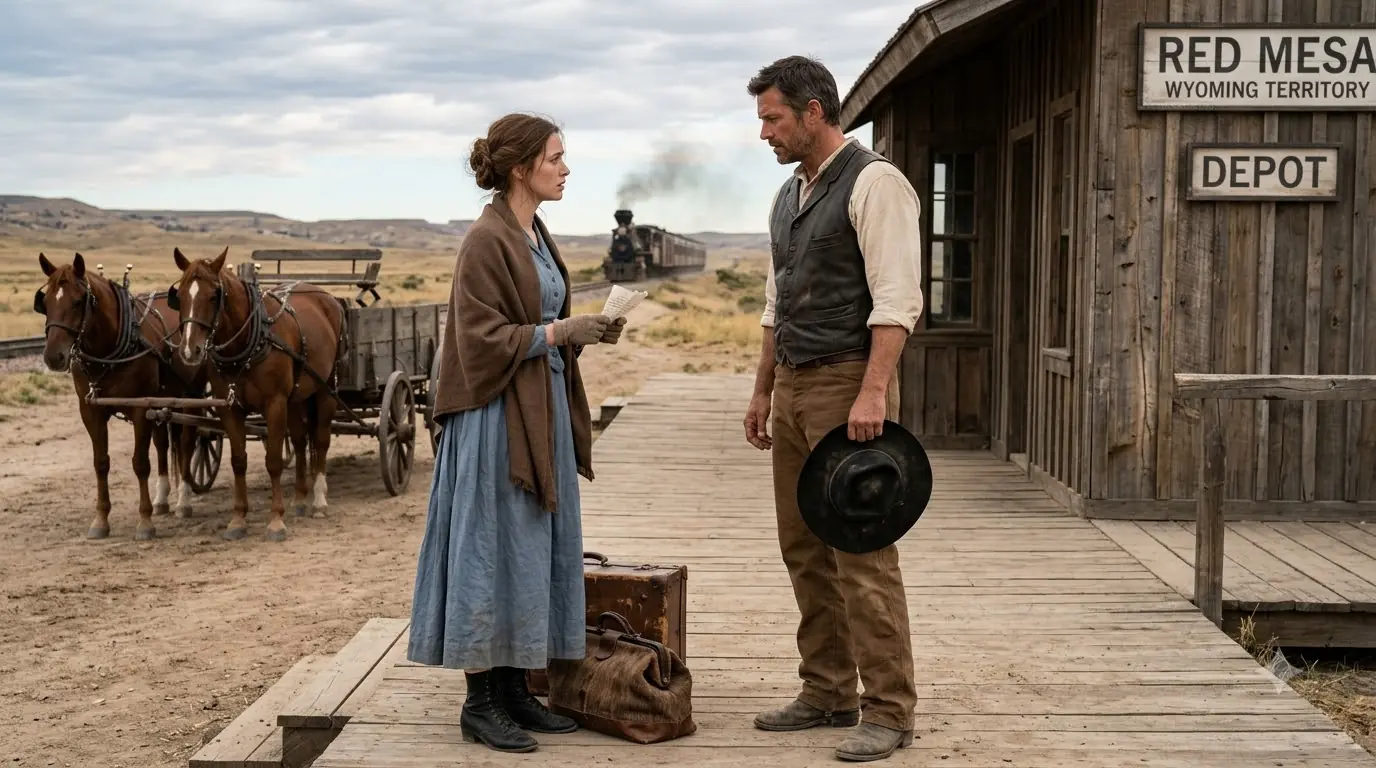
The wealthy rancher who opened that envelope was not looking for perfection. He wanted honesty, steadiness, and someone strong enough to build a life beside him, and the woman they meant to humiliate would become the heart of Ror Creek Ranch.
The late-afternoon sun hung low over the Bennett farmhouse in Missouri, casting long shadows across the peeling porch where twenty-four-year-old Norah Bennett sat with her mending basket. Her needle moved in a practiced rhythm through the torn hem of her youngest sister's dress, the third repair that month. Caroline was careless with beautiful things, probably because beautiful things had always come easily to her. Through the open parlor window, Norah heard her sisters laughing.
"Oh, this is absolutely wicked," Vivien said. "Mother would be horrified if she knew."
"Mother doesn't have to know," Caroline answered. "Besides, it's only a bit of fun."
Norah's needle stopped. Her sisters' idea of fun often meant embarrassment for someone else, and lately that someone was usually her. She set the dress aside and moved quietly toward the window, staying just out of sight.
"Read it again," Margaret said. "The part about seeking a woman of gentle nature and modest beauty."
Vivien cleared her throat dramatically. "Rancher seeking bride. Widower, age thirty-six, owner of Ror Creek Ranch in Wyoming Territory, seeking a woman of gentle nature, modest beauty, and strong character for marriage. Must be willing to relocate. Serious inquiries only."
Caroline took the newspaper. "Father has heard of Ror Creek. This Jack Ror is supposed to own thousands of acres and a huge cattle operation. They say he's been alone for five years since his wife died."
"Then why would a rich man advertise for a wife?" Margaret asked.
Vivien laughed. "Who cares? The real question is who should answer him."
The silence that followed made Norah's stomach turn cold.
"You aren't thinking what I think you're thinking," Margaret said, though she was already giggling.
"Dear, sweet, unfortunate Norah," Vivien replied. "Twenty-four years old, never properly courted, Father's greatest disappointment. The daughter who inherited Mother's dull brown hair and Father's unfortunate nose instead of any of the Bennett beauty."
"That's cruel," Margaret said, then laughed anyway.
"Or genius. He wants modest beauty. Norah is certainly modest. He wants gentle nature. She's quieter than a church mouse. He wants strong character. She's survived us for twenty-four years, hasn't she?"
Caroline laughed so hard she had to catch her breath. "Imagine his face when she steps off the train."
Norah felt the old familiar sting. It was not the first time she had heard her sisters discuss her appearance as though she were not a person but a household defect. She had grown up surrounded by golden hair, bright smiles, fashionable dresses, and suitors arriving at the front door with flowers. Norah had learned instead to mend clothes, balance household accounts, preserve vegetables, soothe sick animals, and disappear when guests arrived.
"We send the response in her name," Vivien continued. "Father has that photograph from last year, the awful one where the sun was in her eyes. We include a sincere little letter about how eager she is for a new life in the West. If the rancher answers, Father will insist she go through with it rather than embarrass the family."
"It is terrible," Margaret whispered.
"It is perfect," Vivien said. "Now help me write it."
Norah stepped away from the window, her heart pounding. She should have stormed into the parlor, torn up the application, and told her father everything. Instead, beneath the humiliation, a dangerous thought appeared.
What if?
She crushed it immediately. The man would never answer. If he did, it would only prove he was desperate enough to accept a woman no one else wanted. She would be sent to Wyoming like unwanted furniture, delivered to a stranger who had studied a bad photograph and decided she was better than being alone. Hope was for her sisters, not for her.
Still, when she returned to her mending, her hands shook.
Six weeks later, a letter arrived.
Norah was collecting eggs when Vivien's shriek of laughter carried across the yard. By the time she entered the dining room, all three sisters were crowded around the table, passing a thick envelope between them. Their father, Thomas Bennett, stood near the fireplace with his arms crossed.
"Norah," he said. "Come here."
She approached slowly, still holding the egg basket.
"It seems you've been corresponding with a gentleman in Wyoming Territory."
The basket nearly slipped from her hands.
Vivien thrust the letter toward her. "Your rancher accepted you. He sent train fare and everything."
Norah unfolded the paper. The handwriting was bold and direct.
Dear Miss Bennett,
I received your letter and photograph with interest. Your words showed character and sincerity, qualities I value above all others. I am prepared to offer you marriage and a home at Ror Creek Ranch.
I will not mislead you about the nature of this arrangement. I am not a romantic man, and I do not make promises about passion. What I can offer is security, respect, honesty, and a comfortable life. Wyoming is hard country and ranch life is demanding, but for a woman of strong constitution it can be rewarding.
I have enclosed fare for the journey to Cheyenne and onward to Red Mesa Station, where I will meet you on September fifteenth. If these terms are acceptable, send word immediately. The choice is yours entirely.
Respectfully,
Jack Ror
Beneath the letter was a bank draft large enough to cover her entire journey and more. This was not the gesture of a foolish or desperate man. It was the action of someone who had made a decision and meant it.
"Well?" her father asked. "What do you have to say for yourself?"
Norah looked from his stern face to her sisters' suddenly uneasy expressions. They wanted her to expose the prank, refuse the proposal, and restore the familiar order of the household. Instead, she read the final sentence again.
The choice is yours entirely.
No man had ever written those words to her before. No one in her family had ever asked what she wanted with such plain respect.
"I'll go," she said.
The room erupted.
"You'll what?" Vivien demanded.
"Norah, don't be absurd," Caroline said. "It was only a joke. We never thought he would actually answer."
"You didn't think he would answer," Norah said, surprised by the steadiness of her own voice. "And you didn't think I would go."
She turned to her father. "He has made an honorable proposal. If you permit it, I will accept."
Thomas Bennett studied her for a long moment. Whatever he saw seemed to satisfy him. "Very well. The arrangement is unusual, but the man appears to be respectable. We will prepare you properly."
"Father," Vivien began.
"Enough. Your sister has received a proposal from a man of good standing. That is more than I expected at this stage."
When he left, the sisters stared at Norah as if she had become someone they did not recognize.
"You are really going?" Margaret asked.
"Yes."
"But you don't know him. He could be cruel. He could be impossible."
She met each sister's eyes. "Thank you. You meant to embarrass me, but you may have given me the only way out I would ever have had."
Upstairs, behind the closed door of her small room, Norah unfolded Jack's letter again. She was choosing between a familiar humiliation and an unknown life, between slow suffocation and a leap into darkness. It was not the romantic choice women dreamed about, but it was hers.
The next twelve days passed in a blur. Her sisters alternated between guilt and ridicule, sometimes urging her to stay and sometimes warning her that Wyoming would expose every weakness she had. Her father handled tickets, luggage, and a modest dowry with businesslike efficiency. Only her mother seemed deeply troubled.
On the evening before Norah's departure, Elizabeth Bennett entered her room while Norah folded clothes into an old trunk.
"May I come in?"
Norah nodded.
Her mother sat on the bed. "I know what your sisters did. Vivien confessed."
Norah continued folding.
"You do not have to go. We can write that you've taken ill. We can explain."
"No."
Elizabeth looked startled by the firmness in her voice.
"Mother, when has anyone in this family ever truly seen me? Caroline's old dresses become mine because no one thinks it worth buying me new ones. Father forgot my last birthday. Vivien once introduced me as the spinster sister as though I were already an old woman. I am twenty-four and already invisible."
"Norah, that isn't fair."
"Isn't it?"
Her mother lowered her eyes.
Norah softened. "I'm not angry anymore. At least I am trying not to be. Jack Ror has no expectation that I be beautiful. He says he wants honesty, work, and steadiness. Those are things I can actually offer."
"And is that enough?" Elizabeth asked. "A marriage without love?"
Norah thought about dances she had never been asked to attend, men who looked through her on their way toward her sisters, and the narrow future waiting if she stayed. "Maybe respect and honesty are a better place to begin than romance. At least they are real."
Her mother studied her for a long time. "You are stronger than I gave you credit for."
"I had to be."
Elizabeth rose and pulled her daughter into a fierce embrace. "Then go. Write to me. Not your father, not your sisters. Me. Tell me the truth about how you are."
"I will."
At the bottom of Norah's trunk, wrapped in a carefully mended shawl, sat the only heirloom that belonged solely to her: her grandmother's music box. She wound it that night and listened to the small melody fill the room. Tomorrow she would travel west toward a man she knew through a single honest letter, and for one dangerous moment, she let herself imagine what it might feel like to be seen.
The station in St. Louis was chaos. Porters shouted, families embraced, merchants argued over luggage, and trains released clouds of steam into the morning air. Norah stood on the platform beside her father with one carpet bag and more fear than she had ever felt in her life.
"You'll write when you arrive," Thomas said.
"Yes, Father."
He handed her a brown-paper package. "Your mother sent this. She said not to open it until the train leaves."
Then, awkwardly, he kissed her forehead. It was more affection than he had shown in years.
The conductor called final boarding.
Norah stared at the train. This was the last possible moment to turn back. She thought of Jack's letter.
The choice is yours entirely.
She stepped aboard.
Only after St. Louis had disappeared did Norah open her mother's package. Inside was a small leather journal and a note written in Elizabeth's elegant hand.
My dear Norah,
I have not been the mother you deserved. I let my own vanities and disappointments blind me to your quiet strength. I see you now, and I am in awe of your courage. This journal is for your new life, for the woman you will become when you are free to be yourself. Write honestly. Carry my love with you, even if I failed to show it properly.
Your loving mother.
Norah pressed the journal against her chest and stared out at the Missouri countryside until her eyes stopped burning.
For three days the train carried her west. Green farmland became open prairie, then high plains where the horizon seemed impossibly far away. At night, in a narrow berth, Norah wrote by lamplight.
September 12, 1884. Somewhere in Kansas. I wonder what he looks like. He is thirty-six, twelve years older than I am. Tall or short? Handsome or plain? I wonder if it matters. He wrote that he is not romantic. I cannot decide if that frightens me or relieves me. Perhaps it is better to build something steady than to chase the kind of love that burns bright and disappears. Or perhaps I only tell myself that because no one has ever tried to romance me.
Cheyenne felt like another world. The streets were wider and rougher than Missouri, the air sharper, and the people less concerned with convention. Ranchers in weathered coats stood beside merchants and travelers. Women moved through town with an independence that would have caused gossip back home.
Norah had four hours before the train to Red Mesa. She stood outside a telegraph office long enough to imagine sending one final message: I changed my mind. I am coming home.
Then she remembered why home no longer felt like home.
She walked away.
By late afternoon, the train slowed beside a tiny station with RED MESA painted in fading letters. Beyond it lay a single main street and scattered buildings beneath an enormous sky. Norah stepped onto the platform with her carpet bag while the conductor unloaded her trunk.
"Someone meeting you, miss?"
"Yes," she said. "I think so."
The train pulled away. For several anxious minutes, the platform was empty except for a yellow dog sleeping in the sun.
Then footsteps sounded behind her.
Norah turned.
Jack Ror was not what she expected.
He stood well over six feet, broad through the shoulders but lean from years of outdoor work. His face was sun-browned and sharply cut, with lines around gray eyes that came from squinting into distance. Dark hair showed a little silver at the temples. He wore a plain work shirt, canvas trousers, worn boots, and a leather vest, and he carried his hat in both hands.
He stopped several feet away.
"Miss Bennett?"
His voice was deep and economical.
"Mr. Ror."
"Journey go all right?"
"Yes. Thank you."
He studied her for a long moment.
Norah knew exactly what he was seeing: brown hair coming loose after three days of travel, an unfashionable hand-me-down dress, a plain face made worse by exhaustion. She raised her chin and met his gaze. If he was disappointed, she wanted him to say so.
Instead, Jack nodded once, lifted her trunk as though it weighed almost nothing, and said, "Wagon's this way. Two hours to the ranch. Better leave before dark."
He offered his hand to help her into the wagon. His palm was rough with calluses, but his grip was careful. Once he climbed beside her, the horses started forward and Red Mesa slowly disappeared behind them.
The land opened around her. Golden grass rolled toward distant mountains stained purple by evening light. The air smelled of dust, sage, horses, and something wild she could not name.
"It's beautiful," Norah said.
Jack glanced at her. "Hard country. Beautiful, but hard. Winters are rough. Summers can be dry. Work never stops."
It sounded like a warning.
"I'm not afraid of work."
"Your letter said that. Said you grew up on a farm. That you cook, mend, preserve food, keep accounts."
Norah's cheeks warmed. The letter had been written by her sisters, but those details were true enough. "I can do those things."
"Good. I have a housekeeper, Mrs. Chen, who comes twice a week. She kept things running after my wife died. But the house needs someone steady. Supplies, accounts, Thomas, all of it."
"Thomas?"
Jack's jaw tightened almost imperceptibly. "My son. Four years old."
Norah hesitated. "Your letter said you were a widower."
"Five years. Sarah died after Thomas was born."
His tone was flat, controlled, and that told Norah more about his grief than any display could have.
"I'm sorry."
"It was a long time ago."
But it clearly was not.
After a while, Norah asked, "Is Thomas why you advertised for a wife?"
"Partly. A boy needs someone who can give him what I can't. Ranch needs help too. And I'm tired of town people trying to arrange my life for me."
He kept his eyes on the road. "I wanted someone from outside the territory. Someone who didn't already know me or have ideas about what I should be."
"And what are we supposed to be?"
"Partners. You run the house, help with Thomas, help with accounts. I provide for you, protect you, treat you with respect. We build something useful."
He paused. "I meant what I wrote. I'm not looking for romance. I don't think I have much of that left."
The words should have hurt. Instead, Norah felt oddly relieved. No performance. No need to become one of her sisters.
"That seems fair."
At dusk they crested a ridge.
"There," Jack said.
Ror Creek Ranch spread across the valley below. A large log-and-stone house stood among barns, corrals, sheds, and a bunkhouse. Fences cut clean lines through the grassland. Cattle dotted distant fields. Lamplight glowed in the windows.
"Three thousand acres deeded," Jack said. "About two thousand more leased for grazing. Eight hundred head this year. Four permanent hands, more during roundup."
Norah stared. "It's bigger than I imagined."
"My father started with almost nothing. I spent ten years making sure it would survive me."
A lanky young ranch hand came from the barn as they arrived.
"Ben Cooper," Jack said. "My foreman. Been with me since he was sixteen."
Ben tipped his hat. "Boss. Ma'am."
"Miss Bennett," Jack said. "We'll be married tomorrow."
Norah turned. "Tomorrow?"
"Pastor Michaels is riding out in the morning. No point waiting unless you want time."
She thought of everything she had already done to reach this place.
"Tomorrow is fine."
Jack led her inside and showed her a small bedroom that had once been Sarah's sewing room. It held a narrow bed, dresser, washstand, chair, and a window facing the barns.
"It's small," he said, sounding almost apologetic. "But it's yours. My room is across the hall. Thomas is next to mine."
Norah looked around. For the first time in her life, she had a room that belonged only to her.
"It's more than fine. Thank you."
Jack lingered in the doorway. "If you want to go back, I'll arrange it. No judgment. No questions."
It was the second time he had given her a way out.
"I don't want to leave."
Something changed in his expression, perhaps relief, perhaps respect.
"Then call me Jack."
"Jack."
"And I'll call you Norah."
Later he brought supper to her room: stew, bread, and coffee. As he set down the tray, he noticed the music box on the dresser.
"I heard music."
"My grandmother's. I hope it didn't bother you."
"No. Sarah played piano. Not well, but she loved it. Haven't heard music in this house in five years."
He looked toward the box. "It was nice."
That night, Norah lay awake listening to horses shifting in the barn and wind moving around the house. Tomorrow she would promise herself to a man she barely knew and become a mother to a child she had never met. She should have been unable to sleep.
Exhaustion took her anyway.
Morning came with pale light and a child's voice in the kitchen.
Norah dressed in her best blue cotton dress, another hand-me-down altered to fit. When she entered the kitchen, Jack stood at the stove making pancakes. A small boy with dark curls and bright blue eyes sat at the table swinging his legs.
He stopped talking when he saw her.
"Thomas," Jack said. "This is Miss Norah. Remember what I told you?"
Thomas nodded solemnly. "You're going to be my new mama."
The word struck Norah like a hand against her chest.
"Hello, Thomas."
"Are you going to live here forever?"
"I think so."
"Good."
He returned to his pancakes as though the matter were settled.
Pastor Michaels arrived an hour later, a weathered man in his sixties who clearly knew Jack well.
"You two certain about this?" he asked before beginning.
"I'm certain," Jack said.
The pastor looked at Norah.
She thought of Missouri, her sisters, the train, and Jack offering her the choice to leave twice.
"I'm certain."
They married in the parlor with Thomas watching from the sofa. Jack wore a clean shirt and had shaved. When the pastor told him he could kiss his bride, Jack hesitated, then bent slowly enough for Norah to move away if she wished.
She did not.
The kiss was brief and careful.
Afterward, Thomas jumped down. "Are you my mama now?"
Norah looked at the child whose mother he could barely remember.
"I suppose I am."
He took her hand. "Papa said you'd teach me to read."
Norah glanced at Jack.
He looked almost embarrassed. "He keeps asking. I can teach him numbers and ranch work. Reading isn't my strength."
"Then I'll teach you," Norah told Thomas.
Before leaving for work, Jack gave her a plain gold band.
"This was Sarah's."
Norah drew back. "I can't take that."
"She's gone, Norah. You're my wife now. I don't want it sitting in a box."
"It belonged to her."
Jack's expression tightened. "She would rather it mean something. Please."
Norah finally held out her hand. The ring was a little loose, but when he slid it onto her finger, the marriage became suddenly real.
"Thank you."
"I'll be back at midday. Thomas, help Mrs. Ror today."
Once Jack left, Thomas tugged her hand. "Want to see my room?"
His room was a disaster of carved horses, sticks, rocks, clothes, and treasures only a four-year-old could understand. Norah spent the morning helping him organize it while he explained the history of every object. He accepted her without caution, and that uncomplicated trust made her chest ache.
At ten, Mrs. Chen arrived. She was a small Chinese woman with sharp eyes and efficient movements, and she studied Norah without apology.
"So. You are the new Mrs. Ror."
"Yes, ma'am. I'm Norah."
"I have kept this house since the first Mrs. Ror died. Mr. Ror says you will manage most daily work, but I will come twice a week for laundry and heavy cleaning."
Norah nodded. "I'd appreciate any help you can give me. This is all new."
Mrs. Chen's expression softened. "Honest answer. Good. Come. I show you the kitchen, pantry, cellar, linen room."
The tour was overwhelming. Ranch hands ate large meals. Breakfast before dawn. Dinner at midday. Supper near dusk. Wednesday was baking day, Thursday laundry, Friday accounts and pay. Coffee needed to be ready almost constantly.
"And Thomas?" Norah asked.
"Good eater. Good boy. Lonely, but good. Men try. Child still needs mother."
Norah felt the weight of those words all day.
At noon, she prepared fried potatoes, bacon, biscuits, and coffee. Jack arrived with Pete Williams and Sam Yates, two ranch hands. Norah served them with shaking hands, afraid they would compare her to Sarah.
Pete asked for seconds.
Sam praised the biscuits.
Jack looked at her plate, then at her. "This is good. Thank you."
It was a small sentence, but warmth spread through Norah's chest.
That afternoon she found the piano in the parlor, dusty and untouched. She pressed one key. The note rang slightly out of tune but sweet.
Thomas came running. "You can play?"
"A little."
Her grandmother had taught her. Norah played a simple melody while Thomas watched. Then she showed him middle C and how to press the keys gently.
Jack returned while they were still at the piano. He stopped in the doorway.
Norah immediately lifted her hands. "I'm sorry. I didn't mean to—"
"It's fine."
His voice was rough.
"Sarah bought that piano six months before she died. I couldn't sell it, but I couldn't stand hearing it either."
"I won't play if it hurts you."
Jack looked directly at her. "Play it. Teach Thomas. Fill this house with music again. It's been dead too long."
He left before she could answer.
Norah realized he had not only been speaking about the house.
The first weeks passed quickly. Norah rose before dawn, learned the ranch schedule, cooked for hungry men, managed supplies, taught Thomas letters, and tried to understand a life unlike anything she had known. The ranch hands remained polite but cautious. Some wondered whether a woman from Missouri would survive the first Wyoming winter.
Jack remained courteous but distant. He worked until dark, slept across the hall, and spent most evenings in his study. They were husband and wife legally, but emotionally they were still strangers.
Ten days after the wedding, Thomas asked a question while Norah tucked him into bed.
"Did you know my first mama?"
Norah's hands stilled.
"No, sweetheart."
"Papa doesn't talk about her. Sometimes I try to remember her face, but I can't. Is that bad?"
"No. You were very little."
"Do you think she would have liked me?"
Norah sat beside him. "She loved you more than anything. Your papa told me that."
"He did?"
"He did. And she would want you to be happy."
Thomas took Norah's hand. "I'm glad you came. Papa is less sad now."
Later, Norah found Jack bent over account books.
"Thomas asked about Sarah."
Jack's pen stopped.
"He says he can't remember her face. Do you have pictures?"
"In a trunk."
"Maybe he should see them."
Jack stood abruptly. "What good does that do? Pictures won't bring her back."
"No. But they might give him peace. They might let him know he came from love."
"You don't understand."
"Then help me understand."
For a second she thought he might. Instead, his expression closed.
"I have work to finish. Thank you for looking after him."
Norah left hurt and frustrated.
The following Saturday, Jack took her to Red Mesa for winter supplies. The town buzzed with curiosity about the mail-order bride. Norah heard whispers as they passed.
"That's her."
"Plain little thing, isn't she?"
"Wonder what Jack was thinking."
She kept her chin high.
At the mercantile, a beautiful blonde woman approached.
"So you're the new Mrs. Ror."
"Norah Ror."
"Lydia Marsh. My father's ranch borders Jack's. We've known each other since childhood."
The emphasis was deliberate.
"It must be quite an adjustment coming from civilization," Lydia added.
Before Norah could answer, Jack appeared beside her.
"Lydia. I see you've met my wife."
"I was only welcoming her."
"Norah is doing fine."
He guided Norah away.
"Don't mind Lydia," he muttered. "She's had designs on every unmarried man in three counties."
"She's very pretty."
"She's very tiresome."
Later, a banker named Martin Shaw approached them at a restaurant. He greeted Norah smoothly, then immediately turned to business.
"Jack, my offer on your south section still stands. Prime land. Good money."
"Not interested."
"Everything has a price."
"Not that land."
After Shaw left, Jack explained that the banker had been trying for years to consolidate ranch property under his control.
The day might have ended there, but the Marsh family invited them for Sunday dinner. Jack tried to refuse. Norah accepted.
On the ride home, he frowned. "You didn't have to say yes."
"I know Lydia wants you. I also know we're married, and I'm not going to hide because people are disappointed by your choice."
Jack glanced at her. "You handled today well."
"What choice did I have?"
"Some people would have fallen apart."
Norah's answer came sharper than intended. "I've spent my whole life being looked at and found wanting, Jack. Red Mesa doesn't frighten me more than my own family did."
He went quiet.
Then Norah told him the truth about the letter.
"My sisters sent it as a joke. They filled out your application because they thought no one would ever want me."
Jack's hands tightened on the reins.
"I wondered. The letter was too polished. Didn't match the photograph."
"What was wrong with the photograph?"
"Nothing."
He looked at her. "Your eyes were honest. Tired. Sad. Real. Like you'd stopped pretending for anyone."
Norah blinked quickly.
No one had ever said anything like that to her.
"I thought you were desperate enough to take anyone."
"I was desperate," Jack said. "But not for anyone. For someone who understood life isn't a fairy tale. I needed a partner, not an ornament. Your sisters lied with words. Your eyes didn't."
They rode in silence.
Finally Norah said, "I'm glad they played the joke. I'm glad I'm here."
Jack looked at her for a long moment.
"Yeah," he said quietly. "Me too."
Sunday dinner at the Marsh Ranch was as uncomfortable as Norah expected. Lydia spent the meal recalling childhood memories with Jack while her mother repeatedly mentioned Sarah's flower gardens and social grace. Jack answered with increasingly short replies.
After dinner, Lydia cornered Norah in the parlor.
"You should understand Jack is not an easy man to marry. During roundup, Sarah used to say he'd go days barely speaking to her. He loves that ranch more than anything."
"That's enough," Norah said.
Both women stared.
"My husband works hard to provide for his family. I will not sit here while you criticize him or use his dead wife to make me feel unwelcome."
Norah rose. "Excuse me."
Jack found her near the front hall moments later.
On the ride home, he said, "Thank you."
"For what?"
"I heard you defend me."
Norah shrugged. "She had no right."
Jack was silent for a long time. Then he said, "Sarah and I weren't perfect. We loved each other, but we wanted different lives. She wanted society, refinement, winters in town. I wanted the ranch. We hurt each other more than we admitted."
"Marriage isn't supposed to be effortless," Norah said. "If it is, maybe no one is trying very hard."
Jack looked at her in surprise.
Then, for the first time, he smiled. A real smile that transformed his entire face.
"You're smarter than I gave you credit for."
"I'm smarter than most people give me credit for. I'm usually too polite to mention it."
Jack laughed, rough and surprised, like the sound had not been used in years.
By October, Norah knew the rhythms of Ror Creek. She understood which hens laid best, which horses were temperamental, how quickly weather changed near the mountains, and how to feed ranch hands who seemed permanently hungry. Thomas followed her everywhere and had begun calling her Mama Norah without hesitation.
One evening Jack came into the parlor while she mended one of his shirts. He held an old children's book.
"Found this in the attic. Thought Thomas might like it."
Norah opened it. Fairy tales, beautifully illustrated.
"It was mine," Jack said. "My mother used to read it to me. She died when I was eight. Fever. My father never remarried. He worked until his heart gave out at fifty-five."
Norah looked at him. "You work like him."
His jaw tightened. "Ranch won't run itself."
"You have good men. Ben can take more responsibility. You don't have to do everything."
"I'm not alone anymore. That's why I married you."
Norah set aside the shirt. "Then let me be a partner. You keep me in the house, but I can help with more. Teach me the ranch accounts. Teach me land, cattle, supplies, markets. What happens if something happens to you? Who understands all of it?"
Jack stared.
"You want to learn ranching?"
"I want to understand our life. You said partner. Partners share information."
After a long silence, he nodded. "You're right. I've treated you like a housekeeper. That's not fair. Tomorrow after Thomas's lessons, come to the study."
The next morning he spent two hours walking her through the ledgers. Cattle purchases, grazing leases, hay costs, market prices, wages, repairs, winter reserves. Norah asked question after question, made notes, and calculated margins faster than Jack expected.
"You're good with numbers."
"Father taught all of us basic bookkeeping. He never let daughters touch his real accounts, but he taught enough."
Norah pointed to a column. "Feed costs are high for autumn."
"Dry summer. Hay crop was poor. That's why I'm selling some yearlings before winter."
Soon the study became part of their routine. Every few days Jack taught her another part of the business, and Norah began noticing possibilities he had overlooked.
One afternoon she studied a ranch map. "Sell Shaw the rocky strip on the south section. Not the whole section, only the narrow creek strip."
Jack frowned. "Why?"
"He wants it because it connects two parcels he already owns. It isn't very useful to us for grazing. He'll pay above market if it gives him the connection. Use the money to improve irrigation north of the main creek."
Jack stared at the map.
"That's not bad."
"When did you become a cattle baron?" he asked.
Norah smiled. "When you stopped treating me like another mouth to feed."
The words landed harder than she intended.
Jack nodded slowly. "You're right. I did that. I'm sorry."
It was his first real apology, and it mattered.
As winter approached, the ranch prepared. Hay stacked high, firewood piled beside the house, fences repaired, cattle moved toward sheltered pasture. Ben warned Norah that blizzards could isolate them for days.
She tried not to show her anxiety, but Jack noticed.
"You're worrying."
"Ben told me about last winter."
"We lost cattle. It was bad."
He leaned against the pantry door. "But we survived. We'll survive this winter too. Having you here will make it easier."
Then, unexpectedly, he began talking about Sarah.
"She hated winter. Hated being trapped out here. She used to beg me to send her to her parents until spring. I always refused. I thought love should be enough to make this life worth it."
Norah listened.
"When she was expecting Thomas, she begged me to take her to Denver for better medical care. I thought the local arrangements were enough. I thought she was frightened and I was being practical."
His voice broke.
"I was wrong."
Norah crossed the pantry and took his hand.
"You cannot know that changing one decision would have changed everything."
"I should have listened."
"Yes," Norah said gently. "You should have listened. But you cannot spend the rest of your life punishing yourself."
Jack looked at her, startled by the honesty.
"Sarah loved you enough to try to make a life here. She gave you Thomas. No one who loves someone wants them to drown forever in guilt."
His fingers tightened around hers.
For years Jack had held grief like a duty. In that pantry, the weight finally broke through his control. He pulled Norah into his arms, holding her with the desperation of a man who had forgotten what comfort felt like.
"I'm tired," he whispered. "I'm so tired of being angry at myself."
Norah held him. "Then choose something else. Choose to be here now. With me. With Thomas. Build something living instead of protecting something that is gone."
They stood together until his breathing steadied.
After that day, the distance between them changed. Jack stopped hiding in his study every evening. Sometimes they talked beside the fire. Sometimes Norah read while he repaired tack or checked accounts. Sometimes they simply sat quietly, and the silence felt companionable instead of empty.
He told her about his childhood and his father's struggle to build Ror Creek. She told him about living in the shadow of her sisters and the grandmother who had been the only person to treat her as though she were already enough.
"Your sisters sound awful," Jack said one evening.
"Thoughtless more than evil. They never considered the damage because they never had to."
Norah looked around the warm parlor. "I'm almost grateful now. Without their joke, I wouldn't be here."
Jack reached across the space between them and took her hand.
The first major storm arrived in early November. The temperature dropped rapidly and the sky turned heavy and gray. Jack and the ranch hands hurried to secure livestock while Norah filled water containers, checked lamp oil, pulled out blankets, and kept Thomas close.
By dusk, snow covered the ranch. By supper, visibility had almost disappeared.
Jack came inside with ice on his coat. "Going to be a long night."
They stayed awake feeding the fire while wind pressed against the house. Thomas eventually fell asleep on the sofa, and Jack carried him upstairs.
When Norah followed, she found Jack standing in the hallway.
"What is it?"
"First storm like this since Sarah."
He looked toward the windows. "I keep expecting to hear her pacing."
"I'm not Sarah."
"No."
He looked at her, and the rawness in his face made her heart beat faster.
"You're steady. You're here. You're exactly what I needed, and I didn't know it."
Neither moved.
"Jack—"
He raised a hand to her cheek, then stopped. "Tell me if you don't want this."
Norah answered by kissing him.
It was awkward at first, then tender, then honest in the same way everything between them had become honest. When they separated, Jack rested his forehead against hers.
"I don't want you to think this is because of the storm."
"I don't."
"What is it then?"
Norah smiled through tears. "A choice. We're finally choosing each other."
That night they stopped pretending their marriage was only practical. They talked for hours about Sarah, about guilt, about fear, about everything Jack had hidden behind work and silence. He admitted that his first marriage had become painfully unhappy before Sarah's death and that part of his guilt came from having felt relief alongside grief.
"What kind of man feels free when his wife dies?" he asked.
"A human one," Norah answered. "Relief from an unhappy situation does not mean you wanted her gone. Grief can hold more than one feeling at once."
Jack looked at her in the darkness.
"Then you came. Plain, honest Norah, asking for nothing except respect, working beside me, teaching Thomas, filling this place with music."
"I'm not special."
"You are exactly what I needed."
He took a breath. "I'm falling in love with you. I know that wasn't our arrangement."
Norah laughed through tears. "Good. Because I'm falling in love with you too."
By morning, three feet of snow pressed against the windows. Thomas called from the hall and found Norah and Jack emerging together.
He stared at them, then grinned. "Are you real married now?"
Jack laughed. "Yes, son."
"Does that mean Mama Norah is staying forever?"
Norah knelt. "Forever."
Thomas threw his arms around both of them.
The storm lasted three days and buried the ranch beneath nearly four feet of snow. Jack and Ben dug paths to the barns and checked livestock, losing only two calves despite the severe weather. Thomas treated the storm as an adventure, while Norah kept meals hot, the house warm, and everyone organized.
When the roads opened, Jack returned to the plan for the south strip.
"I want you with me when I negotiate with Shaw."
Norah stared. "You want me in a land negotiation?"
"I want Shaw to understand this ranch has two people making decisions."
They spent an evening reviewing land values, water rights, and the likely route of future railroad expansion. By the time they met Shaw, Norah knew exactly why he wanted the property.
In Shaw's office, the banker opened with an offer far below what the land was worth to him.
Jack started to respond.
Norah placed a hand on his arm.
"Mr. Shaw, that strip connects your two largest parcels and gives you year-round access along Willow Creek. It is worth far more to you than your offer suggests."
Shaw smiled patronizingly. "Mrs. Ror, perhaps land values in Wyoming are different from those in Missouri."
"Perhaps. But I also know you are consolidating before the railroad announces its next route. We can sell now for a fair price, or we can wait until that announcement makes the land even more valuable."
The smile disappeared.
After a long moment, Shaw laughed. "Well played."
They negotiated for another twenty minutes and left with a figure close to Norah's target. The money would fund irrigation improvements and reduce winter feed costs for years.
Outside, Jack pulled her into an embrace.
"Where did you learn to negotiate like that?"
"Years of surviving my sisters. Stay calm, find the pressure point, never let someone decide your value for you."
Jack laughed. "Remind me never to bargain against you."
"You already married me. Too late."
Winter settled around them. Thomas learned to read simple words. Norah beat Jack at chess within a month. Letters from Missouri arrived more regularly.
Her mother wrote with warmth. Her father sent a stiff but meaningful sentence: I am pleased to hear you have found your place in the world.
Her sisters apologized in awkward stages. Vivien became engaged. Caroline had several suitors. Margaret asked whether there were eligible ranchers in Wyoming.
Jack read part of the letter over Norah's shoulder. "They want to visit?"
"Apparently."
"Invite them. I want to meet the women foolish enough to think they were better than you."
Norah smiled. "They are beautiful."
"So are you."
"Jack, I'm not. I've accepted that. But I'm valuable anyway. That's better."
He turned her toward him and held her face in his rough hands.
"You are beautiful because you're real. Because you're strong, smart, kind. Because your whole face changes when Thomas makes you laugh. Because you bite your lip when you're working through a problem. Because you brought this house back to life."
His voice softened. "I see you, Norah. All of you."
For Christmas, Norah sewed scarves for the ranch hands, made Thomas a stuffed horse, and spent weeks secretly piecing together a quilt for Jack. Blue fabric came from the dress she had worn west. Brown from one of Jack's ruined work shirts. Red from Thomas's outgrown clothing. Calico from new kitchen curtains. In the center she embroidered the Ror Creek brand and their wedding date.
Jack opened it Christmas morning and could not speak for several seconds.
"You gave me a home," Norah said. "I wanted to give you something that showed what that means."
His gift was a leather-bound journal with her name on the cover. Inside he had written: For Norah Ror, who made our house a home and my life complete. Write our story so we never forget how blessed we are.
That evening, wrapped together in the quilt beside the fire, Jack admitted that he had written to her sisters.
Norah sat upright. "You did what?"
"I thanked them for sending me my wife."
"Jack."
"I may also have told them they were fools who failed to recognize treasure in their own house."
Norah began laughing.
"And I might have mentioned that you are better with ranch accounts than half the men I know and negotiated circles around Shaw."
"You didn't."
"I did. Nobody gets to make my wife feel small, not even in memory."
Norah kissed him, laughing and crying at once.
Soon afterward she wrote her own long letter to her sisters. Not to triumph over them, but to tell the truth. She described storms, cattle, Thomas, music in the house, business decisions, Jack's rough kindness, and the slow way love had grown from a practical agreement.
Their replies were more sincere than anything she had received from them before. Vivien admitted that Norah's new life had made her question her own values. Caroline confessed jealousy over the bond Norah had shared with their grandmother. Margaret said plainly that she wanted to know the sister she had overlooked.
"They're growing up," Jack said.
"Sometimes reality forces people to."
By February, winter began to weaken. Days lengthened. Ice dripped from the eaves. Cattle grew restless for spring.
Norah began waking nauseated and dizzy.
At first she blamed food or exhaustion. After two weeks, she knew.
One evening while Jack prepared for bed, she blurted, "I'm pregnant."
He froze.
"What?"
"I'm almost certain."
Norah twisted her hands. "I know it's soon. And after Sarah—"
Jack crossed the room and pulled her into his arms.
"A baby?"
His voice was rough with emotion.
"You're not upset?"
"Upset? Norah, you've given me a home, a partner, a reason to wake up happy."
Then his face changed as fear caught up with joy.
"This time we plan carefully. We'll go to Denver well before the birth. We'll arrange proper medical care. I'm not letting pride or convenience make decisions for us."
"That will be expensive."
"You are more important than money."
He held her face gently. "I'm scared."
"Me too."
"Then we'll be scared together."
Thomas celebrated the news with immediate plans.
"Can I teach the baby to ride? Can I name it Thunder?"
"No Thunder," Norah said, laughing.
"Can I be the best big brother in Wyoming?"
"That one you may try."
As spring returned, Norah's body changed. Jack hovered constantly, pretending he was not hovering. He took baskets from her hands, insisted she rest, and worried over every tired expression.
"I'm not made of glass," she told him one afternoon.
"I know. Humor me anyway."
She did, because she understood what his fussing really was: love mixed with old fear.
In June, her sisters arrived from Missouri.
Vivien climbed from the wagon first and stared at the endless landscape. "Good Lord, Norah. It's enormous."
Caroline stepped down next. "I never imagined it would be this beautiful."
Margaret came last and ran directly to Norah.
"Look at you. You're pregnant and you look so..."
She stopped.
"Happy."
Norah smiled. "I am."
The visit changed all four sisters. Vivien, Caroline, and Margaret tried ranch chores with more enthusiasm than skill. They gathered eggs, helped in the kitchen, listened while Norah explained cattle, accounts, and winter planning, and watched Jack consult her on decisions without hesitation.
One evening on the porch, Vivien finally spoke.
"I'm sorry. For the joke. For all the years before it. We made you feel small because we were careless and vain."
"We thought we were clever," Caroline said. "We thought you would be humiliated out here."
Margaret looked at Norah with tears in her eyes. "Instead you became someone extraordinary. Someone we should have seen all along."
Norah wiped her eyes. "I forgave you a long time ago. That joke brought me here."
"You should never have needed our cruelty to discover your worth," Vivien said firmly. "Do not thank us for that. We took years from you."
The honesty mattered more than any apology wrapped in excuses.
They sat together in silence while Jack and Thomas worked with a horse in the distance. Jack looked up, found Norah's gaze, and smiled.
"He really loves you," Caroline said.
"I love him too."
"You found what everyone spends their life looking for," Margaret whispered.
Norah shook her head. "I found it when I stopped trying to become something I wasn't."
Her sisters stayed two weeks. When they left, the relationships were not magically repaired, but they were honest for the first time.
By late summer, Norah was six months along and healthy. Jack kept his promise. As her due date approached, they traveled to Denver and arranged to stay near a hospital. Thomas remained at Ror Creek with Mrs. Chen, Ben, and the ranch hands.
Labor began one year after Norah had arrived in Wyoming.
Jack paced outside the birthing room, unable to sit, every memory of Sarah pressing against him. This time, however, he had listened. They were where Norah wanted to be, with experienced physicians and help close at hand.
Near dawn, a baby's cry came through the door.
Jack stopped moving.
A doctor appeared and smiled. "Your wife is well. Your daughter is well."
For several seconds Jack could not speak.
When he entered, Norah lay exhausted but smiling, a tiny baby wrapped beside her.
Jack's eyes filled.
"She's perfect."
"So are you," he whispered to Norah.
"We did it," Norah corrected. "Together."
They named the baby Sarah Grace. Sarah, not to replace the woman who had died, but to honor Thomas's first mother without allowing grief to rule the future. Grace, for the strange grace that had brought Norah to Wyoming through a cruel joke and turned it into a life she could never have imagined.
Three weeks later they returned to Ror Creek.
Thomas was beside himself with excitement. He had helped prepare the nursery and announced to everyone that he intended to be the best big brother in the territory. Ben carved a small wooden rattle. Pete brought a blanket his wife had sewn. Sam offered a silver dollar for the baby's future.
That night, after both children were asleep, Norah and Jack stood beside their bedroom window. Moonlight silvered the fields. Jack wrapped his arms around her from behind.
"Thank you," he said.
"For what?"
"For getting on that train. For giving me another chance at love and family. For seeing the man behind all the walls. For making this house alive again."
Norah turned in his arms.
"You gave me a place where I could become myself."
Jack shook his head. "You were always yourself. People just kept telling you it wasn't enough."
Norah thought about the girl in Missouri who had believed beauty belonged to other women. She thought about the train, Red Mesa Station, Sarah's dusty piano, Thomas learning his letters, blizzards, business ledgers, Martin Shaw's office, her sisters apologizing on the porch, and Jack saying, I see you.
Her face had not changed.
Her life had.
She had learned that beauty was not a prize granted to a certain kind of woman. Worth was not measured in golden hair, fashionable dresses, or whether men turned their heads when you entered a room. Love did not require perfection. It required honesty, effort, courage, and the willingness to see another person fully.
Home was not always the place where you were born. Sometimes it was the place you built choice by choice with people who made room for your whole self.
The mail-order bride who arrived in Wyoming because of a cruel joke became the heart of Ror Creek Ranch. The daughter who had been called plain became a partner whose judgment shaped the ranch's future, a mother Thomas trusted, a sister willing to forgive without forgetting, and a wife Jack could no longer imagine living without.
The practical marriage had become a love neither of them had planned.
The ranch stretched around them beneath the Wyoming stars, thousands of acres of work, risk, promise, and belonging. Somewhere downstairs, Norah's grandmother's music box sat beside the newer journal Jack had given her. Sometimes she still wound it and let the melody travel through the house.
It no longer sounded sad.
It sounded like the first note of a story that had finally found where it belonged.
Norah had not changed from plain to beautiful. She had changed from invisible to seen, from apologetic to certain, from someone waiting for the world to assign her value to a woman who understood she had possessed it all along.
Jack had not rescued her from a worthless life. He had simply been the first man willing to look closely enough to recognize what was already there.
And Norah had done the same for him.
She had seen past the wealthy rancher, the controlled widower, the hard-working man who believed feeling less would protect him from pain. She had found the exhausted, grieving person beneath those defenses and refused to treat him as broken beyond repair.
They saved each other not through grand gestures, but through ordinary choices repeated day after day. Teaching a child to read. Sharing account books. Playing music in a silent room. Telling hard truths in a pantry. Standing beside each other in town. Listening when fear spoke. Choosing again after storms.
That was the real love story of Ror Creek Ranch.
Not that a wealthy rancher married a woman everyone called plain.
Not that a cruel joke accidentally produced a happy ending.
But that two people who had both been taught to expect less from life stopped hiding, looked at each other honestly, and decided what they saw was worth building a future around.
And for Norah Bennett Ror, that truth was greater than beauty, greater than revenge, and greater than any romantic fantasy she had once believed belonged only to other women.
She was enough.
She had always been enough.