Evelyn Harper had spent twenty-six years learning what people’s faces looked like when they were disappointed by her.
She knew the quick sweep of the eyes, the polite smile that arrived half a second too late, and the strange kindness people used when they wanted credit for hiding what they truly thought. She knew how relatives lowered their voices when discussing marriage around her, as though she were deaf rather than merely standing in the next room. Most of all, she knew the expression her stepmother wore whenever Evelyn entered a room where her younger, beautiful stepsister Clara was already standing.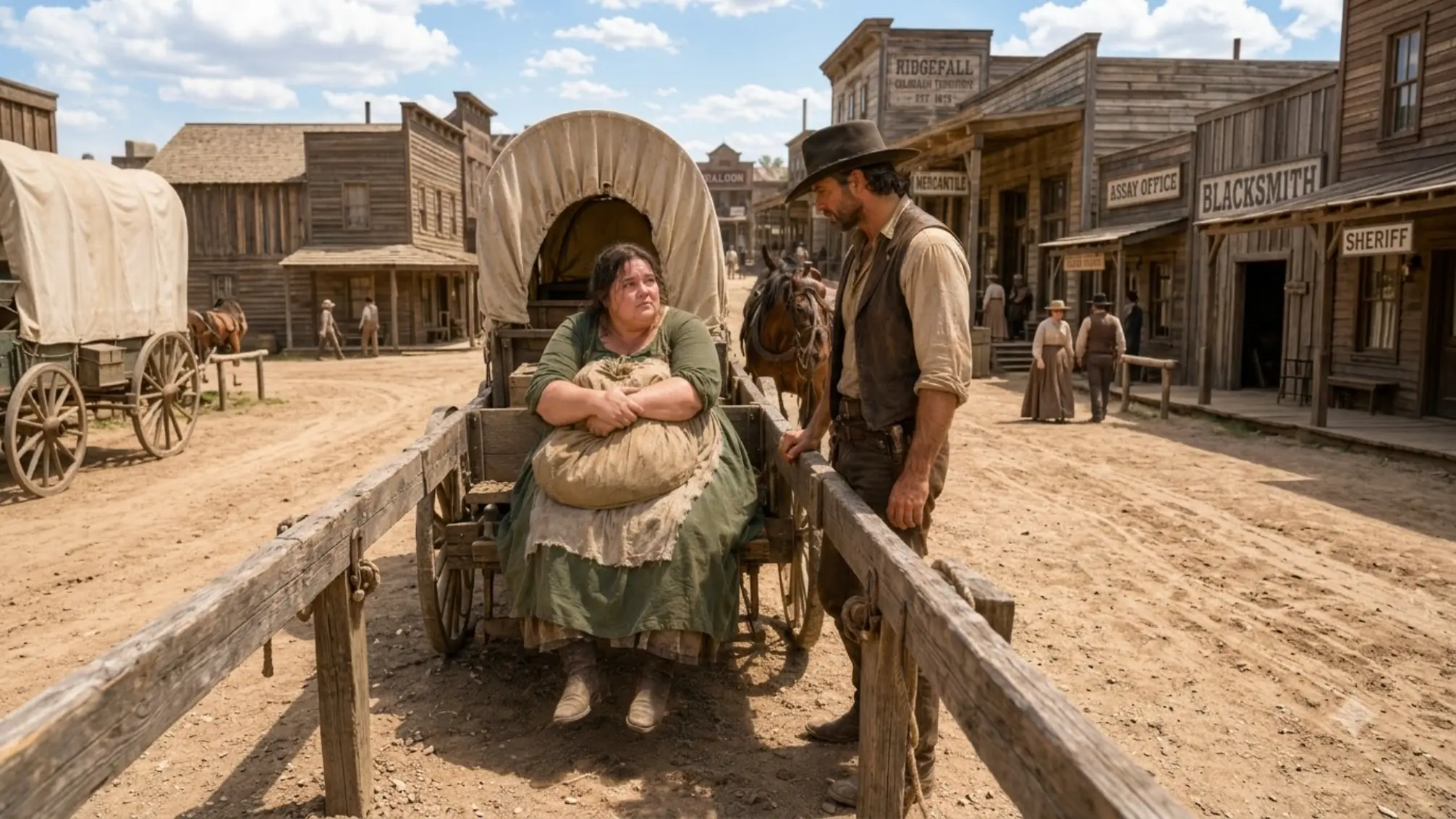
That morning in Millhaven, Colorado, there was no expression at all.
Ruth Harper did not even come downstairs to say goodbye.
She stood behind an upstairs window as Evelyn placed one worn travel bag into the hired wagon. Evelyn’s father remained inside too. He had kissed her forehead the night before, told her the arrangement was sensible, and then returned to his newspaper as though sending his daughter hundreds of miles into the mountains to marry a stranger was no more complicated than ordering winter feed.
Evelyn climbed onto the wagon without looking back.
Three weeks earlier, Ruth had called her into the parlor.
“We found someone,” she had said.
Evelyn had almost laughed.
Someone.
The word made her sound like furniture being given away.
“His name is Wyatt Callahan. Thirty-five. Rancher. Owns a respectable spread near Ridgefall.”
“And he wants a wife?”
“He wants someone capable.”
Evelyn immediately understood.
Not pretty.
Not charming.
Not admired.
Capable.
“What did you tell him about me?”
Ruth’s eyes had shifted toward the window.
“That you’re hardworking. Strong. Practical.”
“What else?”
Her father had adjusted himself in his chair.
Ruth finally said, “We told him you are not considered a beauty.”
Evelyn had stared at her.
The words themselves were not new. They had followed her since adolescence.
She was broad through the shoulders and waist, soft and heavy where fashionable women were expected to be delicate. Her face was round and plain. Her dark hair refused elegant curls. Her hands were thick from years of work.
But hearing her own family describe her to a stranger as though warning him about damaged merchandise still did something deep and ugly inside her chest.
“Did he agree after hearing that?”
“Yes.”
That answer hurt almost more.
A stranger somewhere in the mountains had apparently decided an unattractive woman was acceptable because he needed work done.
Evelyn had stood.
“When do I leave?”
Now, three weeks later, the wagon rolled toward Ridgefall beneath a pale October sky.
The driver was an older man named Gus who understood silence well enough not to fill every mile with questions. They traveled through foothills, pine forests, and narrow mountain passes where the cold became sharper with each hour. Evelyn watched the country change and wondered whether the loneliness ahead could truly be worse than the loneliness she had left behind.
On the third morning, Ridgefall appeared beneath them.
It was hardly a town.
A mercantile stood beside a blacksmith. Across the dirt road sat a saloon, a church, and several weathered wooden buildings. Horses waited at hitching rails while mountain wind carried dust along the street.
A young ranch hand met the wagon.
“Miss Harper?”
Evelyn nodded.
“Mr. Callahan sent me. Name’s Darnell.”
He looked at her only briefly before turning toward the horses.
Evelyn knew that reaction too.
She climbed down, collected her bag, and thanked Gus.
The driver shook her hand.
“Good luck, miss.”
There was enough sincerity in his voice that Evelyn nearly cried.
Instead, she mounted the spare horse Darnell had brought.
Another two hours of climbing carried them toward the Callahan ranch.
The property appeared gradually through the pines: several fenced pastures, a large timber-and-stone house, two barns, a bunkhouse, smoke rising from a chimney, and cattle scattered across pale autumn grass.
A man stood beside the nearest fence.
Evelyn knew immediately who he was.
Wyatt Callahan was tall and broad-shouldered, wearing a faded beige work shirt beneath a dark leather vest and a battered black hat. His face was weathered rather than handsome in the polished way Ruth admired, but there was strength in it. Dark hair showed touches of gray near his temples, and a short beard covered his jaw.
He approached as Evelyn dismounted.
She prepared herself.
This was the moment.
The glance.
The disappointment.
The calculation of how much effort politeness would require.
Wyatt looked at her.
His eyes moved once over her muddy green dress, her worn boots, her broad figure, and the travel bag clutched against her stomach.
Then he removed his hat.
“Miss Harper.”
“Mr. Callahan.”
His brow tightened slightly.
“I should’ve sent a proper wagon.”
Evelyn blinked.
“What?”
“That road from Ridgefall is miserable this time of year. Darnell should’ve taken the north trail.”
Darnell, already leading the horses away, called back, “North trail washed out yesterday.”
Wyatt nodded.
“Then I should’ve come myself.”
Evelyn did not know what to say.
He was worried about the road.
Not her face.
Not her size.
The road.
“It was fine,” she managed.
Wyatt looked toward the house.
“You’re probably cold.”
“A little.”
“Come inside. Coffee’s still warm.”
He reached for her travel bag.
Evelyn instinctively tightened her grip.
“I can carry it.”
Wyatt stopped immediately.
“All right.”
No argument.
No offended masculinity.
He simply walked beside her.
That tiny thing unsettled her more than cruelty would have.
Inside, the house was clean but plainly managed by a man who considered practicality more important than domestic comfort. Shelves were crowded without logic. Iron cookware hung wherever space existed. A stack of ranch records leaned dangerously beside the kitchen wall.
Wyatt rebuilt the fire.
Evelyn moved toward the coffee pot.
“I can do that.”
“Sit.”
She looked at him.
He glanced back from the fire.
“You’ve been traveling three days.”
There was no command in his voice.
Only fact.
Evelyn sat.
A few minutes later, Wyatt placed coffee in front of her and took the chair across the table.
For a while neither spoke.
Then he turned the cup slowly between his hands.
“There’s something I ought to say before anything else.”
Evelyn braced herself.
“The letter from your family bothered me.”
Her stomach tightened.
Wyatt continued.
“They described you like they were advertising a piece of equipment.”
Evelyn stared.
“Strong. Useful. Capable. Not decorative.”
Her cheeks burned.
“I’m sorry.”
Wyatt frowned.
“For what?”
“For disappointing you.”
Something changed in his face.
“You haven’t.”
“You’ve known me ten minutes.”
“Exactly.”
He leaned back.
“So I don’t know enough about you to be disappointed.”
Evelyn looked down at the coffee.
Wyatt continued carefully.
“I wrote asking what kind of person you were. They answered by telling me what chores you could do.”
“That sounds like Ruth.”
“I asked whether you laughed easily. Whether you liked mountains. Whether you read. Whether you were stubborn.”
Despite herself, Evelyn almost smiled.
“Stubborn?”
“I’m thirty-five and live eight thousand feet up a mountain. I’m not looking for someone fragile.”
Now she did smile.
Only briefly.
Wyatt noticed.
“I invited you because I wanted the chance to know you,” he said. “You don’t need to prove you’re worth keeping.”
The words hit something Evelyn had protected for years.
She looked away quickly.
“Thank you.”
Wyatt nodded.
“Your room is ready. Nothing else needs deciding tonight.”
That first evening, Evelyn lay beneath a heavy quilt listening to the wind outside.
She had expected rejection.
Instead she had been given coffee.
A warm room.
And one sentence she did not know how to believe.
You don’t need to prove you’re worth keeping.
The first week passed quietly.
Evelyn began working because working was what she knew.
She reorganized the pantry.
She discovered moisture in the root cellar and moved several crates before rot spread through the winter vegetables. She repaired a broken ledger system that had apparently been confusing Wyatt for years. She began baking bread before sunrise because none of the ranch hands seemed capable of remembering breakfast unless food physically appeared in front of them.
Nobody praised her excessively.
More importantly, nobody acted as if her work was owed.
On the fourth morning, Wyatt entered the kitchen and stopped.
“You moved the coffee.”
Evelyn immediately stiffened.
“I can put it back.”
“Why?”
“You sounded annoyed.”
“I’m amazed.”
He pointed toward the shelf.
“I can see it from the doorway.”
Evelyn studied his expression.
He was serious.
“I spent five years looking for that coffee every morning.”
“You could’ve simply assigned it a shelf.”
“I run cattle better than kitchens.”
“That is becoming obvious.”
Wyatt stared at her.
For one horrible second, Evelyn thought she had gone too far.
Then he laughed.
It was short, low, and completely unexpected.
Evelyn found herself laughing too.
Something changed after that.
Not quickly.
Wyatt was not a quick man.
He was patient with horses, deliberate with decisions, and careful with words. But he began sitting longer at the kitchen table after supper.
Sometimes they discussed the ranch.
Other nights they talked about books, childhood, weather, or nothing important at all.
He told her about Caroline, the woman he had once planned to marry.
“She left after two winters,” Wyatt said one evening. “Went east.”
“Did you love her?”
“Yes.”
Evelyn appreciated that he did not pretend otherwise.
“Did you hate her for leaving?”
“No.”
“Why not?”
“She wanted a different life.”
Wyatt looked toward the fire.
“I hated myself for believing I could make someone stay.”
The confession surprised her.
“You think that’s why I’m here?”
His eyes returned to her.
“No.”
“Then why did you agree to marry someone you’d never seen?”
“Because I stopped trusting wanting.”
The room went quiet.
Wyatt continued.
“I thought practical might hurt less.”
Evelyn looked at her hands.
“That makes two of us.”
Another week passed.
Evelyn discovered discrepancies in ranch supply invoices.
The numbers were small enough to overlook but consistent enough to be deliberate.
She carried the ledger into the barn where Wyatt was repairing harness.
“I think someone is stealing from you.”
He set down the leather strap.
“Show me.”
Evelyn explained the pattern.
Inflated invoices.
Repeated percentages.
Orders that did not match delivered quantities.
Wyatt listened without interrupting.
“You found this yourself?”
“Yes.”
“Who else knows?”
“No one.”
He looked at her for a long moment.
Then he said, “Sit with me tonight. We’ll go through every book.”
They spent two hours at the kitchen table.
By the end, they traced the scheme to a ranch hand cooperating with the Ridgefall mercantile owner.
Wyatt handled it quietly the next morning.
The ranch hand was dismissed.
The merchant repaid the missing money rather than face the county sheriff.
Two days later, Hector, Wyatt’s senior ranch hand, appeared in the kitchen doorway.
“Mrs. Callahan.”
Evelyn looked up from preserves.
“Yes?”
“That account business.”
She waited.
“Good work.”
Then he walked away.
It was one of the finest compliments she had ever received.
People began treating her differently.
Not because she had become prettier.
She had not.
Her face remained broad.
Her body remained heavy.
Her dresses remained plain.
But something in her posture changed.
She stopped apologizing before expressing an opinion.
She stopped qualifying every idea.
When Wyatt asked what she thought about adding a smokehouse, Evelyn showed him where it should be built.
When she suggested changing the garden layout, he said, “Do it.”
When she warned that the root cellar needed drainage work, he sent Hector with tools.
Her knowledge was treated as knowledge.
The experience changed her more deeply than praise ever could.
One evening, Wyatt found her studying household accounts.
“How are you finding the ranch?”
“Cold.”
He smiled slightly.
“The ranch, Evelyn.”
“I know.”
She closed the book.
“It’s difficult.”
“I warned you.”
“You did.”
“Regret coming?”
The question was casual.
The tension beneath it was not.
Evelyn considered lying.
Then she remembered how consistently Wyatt valued truth.
“No.”
His shoulders loosened.
She noticed.
“You were worried.”
“A little.”
“You could have asked.”
“I just did.”
Evelyn smiled.
“You hide questions inside other questions.”
“I’m working on that.”
“You should.”
He looked at her for a moment.
“I’m glad you’re here.”
The words were simple.
Evelyn felt them for the rest of the night.
Several weeks later, a letter arrived from Millhaven.
Wyatt opened it at the kitchen table.
Evelyn recognized her father’s handwriting immediately.
“What does he want?”
Wyatt did not answer at once.
He handed her the paper.
The letter began with concern about Evelyn’s adjustment.
Then came the real purpose.
Water rights.
A narrow creek crossed the northern edge of the Callahan property. The land had once belonged to Evelyn’s mother’s family before being sold years earlier.
William Harper now claimed the transaction had been improper.
He requested an easement.
Evelyn read the letter twice.
Then something terrible became clear.
“They knew.”
Wyatt watched her.
“My family knew about this land before they sent me.”
“I think so.”
“They didn’t send me because they wanted me gone.”
She laughed bitterly.
“They sent me because they wanted me here.”
Wyatt’s expression hardened.
“Evelyn.”
“I was leverage.”
She stood abruptly.
“All those years telling me I was useless, and when they finally discovered one use for me, they shipped me into the mountains.”
Wyatt rose too.
“Look at me.”
She did.
“I didn’t know.”
“I know.”
“I want that clear.”
“It is.”
He stepped closer but did not touch her.
“This marriage is not their transaction anymore.”
Evelyn swallowed.
“What is it?”
Wyatt hesitated.
Something vulnerable crossed his face.
“I don’t entirely know yet.”
A strange tenderness moved through her.
“But I know it belongs to us.”
They answered the letter together.
The response was polite, factual, and final.
The land had been legally purchased.
No easement would be granted.
The matter was closed.
Eleven days later, the Harper family arrived in person.
Ruth stepped from the wagon first.
Clara followed.
William came last.
Evelyn stood in the yard and watched the people who had once made her feel enormous and inconvenient suddenly appear strangely small against the mountains.
Ruth stared at her.
“You look different.”
“I’m not.”
“You are.”
Evelyn almost smiled.
Maybe Ruth was right.
They entered the house.
Wyatt arrived from the pasture soon afterward and took the chair beside Evelyn at the table.
Ruth began politely.
She always did.
“We are simply concerned about the property issue.”
“There is no issue,” Evelyn said.
“The creek originally belonged to your mother’s family.”
“The land was sold.”
“Your father believes—”
“My father handled the sale.”
William looked down.
Evelyn turned toward him.
“Didn’t you?”
“Yes.”
“Was it legal?”
A pause.
“Yes.”
Ruth’s mouth tightened.
“The circumstances were complicated.”
“No.”
Evelyn leaned forward.
“You sent me here because you thought marrying me to Wyatt would give you influence over the property.”
Nobody answered.
That was answer enough.
Evelyn looked at her father.
“Tell me.”
William closed his eyes.
“It was part of the consideration.”
Part.
As though she had been a negotiable clause.
Ruth quickly intervened.
“You received a home and a husband.”
Wyatt’s chair moved slightly.
Evelyn raised one hand before he could speak.
She wanted this herself.
“So I should be grateful?”
Ruth sighed.
“You always make everything sound cruel.”
“You described me to him as capable labor with an unfortunate face.”
Clara looked away.
Ruth’s expression hardened.
“We told him the truth.”
“No,” Wyatt said.
Everyone turned.
His voice was quiet.
“You told me what you thought mattered.”
Ruth blinked.
Wyatt continued.
“You told me she was plain.”
He looked at Evelyn.
“You forgot to mention she can find a stolen dollar hidden inside ten pages of accounts.”
Ruth remained silent.
“You told me she was large.”
His voice stayed level.
“You forgot to mention she works harder than men half again her size and still notices when a seventeen-year-old ranch hand hasn’t eaten.”
Evelyn’s throat tightened.
“You told me she had a difficult temperament.”
Wyatt leaned back.
“What I found was a woman who says the truth before everyone else gathers enough courage.”
Ruth looked almost offended.
Wyatt finished.
“So if you came here expecting me to believe Evelyn is the problem in this house, you’ve wasted the trip.”
Silence filled the kitchen.
William stood.
“We should leave.”
Ruth stared at him.
“William.”
“We should leave.”
He looked at Evelyn.
For the first time in years, she saw shame on her father’s face.
It did not repair anything.
But it mattered.
Before leaving, William paused beside her.
“You look happy.”
Evelyn nodded.
“I am.”
He looked toward Wyatt.
Then back to her.
“I’m glad.”
Evelyn believed he meant it.
That made what came next harder.
Three days later, word reached the ranch that Ruth had stopped in Ridgefall before returning home.
She had spoken with Dorothy Price, a woman with influence across the valley.
Rumors spread.
Evelyn had deceived Wyatt.
The marriage was unstable.
The Callahan property might face a legal challenge.
That final rumor mattered because Wyatt had spent three years negotiating a major water agreement with neighboring rancher Garrett Morrison.
Any uncertainty surrounding ownership could destroy it.
When Evelyn heard, she immediately found Wyatt.
“This can cost you the Morrison agreement.”
“It can.”
“Three years.”
“Yes.”
“I’ll fix it.”
Wyatt’s expression hardened.
“We’ll fix it.”
“This is my family.”
“And this is our ranch.”
The word struck her.
Our.
Wyatt stepped closer.
“Don’t make the mistake of thinking standing beside you means I believe you can’t stand alone.”
Evelyn looked at him.
“I know you can.”
His voice softened.
“I just don’t think you should have to every time.”
The next morning, they rode to Morrison’s ranch together.
Garrett Morrison was in his sixties and had little patience for gossip.
He listened while Evelyn explained everything.
The arranged marriage.
The Harper scheme.
The creek.
The visit.
The rumors.
She did not dramatize herself.
She simply gave him facts.
When she finished, Morrison sat quietly.
“So your family tried placing you here to get leverage over Callahan?”
“Yes.”
“And instead you sided with Callahan.”
“I sided with what was right.”
Morrison looked toward Wyatt.
“Where’d you find this woman?”
Wyatt’s answer came immediately.
“She found me.”
Morrison laughed.
Then he extended his hand toward Evelyn.
“The agreement continues.”
On the ride home, Evelyn let herself breathe.
Wyatt rode beside her.
After several silent miles, she said, “I’m not leaving.”
His head turned.
“Whatever Ruth does next.”
She looked ahead.
“I’m staying.”
Wyatt was quiet for so long that Evelyn finally glanced toward him.
There was something raw in his face.
“Good.”
Only that.
But she understood the history inside it.
A woman he had once loved had left.
Evelyn had just told him she would not.
That evening, she found a letter hidden in the pocket of her old travel coat.
Clara had written it.
Ruth had contacted a Denver attorney.
She intended to challenge the original land sale legally.
The next morning, Evelyn and Wyatt rode for Denver.
His attorney, Harland Pruitt, discovered the problem was more complicated than anyone expected.
The original Hargrove land grant included language giving Evelyn’s mother’s descendants certain rights regarding the creek property.
Ruth was not inventing everything.
She was exploiting something real.
Then Evelyn remembered something.
Her mother had once told her, when Evelyn was eleven, that the creek land was meant to belong to her.
Not to William.
Not to Ruth.
To Evelyn.
Suddenly the entire scheme changed.
Her family was preparing to assert Evelyn’s inheritance rights while pretending to represent her interests.
“They’re trying to use my own claim without me,” Evelyn said.
Pruitt nodded.
“Essentially.”
“Then I assert it myself.”
Both men looked at her.
Evelyn continued.
“If the covenant gives rights to me, then they belong to me alone. My family cannot act as my representatives if I formally act for myself first.”
Pruitt slowly smiled.
“That could work.”
“Could?”
“It should.”
“Then do it.”
For four hours, they prepared the filing.
Evelyn answered questions about her mother, childhood conversations, property history, and family records.
By afternoon, the counterclaim was complete.
When they finally stepped outside, Wyatt looked at her with unmistakable admiration.
“What?”
“You terrify me a little.”
She stared.
Then realized he was joking.
“You should be terrified.”
“I am.”
She laughed.
They ate supper in Denver that night.
Nothing fancy.
Stew.
Bread.
Coffee.
But sitting across from Wyatt, Evelyn suddenly understood she was happy.
Not useful.
Not tolerated.
Happy.
Later, at the hotel, she finally asked what neither had been brave enough to say.
“When all of this ends, what happens to us?”
Wyatt looked at her.
“What do you want?”
“I asked first.”
He took his time.
“I want the kitchen conversations.”
Evelyn waited.
“I want you arguing with me about fences.”
She smiled.
“I want you finding problems before I know they exist.”
“That sounds romantic.”
“It is to me.”
Her smile faded into something softer.
Wyatt continued.
“I want you on that ranch because you want to be there.”
His voice lowered.
“And I want to stop pretending I only wanted a practical marriage.”
Evelyn looked down.
“I’m not beautiful.”
Wyatt’s expression changed instantly.
“According to who?”
“Most people.”
“I’m not marrying most people.”
“You already married me.”
“Then most people are too late.”
She laughed despite herself.
Wyatt moved closer.
“I know what you look like, Evelyn.”
Her smile disappeared.
“I looked at you the first day.”
“I remember.”
“And I kept looking.”
He reached for her hand.
“I still am.”
Tears filled her eyes.
Wyatt squeezed her fingers.
“I don’t want a different woman.”
The legal battle lasted another month.
Pruitt located the original seller, who provided sworn testimony confirming the sale had been voluntary. Evelyn’s independent filing destroyed Ruth’s attempt to control the claim in her name. Faced with evidence, legal costs, and no ability to pretend she represented Evelyn, Ruth’s attorney withdrew the challenge.
When the final letter arrived, Evelyn expected triumph.
Instead she felt quiet.
Settled.
Wyatt read the letter.
“It’s over.”
“Yes.”
He placed it down.
Then, without warning, he crossed the kitchen and wrapped both arms around her.
Evelyn froze.
Only for a second.
Then she held him.
“Thank you,” she whispered.
“For what?”
“For looking yourself.”
Wyatt pulled back slightly.
“What?”
“When my family told you what I was, you could have believed them.”
His hands remained around her.
“I don’t let other people decide what’s valuable.”
She looked into his eyes.
“I noticed.”
Winter settled over the ranch.
Snow covered the pastures.
The Morrison agreement was finalized.
The valley stopped talking about Evelyn as the woman Wyatt had been sent.
Instead, she became Mrs. Callahan.
The woman who kept the ranch accounts.
The woman who saved the winter stores.
The woman whose biscuits Pete insisted were better than anybody’s in Colorado Territory.
The woman Dorothy Price eventually approached and quietly admitted she had misjudged.
One snowy morning, Wyatt entered the kitchen while Evelyn was preparing breakfast.
He sat down.
“I need to ask something.”
Evelyn turned.
“You look nervous.”
“I am.”
That got her attention.
Wyatt rubbed one hand across his jaw.
“We married for practical reasons.”
“Supposedly.”
“I want to change that.”
Evelyn stared.
“We’re already married.”
“I know.”
“Then what exactly are you proposing?”
Wyatt stood.
“I’m proposing I start deserving it.”
The spoon in Evelyn’s hand became very still.
He approached her.
“I want to choose you properly.”
Her eyes burned.
“I want this to be your home because you are wanted here.”
He swallowed.
“Not because you work.”
Another step.
“Not because you saved the accounts.”
Another.
“Not because you can run this house better than I ever could.”
He stopped directly in front of her.
“Because when you’re not in a room, I notice.”
Evelyn’s breath caught.
“When you disagree with me, I think about it after you leave.”
His voice became softer.
“When you laugh, I want to know what caused it.”
Evelyn stared at him.
“And when you said you weren’t leaving, I realized I’d been afraid to ask you to stay.”
She placed the spoon down.
“Wyatt.”
“I love you.”
There was no grand speech after that.
He said it the way he said everything important.
Plain.
Certain.
True.
Evelyn’s hands trembled.
“They spent years telling me nobody would.”
“I know.”
“They said men would tolerate me if I worked hard enough.”
“I know.”
She looked at him through tears.
“What if part of me still believes them?”
Wyatt reached up and touched her cheek.
“Then I’ll spend however long it takes giving that part better evidence.”
A broken laugh escaped her.
“You really do think like a rancher.”
“I’ve been accused of worse.”
She covered his hand with hers.
“I’ve been choosing you since about the third week.”
Wyatt blinked.
“You could’ve told me.”
“I was waiting for you to catch up.”
For once, Wyatt Callahan had no answer.
His entire face opened into the warmest smile Evelyn had ever seen.
Then he kissed her.
Outside, snow continued falling across the Colorado high country.
Inside, the woman her family had once described as a burden stood in a kitchen she had rebuilt into a home, held by a man who had never once asked her to become smaller.
Spring eventually came.
The valley turned green.
The creek ran high with snowmelt.
One evening in April, Evelyn stood on the ranch porch watching sunlight fade across the mountains.
Wyatt came outside carrying two cups of coffee.
He handed her one.
She smiled.
“You remembered.”
“I always remember.”
They stood side by side.
After a while, Wyatt asked, “What are you thinking about?”
“My mother.”
He waited.
“She loved mountain light.”
Evelyn watched the final sunlight move across the peaks.
“She once told me the evening light here looked like it knew the day was ending and was trying to touch everything before it disappeared.”
Wyatt studied the mountains.
“She was right.”
“She usually was.”
His hand found hers.
For a long time, neither spoke.
Evelyn thought about Millhaven.
The upstairs window.
Ruth’s crossed arms.
Her father’s silence.
The wagon.
The travel bag.
The woman who had climbed aboard convinced she was being discarded because nobody could imagine wanting her.
She understood something now.
She had not transformed into a different woman.
Wyatt had not rescued some hidden beauty from beneath an ugly exterior.
The ranch had not magically corrected her.
She was still broad.
Still plain.
Still stubborn.
Still practical.
Still quicker to notice problems than compliments.
What changed was simpler.
She had finally entered a place where nobody required her to apologize for being exactly those things.
Wyatt squeezed her hand.
“Evelyn.”
“Yes?”
“Thank you for staying.”
She turned toward him.
For twenty-six years, people had told her where she did not belong.
Her family had sent her away believing they were positioning a useful piece on a board.
Instead, they had accidentally sent her toward the first person who looked at her without asking what she could become for him.
Evelyn leaned against Wyatt’s shoulder.
“There was never anywhere else I was meant to go.”
The last sunlight disappeared beyond the ridge.
The ranch settled into evening.
And the daughter her family had called ugly stood beside the man who had never needed her to be beautiful before deciding she was worth choosing.