Caleb Durst arrived at the Harding County Agricultural Auction with seven hundred dollars folded inside a plain white envelope and no room for a single bad decision. The money had been taken from what remained of his emergency savings after a brutal growing season, a broken grain cart, and three overdue bills he had not yet shown the bank. His faded plaid shirt was clean but worn thin at the elbows, while black electrical tape held the toe of his left work boot together. To the wealthy equipment dealers gathering near the auction ring, Caleb looked like a struggling farmer who had come to watch other men buy the machines he could no longer afford.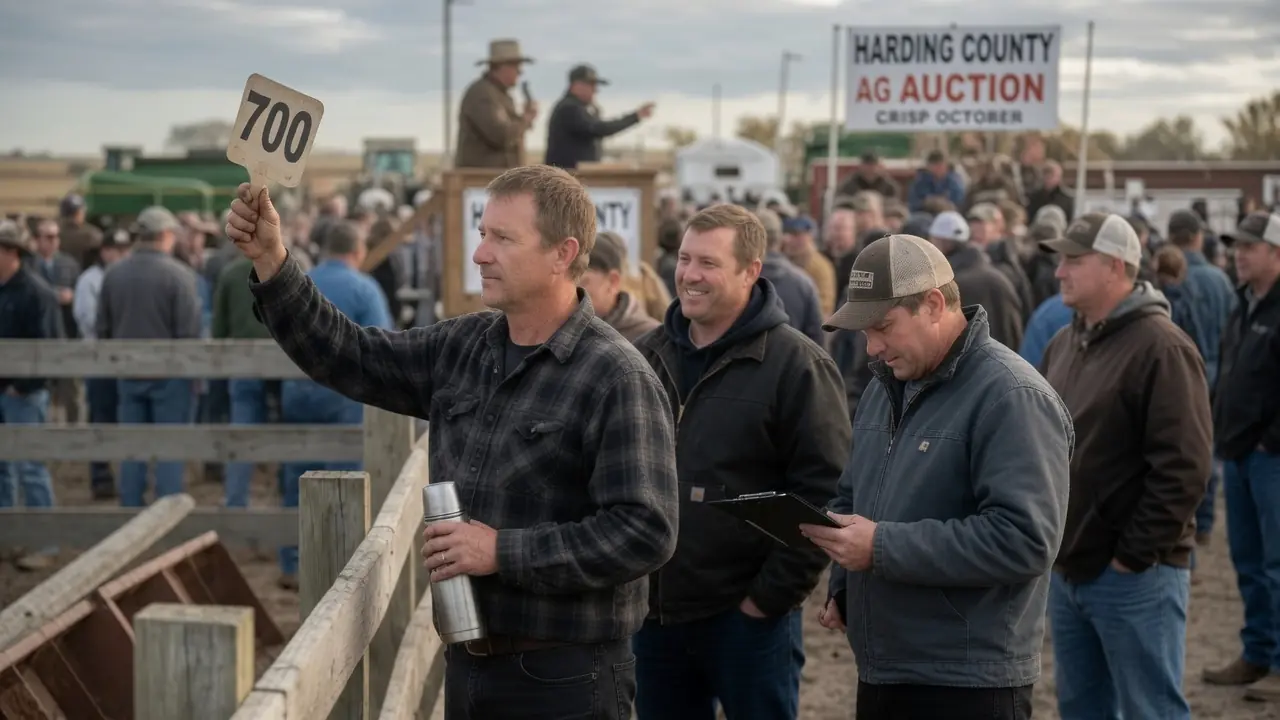
Rick Harlan noticed those boots before he noticed anything else.
Rick had driven from Omaha in a spotless pickup, wearing a new brown jacket and expensive leather work boots untouched by mud. At forty-six, he had built a profitable business buying neglected agricultural equipment cheaply, restoring just enough of it to attract buyers, and reselling it for several times what he paid. He carried a tablet containing auction prices, manufacturer records, and resale estimates, and he trusted the screen more than he trusted anyone standing around him.
Beside Rick stood Phil Garrett, the auctioneer responsible for moving nearly two hundred lots before sunset. Phil was fifty-eight, sharp-eyed, and experienced enough to recognize when a bidder knew more than he was revealing. He wore a dark cap pulled low against the October wind and held his gavel as naturally as another man might hold a coffee cup. Unlike Rick, Phil did not judge Caleb by his boots, but he did wonder why the quiet farmer had been standing near the back fence for almost two hours without bidding.
Rick lifted his coffee and nodded toward Caleb.
“Man came to an equipment sale dressed like the equipment already defeated him.”
Two dealers standing nearby laughed.
One of them added, “Maybe he’s waiting for the auctioneer to sell those boots by the pound.”
Caleb heard every word.
He did not turn around.
He unscrewed the cap of his dented thermos, drank cold coffee, and kept his attention on the catalog page folded inside his jacket pocket. He had not come for the tractors, trailers, combines, irrigation parts, or polished tools drawing the largest crowds.
He had come for Lot 39.
The catalog described it in one unremarkable sentence:
Contents of Baker Road storage property, sold as is. Buyer responsible for removal.
The photographs showed a fenced collection of rusted agricultural machinery tangled beneath torn canvas. Bent frames, corroded chains, old housings, and dirt-covered metal filled the lot so completely that most buyers saw only the cost of hauling it away.
Caleb saw something else.
Four years earlier, after his wife Marie died, Caleb had spent countless nights sitting alone at his kitchen table. The silence inside the farmhouse was unbearable at first, so he filled it with books. He read agricultural history, abandoned equipment patents, technical manuals, and old university publications describing machinery produced by companies that disappeared decades ago.
Most people in Harding County believed Caleb had become quieter after losing Marie.
They did not know he had also become more observant.
Two nights before the auction, Caleb enlarged the catalog photograph on his aging laptop. Beneath a torn section of canvas, he noticed the edge of a curved auger housing. The angle was unusual. So was the cast support bracket visible near the bottom.
He had seen both in a technical history of Columbus Agricultural Engineering, a Nebraska manufacturer that closed in 1948.
The company had produced a short-lived grain-transfer system called the Ironcrest. Only a few complete units were known to remain, and most belonged to museums or private collections. More importantly, a modern Canadian manufacturer named Northgate Grain Systems had spent years researching the Ironcrest auger design because its unusual pitch moved grain efficiently without causing the cracking common in modern systems.
Northgate possessed drawings but lacked intact reference machines.
The Baker Road lot might contain three.
Caleb attended the preview alone.
He lifted the canvas while everyone else examined newer equipment near the entrance. Surface rust covered the machines, but the castings remained solid. The auger flights were complete, the housings matched archived measurements, and one faded side plate still showed part of the Columbus manufacturer’s emblem.
Caleb had returned home that night and counted his money.
Seven hundred dollars.
That was everything he could risk.
The auction opened beneath a pale sky while American flags snapped above the grounds. Farmers gathered near tractors and livestock trailers, dealers studied their screens, and families moved between food stands carrying paper cups of coffee. Phil sold the first major combine for more than one hundred thousand dollars, and the crowd applauded when the winning bidder lifted his paddle.
Caleb remained at the back fence.
Hours passed.
Rick purchased two seed drills and an old tractor below market value. Each win increased his confidence. He joked with other dealers, complained about inexperienced bidders, and occasionally glanced toward Caleb as though the farmer’s silent presence offended him.
By early afternoon, the biggest items were gone.
The crowd thinned.
Phil turned the catalog page.
“Lot thirty-nine,” he called. “Contents of the Baker Road storage property. Sold as is, buyer handles removal.”
Photographs of rusted machinery appeared on the large screen beside the ring.
Several buyers laughed.
Rick looked over his shoulder at Caleb.
“There’s your dream collection,” he said loudly. “Looks perfect for those boots.”
The laughter spread.
Phil examined the lot description and raised his microphone.
“Let’s begin at one thousand dollars.”
Nobody moved.
“Eight hundred?”
Silence.
“Six hundred?”
A salvage buyer named Leon Hess raised his paddle.
Phil pointed toward him. “Six hundred. Do I hear six-fifty?”
Hess lifted the paddle again.
Caleb remained still.
Rick leaned toward one of his companions. “Even the scrap dealer’s going to regret that.”
Phil scanned the crowd.
“Six-fifty. Seven hundred?”
Caleb raised his bidder card.
The number 700 appeared above his hand.
Heads turned.
Rick stared at him, then laughed.
“Well, I’ll be damned. The poor man came to buy himself a bigger pile of problems.”
Phil noticed Caleb’s expression.
There was no excitement in it.
No nervous pride.
Only patience.
Hess raised his paddle.
“Seven-fifty,” Phil called.
Caleb’s hand lowered.
He felt the envelope inside his jacket. Seven hundred was his limit. The bidding had already passed it.
Then Hess spoke to the assistant beside him and shook his head. He had misunderstood the previous call. He thought his six-fifty bid remained active and withdrew before the next bid was accepted.
Phil corrected the sequence.
“We’re still at seven hundred with bidder seven hundred.”
Caleb’s pulse steadied.
Rick looked down at his tablet for the first time.
He enlarged the auction photograph.
Something in Caleb’s certainty had finally made him curious.
Phil raised the gavel.
“Seven hundred. Any advance?”
Rick searched the visible serial plates.
The screen image was poor.
Caleb saw his fingers moving faster.
“Seven hundred going once.”
Rick typed the word Columbus.
“Going twice.”
His tablet began loading search results.
Rick’s expression changed.
“Wait,” he said.
Phil looked toward him. “Are you bidding?”
Rick hesitated.
He still could not confirm the identification. Bidding eight hundred on worthless scrap would embarrass him in front of the dealers who trusted his judgment. He glanced at Caleb’s patched boots, then back at the screen.
His pride answered before his knowledge did.
“No.”
Phil brought the gavel down.
“Sold to Caleb Durst for seven hundred dollars.”
The crowd laughed and applauded sarcastically.
Caleb lowered his bidder card.
Rick walked toward him with his tablet tucked beneath one arm. Several dealers followed, eager for another joke before the next lot began.
“You spent your last seven hundred dollars on rust,” Rick said. “I guess that’s all a broke farmer like you understands.”
Caleb screwed the cap onto his thermos.
“No, Rick. I spent seven hundred because your expensive tablet was too stupid to recognize what your eyes missed.”
The laughter stopped.
Rick’s smile twitched.
“That pile won’t cover the fuel needed to haul it home.”
Caleb stepped closer.
The difference in their boots became almost comical. Rick’s were polished and expensive. Caleb’s were cracked, muddy, and repaired with tape.
“Then remember your laugh,” Caleb said. “Northgate Grain Systems may pay me more for those machines than you earned all morning.”
Rick’s face tightened.
“Northgate?”
Caleb walked away.
Rick immediately searched the company name.
By the time he found the first article describing Northgate’s research into historical grain-handling designs, Caleb was already paying the auction clerk with fourteen fifty-dollar bills.
Phil Garrett watched from the registration desk.
“You knew exactly what you wanted,” he said.
“I hoped I did.”
“That’s different from the way most men bid.”
“How do most men bid?”
Phil glanced toward Rick.
“They bid because someone else looks interested.”
Caleb folded the receipt.
“I couldn’t afford to do that.”
Rick approached before Caleb left.
“What manufacturer?” he demanded.
Caleb placed the receipt inside his jacket.
“You called it scrap.”
“I’m asking a question.”
“And I’m leaving.”
Rick stepped into his path. “You think one old machine makes you an expert?”
“There are three.”
The dealer stared at him.
Caleb moved around him and headed toward his truck.
Phil’s next call echoed across the auction grounds, but Rick no longer listened. He stared at Lot 39, realizing the quiet farmer had noticed something every professional buyer had missed.
Two days later, Caleb returned to the Baker Road property with an old flatbed trailer, heavy chains, wooden blocks, and a hand-operated come-along. The machinery looked worse in daylight than it had during the preview. Rust covered the frames, bolts had fused in place, and dirt filled every corner.
A young auction employee named Tyler offered to help for twenty dollars.
Caleb accepted.
Pride, he had learned, was not the same as refusing useful hands.
They removed the first canvas cover.
Beneath it sat an intact Ironcrest grain-transfer unit.
The manufacturer’s plate was almost unreadable, but after Caleb cleaned it carefully, the stamped words appeared.
COLUMBUS AGRICULTURAL ENGINEERING — 1946
Tyler whistled.
“Is that good?”
“It might be.”
The second unit had a dented housing but complete internal flights. The third was buried beneath chains and parts from unrelated machinery, yet its main casting remained unbroken.
Caleb loaded all three slowly.
By sunset, his shoulders ached and his hands had begun bleeding through two small cuts. He drove home beneath a fading orange sky, watching the machines through his rearview mirror.
Marie would have asked whether he was certain.
Caleb would have told her no.
Then she would have smiled and said certainty was overrated when preparation was available.
He parked the trailer inside his machine shed.
The following morning, he cleaned one side plate, took measurements, and called Northgate Grain Systems in Winnipeg. The receptionist transferred him twice before a product-development engineer answered.
Caleb described the units.
The man became quiet.
“You have three Ironcrests?”
“I believe so.”
“Complete?”
“Two nearly complete. One fully complete.”
“Do the auger flights have the original twelve-degree transition?”
Caleb had measured that exact feature.
“Yes.”
The engineer inhaled slowly.
“Do not remove anything else.”
“I wasn’t planning to.”
“We need photographs.”
Caleb sent twelve.
The company called back within twenty minutes.
“We want to send a representative.”
“How soon?”
“Tomorrow, if possible.”
The representative arrived two days later.
His name was Paul Mercer, a thirty-eight-year-old engineer with a trimmed beard, a hard case full of measuring instruments, and the focused manner of a man seeing something he had studied only through drawings.
Paul spent three hours inside the machine shed.
He measured flight angles, casting thickness, shaft dimensions, and gear alignment. He photographed manufacturer marks and called two colleagues during the inspection.
Caleb waited silently.
Finally, Paul stood beside the complete unit and removed his gloves.
“Mr. Durst, do you understand what you purchased?”
“Enough to call you.”
Paul smiled.
“These machines answer design questions our company has spent almost six years trying to solve.”
“What are the answers worth?”
The engineer’s smile faded into respect.
Caleb invited him inside for coffee.
They sat at the kitchen table, though Marie’s chair remained empty. Paul explained that Northgate wanted temporary exclusive access to the machines for scanning, measurement, and prototype calibration. The company might later purchase them, but immediate access mattered more.
Paul offered fifteen thousand dollars.
Caleb drank his coffee.
“No.”
The engineer looked surprised.
“You bought them for seven hundred.”
“What I paid has nothing to do with what they’re worth to you.”
Paul leaned back.
“What figure did you have in mind?”
“Forty-seven thousand for six months of access. Machines stay here. Your company covers transportation for engineers, liability insurance, and any restoration work you request.”
“That’s extremely specific.”
“I read your annual report. Your failed prototype program cost almost two million last year.”
Paul stared at him.
Caleb continued.
“If these machines solve even one problem, forty-seven thousand is cheap.”
Negotiations lasted two weeks.
Northgate agreed to Caleb’s figure.
A local attorney reviewed the contract for one hundred eighty dollars. The agreement protected Caleb’s ownership, required the company to repair any damage, and gave him the right to review future purchase offers.
When the first payment reached his account, Caleb sat inside his truck outside the bank.
Forty-seven thousand dollars appeared on the receipt.
He held the paper with both hands.
The money did not make him wealthy.
It did something more immediate.
It stopped the farm from falling apart.
Caleb paid the overdue operating loan. He repaired the grain cart, replaced the broken north fence, and settled the medical bill remaining from Marie’s final year. He bought proper work boots but kept the taped pair near the back door.
He also left five thousand dollars untouched.
For the first time in years, an emergency could arrive without immediately destroying him.
Caleb told nobody about the amount.
Harding County discovered it anyway.
A Northgate truck visited the farm.
Then another.
Engineers spent days scanning the Ironcrest units. The local parts store delivered equipment Caleb had postponed buying for years. The bank manager began greeting him with unusual warmth.
Rumors spread through the diner, auction grounds, and grain co-op.
Some people claimed Caleb received twenty thousand.
Others said one hundred thousand.
Rick Harlan heard the truth from a machinery contact in Canada.
Forty-seven thousand dollars for access alone.
He found Caleb loading feed at the co-op.
This time, Rick’s boots were dusty, though only because the parking lot had been muddy.
“Durst.”
Caleb lifted another bag into his truck.
“Rick.”
“I heard Northgate visited your place.”
“People hear a lot.”
“What exactly was inside Lot 39?”
“The same machinery shown in the catalog.”
“Don’t play games.”
Caleb brushed dust from his hands.
“I wasn’t playing at the auction. That was your mistake.”
Rick’s jaw tightened.
“You could have said something before the sale.”
“Why?”
“Because those machines mattered to the industry.”
“They mattered while you were laughing too.”
Rick looked away briefly.
“How much did they pay?”
Caleb closed the tailgate.
“Enough.”
“Forty-seven thousand?”
Caleb’s silence confirmed it.
Rick’s face reddened.
“You got lucky.”
“No.”
“You happened to recognize one shape in a bad photograph.”
“I spent years reading the books you thought were useless.”
Rick stepped closer.
“You think you’re better than everyone now?”
Caleb looked at the man’s polished tablet case, expensive watch, and anger born entirely from someone else’s success.
“No. I think you mistook being loud for being informed.”
Several farmers nearby heard the exchange.
Rick noticed them watching.
“You won’t get that lucky twice.”
Caleb opened his truck door.
“I didn’t need luck the first time.”
He drove away.
The following autumn, Caleb returned to the Harding County auction.
He carried the same thermos and wore his repaired boots rather than the new pair. Phil Garrett noticed him near the back fence and smiled.
Rick stood closer to the ring but watched Caleb more often than the equipment.
Lot 12 included a worn set of seed-drill coulters. Caleb inspected them, raised his card twice, and purchased them for two hundred thirty dollars.
Three dealers immediately began asking each other whether the coulters were rare.
They were not.
Caleb simply needed them.
The uncertainty amused Phil.
During a break, the auctioneer approached him.
“You’ve changed the way half these men bid.”
“I haven’t changed anything.”
“They watch you now.”
“That sounds expensive for them.”
Phil laughed.
Then his expression became thoughtful.
“What did you really see in Lot 39?”
Caleb took a drink from the thermos.
“I read about the manufacturer years ago.”
“That’s all?”
“That’s enough.”
Phil shook his head. “Most men would call it instinct.”
“Instinct is often knowledge people forgot they learned.”
The Northgate partnership continued.
After engineers completed their measurements, the company offered to purchase all three machines for eighty-five thousand dollars. Caleb sold two and kept the most complete unit under a long-term loan agreement with a Nebraska agricultural museum.
The museum displayed the Ironcrest beneath restored lettering.
A small plaque explained that the machine had been discovered inside a neglected storage lot by a Nebraska farmer who recognized its historical and engineering value.
Caleb refused to include the auction price.
“The story isn’t about buying something cheap,” he told the curator. “It’s about seeing what everyone else dismissed.”
The museum included that sentence instead.
Rick visited the exhibit months later.
He did not tell anyone.
He stood before the restored Ironcrest, reading the plaque twice. The rust had been removed from several sections, revealing strong cast metal beneath it. The auger housing he had mocked now sat beneath careful lighting while engineers and visitors studied its design.
Phil happened to be there with his granddaughter.
He saw Rick near the exhibit.
“Funny-looking scrap,” Phil said.
Rick stiffened.
Then he surprised the auctioneer.
“I was wrong.”
Phil waited.
Rick looked toward the machine.
“I judged the buyer before I judged the lot.”
“That happens.”
“It cost me.”
Phil shook his head.
“No. You lost nothing. Caleb gained something.”
Rick considered the distinction.
He left without speaking to Caleb.
Caleb used the later sale money to protect the farm, not transform it into something unrecognizable. He repaired buildings, improved drainage, replaced one tractor, and invested in soil conservation. He remained on the same 280 acres and still drank bitter coffee from the same thermos.
People treated him differently.
Dealers stopped laughing when he entered an auction. Farmers began calling to ask whether old equipment might be valuable. Young people from the local agricultural program visited his shed to hear him discuss forgotten designs.
Caleb always gave the same warning.
“Do not assume old means valuable. Study first.”
A seventeen-year-old student once asked how he knew the Ironcrests mattered when everyone else saw junk.
Caleb pointed toward the taped boots hanging near the door.
“People made the same mistake with those.”
The boy looked confused.
“They saw something worn out,” Caleb explained. “They never asked how far it had traveled.”
Years later, the story of Lot 39 remained part of Harding County auction history.
Some versions claimed Caleb turned seven hundred dollars into fifty thousand overnight. Others said the machines were worth millions. A few insisted Rick attempted to bid after the gavel fell and begged Caleb to sell him the lot.
Caleb corrected only the most important detail.
He had not won because the machines were secretly magical.
He won because he had prepared for a moment everyone else wasted laughing.
The rare equipment was hidden beneath rust.
Its value had always been there.
So had Caleb’s.
The auction crowd simply noticed both too late.